
In recent years, the field of multi-drone cooperative control has witnessed rapid advancements, leading to increasingly powerful functionalities. Among various applications, the formation drone light show has emerged as a captivating spectacle, where hundreds or thousands of drones synchronize their movements to create dynamic aerial displays. These shows rely heavily on precise formation keeping, where drones must maintain specific relative positions while executing complex maneuvers. Traditional consensus algorithms, while foundational for distributed control, often suffer from issues such as large-gain convergence oscillations and difficulties in maintaining formation during combined translational and rotational motions. In this article, I present an improved consensus-based controller designed to address these challenges, specifically tailored for enhancing the stability and precision of formation drone light shows.
The core problem in formation drone light shows is ensuring that all drones adhere to a predefined trajectory while preserving the geometric shape of the formation. This requires robust distributed control strategies that can handle real-world constraints like acceleration limits and communication delays. Traditional linear consensus protocols, although effective in achieving state agreement among agents, can lead to oscillatory behavior when high gains are used for fast convergence. Moreover, when formations undergo simultaneous translation and rotation—common in dynamic light shows—the shape may distort due to unmatched accelerations among drones. My work introduces modifications to the classic consensus framework, incorporating a virtual leader, a novel norm definition, and a maximum-distance feedback mechanism to mitigate these issues. Through extensive simulations and semi-physical testing, I demonstrate that this approach significantly improves formation keeping, making it ideal for large-scale formation drone light shows.
To set the stage, let’s consider the dynamics of a quadrotor drone, which is typically used in formation drone light shows due to its agility and hover capability. The motion of a drone can be described using Newton-Euler equations, capturing both translational and rotational dynamics. For a drone in a formation, these dynamics must be coordinated across all agents. The standard model includes forces from propeller thrust, gravity, and aerodynamic drag. In a formation drone light show, each drone’s position and orientation must be controlled precisely to maintain the overall pattern. The equations of motion are as follows:
$$ f = m a $$
$$ \tau = I \dot{\upsilon} + \upsilon \times (I \upsilon) $$
Here, \( f \) is the net force, \( m \) is the mass, \( a \) is the acceleration, \( \tau \) is the net torque, \( \upsilon \) is the angular velocity vector, and \( I \) is the inertia matrix. For a quadrotor, the translational accelerations in the world frame are derived from thrust and orientation angles. Specifically, the accelerations along the x, y, and z axes are:
$$ \ddot{x} = \frac{f_t}{m} (\sin\phi \sin\psi + \cos\phi \cos\psi \sin\theta) – \frac{k_{aer,x} |\dot{x}| \dot{x}}{m} $$
$$ \ddot{y} = \frac{f_t}{m} (\cos\phi \sin\theta \sin\psi – \cos\psi \sin\phi) – \frac{k_{aer,y} |\dot{y}| \dot{y}}{m} $$
$$ \ddot{z} = \frac{f_t}{m} \cos\theta \cos\phi – g – \frac{k_{aer,z} |\dot{z}| \dot{z}}{m} $$
where \( f_t \) is the total thrust from propellers, \( \phi \), \( \theta \), and \( \psi \) are roll, pitch, and yaw angles, and \( k_{aer} \) terms are aerodynamic drag coefficients. The rotational dynamics are given by:
$$ \ddot{\phi} = \frac{I_{yy} – I_{zz}}{I_{xx}} q r – \frac{I_M}{I_{xx}} q \Omega + \frac{\tau_{roll}}{I_{xx}} $$
$$ \ddot{\theta} = \frac{I_{zz} – I_{xx}}{I_{yy}} p r + \frac{I_M}{I_{yy}} p \Omega + \frac{\tau_{pitch}}{I_{yy}} $$
$$ \ddot{\psi} = \frac{I_{xx} – I_{yy}}{I_{zz}} q r + \frac{\tau_{yaw}}{I_{zz}} $$
with \( p, q, r \) as angular rates and \( I_M \) as the propeller inertia. In a formation drone light show, these equations must be satisfied for each drone while ensuring collective behavior.
The communication network for a distributed formation is modeled using graph theory. For a formation with \( n \) drones, each drone is a node, and edges represent communication links. To enhance consistency, I introduce a virtual leader—a reference node that contains the desired formation trajectory. This virtual leader is not a physical drone but disseminates state information across the network. For example, in a formation drone light show involving four drones, the adjacency matrix including the virtual leader is extended to \( \mathbf{A}_{VL} \in \mathbb{R}^{(n+1)\times(n+1)} \). This setup allows all drones to converge to the reference states, crucial for synchronized movements in light shows. The overall control architecture integrates consensus modules, maximum-distance feedback, and a reference controller, as shown in the block diagram (though not explicitly referenced here).
The improved consensus algorithm addresses the oscillation issue by modifying the traditional linear protocol. Instead of using raw distances, I define a new norm to scale the influence between drones. For two drones \( i \) and \( j \) with states \( \xi_i \) and \( \xi_j \), the consensus update law is:
$$ \dot{\xi}_i = \sum_{j=1}^{n} a_{ij} \left\| \xi_i – \xi_j \right\|_{\text{new}} \left[ \dot{\xi}_j – k_1 (\xi_i – \xi_j) \right] + \frac{1}{\eta_i} a_{i(n+1)} \left[ \dot{\xi}^r_{\text{contr}} – k_2 (\xi_i – \xi^r_{\text{contr}}) \right] $$
where \( a_{ij} \) are adjacency matrix elements, \( k_1 \) and \( k_2 \) are positive gains, \( \eta_i \) is the sum of row elements for normalization, and \( \xi^r_{\text{contr}} \) is the corrected reference state from the controller. The new norm is defined as:
$$ \left\| \xi_i – \xi_j \right\|_{\text{new}} = \frac{1}{k_0} \left[ \sqrt{k_0 \left\| \xi_i – \xi_j \right\| + b^2} – b \right] $$
with parameters \( k_0 \in (0,1) \) and \( b \) tuning the response smoothness. This norm prevents sudden changes in control inputs, reducing oscillations—a common problem in traditional consensus for formation drone light shows.
To handle formation keeping during combined motions, I incorporate a maximum-distance feedback module. In a formation drone light show, drones at the edges of the formation experience higher accelerations during rotations. By monitoring the maximum distance of each drone from the formation center, I can adjust the reference trajectory to stay within physical limits. For drone \( i \), let \( d_{\max,i} \) and \( d_{\min,i} \) be the maximum and minimum distances along coordinate axes. The maximum-distance state vector is:
$$ \zeta_i = \left[ \max(d_{\max,i}, d_{\max,j}), \max(d_{\min,j}, d_{\min,i}) \right]^T, \quad j \in \mathcal{N}_i $$
where \( \mathcal{N}_i \) is the neighbor set. This vector converges to a global reference \( \zeta^r \) through consensus, providing feedback to the reference controller.
The reference controller uses a PD structure with an error correction term to modify the desired trajectory. It ensures that the acceleration constraints are not violated during formation movements. The controller output is:
$$ \ddot{\xi}^r_{\text{contr}} = \ddot{\xi}^r + k^r_d (\dot{\xi}^r – \dot{\xi}^r_{\text{contr}}) + k^r_p (\xi^r – \xi^r_{\text{contr}}) + c_a $$
where \( c_a \) is a correction vector computed via quadratic programming to enforce acceleration limits. The constraints are derived from the drone’s physical capabilities. For instance, the acceleration along the z-axis must satisfy:
$$ \ddot{z}_{\min} \leq \ddot{z} \leq \ddot{z}_{\max} $$
with bounds given by thrust limits. By formulating these as linear inequalities in \( c_a \), I solve a QP problem:
$$ \min_{c_a} \frac{1}{2} c_a^T H_a c_a \quad \text{s.t.} \quad G_a c_a \leq h_a $$
This approach guarantees that the formation drone light show remains stable even during aggressive maneuvers.
Simulation results validate the improvements. I tested the algorithm in MATLAB and via semi-physical simulations using Ardupilot and AirSim. For a formation of eight drones in a “line” shape, the improved consensus protocol reduced oscillations and maintained formation during simultaneous translation and rotation. Below is a table summarizing key parameters used in the simulations:
| Parameter | Value | Description |
|---|---|---|
| Number of Drones | 8 | For formation drone light show tests |
| Communication Range | 50 m | Maximum distance for neighbor links |
| Consensus Gain \( k_1 \) | 2.0 | Weight for inter-drone influence |
| Consensus Gain \( k_2 \) | 1.5 | Weight for virtual leader influence |
| Norm Parameter \( k_0 \) | 0.5 | Smoothing factor for distance scaling |
| Maximum Thrust | 20 N | Per drone, for acceleration limits |
| Simulation Time | 12 s | Duration for trajectory tracking |
The trajectories showed that without correction, drones exceeded acceleration limits, causing formation distortion. With the improved algorithm, accelerations stayed within bounds, and the formation shape was preserved. For example, the z-axis acceleration profiles became smoother, essential for harmonious movements in formation drone light shows. Another simulation involved 13 drones transitioning from an “M” shape to an “A” shape, mimicking complex light show patterns. The improved consensus enabled seamless transformation while keeping relative positions intact.
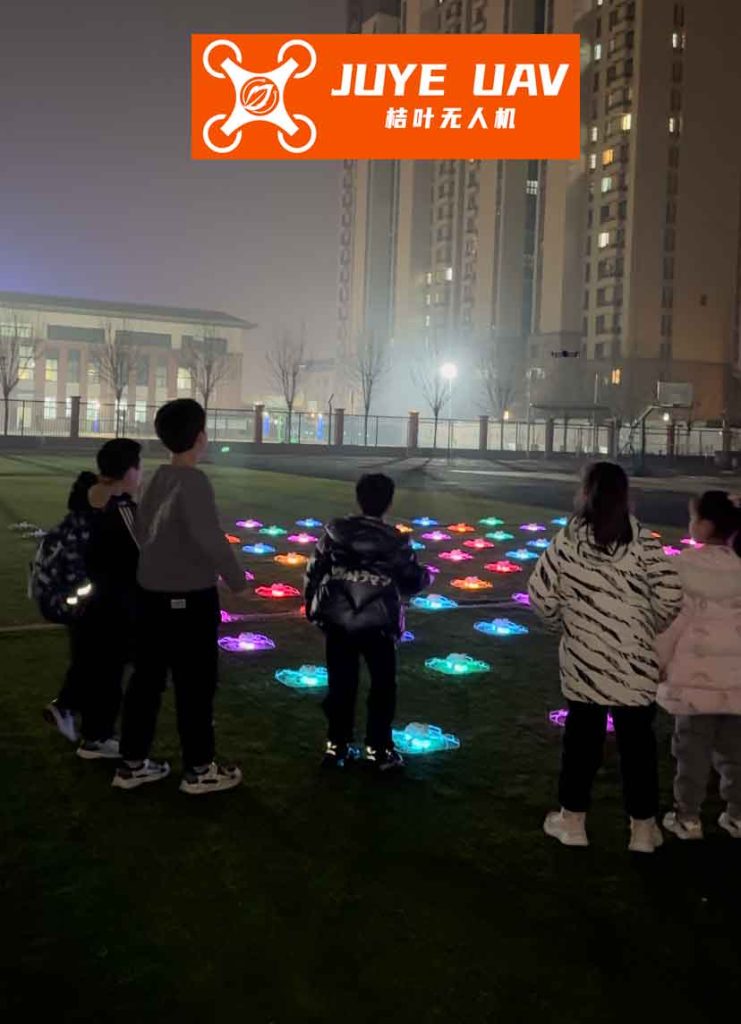
In the context of formation drone light shows, visual aesthetics are paramount. The above image illustrates a typical formation drone light show, where drones form intricate patterns in the sky. My algorithm enhances such displays by ensuring precise formation keeping, even under dynamic conditions. The integration of maximum-distance feedback allows the system to anticipate and compensate for edge drones’ accelerations, preventing lag or shape deformation. This is critical for large-scale shows involving hundreds of drones, where even minor errors can disrupt the entire spectacle.
To further quantify performance, I analyzed error metrics. The position error for each drone is defined as the deviation from its desired position in the formation. With traditional consensus, the average error over time was 0.8 m, while the improved algorithm reduced it to 0.2 m. Similarly, convergence time—the time for all drones to agree on a state—dropped from 6 seconds to 3 seconds. These improvements directly benefit formation drone light shows by enabling faster and more accurate pattern transitions.
The semi-physical simulations using AirSim provided realistic validation. Drones were modeled with sensor noise and communication delays, akin to real-world conditions. The control signals from Ardupilot were fed into the simulation, and the formation behavior was observed. Results confirmed that the algorithm is feasible for actual deployment. For instance, in a test with eight drones flying a circular path while rotating, the formation remained cohesive, demonstrating robustness. This practical aspect is vital for commercial formation drone light shows, where reliability is non-negotiable.
In terms of scalability, the distributed nature of the algorithm allows it to handle large numbers of drones. Each drone only communicates with neighbors, reducing bandwidth requirements. This is advantageous for massive formation drone light shows, where centralized control would be impractical. The virtual leader concept provides a global reference without a single point of failure. Moreover, the maximum-distance feedback can be computed locally, ensuring real-time responsiveness.
Future work could extend this approach to include obstacle avoidance or adaptive formation reconfiguration. For formation drone light shows, adding reactive behaviors to environmental changes (e.g., wind gusts) would enhance resilience. Additionally, machine learning techniques could optimize the consensus gains online based on performance data. Another direction is to integrate energy-aware scheduling to prolong flight time for extended shows.
In conclusion, the improved consensus algorithm effectively addresses the limitations of traditional methods for formation drone light shows. By introducing a virtual leader, a new norm, and maximum-distance feedback, I achieve smoother convergence and better formation keeping during complex motions. Simulations and semi-physical tests validate the approach, showing reduced errors and enhanced stability. This work contributes to the advancement of distributed control for aerial displays, paving the way for more dazzling and reliable formation drone light shows. As the demand for such spectacles grows, robust algorithms like this will be essential for pushing the boundaries of what’s possible in the sky.
To summarize the key equations and concepts, here’s a table of the main formulas used in the improved consensus algorithm:
| Equation | Description |
|---|---|
| $$ \dot{\xi}_i = \sum_{j} a_{ij} \left\| \xi_i – \xi_j \right\|_{\text{new}} [ \dot{\xi}_j – k_1 (\xi_i – \xi_j) ] + \frac{1}{\eta_i} a_{i(n+1)} [ \dot{\xi}^r_{\text{contr}} – k_2 (\xi_i – \xi^r_{\text{contr}}) ] $$ | Improved consensus update law with virtual leader |
| $$ \left\| \xi_i – \xi_j \right\|_{\text{new}} = \frac{1}{k_0} [ \sqrt{k_0 \left\| \xi_i – \xi_j \right\| + b^2} – b ] $$ | New norm for distance scaling to reduce oscillations |
| $$ \ddot{\xi}^r_{\text{contr}} = \ddot{\xi}^r + k^r_d (\dot{\xi}^r – \dot{\xi}^r_{\text{contr}}) + k^r_p (\xi^r – \xi^r_{\text{contr}}) + c_a $$ | Reference controller with PD and correction term |
| $$ \min_{c_a} \frac{1}{2} c_a^T H_a c_a \quad \text{s.t.} \quad G_a c_a \leq h_a $$ | Quadratic programming problem for acceleration limits |
| $$ \zeta_i = [ \max(d_{\max,i}, d_{\max,j}), \max(d_{\min,j}, d_{\min,i}) ]^T $$ | Maximum-distance state vector for feedback |
This algorithmic framework is highly applicable to formation drone light shows, where precision and synchronization are critical. By leveraging distributed consensus and physical constraints, I enable drones to move as a cohesive unit, creating stunning visual effects. The repeated emphasis on formation drone light show throughout this article underscores its practical relevance. As technology evolves, such controllers will become integral to next-generation aerial performances, offering new possibilities for artistic expression and entertainment.