
The spectacle of a formation drone light show represents a mesmerizing fusion of technology and art. Witnessing hundreds, sometimes thousands, of illuminated drones moving in perfect synchrony to paint intricate, dynamic images across the night sky is an experience that continues to captivate global audiences. However, behind this breathtaking visual poetry lies a profound and complex technological challenge: the real-time, robust, and precise coordination of a large swarm of autonomous agents in a dynamic, uncertain environment. Traditional pre-programmed flight paths, while effective for static sequences, struggle with adaptability, fault tolerance, and the creation of truly dynamic, responsive performances. This article details my research into applying cutting-edge, model-free deep reinforcement learning (DRL) to architect the next generation of intelligent control systems for formation drone light shows, enabling not just pre-scripted patterns but adaptive, resilient, and creatively unbounded aerial performances.
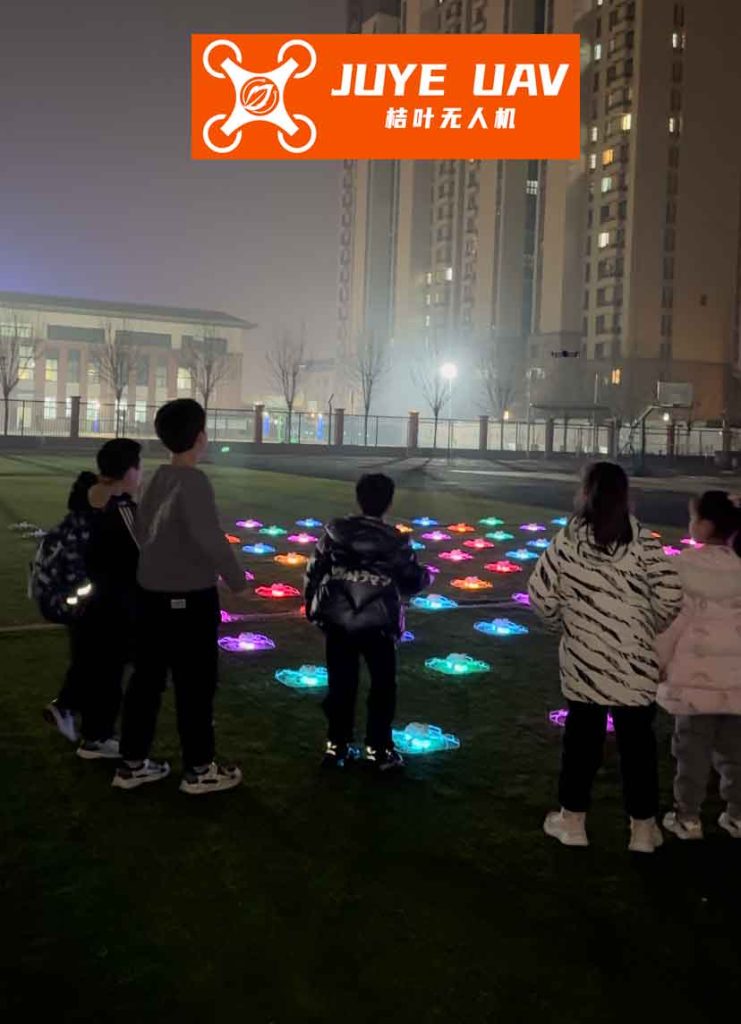
The core challenge in orchestrating a formation drone light show transcends simple point-to-point navigation. Each drone must be considered an autonomous agent that perceives its local environment—its own state, the states of neighboring drones, and its intended position within the grand artistic canvas—and makes continuous control decisions to maintain the collective’s integrity. Environmental disturbances like wind gusts, communication latencies, potential drone failures, and the need for real-time trajectory adjustments based on live inputs (e.g., music, sensor data) render purely deterministic, centralized control architectures brittle and inflexible. My work posits that the solution lies in decentralized intelligence, where each drone learns a robust control policy through interaction with a simulated yet highly stochastic environment, modeled as a Markov Decision Process (MDP).
The Reinforcement Learning Paradigm for Swarm Intelligence
Reinforcement Learning provides the ideal mathematical framework for this challenge. In the context of a formation drone light show, each drone is an agent operating within an MDP defined by the tuple $(S, A, P, R)$.
- State Space (S): This is the agent’s perception of the world. For a drone $i$ in a show, the state $s_i$ must encapsulate information crucial for maintaining its position in the formation. A minimalist yet effective representation I employ is based on relative geometry. Let $p_i = [x_i, y_i, z_i]^T$ and $\psi_i$ denote drone $i$’s 3D position and yaw (heading) in a global or local performance coordinate frame. Let $p_i^{des}(t) = [x_i^{des}(t), y_i^{des}(t), z_i^{des}(t)]^T$ represent its desired position at time $t$ within the predefined show choreography. A rich state vector can be:
$$
s_i = [\Delta x, \Delta y, \Delta z, d, \dot{d}, \psi_i, \psi^{des}, \phi_i, \text{neighbor\_info}]^T
$$
$$
\text{where } \Delta p = p_i – p_i^{des} = [\Delta x, \Delta y, \Delta z]^T, \quad d = ||\Delta p||, \quad \dot{d} = \frac{d}{dt}d
$$
Here, $\phi_i$ is the current roll angle. `neighbor_info` could be a processed vector containing relative positions of drones within a local communication radius, preventing collisions and maintaining local swarm structure. For a formation drone light show, the desired yaw $\psi^{des}$ is often crucial for orienting LED faces towards the audience.
- Action Space (A): The control inputs available to each drone. For multi-rotor drones common in light shows, this typically involves high-level velocity or acceleration commands in the body or world frame. To simplify and ensure smoothness, I often define a discrete action space for training:
$$
A = \{ (\dot{x}_c, \dot{y}_c, \dot{z}_c)_k \}, \quad k=1,…,N_a
$$
where each action represents a commanded velocity vector. The underlying flight controller (e.g., a PID or model-predictive controller) translates this into motor commands. For fixed-wing drone concepts in shows, the action might be roll angle commands, as explored in prior research.
- Reward Function (R): The artistic and operational “director” of the learning process. Designing $R(s, a, s’)$ is critical. It must encode the primary objective: accurately achieving and maintaining the formation drone light show pattern. A well-shaped reward accelerates learning. My typical composite reward for drone $i$ is:
$$
r_i^{(t)} = w_p \cdot r_{position} + w_s \cdot r_{smoothness} + w_c \cdot r_{collision} + w_b \cdot r_{boundary}
$$
$$
r_{position} = -\left( \alpha \cdot d + \beta \cdot |\psi_i – \psi^{des}| \right)
$$
$$
r_{smoothness} = -||a_i^{(t)} – a_i^{(t-1)}||^2
$$
$$
r_{collision} = \begin{cases}
\zeta_{collision} & \text{if } \min_{j \neq i} ||p_i – p_j|| < d_{safe} \\
0 & \text{otherwise}
\end{cases}
$$
$$
r_{boundary} = \begin{cases}
\zeta_{boundary} & \text{if } p_i \text{ is outside performance volume} \\
0 & \text{otherwise}
\end{cases}
$$
The weights $w_*$ and parameters $\alpha, \beta, \zeta$ are tuned to balance precision, energy efficiency, and safety. For a formation drone light show, $r_{position}$ is paramount, demanding millimeter-level accuracy for crisp visual effects.
From DQN to a Specialized Architecture: The ID3QN Algorithm
While standard Deep Q-Networks (DQN) can function, the unique demands of a formation drone light show—high precision, multi-agent coordination, and robustness to noise—necessitate algorithmic enhancements. My proposed architecture, the Imitative Dueling Double Deep Q-Network (ID3QN), integrates several key innovations.
First, the neural network architecture itself uses a Dueling structure. The Q-value network splits into two streams: one estimates the state-value function $V(s)$, representing the inherent value of being in a particular state (e.g., “being well-aligned in the formation”), and the other estimates the advantage function $A(s, a)$, representing the relative value of each action. These are combined to produce the final Q-values:
$$
Q(s, a; \theta, \alpha, \beta) = V(s; \theta, \beta) + \left( A(s, a; \theta, \alpha) – \frac{1}{|A|} \sum_{a’} A(s, a’; \theta, \alpha) \right)
$$
This separation allows the network to learn which states are valuable independently of the effect of each action, leading to more stable and efficient policy learning, which is vital when managing the complex state space of a formation drone light show.
Second, to combat the well-known overestimation bias of Q-learning, I employ Double Q-learning. This decouples the action selection from the action evaluation using separate target and online networks. The target value $y_t$ for updating the online network is calculated as:
$$
y_t = r_{t+1} + \gamma Q(s_{t+1}, \underset{a’}{\arg\max} \, Q(s_{t+1}, a’; \theta_t); \theta_t^-)
$$
where $\theta_t$ are the parameters of the online network and $\theta_t^-$ are the parameters of the target network. This leads to more accurate and stable Q-value estimates.
The most critical innovation for the formation drone light show context is the **$\epsilon$-imitation** action selection strategy during training. Pure $\epsilon$-greedy exploration is highly inefficient in a vast state-action space and can lead to dangerous maneuvers. Instead, I blend exploration with guided imitation. With probability $\epsilon$, the agent does not choose a random action. Instead, it chooses an action that “imitates” what a simple, safe controller would do. For example, it might choose the action whose resulting velocity vector best points toward the desired position $p_i^{des}$, or mimics the average action of successfully positioned neighbors. This strategy drastically reduces useless exploration, fills the experience replay buffer with higher-quality transitions, and accelerates learning of the delicate coordination needed for a flawless formation drone light show.
The complete ID3QN training loop for a single drone agent is summarized in the algorithm below and illustrated in the architecture diagram.
| Component | Symbol | Description for Formation Drone Light Show |
|---|---|---|
| State | $s_i$ | Relative position error $(\Delta x, \Delta y, \Delta z)$, distance $d$, its derivative $\dot{d}$, current & desired yaw, roll, local neighbor info. |
| Action | $a_i$ | Discrete set of high-level velocity commands $(\dot{x}_c, \dot{y}_c, \dot{z}_c)$ sent to the flight controller. |
| Reward | $r_i$ | Weighted sum: negative position/heading error, negative control jerk, large penalty for collisions and boundary violations. |
| Policy | $\pi(a|s)$ | The learned neural network mapping states to optimal actions for show coordination. |
Training and Simulation in a Stochastic Digital Twin
Training a real formation drone light show swarm from scratch via trial-and-error is impractical and risky. Therefore, I create a high-fidelity “digital twin” simulation environment. This simulator models not only the basic dynamics of the drones but, crucially, injects stochasticity to mimic real-world imperfections:
$$
\dot{p}_i = v_i + \eta_p, \quad \dot{v}_i = \frac{u_i}{m} + \eta_v
$$
where $u_i$ is the control force derived from the action, $m$ is mass, and $\eta_p, \eta_v$ are noise processes (e.g., Gaussian) simulating wind gusts, sensor inaccuracies, and actuator delays. Communication dropouts between drones can also be randomly simulated. Training in this noisy environment forces the ID3QN policy to learn robustness, a non-negotiable requirement for a commercial formation drone light show that must perform reliably under varying conditions.
I utilize a distributed learning paradigm. While each drone runs its own instance of the ID3QN policy, they can share experiences or gradients (in a federated learning setup) to accelerate collective learning. The experience replay buffer $D$ stores tuples $(s_t, a_t, r_t, s_{t+1})$ from all agents, allowing the network to learn from a diverse set of situations encountered by the entire swarm during the formation drone light show simulation.
| Parameter | Value | Purpose |
|---|---|---|
| Learning Rate ($\alpha$) | $1\times10^{-4} \to 5\times10^{-5}$ | Controls gradient update step size (often decayed). |
| Discount Factor ($\gamma$) | 0.95 | Determines importance of future rewards. |
| Replay Buffer Size | $1\times10^6$ | Stores past experiences for batch sampling. |
| Batch Size | 128 | Number of experiences sampled for each update. |
| $\epsilon$ decay | 1.0 $\to$ 0.05 over 50k episodes | Gradually reduces exploration rate. |
| Target Update Freq. ($\tau$) | 0.005 (soft update) | Rate at which target network synchs with online net. |
From Simulation to the Sky: Transfer and Hardware-in-the-Loop Validation
The ultimate test of any learned policy is its transfer to real hardware. The policy trained in simulation is a neural network—a set of weights. This makes deployment straightforward: the trained network is loaded onto the onboard computer (e.g., a Jetson module) of each drone in the formation drone light show. During performance, each drone independently runs its policy in real-time:
- Perception: Fuses its own GPS/RTK, IMU, and possibly UWB data to estimate its state $p_i, \psi_i, \phi_i$.
- Communication: Receives (or broadcasts) limited state information and the current global desired formation pattern $p^{des}(t)$ for all drones or just its own slot.
- Decision: Constructs its state vector $s_i$ and passes it through the ID3QN network to select the optimal velocity command $a_i$.
- Actuation: Sends $a_i$ to its low-level flight controller, which executes the maneuver.
To validate this pipeline before a live show, I employ Hardware-in-the-Loop (HIL) testing. Real drone flight controllers (e.g., Pixhawk) are connected to a powerful physics simulator (e.g., Gazebo, X-Plane). The ID3QN policy runs on real companion computers (Jetson TX2/NX) that communicate with the flight controllers via MAVLink. This setup tests the entire software stack, communication latency, and the policy’s performance against high-fidelity physics and rendering, providing strong confidence for the final aerial deployment of the formation drone light show.
Results and The Future of Intelligent Aerial Performances
In extensive simulations comparing ID3QN against baselines like DQN and Dueling DQN, the ID3QN policy consistently achieves higher cumulative rewards, converges faster due to $\epsilon$-imitation, and demonstrates superior robustness to sensor noise and wind disturbances. The learned policies enable drones to recover smoothly from large initial offsets, maintain tight formation even during complex rotational maneuvers, and avoid collisions autonomously—all essential traits for a professional formation drone light show.
The implications extend far beyond static shows. This framework enables:
- Adaptive Choreography: The formation can dynamically react to live inputs. The desired state $p_i^{des}(t)$ could be generated in real-time by a music analyzer or an artist’s interface, creating a live, interactive formation drone light show.
- Fault Tolerance: If a drone fails, its neighbors can dynamically adjust their policy (via a modified state that includes the gap) to reconfigure the pattern and minimize visual disruption.
- Complex Trajectories: Moving beyond static waypoints, the swarm can learn to track complex, dynamic 3D curves with precision, enabling new forms of aerial storytelling.
The journey from reinforcement learning algorithms to a stunning, reliable formation drone light show exemplifies the power of AI-driven autonomy. By framing the show as a multi-agent reinforcement learning problem and solving it with advanced architectures like ID3QN, we move from pre-scripted sequences to intelligent, adaptive, and resilient aerial collectives. The night sky becomes not just a screen, but a dynamic canvas for an intelligent formation drone light show, where each drone is a collaborative pixel guided by learned artistry and robust coordination. The future of entertainment and aerial display lies in such decentralized intelligence, promising ever more breathtaking and impossible-seeming spectacles.