
The mesmerizing spectacle of a formation drone light show, where hundreds of unmanned aerial vehicles (UAVs) move in perfect synchrony to paint the night sky with dynamic, luminous patterns, represents one of the most visible and compelling applications of advanced multi-agent systems. As an enthusiast and researcher in this field, I have always been fascinated by the complex orchestration required to transform individual drones into a cohesive, intelligent swarm. The core challenge lies not merely in choreographing beautiful paths, but in ensuring robust, real-time control that guarantees safety, precision, and adaptability. At the heart of every successful formation drone light show is a sophisticated control architecture that must solve fundamental problems: maintaining precise formation geometry, achieving velocity consensus among all agents, and, critically, executing safe and efficient collaborative obstacle avoidance—often from other drones in the swarm, environmental factors, or performance structures.
This article delves into the technical foundations that enable these aerial ballets. We will explore the mathematical models for swarm dynamics, analyze prevalent formation control strategies, and critically examine obstacle avoidance methodologies. A significant focus will be on overcoming the limitations of classical approaches like the Artificial Potential Field (APF) method through integration with optimal consensus control, a synthesis crucial for the reliability of large-scale formation drone light show operations. Through discussions on graph theory for communication, performance optimization, and practical implementation considerations, we will unpack the engineering marvel that allows drones to behave as a single, graceful entity in the sky.
1. Foundations: Modeling the Drone Swarm as a Multi-Agent System
To control a formation for a drone light show, we first must define a formal model for the swarm. A common and effective approach is to treat each drone as an agent governed by double-integrator dynamics. This model is sufficiently rich to capture essential motion characteristics while remaining tractable for control design. For a swarm of \( n \) drones operating in a three-dimensional space (though often simplified to 2D for planar shows), the kinematics of the \( i \)-th drone are given by:
$$ \dot{\mathbf{p}}_i(t) = \mathbf{v}_i(t) $$
$$ \dot{\mathbf{v}}_i(t) = \mathbf{u}_i(t), \quad i = 1, 2, …, n $$
where \( \mathbf{p}_i = [x_i, y_i, z_i]^T \) is the position vector, \( \mathbf{v}_i \) is the velocity vector, and \( \mathbf{u}_i \) is the control input (acceleration) vector for drone \( i \). The state of the entire formation drone light show swarm can be aggregated as:
$$ \mathbf{P} = [\mathbf{p}_1^T, \mathbf{p}_2^T, …, \mathbf{p}_n^T]^T, \quad \mathbf{V} = [\mathbf{v}_1^T, \mathbf{v}_2^T, …, \mathbf{v}_n^T]^T, \quad \mathbf{U} = [\mathbf{u}_1^T, \mathbf{u}_2^T, …, \mathbf{u}_n^T]^T. $$
The control objective for a static formation in a drone light show is to drive the swarm such that:
$$ \lim_{t \to \infty} (\mathbf{p}_i(t) – \mathbf{p}_j(t)) = \boldsymbol{\delta}_{ij}, $$
$$ \lim_{t \to \infty} (\mathbf{v}_i(t) – \mathbf{v}_j(t)) = \mathbf{0}, \quad \forall i, j $$
where \( \boldsymbol{\delta}_{ij} \) is the desired constant offset between drones \( i \) and \( j \) that defines the formation shape (e.g., a circle, a logo, a wave). Achieving this state is known as reaching consensus on relative position and velocity.
2. Communication Topology and Graph Theory
Drones in a formation light show cannot rely on a central controller for all commands due to latency, single-point failure risk, and scalability issues. Instead, they employ distributed or decentralized control, where each drone computes its own control input based on information from its “neighbors.” This communication network is modeled using graph theory.
Let graph \( \mathcal{G} = (\mathcal{V}, \mathcal{E}) \) represent the communication topology. Here, \( \mathcal{V} = \{1, 2, …, n\} \) is the set of vertices (drones), and \( \mathcal{E} \subseteq \mathcal{V} \times \mathcal{V} \) is the set of edges. An edge \( (i, j) \in \mathcal{E} \) exists if drone \( i \) can receive state information from drone \( j \). For a formation drone light show, the graph is typically undirected (communication is bidirectional) and should be connected, ensuring information flows through the entire swarm. This structure is defined by two key matrices:
- Adjacency Matrix (A): A binary \( n \times n \) matrix where \( a_{ij} = 1 \) if \( (j, i) \in \mathcal{E} \) and \( 0 \) otherwise.
- Laplacian Matrix (L): \( \mathbf{L} = \mathbf{D} – \mathbf{A} \), where \( \mathbf{D} = \text{diag}(d_1, d_2, …, d_n) \) is the degree matrix with \( d_i = \sum_{j=1}^n a_{ij} \). The Laplacian matrix is fundamental to consensus algorithms as it encodes the network’s connectivity. For a connected graph, \( \mathbf{L} \) has a single zero eigenvalue with the corresponding eigenvector \( \mathbf{1}_n \) (a vector of all ones).
Different topologies offer trade-offs between robustness and communication complexity. Common topologies for a formation drone light show include rings, stars, and meshes.
| Topology | Description | Robustness | Communication Load per Agent | Typical Use Case |
|---|---|---|---|---|
| Ring | Each drone communicates with two neighbors. | High (survives single-link failure) | Low (2 neighbors) | Linear formations, simple choreography. |
| Star (Leader-Follower) | One leader communicates with all followers; followers may not communicate with each other. | Low (leader is single point of failure) | High for leader, low for followers. | Simplified control structure for basic shows. |
| Mesh (All-to-All) | Every drone communicates with every other drone. | Very High | Very High (\(n-1\) neighbors) | Small, highly synchronized swarms for complex patterns. |
| Tree/Hierarchical | Hierarchical communication structure. | Medium | Variable | Large-scale shows with squad-level coordination. |
3. Formation Control Strategies
The goal of formation control is to generate the control inputs \( \mathbf{u}_i \) that achieve the consensus conditions. Several strategies are employed in formation drone light shows:
- Leader-Follower: A designated leader drone follows a pre-planned trajectory. Followers maintain a prescribed offset relative to the leader or to other followers. While simple, this method lacks robustness—the failure of the leader or a single follower can collapse the formation.
- Virtual Structure: The entire formation is treated as a single, rigid virtual body moving through space. Each drone’s desired position is defined relative to a point on this virtual structure. This method provides excellent formation keeping but requires precise global knowledge and can be inflexible for dynamic reconfiguration.
- Behavior-Based: Combines several desired behaviors (e.g., collision avoidance, goal attraction, formation keeping) with weighted priorities. It’s flexible but can be challenging to analyze and guarantee stability for the entire formation drone light show.
-
Consensus-Based (The Focus Here): This is a distributed approach where each drone’s control law is based on the weighted differences between its own state and the states of its neighbors. A basic linear consensus protocol for double-integrator agents is:
$$ \mathbf{u}_i(t) = -\sum_{j=1}^{n} a_{ij}(t)[k_p(\mathbf{p}_i(t) – \mathbf{p}_j(t) – \boldsymbol{\delta}_{ij}) + k_v(\mathbf{v}_i(t) – \mathbf{v}_j(t))] $$
where \( k_p \) and \( k_v \) are positive control gains. This protocol drives relative position and velocity errors to zero, making it ideal for maintaining the rigid geometry required in a formation drone light show.
4. The Critical Challenge: Collaborative Obstacle Avoidance
In any real-world formation drone light show, the swarm must avoid obstacles. These can be static (e.g., trees, buildings, performance rigging) or dynamic (e.g., other drones, especially during formation transitions). The avoidance must be collaborative; the swarm should reconfigure smoothly rather than breaking apart, minimizing deviation from the intended show path.
The Artificial Potential Field (APF) method is a popular local obstacle avoidance technique. The core idea is to superimpose an attractive potential field pulling the drone toward its goal (or desired formation position) and repulsive potential fields pushing it away from obstacles. The control force is the negative gradient of the total potential field \( U_{\text{total}} \).
The attractive potential from a goal at \( \mathbf{p}_g \) is typically quadratic:
$$ U_{\text{att}}(\mathbf{p}) = \frac{1}{2} k_a \|\mathbf{p} – \mathbf{p}_g\|^2 $$
leading to an attractive force: \( \mathbf{F}_{\text{att}} = -\nabla U_{\text{att}} = -k_a (\mathbf{p} – \mathbf{p}_g) \).
The traditional repulsive potential from an obstacle at \( \mathbf{p}_o \) with influence radius \( \rho_0 \) is:
$$ U_{\text{rep}}(\mathbf{p}) = \begin{cases}
\frac{1}{2} k_r \left( \frac{1}{\|\mathbf{p} – \mathbf{p}_o\|} – \frac{1}{\rho_0} \right)^2, & \text{if } \|\mathbf{p} – \mathbf{p}_o\| \le \rho_0 \\
0, & \text{if } \|\mathbf{p} – \mathbf{p}_o\| > \rho_0
\end{cases} $$
with the repulsive force: \( \mathbf{F}_{\text{rep}} = -\nabla U_{\text{rep}} \).
While APF is computationally simple and reactive, it suffers from well-known drawbacks that are unacceptable in a precision formation drone light show:
- Local Minima: The drone can get stuck where the sum of attractive and repulsive forces is zero, but the goal is not reached.
- Goal Non-Reachability: When an obstacle is near the goal, the repulsive force may dominate and prevent the drone from reaching the exact target position.
- Oscillations in Narrow Passages: The forces can cause back-and-forth motion.
- Lack of Swarm Coordination: Applying APF independently to each drone can lead to contradictory motions, breaking the formation and potentially causing inter-drone collisions.
5. An Integrated Solution: APF with Optimal Consensus Control
To overcome these limitations for a reliable formation drone light show, we can integrate a modified APF with an optimal consensus control framework. The core idea is to formulate the problem as optimizing a global cost function for the entire swarm, balancing formation keeping, control effort, and obstacle avoidance.
Step 1: Improved APF for Reactivity and Inter-Agent Repulsion.
First, we modify the repulsive potential to be more reactive. A power function can be introduced to sharpen the force increase near obstacles:
$$ \mathbf{F}_{\text{rep}}^{\text{(new)}}(\mathbf{p}) = \begin{cases}
k_r’ \left( \frac{1}{\|\mathbf{p} – \mathbf{p}_o\|} – \frac{1}{\rho_0} \right) \cdot \left( \frac{\rho_0}{\|\mathbf{p} – \mathbf{p}_o\|} \right)^\beta \cdot \frac{(\mathbf{p} – \mathbf{p}_o)}{\|\mathbf{p} – \mathbf{p}_o\|}, & \text{if } \|\mathbf{p} – \mathbf{p}_o\| \le \rho_0 \\
\mathbf{0}, & \text{otherwise}
\end{cases} $$
where \( \beta > 0 \) controls the sharpness. This helps drones react more decisively when entering an obstacle’s field. Crucially, we add a dedicated inter-agent repulsive force \( \mathbf{F}_{\text{col}}^{ij} \) between drones \( i \) and \( j \) to prevent in-swarm collisions during avoidance maneuvers, activated when their separation falls below a safe distance \( d_{\text{safe}} \).
Step 2: Optimal Consensus Control with an Obstacle-Aware Cost Function.
We define a global performance index \( J \) for the swarm that we aim to minimize:
$$ J = J_{\text{consensus}} + J_{\text{control}} + J_{\text{obstacle}} $$
\( J_{\text{consensus}} = \int_0^\infty \left( \mathbf{\tilde{P}}^T \mathbf{Q}_1 \mathbf{\tilde{P}} \right) dt \) penalizes deviations from the desired formation (where \( \mathbf{\tilde{P}} \) is the formation error state).
\( J_{\text{control}} = \int_0^\infty \left( \mathbf{U}^T \mathbf{R} \mathbf{U} \right) dt \) penalizes excessive control effort.
\( J_{\text{obstacle}} = \int_0^\infty \left( \sum_{i=1}^n g(\mathbf{p}_i) \right) dt \) is a novel obstacle cost term. Here, \( g(\mathbf{p}_i) \) is a barrier-like function that becomes very large as drone \( i \) approaches an obstacle, formally discouraging such paths in the optimization.
The control protocol is then derived by solving the associated optimal control problem (e.g., using the Hamilton-Jacobi-Bellman framework or Linear Quadratic Regulator methods adapted for multi-agent systems). The resulting control law for drone \( i \) has the form:
$$ \mathbf{u}_i^* = \underbrace{-k_1 \sum_{j \in \mathcal{N}_i} (\mathbf{\tilde{p}}_{ij} + \gamma \mathbf{\tilde{v}}_{ij})}_{\text{Optimal Consensus}} \underbrace{ – \nabla_{\mathbf{p}_i} \Phi_{\text{APF}} }_{\text{Improved APF Force}} \underbrace{ – \frac{1}{2} \nabla_{\mathbf{v}_i} \left( \sum_{i=1}^n g(\mathbf{p}_i) \right) }_{\text{Optimal Obstacle Gradient}} $$
where \( \mathbf{\tilde{p}}_{ij} = (\mathbf{p}_i – \mathbf{p}_j) – \boldsymbol{\delta}_{ij} \), \( \mathbf{\tilde{v}}_{ij} = \mathbf{v}_i – \mathbf{v}_j \), and \( \Phi_{\text{APF}} \) is the total improved APF potential. The gains \( k_1, \gamma \) are the optimal values obtained from solving the consensus and control effort minimization.
Step 3: Hybrid Logic for Robustness.
A supervisory logic layer is essential:
1. When no obstacles are detected, drones follow the pure optimal consensus protocol for precise formation flight.
2. When an obstacle is detected within \( \rho_0 \), the improved APF force is activated for reactive avoidance.
3. If a local minimum is detected (e.g., velocity drops below a threshold while near an obstacle), the APF module is temporarily disabled, and the swarm relies on the optimal obstacle gradient term \( J_{\text{obstacle}} \) in the consensus protocol to navigate out of the trap. Once clear, APF is re-engaged.
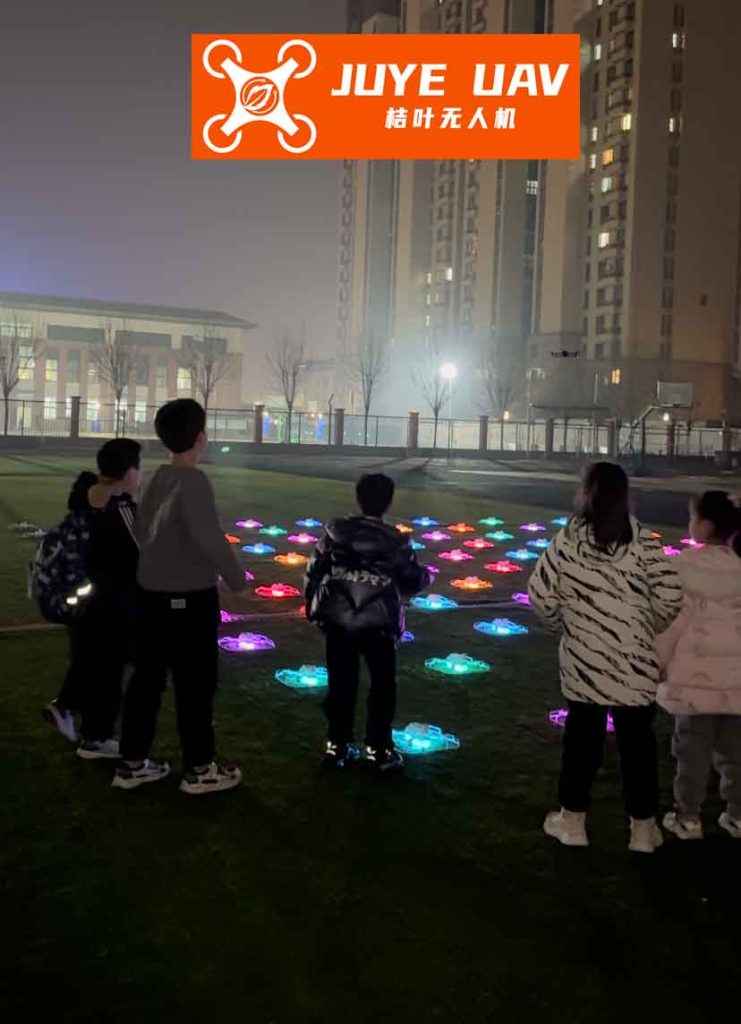
6. Performance Optimization and Metrics for a Drone Light Show
Evaluating the success of a formation drone light show algorithm goes beyond simply reaching the goal. Key performance metrics must be optimized:
| Metric | Description | Mathematical Form (Example) | Desired Property |
|---|---|---|---|
| Formation Error | Deviation from desired relative positions. | \( E_f(t) = \frac{1}{|\mathcal{E}|} \sum_{(i,j)\in\mathcal{E}} \| (\mathbf{p}_i(t) – \mathbf{p}_j(t)) – \boldsymbol{\delta}_{ij} \| \) | Minimize, especially during and after maneuvers. |
| Velocity Consensus Error | Deviation from common swarm velocity. | \( E_v(t) = \frac{1}{n} \sum_{i=1}^n \| \mathbf{v}_i(t) – \bar{\mathbf{v}}(t) \| \) where \( \bar{\mathbf{v}} \) is average velocity. | Minimize for smooth, synchronized motion. |
| Control Effort | Total energy/acceleration used. | \( J_c(t) = \int_0^t \sum_{i=1}^n \| \mathbf{u}_i(\tau) \|^2 d\tau \) | Minimize to extend battery life and reduce wear. |
| Obstacle Avoidance Success | Minimum distance to any obstacle. | \( d_{\min}(t) = \min_{i, o} \| \mathbf{p}_i(t) – \mathbf{p}_o \| \) | \( d_{\min}(t) > d_{\text{safe}} \) at all times \( t \). |
| Task Completion Time | Time for all drones to settle into final formation. | \( T_{\text{settle}} = \inf \{ t : E_f(t) < \epsilon \text{ and } E_v(t) < \epsilon \} \) | Minimize for efficient show choreography. |
The integrated APF with optimal consensus control aims to find the Pareto-optimal solution that balances these often-competing metrics. For instance, a pure APF approach might avoid an obstacle quickly (good \( d_{\min} \)) but scatter the formation (high \( E_f \)), requiring significant control effort (\( J_c \)) and time (\( T_{\text{settle}} \)) to recover. The optimal consensus framework explicitly weighs these costs to find a globally efficient path for the entire formation drone light show.
7. Practical Implementation and Future Directions
Translating these algorithms into a real-time system for a formation drone light show involves additional layers:
- State Estimation: Drones need accurate real-time knowledge of their own position (via GPS-RTK, UWB, or motion capture systems) and the states of neighbors (via peer-to-peer radio links).
- Communication Delays and Dropouts: The control algorithms must be robust to non-ideal communication, often requiring predictive or delay-tolerant consensus protocols.
- Trajectory Planning: The high-level show choreography is a sequence of desired formation waypoints and shapes. Smooth trajectory planners generate feasible paths that serve as the time-varying goals \( \mathbf{p}_g(t) \) for the consensus/APF controller.
- Failure Management: Protocols must handle drone failures gracefully, possibly allowing the swarm to reconfigure around the lost agent.
Future advancements in formation drone light show technology will likely involve:
1. Machine Learning: Using reinforcement learning to train robust, adaptive policies that can handle novel obstacle configurations and complex swarm interactions beyond the scope of analytic models.
2. Advanced Sensing: Integrating onboard vision or LiDAR for dense, dynamic environments where pre-mapping obstacles is impossible.
3. Extreme Scalability: Developing hierarchical or scalable consensus algorithms for swarms of thousands of drones, pushing the boundaries of visual spectacle and coordination.
8. Conclusion
The breathtaking artistry of a modern formation drone light show is a direct manifestation of profound engineering in distributed control systems. Moving beyond simple waypoint following, the challenge of maintaining precise, fluid formations while dynamically avoiding obstacles requires a sophisticated synthesis of ideas from graph theory, optimal control, and potential field navigation. The integrated approach of augmenting an improved, reactive Artificial Potential Field method with an optimal consensus control framework provides a robust solution. It directly addresses the classic pitfalls of APF by embedding obstacle awareness into a global cost function that the swarm collectively minimizes. This ensures not only collision-free navigation but also the preservation of formation integrity and the minimization of control energy—key factors for the efficiency and reliability of large-scale performances. As algorithms advance and computational power grows, the complexity and intelligence of these aerial symphonies will only increase, solidifying the formation drone light show as a premier showcase of autonomous swarm robotics.