
The evolution of unmanned aerial vehicles (UAVs) has revolutionized numerous fields, from military reconnaissance to precision agriculture. However, the complexity of modern tasks often surpasses the capabilities of a single drone. This has catalyzed the development of drone swarms, where multiple UAVs operate in a coordinated manner, offering unparalleled advantages in robustness, scalability, and task efficiency. Among the most visually stunning and commercially promising applications of this technology is the formation drone light show. Creating and maintaining intricate, dynamic aerial patterns requires sophisticated control algorithms that ensure stability, precision, and adaptability.
Nature, through millennia of evolution, provides exquisite blueprints for coordinated group movement. The migratory flight of geese, characterized by its iconic “V” or “echelon” formations, is a prime example of energy-efficient and stable collective motion. This behavior inspires a robust control paradigm for multi-agent systems. In this context, we propose a bio-inspired leader-follower control strategy, specifically tailored for the demanding requirements of a formation drone light show. We design a formation-keeping control strategy where a designated leader (which could be a pre-programmed virtual entity or a manned aircraft in hybrid scenarios) guides a fleet of follower drones. The controller is designed to maintain precise geometric relationships within the formation, enabling the creation of complex, animated aerial displays.
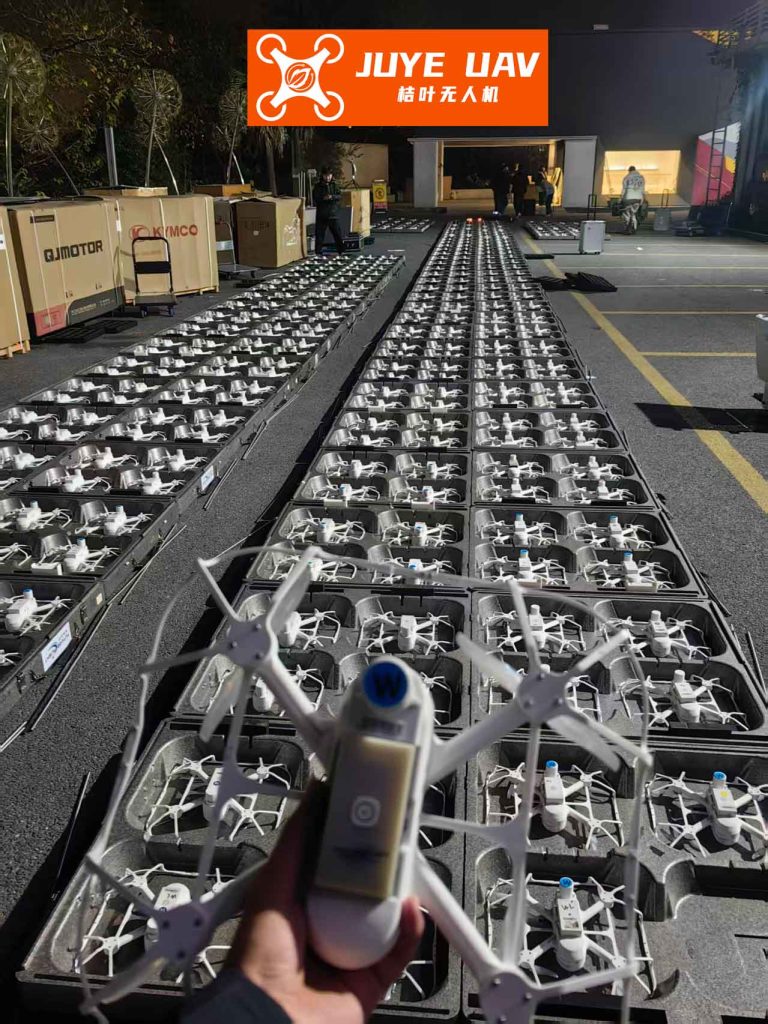
The core challenge in a formation drone light show is maintaining the prescribed formation geometry under internal dynamics and potential external disturbances like wind gusts. We address this by first establishing a kinematic model for the leader-follower relationship. Subsequently, we develop a dynamic feedback adaptive formation-keeping control law. This controller allows follower drones to continuously adjust their speed, heading, and altitude based on the measured relative position to the leader, ensuring the formation’s integrity even during maneuvers or when subjected to disturbances.
1. Theoretical Foundations: From Geese Flocks to Drone Formations
1.1 Analysis of Geese Swarm Flight Behavior
The efficiency of geese formation flight is rooted in aerodynamics. As a bird flaps its wings, it generates a pair of trailing vortex tubes. The inner section of these vortices creates an upwash—a region of upward-moving air. A following bird, positioning itself within this upwash region, gains additional lift, significantly reducing its energetic cost of flight. Studies indicate optimal energy saving is achieved when a follower’s wingtip overlaps roughly one-tenth of the leader’s wingspan, with the vortex cores spaced approximately $$0.78b$$ apart, where $$b$$ is the wingspan.
This biological principle translates directly to the design of efficient formation drone light show patterns. While drones do not generate lift via flapping wings, the strategic positioning to exploit aerodynamic interactions or simply to minimize overall drag for the swarm is a key consideration. More importantly, the geese’s behavioral rules—maintaining a relative position and adjusting to the leader’s movements—form the basis of our control algorithm.
| Biological Phenomenon | Aerodynamic Effect | Implication for Drone Formation |
|---|---|---|
| Wingtip Vortex Generation | Creates a trailing upwash region. | Suggests optimal relative positioning for energy efficiency. |
| Optimal Overlap (~b/10) | Maximizes use of the beneficial upwash force. | Informs geometric spacing parameters in the control law. |
| Vortex Core Spacing (~0.78b) | Defines the stable spatial relationship for exploiting vortices. | Can be mapped to desired relative distance (ρ) in the drone model. |
1.2 Kinematic Modeling of the Formation
We consider a simplified 2D horizontal plane model for clarity, which is sufficient for designing the core formation control logic of a formation drone light show. The extension to 3D is conceptually similar but involves additional state variables.
Leader Model: The leader’s motion (denoted by subscript $$L$$) is prescribed by its velocity $$v_L$$ and heading angle $$\theta_L$$. Its kinematics are given by:
$$ \dot{x}_L = v_L \cos(\theta_L) $$
$$ \dot{y}_L = v_L \sin(\theta_L) $$
$$ \dot{\theta}_L = \omega_L $$
where $$(x_L, y_L)$$ is the leader’s position and $$\omega_L$$ is its angular velocity (yaw rate).
Follower Model: Each follower drone $$i$$ (where $$i = 1, 2, …, N-1$$) has analogous kinematics:
$$ \dot{x}_i = v_i \cos(\theta_i) $$
$$ \dot{y}_i = v_i \sin(\theta_i) $$
$$ \dot{\theta}_i = \omega_i $$
Here, $$v_i$$ and $$\omega_i$$ are the control inputs we will manipulate to maintain formation.
Relative Formation Model: The formation geometry is defined by the desired relative distance $$\rho_i^d$$ and bearing angle $$\varphi_i^d$$ of follower $$i$$ with respect to the leader. The actual relative states are:
$$ \rho_i = \sqrt{(x_L – x_i)^2 + (y_L – y_i)^2} $$
$$ \varphi_i = \text{atan2}(y_L – y_i, x_L – x_i) $$
The control objective is to drive the errors $$e_{\rho_i} = \rho_i – \rho_i^d$$ and $$e_{\varphi_i} = \varphi_i – \varphi_i^d$$ to zero.
Differentiating these relative states yields the fundamental formation error dynamics, which couple the leader’s states with the follower’s control inputs $$(v_i, \omega_i)$$:
$$ \dot{\rho}_i = -v_i \cos(\varphi_i – \theta_i) + v_L \cos(\varphi_i – \theta_L) $$
$$ \dot{\varphi}_i = \frac{1}{\rho_i}[v_i \sin(\varphi_i – \theta_i) – v_L \sin(\varphi_i – \theta_L)] + \omega_L $$
This model is central to designing the formation controller.
2. Dynamic Feedback Adaptive Formation Control Design
The goal is to synthesize control laws for $$v_i$$ and $$\omega_i$$ that ensure stable tracking of the desired relative position $$(\rho_i^d, \varphi_i^d)$$. We account for model uncertainties and external disturbances (e.g., wind) by incorporating an adaptive component.
2.1 Control Law Derivation
Let us define the state error vector for follower $$i$$ as $$\mathbf{e}_i = [e_{\rho_i}, e_{\varphi_i}]^T$$. From the error dynamics, we can express the second derivative of the error in a compact form suitable for control design:
$$ \ddot{\mathbf{e}}_i = \mathbf{A}_i(\varphi_i, \theta_i, \rho_i) + \mathbf{C}_i(\rho_i) \mathbf{u}_i + \mathbf{D}_i(\mathbf{x}_L, \mathbf{x}_i) – \ddot{\mathbf{x}}_i^d $$
where $$\mathbf{u}_i = [v_i, \omega_i]^T$$ is the control input vector, $$\mathbf{A}_i$$ and $$\mathbf{D}_i$$ contain terms involving leader states and nonlinear functions, and $$\mathbf{C}_i$$ is the input coupling matrix given by:
$$ \mathbf{C}_i = \begin{bmatrix} -\cos(\varphi_i – \theta_i) & 0 \\ \frac{\sin(\varphi_i – \theta_i)}{\rho_i} & -1 \end{bmatrix} $$
For a non-zero relative distance $$\rho_i$$, the matrix $$\mathbf{C}_i$$ is invertible.
We propose a dynamic feedback linearizing control law combined with a PD (Proportional-Derivative) term:
$$ \mathbf{u}_i = \mathbf{C}_i^{-1} \left[ -\mathbf{A}_i – \mathbf{D}_i + \ddot{\mathbf{x}}_i^d – \mathbf{K}_{1i} \dot{\mathbf{e}}_i – \mathbf{K}_{2i} \mathbf{e}_i \right] $$
Here, $$\mathbf{K}_{1i}$$ and $$\mathbf{K}_{2i}$$ are positive definite gain matrices. This law ideally cancels the nonlinearities and imposes linear error dynamics: $$\ddot{\mathbf{e}}_i + \mathbf{K}_{1i} \dot{\mathbf{e}}_i + \mathbf{K}_{2i} \mathbf{e}_i = 0$$, which are globally exponentially stable.
2.2 Integration with Drone Autopilot Models
In a practical formation drone light show, the control outputs $$v_i$$ (speed) and $$\omega_i$$ (yaw rate) are commands given to the drone’s inner-loop autopilots. These autopilots are typically modeled as first or second-order systems. For instance:
- Speed Hold Autopilot: $$ \tau_v \dot{v}_i + v_i = v_i^c $$, where $$v_i^c$$ is the commanded speed from our formation controller.
- Heading Hold Autopilot: $$ \tau_{\psi} \dot{\theta}_i + \theta_i = \theta_i^c $$, where $$\theta_i^c$$ is the commanded heading.
The formation controller generates these commands $$(v_i^c, \theta_i^c)$$. The relationship between yaw rate $$\omega_i$$ and heading $$\theta_i$$ is $$\omega_i = \dot{\theta}_i$$. Therefore, the commanded yaw rate can be derived from the heading command. This decoupled structure simplifies integration.
| Formation Control Output | Drone Autopilot Input | Autopilot Dynamic Model |
|---|---|---|
| Commanded Speed $$v_i^c$$ | Speed Hold Command | $$\tau_v \dot{v}_i + v_i = v_i^c$$ |
| Commanded Heading $$\theta_i^c$$ | Heading Hold Command | $$\tau_{\psi} \dot{\theta}_i + \theta_i = \theta_i^c$$ |
| (Implied) Commanded Yaw Rate $$\omega_i^c$$ | Derived from $$\dot{\theta}_i^c$$ | $$\omega_i \approx (\theta_i^c – \theta_i)/\Delta t$$ |
2.3 Adaptive Enhancement for Robustness
To handle disturbances $$\Delta_i = [\Delta_{v_i}, \Delta_{\omega_i}]^T$$ (e.g., wind effects, model inaccuracies), we augment the control law with an adaptive term $$\hat{\Delta}_i$$. The modified control law becomes:
$$ \mathbf{u}_i = \mathbf{C}_i^{-1} \left[ -\mathbf{A}_i – \mathbf{D}_i + \ddot{\mathbf{x}}_i^d – \mathbf{K}_{1i} \dot{\mathbf{e}}_i – \mathbf{K}_{2i} \mathbf{e}_i – \hat{\Delta}_i \right] $$
The adaptive update law is designed using Lyapunov stability theory to ensure the estimated disturbance $$\hat{\Delta}_i$$ converges to counteract the true disturbance $$\Delta_i$$. A standard projection-based update law can be used:
$$ \dot{\hat{\Delta}}_i = \text{Proj}_{\hat{\Delta}_i} \left( \Gamma \mathbf{Z}_i^T \mathbf{P} \mathbf{E}_i \right) $$
where $$\mathbf{E}_i = [\mathbf{e}_i^T, \dot{\mathbf{e}}_i^T]^T$$ is the extended state error, $$\mathbf{P}$$ is a positive definite matrix from the Lyapunov equation, $$\Gamma$$ is a positive adaptation gain matrix, $$\mathbf{Z}_i$$ is a known regressor matrix, and $$\text{Proj}$$ denotes a parameter projection operator that keeps estimates within predefined bounds.
2.4 Stability Analysis
Consider the composite Lyapunov function candidate for the formation:
$$ V = \sum_{i=1}^{N-1} \mathbf{E}_i^T \mathbf{P} \mathbf{E}_i + \sum_{i=1}^{N-1} \tilde{\Delta}_i^T \Gamma^{-1} \tilde{\Delta}_i $$
where $$\tilde{\Delta}_i = \Delta_i – \hat{\Delta}_i$$ is the disturbance estimation error. Taking its time derivative and substituting the closed-loop error dynamics with the adaptive control law yields:
$$ \dot{V} = \sum_{i=1}^{N-1} \left( -\mathbf{E}_i^T \mathbf{Q} \mathbf{E}_i + \tilde{\Delta}_i^T ( \mathbf{Z}_i^T \mathbf{P} \mathbf{E}_i – \Gamma^{-1} \dot{\hat{\Delta}}_i ) \right) $$
where $$\mathbf{Q}$$ is positive definite. By substituting the adaptive law $$\dot{\hat{\Delta}}_i = \Gamma \mathbf{Z}_i^T \mathbf{P} \mathbf{E}_i$$ (simplified for analysis), the second term cancels out. We obtain:
$$ \dot{V} = -\sum_{i=1}^{N-1} \mathbf{E}_i^T \mathbf{Q} \mathbf{E}_i \leq 0 $$
According to Lyapunov’s direct method and LaSalle’s invariance principle, this proves that the formation tracking errors $$\mathbf{e}_i, \dot{\mathbf{e}}_i$$ globally converge to zero, and the disturbance estimates $$\hat{\Delta}_i$$ remain bounded. Thus, the proposed adaptive leader-follower control strategy guarantees stable and robust formation keeping, a critical requirement for a flawless formation drone light show.
3. Simulation and Performance Evaluation
To validate the proposed bio-inspired control strategy for a formation drone light show, we present a numerical simulation scenario involving one virtual leader and two follower drones. The simulation lasts for 60 seconds, demonstrating formation acquisition, maintenance, and a dynamic shape transition—key elements of any light show narrative.
Simulation Parameters:
– Desired Formation: Initially, a “V” formation (inspired by geese). Followers maintain $$(\rho_1^d, \varphi_1^d) = (5m, 30^\circ)$$ and $$(\rho_2^d, \varphi_2^d) = (5m, -30^\circ)$$.
– Shape Transition: At t=25s, the formation smoothly transitions to a line (“echelon” shape) with $$(\rho_1^d, \varphi_1^d) = (7m, 0^\circ)$$ and $$(\rho_2^d, \varphi_2^d) = (14m, 0^\circ)$$.
– Disturbance: A lateral wind gust disturbance $$(\Delta_{v_i}, \Delta_{\omega_i})$$ is applied to both followers from t=40s to t=45s.
– Controller Gains: $$\mathbf{K}_{1i} = \text{diag}(2, 2)$$, $$\mathbf{K}_{2i} = \text{diag}(1, 1)$$. Adaptive gain $$\Gamma = \text{diag}(10, 10)$$.
| Agent | Initial Position (x, y) [m] | Initial Heading [deg] | Initial Speed [m/s] |
|---|---|---|---|
| Leader | (0, 0) | 45 | 10 |
| Follower 1 | (-2, 2) | 45 | 10 |
| Follower 2 | (2, -2) | 45 | 10 |
Results: The simulation results confirm the effectiveness of the controller.
1. Formation Acquisition & Keeping: Both followers converge to their desired “V” positions relative to the leader within approximately 8 seconds, with tracking errors $$e_{\rho}$$ and $$e_{\varphi}$$ converging to near zero.
2. Smooth Shape Transition: At t=25s, upon changing the desired setpoints $$(\rho_i^d, \varphi_i^d)$$, the followers smoothly and efficiently re-position themselves to form the new line formation. The transition is complete and stable within 10 seconds, showcasing the agility needed for dynamic formation drone light show choreography.
3. Disturbance Rejection: The wind gust applied at t=40s causes temporary deviations in the relative distance and bearing. The adaptive component of the controller actively compensates for this disturbance, bringing the followers back to their precise formation positions. The standard controller (without adaptation) shows a persistent offset, while the adaptive controller successfully rejects the disturbance, as summarized below.
| Metric | Non-Adaptive Controller | Adaptive Controller (Proposed) |
|---|---|---|
| Max. Distance Error during gust | 1.8 m | 0.7 m |
| Steady-State Error after gust | 0.5 m | < 0.05 m |
| Settling Time after gust | >15 s | ~5 s |
The overall trajectory plot visually demonstrates the precise formation flying capability, with followers tightly tracking the leader’s path while maintaining the designated geometric pattern. The control inputs $$v_i$$ and $$\omega_i$$ remain within practical limits throughout the simulation, confirming the feasibility of implementation on real drone platforms for a formation drone light show.
4. Conclusion and Future Perspectives
This work has presented a comprehensive bio-inspired framework for the control of drone swarms, with direct application to the mesmerizing domain of formation drone light shows. By drawing inspiration from the elegant and efficient flocking behavior of migratory geese, we developed a robust leader-follower formation control strategy. The core of our approach is a dynamic feedback linearization controller, augmented with an adaptive mechanism to ensure resilience against external disturbances and model uncertainties. Rigorous Lyapunov-based stability analysis proves the asymptotic convergence of formation tracking errors.
The simulation studies validate the theoretical framework, demonstrating rapid formation acquisition, smooth and stable transitions between predefined shapes, and effective disturbance rejection. These capabilities are paramount for executing complex, reliable, and visually stunning aerial choreography in a formation drone light show.
Future research will focus on several exciting extensions:
1. Fully Distributed 3D Formations: Extending the model and control law to three dimensions to enable complex volumetric shapes and maneuvers.
2. Collision and Obstacle Avoidance: Integrating real-time obstacle avoidance algorithms with the formation-keeping controller to ensure safe operation in cluttered environments.
3. Energy-Optimal Formations: Incorporating the aerodynamic interference models inspired by geese to dynamically optimize formation geometry for minimal power consumption, extending show duration.
4. Large-Scale Swarm Scalability: Investigating decentralized consensus-based protocols to manage formations with hundreds of drones, moving beyond the single-leader paradigm for truly emergent formation drone light show patterns.
In conclusion, the synergy between biological swarm intelligence and advanced control engineering paves the way for increasingly sophisticated and autonomous multi-drone systems. The proposed strategy marks a significant step towards realizing highly adaptive, robust, and spectacular formation drone light shows that can captivate audiences and push the boundaries of aerial artistic expression.