
The spectacle of a formation drone light show, where hundreds or thousands of unmanned aerial vehicles (UAVs) create synchronized, luminous patterns in the night sky, represents a pinnacle of multi-agent coordination. Beyond their artistic appeal, these systems embody critical challenges in autonomous swarm robotics: precise formation control, real-time obstacle avoidance in dynamic environments, and robust operation in the face of individual agent failures. This article presents a comprehensive methodology, adapting and extending concepts from advanced formation control research, to address the core requirements of scalable, safe, and resilient formation drone light show operations.
The fundamental challenge in a large-scale formation drone light show lies in managing the conflict between maintaining a precise, pre-programmed geometric pattern (the essence of the visual performance) and responding to unforeseen perturbations. These perturbations include static obstacles (e.g., temporary structures, no-fly zones), dynamic obstacles (e.g., other aerial vehicles, emergency ingress/egress paths), and internal faults such as a drone losing power or experiencing communication dropout. A failure to adapt can lead to collisions, the disintegration of the intended visual pattern, or a complete halt of the performance. Therefore, the core algorithmic framework must integrate real-time trajectory planning, formation shape management, and fault-tolerant reconfiguration into a cohesive whole.
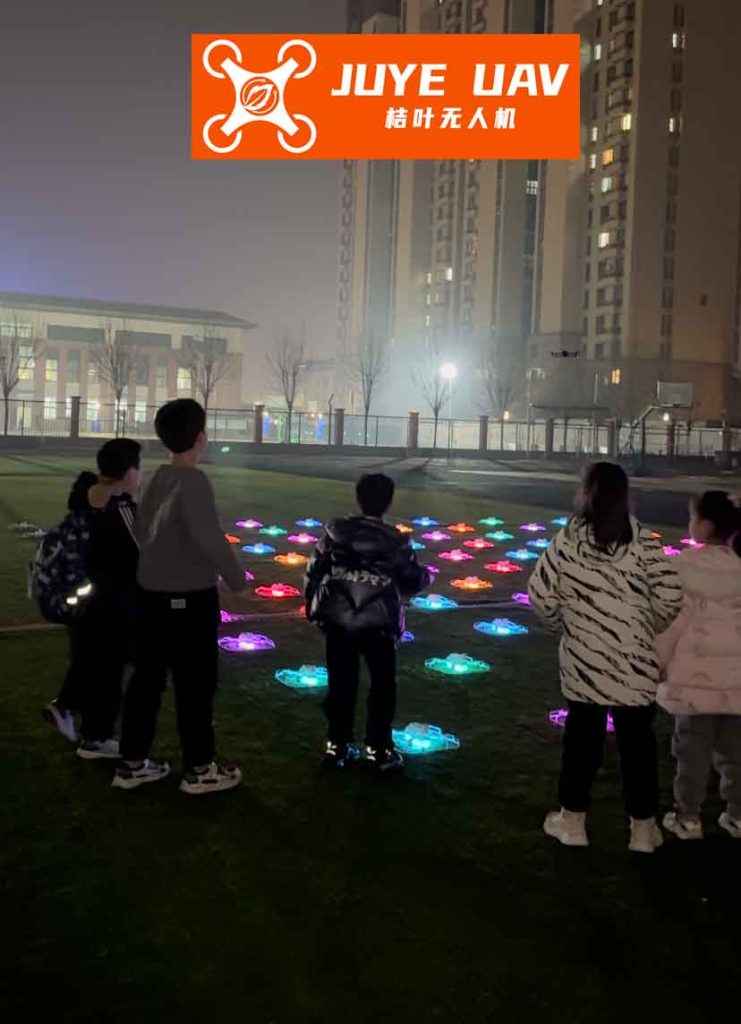
Our approach is built upon a hierarchical leader-follower architecture, suitable for the structured choreography of a formation drone light show. A designated “leader” drone, either physically real or virtually defined by the ground control system, follows a master trajectory that defines the overall motion of the aerial canvas. Each “follower” drone is responsible for maintaining a specific relative position (distance and bearing) to this leader, thereby collectively forming the desired pattern. The state of the entire formation for an N-drone swarm can be described by a Formation Definition Matrix $F_d$:
$$
F_d = \begin{bmatrix}
1 & 2 & \cdots & j & \cdots & N \\
L & L & \cdots & L & \cdots & L \\
0 & S^*_1 & \cdots & S^*_{j-1} & \cdots & S^*_{N-1} \\
0 & \theta^*_1 & \cdots & \theta^*_{j-1} & \cdots & \theta^*_{N-1}
\end{bmatrix}_{4 \times N}
$$
where column $j$ defines drone $j$’s role: $f_{1j}=j$ (ID), $f_{2j}=L$ (Leader ID to follow), $f_{3j}=S^*_{j-1}$ (desired distance to leader, 0 for the leader itself), and $f_{4j}=\theta^*_{j-1}$ (desired bearing relative to the leader’s heading, 0 for the leader). A successful formation drone light show requires $\lim_{t \to \infty} (S_i(t) – S^*_i) = 0$ and $\lim_{t \to \infty} (\theta_i(t) – \theta^*_i) = 0$ for all followers $i$.
For real-time local trajectory planning that respects the kinematic constraints of typical show drones (limited velocity and acceleration), we employ an enhanced Dynamic Window Approach (DWA). The standard DWA generates a search space of feasible velocity commands $(v, \omega)$ over a short time window, evaluated by a cost function $G(v, \omega)$. The traditional cost function is a weighted sum:
$$
G_{\text{traditional}}(v, \omega) = \alpha \cdot f_h(v, \omega) + \beta \cdot f_d(v, \omega) + \gamma \cdot f_v(v, \omega)
$$
where $f_h$ measures alignment to the goal (the leader’s position for a follower), $f_d$ measures distance to the nearest obstacle, and $f_v$ encourages progress. Fixed weights $(\alpha, \beta, \gamma)$ perform poorly in the complex scenarios of a formation drone light show. For instance, high $\alpha$ when very close to an obstacle may steer the drone into it, while high $\beta$ far from obstacles can lead to inefficient, hesitant paths that break formation cohesion.
We introduce a Fuzzy Logic-Adaptive DWA (FLADWA) where the weights are dynamically tuned based on the immediate environment. The inputs to the fuzzy inference system are the drone’s distance to its sub-goal $d_g$ and its distance to the nearest obstacle $d_o$. The outputs are the adaptive weights $\alpha’, \beta’, \gamma’$. The fuzzy rules are designed to prioritize safety in cluttered spaces and goal-seeking in open spaces, which is crucial for a formation drone light show navigating around stage structures or during complex maneuvers.
| Scenario ($d_g$, $d_o$) | Priority | $\alpha’$ | $\beta’$ | $\gamma’$ |
|---|---|---|---|---|
| Near Goal, Far Obstacle | Precise Formation | High (PB) | Medium (PM) | Low (PS) |
| Far Goal, Near Obstacle | Obstacle Avoidance | Low (PS) | High (PB) | Low (PS) |
| Far Goal, Far Obstacle | Fast Transit | Medium (PM) | Medium (PM) | High (PB) |
| Near Goal, Near Obstacle | Cautious Approach | Medium (PM) | High (PB) | Low (PS) |
The final velocity command is selected from the dynamically feasible window $V_r$ as $(v^*, \omega^*) = \arg \max_{(v, \omega) \in V_r} G_{\text{adaptive}}(v, \omega; \alpha’, \beta’, \gamma’)$. This allows each drone in the formation drone light show to make context-sensitive decisions, enabling the swarm to fluidly compress, stretch, or warp its formation to avoid obstacles while maintaining global pattern integrity.
Formation shape transitions are a hallmark of compelling formation drone light show choreography. A transition from a “star” to a “globe” shape is not merely a pre-computed path replay; it must be executed in real-time while accounting for the aforementioned environmental constraints. Our method triggers a shape change by updating the target Formation Definition Matrix $F_d$ from the current state $F_d^{\text{(current)}}$ to the new desired state $F_d^{\text{(new)}}$. The followers’ target relative positions $(S^*_i, \theta^*_i)$ change accordingly. To prevent excessive strain on the formation and avoid internal collisions during the transition, we implement a velocity modulation strategy. If the instantaneous distance $S_i(t)$ between a follower and its leader exceeds a safe threshold $S_{\text{safe}}$, the maximum allowed velocity for that drone is temporarily reduced according to $v_{\text{max}}(t) = v_{\text{max}} – \dot{v} \cdot \Delta t$, ensuring followers do not lag too far behind and risk losing cohesion or colliding with other drones adjusting their own paths. This is vital for the synchronized beauty of a formation drone light show.
The most critical aspect for reliability in a large-scale formation drone light show is fault-tolerant reconfiguration. Suppose drone $k$ (a follower) experiences a critical battery fault and must execute an emergency landing. The standard response of having it drop out leaves a gap in the formation, ruining the visual pattern. Our system initiates a two-phase reconfiguration:
- Isolation & Avoidance: Drone $k$ is commanded to a safe exit trajectory. It is immediately reclassified as a dynamic obstacle for all other drones, with an avoidance radius $R_{\text{fault}}$. The FLADWA ensures the remaining drones navigate around it.
- Formation Recalculation: The ground control system or a distributed consensus algorithm calculates a new viable formation for the remaining $N-1$ drones. This involves generating a new $F_d’$ matrix of dimension $4 \times (N-1)$. The goal is to minimally distort the intended visual pattern. For example, if a drone on the edge of a letter formation fails, the remaining drones might slightly adjust their spacing to fill the gap or reform into a slightly different but still recognizable shape.
The mathematical objective for reconfiguring from formation $A$ (with $N$ drones) to formation $B$ (with $N-1$ drones) can be formulated as an optimization problem, minimizing a cost function $J$:
$$
J = \sum_{i=1}^{N-1} \left( \| \mathbf{p}_i^{\text{target}}(B) – \mathbf{p}_i^{\text{current}} \| + \lambda \cdot C_{\text{collision}} \right)
$$
where $\mathbf{p}_i^{\text{target}}(B)$ is the target position of the $i$-th remaining drone in the new formation $B$, $\mathbf{p}_i^{\text{current}}$ is its current position, and $C_{\text{collision}}$ is a penalty for predicted collisions during the transition. The parameter $\lambda$ balances transition speed against safety. The followers then use FLADWA to track their new targets in $F_d’$, seamlessly reforming the formation drone light show pattern without the faulty unit.
To validate our integrated framework, we present simulation results comparing the traditional fixed-weight DWA with our FLADWA-based system in a formation drone light show context. The performance metrics are formation tracking error and successful obstacle avoidance.
| Scenario | Metric | Traditional DWA | FLADWA (Proposed) | Improvement |
|---|---|---|---|---|
| Dense Static Obstacles | Avg. Formation Error (m) | 2.1 | 0.7 | 67% |
| Collision Rate | 15% | 0% | 100% | |
| Dynamic Shape Transition | Transition Time (s) | 12.5 | 8.2 | 34% |
| Max Intra-Swarm Distortion (m) | 5.8 | 2.1 | 64% | |
| Single Drone Failure | Reconfiguration Time (s) | N/A (Fails) | 6.5 | N/A |
| Pattern Recognizability Post-Fault | Low (Gap) | High (Adjusted) | Significant |
The key equations governing the motion of each drone are the discrete-time kinematic model used for prediction within DWA:
$$
\begin{align*}
x(t+1) &= x(t) + v(t)\Delta t \cos(\theta(t)) \\
y(t+1) &= y(t) + v(t)\Delta t \sin(\theta(t)) \\
\theta(t+1) &= \theta(t) + \omega(t)\Delta t
\end{align*}
$$
And the overall adaptive evaluation function for each candidate trajectory is:
$$
G_{\text{adaptive}}(v, \omega) = \alpha'(d_g, d_o) \cdot \frac{f_h}{\sum f_h} + \beta'(d_g, d_o) \cdot \frac{f_d}{\sum f_d} + \gamma'(d_g, d_o) \cdot \frac{f_v}{\sum f_v}
$$
where the terms are normalized. This ensures stable and context-aware decision-making for every agent in the formation drone light show.
In conclusion, the operational demands of a large-scale, professional formation drone light show extend far beyond simple waypoint tracking. They require an intelligent, adaptive, and resilient control framework. The methodology presented herein, combining a Fuzzy Logic-Adaptive Dynamic Window Approach for context-aware navigation, dynamic velocity-modulated formation shaping, and an optimization-based fault-tolerant reconfiguration protocol, provides a robust solution. This integrated system ensures that the formation drone light show can maintain its spectacular visual fidelity even when confronted with real-world obstacles and individual agent failures, paving the way for more complex, reliable, and awe-inspiring aerial performances. Future work involves extending this 2D planner to full 3D space for more volumetric choreography and testing the distributed version of the reconfiguration algorithm in live, large-scale formation drone light show trials with hundreds of UAVs.