
The spectacular visual artistry of a formation drone light show captivates audiences worldwide. These aerial ballets, however, are far more than simple, pre-programmed paths. They are complex, dynamic systems where hundreds of unmanned aerial vehicles (UAVs) must execute intricate, synchronized maneuvers, often transitioning between breathtaking geometric shapes in real-time. The core technological challenge enabling this art form is formation reconfiguration—the safe, efficient, and timely transition of a drone swarm from one defined pattern to another. This paper presents a robust methodology for real-time trajectory planning during such reconfigurations, based on an enhanced Rapidly-exploring Random Tree (RRT) algorithm, specifically tailored for the stringent demands of a formation drone light show.
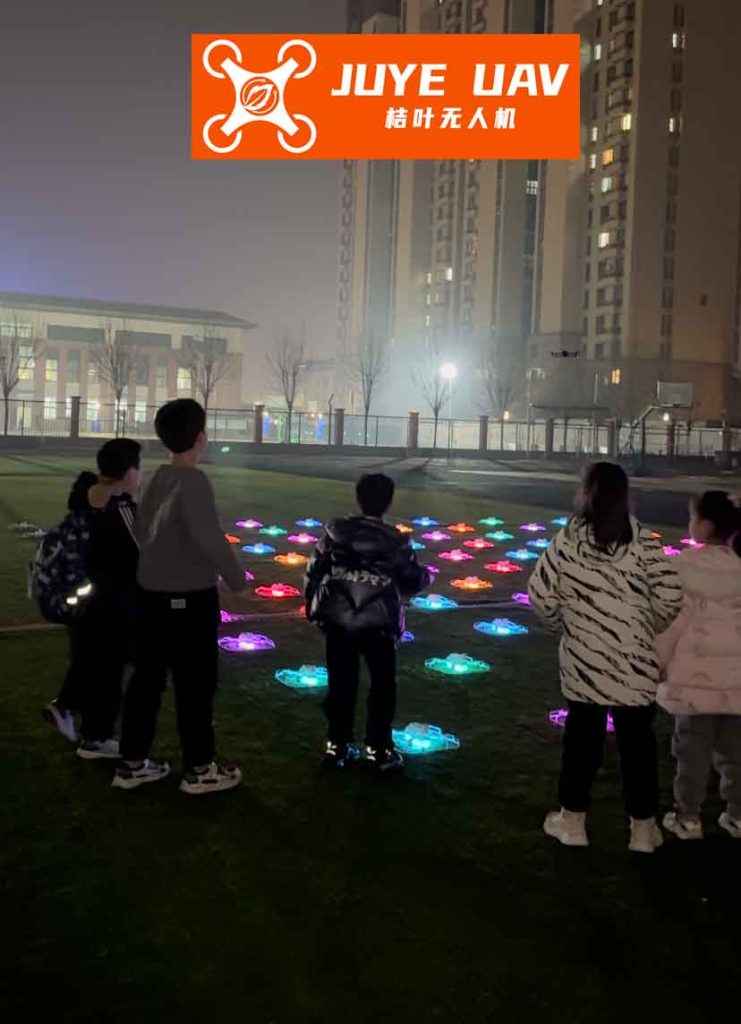
The operational environment for a formation drone light show is deceptively complex. Drones must avoid collisions with each other (intra-formation collision) and with no-fly zones or temporary obstacles (external threats), all while adhering to their physical flight dynamics (like minimum turn radius). Furthermore, to achieve a visually pleasing and synchronized transition, drones often must arrive at their new positions in the formation simultaneously or in a specific choreographed sequence. This combination of kinodynamic constraints, obstacle avoidance, and multi-agent coordination makes traditional, static waypoint planning insufficient for dynamic, large-scale formation drone light show sequences.
1. Kinematic Modeling for Formation Control
We consider a swarm of n homogeneous drones operating in a 2D plane (extendable to 3D). A leader-follower structure is adopted for its simplicity and scalability in a formation drone light show context. One drone is designated the leader (L), whose trajectory primarily dictates the swarm’s overall movement. The followers (F_i) maintain relative positions to the leader to form the desired pattern. We define a formation coordinate frame fixed to the leader. The relative kinematics of a follower with respect to the leader can be derived. Let the leader’s velocity, flight-path azimuth (heading), and flight-path roll angle be \(V_L\), \(\psi_L\), and \(\mu_L\), respectively. For a follower \(F\) with states \(V_F\), \(\psi_F\), \(\mu_F\), and relative position \((x, y)\) in the formation frame, the simplified relative motion equations are:
$$
\begin{aligned}
\dot{x} &= V_F \cos(\psi_E) \cos(\mu_E) + \dot{\psi}_L y – V_L \\
\dot{y} &= V_F \sin(\psi_E) \cos(\mu_E) – \dot{\psi}_L x + \dot{\mu}_L z \\
\psi_E &= \psi_F – \psi_L \\
\mu_E &= \mu_F – \mu_L
\end{aligned}
$$
where \(\psi_E\) and \(\mu_E\) are the relative azimuth and roll angles. For level, coordinated turns often used in smooth formation drone light show transitions, \(\mu\) and \(\dot{\mu}\) are small. The key constraint is the minimum turn radius \(R_{min}\), determined by the drone’s maximum bank angle \(\mu_{max}\) and speed \(V\):
$$
R_{min} = \frac{V^2}{g \cdot \tan(\mu_{max})}
$$
This \(R_{min}\) is a fundamental limit for any smooth maneuver in a formation drone light show.
2. Core Algorithm: Rapidly-exploring Random Tree (RRT)
The RRT algorithm is a sampling-based motion planner ideal for solving problems with complex constraints, making it a strong candidate for planning individual paths within a formation drone light show. Let the configuration space be \(S \subset \mathbb{R}^2\), with obstacle-free space \(\bar{S}_T\) and obstacle region \(S_T\). Given an initial state \(Z_I\) and a goal state \(Z_G\), the basic RRT algorithm grows a tree \(T\) as follows:
- Sampling: Generate a random sample \(Z_{rand}\) in \(\bar{S}_T\) (with probability \(p\)) or set \(Z_{rand} = Z_G\) (probability \(1-p\)).
- Nearest Neighbor: Find the node \(Z_{near}\) in \(T\) closest to \(Z_{rand}\).
- Extension: From \(Z_{near}\), extend a step of length \(L\) towards \(Z_{rand}\) to create a new node \(Z_{new}\).
- Collision Check: If the segment \(Z_{near}Z_{new}\) is collision-free, add \(Z_{new}\) to \(T\).
- Termination: Repeat until \(Z_{new}\) is within \(L\) of \(Z_G\).
The resulting path from \(Z_I\) to \(Z_G\) is the sequence of nodes. While effective for finding feasible paths, the raw RRT output is unsuited for a formation drone light show due to two main issues: 1) The path is jagged with redundant nodes, causing unnecessary and shaky maneuvers. 2) Path segments connect at sharp angles, demanding instantaneous heading changes that violate the \(R_{min}\) constraint, leading to unstable tracking and potential collision in a dense swarm.
3. Enhanced RRT for Drone Trajectory Smoothing
To produce flyable paths suitable for a graceful formation drone light show, we augment the basic RRT with post-processing and in-process guidance strategies.
3.1. Redundant Node Pruning
Given the node set \(\text{Root} = \{Z_I, Z_1, Z_2, …, Z_n, Z_G\}\) from the RRT, we remove unnecessary nodes. We iteratively check if a direct connection between non-consecutive nodes is collision-free and dynamically feasible. If so, the intermediate nodes are bypassed. This significantly shortens and straightens the path. The algorithm is summarized below:
| Step | Action |
|---|---|
| 1 | Initialize pruned set \(\text{Refined} = \{Z_I\}\). Set current node \(Z_c = Z_I\). |
| 2 | Starting from \(Z_G\), iterate backwards through \(\text{Root}\) to find the farthest node \(Z_i\) from \(Z_c\) such that the path \(Z_c Z_i\) is feasible. |
| 3 | Add \(Z_i\) to \(\text{Refined}\). Set \(Z_c = Z_i\). |
| 4 | Repeat steps 2-3 until \(Z_c = Z_G\). Output \(\text{Refined}\). |
3.2. Transition Trajectory Insertion
This is the critical step for ensuring smooth turns in a formation drone light show. At a node \(Z_i\) where the path direction changes, we replace the sharp corner with a dynamically feasible circular arc (a Dubins path segment). Let the incoming path segment be \(\overrightarrow{Z_{i-1}Z_i}\) and the outgoing segment be \(\overrightarrow{Z_{i}Z_{i+1}}\). We compute the required turn.
$$
\begin{aligned}
\text{Turn Direction} &: \text{Sign of } \left( \overrightarrow{Z_{i-1}Z_i} \times \overrightarrow{Z_{i}Z_{i+1}} \right) \\
\text{Turn Center } O_c &: \text{Lies at distance } R_{min} \text{ from both the in-line and out-line.}
\end{aligned}
$$
The condition for the existence of such a transition arc between two straight segments is that the distance from the turn center \(O_c\) to the vertex \(Z_i\) must be greater than or equal to \(R_{min} / \sin(\theta/2)\), where \(\theta\) is the turning angle. If this condition holds, we insert an arc of radius \(R_{min}\) between the two segments, defining tangent points \(O_e\) (entry) and \(O_x\) (exit). This guarantees the path curvature never exceeds \(1/R_{min}\), making it perfectly trackable by the drone. The process is illustrated in the following formula for finding \(O_c\) when constructing a right turn:
$$
\begin{aligned}
L_1 &\| \overrightarrow{Z_{i-1}Z_i}, \quad d(L_1, \overrightarrow{Z_{i-1}Z_i}) = R_{min} \\
L_2 &\| \overrightarrow{Z_{i}Z_{i+1}}, \quad d(L_2, \overrightarrow{Z_{i}Z_{i+1}}) = R_{min} \\
O_c &= L_1 \cap L_2
\end{aligned}
$$
where \(L_1\) and \(L_2\) are lines offset from the original path segments. The resulting path is not only smooth but also time-optimal for the given turn under the constant-speed, maximum-bank constraint, a vital feature for synchronizing a formation drone light show.
4. Multi-Agent Formation Reconfiguration Strategy
Planning for an entire formation drone light show involves coordinating the smooth paths of all \(n\) drones during the reconfiguration from an initial pattern \(P\) to a goal pattern \(Q\). We impose a set of hierarchical constraints.
| Constraint Category | Description | Mathematical Formulation / Method |
|---|---|---|
| 1. Dynamical Feasibility | Paths must respect \(R_{min}\) and minimum straight segment length \(l_{min}\). | \(R_{min} = V^2/(g \tan(\mu_{max}))\); RRT step \(L \ge l_{min}\). |
| 2. External Obstacle Avoidance | Drones must avoid static/mapped no-fly zones (e.g., audience, structures). | For obstacle \(j\) with center \((a_j, b_j)\), radius \(r_j\): \(\min \sqrt{(x_i(t)-a_j)^2 + (y_i(t)-b_j)^2} \ge \lambda r_j, \forall i,t\). |
| 3. Target Geometry | Final positions must match the desired new show pattern (e.g., a logo, shape). | Goal states \(Z_{G,i}\) are predefined from pattern \(Q\). |
| 4. Sequential Planning & Intra-Formation Avoidance | Prevent collisions between drones during reconfiguration. This is paramount for a safe formation drone light show. | Step 1: Plan optimal smooth path for leader using enhanced RRT. Step 2: For each follower \(i\), plan its path with a biased sampling strategy. The probability of accepting a random sample \(Z_{rand}\) is reduced based on its proximity to the leader’s planned position at a corresponding time, encouraging separation. |
| 5. Temporal Synchronization (Simultaneous Arrival) | For a visually cohesive transition in the formation drone light show, drones should reach their new positions simultaneously. | Given leader path length \(l_L\) and speed \(v_L\), compute nominal transition time \(t = l_L / v_L\). For follower \(i\) with path length \(l_i\), adjust its speed \(v_i\) within \([v_{min}, v_{max}]\) such that \(l_i / v_i = t\). |
| 6. Continuous Collision Checking | Verify the minimum inter-drone distance constraint holds at all times. | Discretize all paths with step \(\Delta t\). For all times \(t_k\) and all drone pairs \((i,j)\), check: \( \| \mathbf{pos}_i(t_k) – \mathbf{pos}_j(t_k) \| > d_{safe} \). |
The complete algorithm for generating a safe and synchronized reconfiguration plan for a formation drone light show is executed as follows:
- Leader Path Planning: Generate a smooth, obstacle-free path from its initial to its goal position using the Enhanced RRT (with pruning and transition arcs).
- Follower Path Planning: For each follower, run the Enhanced RRT with biased sampling (considering the leader’s path as a dynamic obstacle) to plan its smooth path.
- Velocity Assignment: Calculate the nominal time \(t\) from the leader’s path. For each follower, compute the required constant speed \(v_i = l_i / t\). If \(v_i\) falls outside \([v_{min}, v_{max}]\), slightly adjust \(t\) or perform iterative path shortening/lengthening (e.g., by adjusting the RRT goal bias).
- Collision Validation: Perform a final high-resolution check of inter-drone distances over the entire maneuver. If violations occur, replan the most offending path with a higher penalty on the collision distance.
5. Simulation Analysis and Performance
We simulate a critical transition within a formation drone light show: a three-drone “line” formation transforming into a “vertical line” formation while avoiding three circular obstacle zones. Drones have \(V = 20-25 \, \text{m/s}\), \(\mu_{max} = 0.6 \, \text{rad}\), yielding \(R_{min} \approx 120 \, \text{m}\). The safe distance \(d_{safe} = 40 \, \text{m}\).
The enhanced RRT algorithm successfully planned smooth, collision-free paths. The key results are summarized below:
| Performance Metric | Left Follower | Leader | Right Follower | Constraint |
|---|---|---|---|---|
| Path Length (Original) | 1120.0 m | 960.0 m | 1080.0 m | – |
| Path Length (Smoothed) | 907.8 m | 863.6 m | 894.9 m | – |
| Assigned Speed | 23.65 m/s | 22.50 m/s | 23.31 m/s | Within [20, 25] m/s |
| Arrival Time | 38.38 seconds (Simultaneous) | Met | ||
| Min. Inter-Drone Distance | > 49 m | > 40 m (Met) | ||
| Min. Obstacle Distance | > 5.2 m | > 0 m (Met) | ||
The smoothing process (pruning + transition arcs) reduced path lengths by 10-20%. More importantly, the generated paths are composed of straight segments connected by arcs of radius \(R_{min}\), making them inherently trackable. The velocity assignment ensured simultaneous arrival, a key aesthetic for a formation drone light show. The continuous collision check confirmed safety throughout the maneuver.
We compared our Enhanced RRT against two other common planners adapted for this task: a Particle Swarm Optimization (PSO) with Dubins paths and a Gauss Pseudospectral Optimal Control solver. The comparison, averaged over 50 runs, is shown below:
| Algorithm | Avg. Transition Time | Avg. Min. Separation | Avg. Comp. Time | Remarks |
|---|---|---|---|---|
| Enhanced RRT (Ours) | 45.6 s | 49.9 m | 2.5 s | Best balance: Fast planning, safe, good path quality. |
| PSO-Dubins | 118.6 s | 51.4 m | 20.5 s | Very safe, but long paths and slow planning. |
| Pseudospectral Method | 37.1 s | 45.7 m | 34.8 s | Optimal paths but computationally expensive; borderline safety. |
Our method provides a superior balance crucial for a real-time formation drone light show system: computational efficiency (enabling rapid re-planning if needed), safety guarantees, and high-quality, trackable paths that result in efficient transition times.
6. Practical Application in Formation Drone Light Show Systems
Integrating this reconfiguration planner into a real formation drone light show system involves a layered architecture. The Show Choreography Layer defines the sequence of patterns and the desired transition times. The Formation Planning Layer (running our Enhanced RRT algorithm) computes the smooth, synchronized trajectories for all drones between patterns. Finally, the Individual Drone Control Layer uses precise path-following algorithms (like nonlinear guidance logic) to track the assigned trajectories, with the transition arcs ensuring stable tracking even during turns.
The primary advantage for a formation drone light show is robustness. The RRT’s sampling nature allows it to quickly find solutions in cluttered environments (e.g., near buildings or with temporary no-fly zones). The smoothing ensures the resulting show is fluid and graceful, not jerky. The formal collision checking mitigates the catastrophic risk of mid-air collisions in a dense swarm of hundreds of drones.
Future work involves extending the planner to 3D for more dramatic formation drone light show effects, incorporating wind disturbance models, and developing distributed versions of the algorithm where drones collaboratively plan in real-time, further enhancing the resilience and scalability of next-generation aerial displays.
7. Conclusion
The artistic magic of a formation drone light show is built upon a foundation of rigorous multi-agent trajectory planning and control. The proposed Enhanced RRT-based reconfiguration method provides a effective solution to the core problem of safe, smooth, and synchronized pattern transitions. By integrating path pruning, dynamical transition arcs, and a hierarchical constraint-satisfaction strategy, the method generates flyable trajectories that respect drone kinematics, avoid obstacles, prevent inter-drone collisions, and meet tight synchronization requirements. This approach offers an optimal balance of computational speed, solution quality, and safety assurance, making it a highly suitable technological cornerstone for designing and executing the complex, dynamic, and breathtaking maneuvers that define a modern formation drone light show. As these displays grow in scale and ambition, such advanced planning algorithms will be indispensable for pushing the boundaries of aerial artistry.