
The execution of large-scale, dynamic formation drone light shows in complex, real-world environments presents a significant technical challenge. While achieving precise geometric patterns in open, obstacle-free spaces is now commonplace, the next frontier involves enabling these aerial fleets to adapt their formations intelligently in response to unexpected obstacles, other drones, or dynamic stage elements, all while relying only on limited, local sensor information. This capability would unlock unprecedented creative possibilities, allowing shows to weave through architectural structures, forests, or around moving performance elements safely and seamlessly. Traditional centralized control or global path-planning methods fall short in such scenarios due to communication latency, the impossibility of perfect global knowledge, and the need for real-time, distributed decision-making. This article explores a cutting-edge solution: a decentralized control framework based on Deep Reinforcement Learning (DRL) that empowers each drone in a formation drone light show to make autonomous navigation and collision avoidance decisions, ensuring the integrity and safety of the performance under local perception constraints.
The core challenge in a locally perceived environment is that no single drone has a complete map. Each unit can only sense obstacles, other drones, and target positions within a limited range. Therefore, the control strategy must be distributed and based on local observations. We adopt a hierarchical leader-following strategy tailored for a formation drone light show. One drone is designated as the formation leader, responsible for guiding the entire fleet towards the show’s key positional milestones (e.g., the next major pattern anchor point). The remaining drones are followers, tasked with maintaining a relative position within the evolving formation. The critical innovation lies in how followers determine their target. Instead of a fixed offset from the leader, a consensus algorithm is used. Each follower calculates its desired position based on weighted information from its neighboring drones (which may include the leader and other followers). This creates a resilient and flexible formation structure that can fluidly deform around obstacles while maintaining overall cohesion, essential for an adaptive formation drone light show.
The kinematic model for each drone in the show is foundational. We define its state in a ground coordinate system. Let the position vector be $\mathbf{p} = [p_x, p_y, p_z]^T$ and the velocity vector be $\mathbf{v} = [v_x, v_y, v_z]^T$. The kinematic relationships are given by:
$$
\begin{aligned}
\dot{p}_x &= v_x = v \cos\gamma \cos\chi \\
\dot{p}_y &= v_y = v \cos\gamma \sin\chi \\
\dot{p}_z &= v_z = v \sin\gamma
\end{aligned}
$$
where $v$ is the airspeed, $\gamma$ is the flight path angle, and $\chi$ is the heading angle. The acceleration, derived from the time derivative of velocity, is crucial for control:
$$
\begin{bmatrix} a_x \\ a_y \\ a_z \end{bmatrix} =
\begin{bmatrix}
\cos\gamma \cos\chi & -v \sin\gamma \cos\chi & -v \cos\gamma \sin\chi \\
\cos\gamma \sin\chi & -v \sin\gamma \sin\chi & v \cos\gamma \cos\chi \\
\sin\gamma & v \cos\gamma & 0
\end{bmatrix}
\begin{bmatrix} \dot{v} \\ \dot{\gamma} \\ \dot{\chi} \end{bmatrix}.
$$
A simplified, first-order autopilot model is assumed for the inner-loop control:
$$
\begin{aligned}
\dot{v} &= (v_c – v)/\tau_v \\
\dot{\gamma} &= (\gamma_c – \gamma)/\tau_\gamma \\
\dot{\chi} &= (\chi_c – \chi)/\tau_\chi
\end{aligned}
$$
Here, $v_c$, $\gamma_c$, and $\chi_c$ are the command signals for speed, flight path angle, and heading, respectively. These three commands constitute the action space for our DRL agent, governing the flight of each drone in the formation drone light show.
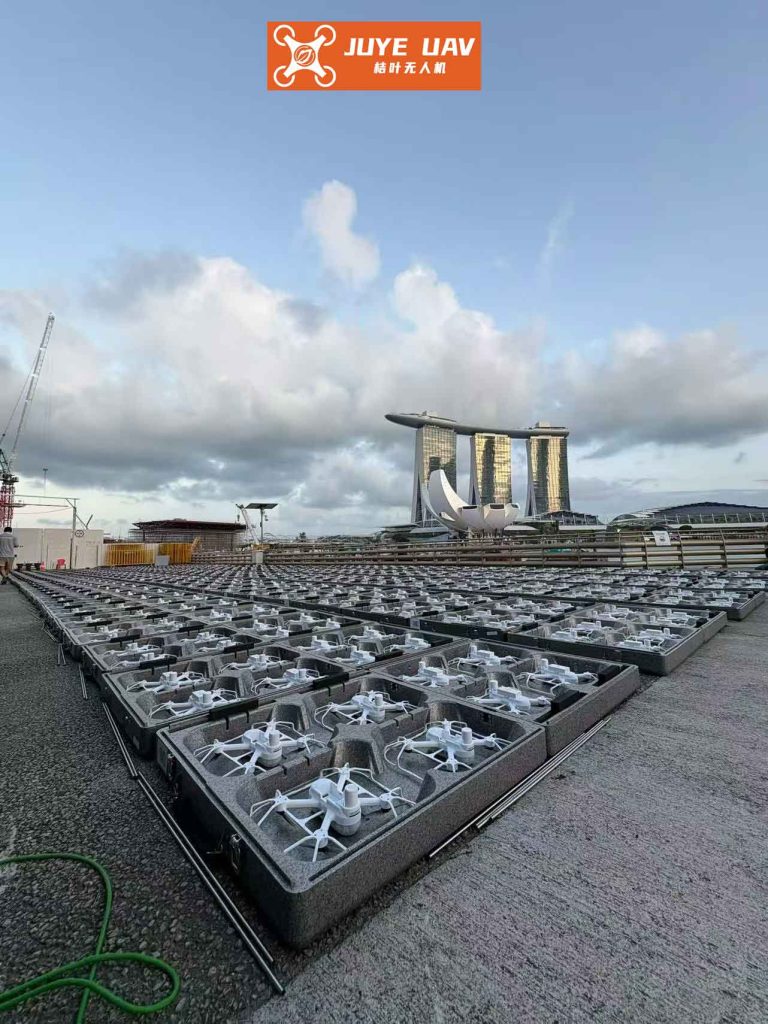
The system architecture for local perception and control is centered on a DRL-based autonomous decision-making module. The environment for a formation drone light show contains static obstacles (e.g., buildings, trees), dynamic obstacles (e.g., other aerial performers, birds), and the drones themselves, which must avoid colliding with each other. Each drone’s observation space $S$ is carefully designed to include only locally available information:
$$
S = [S_{\text{self}}, S_{\text{target}}, S_{\text{obstacles}}]
$$
Where:
– $S_{\text{self}}$ includes the drone’s own position, velocity, previous action, and orientation ($\gamma$, $\chi$).
– $S_{\text{target}}$ differs for leader and follower. For the leader, it is the fixed global target point for the next show sequence. For a follower, it is a *moving target* comprising the consensus-derived target position $\mathbf{p}^t_i$, its velocity $\mathbf{v}^t_i$, and acceleration $\mathbf{a}^t_i$.
– $S_{\text{obstacles}}$ contains the relative position and radius of the nearest 6 obstacles (static, dynamic, or other drones).
The consensus algorithm is key for the followers’ target calculation. Given a communication topology graph $G$ and a damping factor $\eta \in (0,1)$, a weight matrix $W$ is computed. The moving target position and velocity for follower $i$ at time step $k$ are then calculated as a weighted average of its neighbors’ states:
$$
\begin{aligned}
\mathbf{p}^t_i(k) &= \sum_{j \in \mathcal{N}_i} w_{ij} \mathbf{p}_j(k) \\
\mathbf{v}^t_i(k) &= \sum_{j \in \mathcal{N}_i} w_{ij} \mathbf{v}_j(k)
\end{aligned}
$$
This allows the formation to be fluid and responsive. A tracking guidance law provides a baseline control signal $\mathbf{u}_{guid}$ for reaching a target, which aids in reward shaping:
$$
\mathbf{u}_{guid} = -k_p (\mathbf{p} – \mathbf{p}^t) – k_v (\mathbf{v} – \mathbf{v}^t) + \mathbf{a}^t.
$$
With $k_p=1$ and $k_v=\sqrt{3}$, this law provides a stable, optimal reference for the drone to follow its target, a fundamental behavior for any drone in a coordinated formation drone light show.
The problem is framed as a series of single-agent reinforcement learning tasks to reduce complexity. First, an agent is trained to control the Leader Drone, learning to navigate to fixed targets while avoiding obstacles. This trained policy is then used to guide the training of the Follower Drone agent, which must track its moving consensus target. The core of the DRL approach lies in the design of a dense, continuous reward function $R$ that combines several objectives essential for a successful formation drone light show:
1. Stage Completion Reward ($R_1$): A sparse but large bonus is given only upon successfully reaching the target zone. Sub-goal rewards can be added for approaching intermediate waypoints in the show’s choreography.
2. Obstacle Proximity Penalty ($R_2$): Inspired by artificial potential fields, this creates a repulsive force. The penalty increases inversely with the square of the distance to any obstacle within a safety radius $d_o$:
$$R_2 = -\frac{1}{2}\eta \left( \frac{1}{d(\mathbf{p}, \mathbf{p}_{obs})} – \frac{1}{d_o} \right)^2 \quad \text{for} \quad d \leq d_o.$$
A similar term penalizes flying too close to the ground.
3. Collision Penalty ($R_3$): A large, constant negative reward is given if a collision occurs ($d \leq r_{obs}$), terminating the episode.
4. Guidance Reward ($R_4$): This encourages the drone’s actual acceleration $\mathbf{a}$ to align with the ideal guidance acceleration $\mathbf{u}_{guid}$:
$$R_4 = -k_g \cdot \arccos\left(\frac{\mathbf{a} \cdot \mathbf{u}_{guid}}{\|\mathbf{a}\|\|\mathbf{u}_{guid}\|}\right).$$
5. Progress Reward ($R_5$): A small, step-by-step reward proportional to the reduction in distance to the target: $R_5 = k_d (d_{prev} – d_{curr})$.
6. Formation Lag Penalty ($R_6$ – Followers only): To prevent followers from straying too far and breaking the formation, a penalty is applied if the distance to its target exceeds a threshold $r_f$: $R_6 = -k_f \cdot d(\mathbf{p}, \mathbf{p}^t)$.
The total reward is a weighted sum: $R_{total} = \sum_i w_i R_i$. The weights are tuned to balance the competing objectives of reaching the goal quickly, avoiding collisions, and maintaining formation cohesion. The DRL agent, typically using an actor-critic algorithm like Proximal Policy Optimization (PPO), learns a policy $\pi(\mathbf{a} | \mathbf{s})$ that maps its local observation $\mathbf{s}$ to the three-dimensional action $\mathbf{a} = [v_c, \gamma_c, \chi_c]^T$.
The training process for a formation drone light show system involves extensive simulation in randomized environments. A typical training domain might be a large volume (e.g., 10km x 10km x 3km) populated with numerous static and dynamic obstacles. The drones start in one region and must reach a target region on the opposite side. The leader is trained first. Once its policy converges—indicated by a stable rise in cumulative reward—its frozen policy is deployed in the environment to generate trajectories for training the followers. The follower agent learns to track its moving consensus target while avoiding the leader, other followers, and all environmental obstacles. The complexity is reflected in the follower’s noisier, more challenging reward curve during training.
After training, the performance of the DRL-controlled formation drone light show can be evaluated using key metrics:
| Metric | Description | Typical Target for a Reliable Show |
|---|---|---|
| Mission Success Rate | The percentage of episodes where all drones safely reach the final target zone. | > 95% |
| Collision Rate | The frequency of drone-drone or drone-obstacle collisions. | < 0.1% |
| Average Formation Error | The mean deviation of followers from their ideal consensus positions during flight. | Minimized, within visual tolerance for the show. |
| Smoothness of Control Commands | Measured by the rate of change of $v_c$, $\gamma_c$, $\chi_c$. | High smoothness for stable, energy-efficient flight. |
A significant advantage of the DRL approach over traditional methods for a formation drone light show is its adaptability and performance in local perception scenarios:
| Aspect | Traditional Methods (APF, Optimization) | Deep Reinforcement Learning Approach |
|---|---|---|
| Global Information | Generally required for planning. | Not required; operates on local perception only. |
| Real-time Computation | Can be high for online re-planning. | Very fast forward pass through a neural network. |
| Handling Dynamics | May require separate dynamic controllers. | Policy learns dynamics and control end-to-end. |
| Formation Flexibility | Often requires pre-defined, rigid formation shapes. | Formation emerges and deforms naturally from local consensus rules. |
| Obstacle Reactivity | Reacts based on pre-defined potential fields or rules. | Learns complex, context-aware avoidance maneuvers from experience. |
In conclusion, the application of deep reinforcement learning to the control of formation drone light shows represents a paradigm shift towards intelligent, resilient, and truly autonomous aerial displays. By decentralizing control and equipping each drone with a policy trained to make optimal decisions based on limited local information, this method solves the critical problem of navigation in complex, partially unknown environments. The fusion of leader-following strategy, consensus algorithms for flexible formation keeping, and carefully shaped reward functions enables a fleet of drones to not only execute breathtaking choreography but also to dynamically and safely adapt it in real-time. This technology moves the formation drone light show from a pre-programmed spectacle in an empty sky to an interactive, intelligent performance capable of engaging with complex stages and dynamic environments, opening a new chapter in aerial entertainment and artistic expression.