
The aerial spectacle of a formation drone light show, where hundreds or thousands of unmanned aerial vehicles (UAVs) move in synchrony to create dynamic, illuminated shapes in the night sky, represents a pinnacle of multi-agent coordination technology. Beyond their entertainment value, these systems embody critical challenges in the fields of robotics, control theory, and artificial intelligence. Each drone in the formation is a complex, underactuated system, and coordinating a fleet of them in a constrained three-dimensional airspace, often laden with obstacles and under the influence of environmental disturbances, requires sophisticated algorithms for path planning and cooperative control. This article delves into a comprehensive framework integrating reinforcement learning-based trajectory generation, artificial potential fields for reactive safety, and distributed consensus control, providing a robust solution for the safe and precise execution of complex formation drone light show patterns.
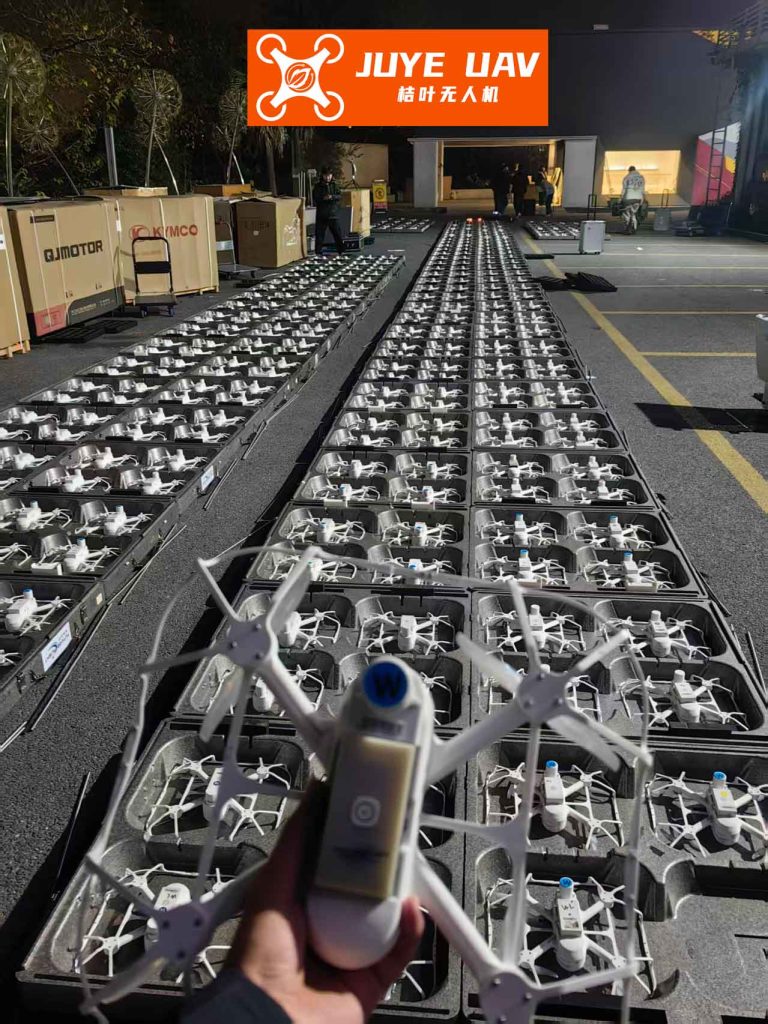
The core of any formation drone light show lies in transforming a high-level artistic choreography into safe, flyable paths for each individual agent. Traditional methods often plan a path for a single leader and then derive follower trajectories, which can fail in unknown or dynamic environments. We propose a hierarchical approach. First, an intelligent path for a virtual leader is generated using a modified Q-Learning algorithm. The state-space is discretized into a 3D grid, and the action-space is expanded to 26 possible movement directions (e.g., faces, edges, vertices of a cube centered on the drone), allowing for more realistic and smooth exploration compared to simpler 6-direction models. The reward function $$r(s, a, s’) = r_{act}(d) + r_{env}(s’)$$ is carefully designed, where $$r_{act}(d)$$ penalizes longer step lengths $$d$$ to encourage shortest paths, and $$r_{env}(s’)$$ provides a large positive reward for reaching the goal $$P_g$$, a large negative reward for entering obstacle regions $$\Lambda_o$$ or leaving the defined airspace $$\Lambda_{env}$$, and a neutral reward otherwise. This setup guides the learning process effectively.
The Q-table is updated using the standard temporal-difference learning rule:
$$Q(s, a) \leftarrow Q(s, a) + \alpha \left[ r + \zeta \max_{a’} Q(s’, a’) – Q(s, a) \right]$$
where $$\alpha$$ is the learning rate and $$\zeta$$ is the discount factor. An $$\epsilon$$-greedy policy balances exploration and exploitation. The resulting path is a sequence of discrete waypoints. To ensure kinematic feasibility for the dynamics of a quadrotor in a formation drone light show, these points are smoothed into a continuous, differentiable trajectory using a B-spline curve:
$$P_0(t) = \sum_{m=0}^{M} P_{0}^{m} \Re_{m, l}(t)$$
where $$P_{0}^{m}$$ are the learned waypoints and $$\Re_{m, l}(t)$$ are the B-spline basis functions of degree $$l$$. This provides the virtual leader’s reference trajectory $$P_0(t)$$, which encodes the overall shape and timing of the light show segment.
The real challenge begins with coordinating the follower drones. In a formation drone light show, each follower $$i$$ must track its own desired trajectory $$P_i^d(t) = P_0(t) – \Delta_{i0}$$, where $$\Delta_{i0}$$ is the pre-defined formation offset. The system must also prevent mid-air collisions between drones and avoid static obstacles, all while rejecting disturbances like wind gusts. We model each quadrotor’s full 6-DOF dynamics, which is more representative for a formation drone light show than a simple point-mass model. The dynamics are separated into translational (position) and rotational (attitude) subsystems.
The translational dynamics for follower $$i$$ are:
$$
\begin{cases}
\dot{P}_i = V_i \\
\dot{V}_i = U_i^P
\end{cases}
$$
where $$P_i = [x_i, y_i, z_i]^T$$, $$V_i$$ is the velocity, and $$U_i^P$$ is the virtual control input (specific thrust vector).
The rotational dynamics are:
$$
\begin{cases}
\dot{\Theta}_i = \Omega_i \\
\dot{\Omega}_i = F(\Theta_i, \Omega_i) + G U_i^\Theta + D_i(t)
\end{cases}
$$
where $$\Theta_i = [\phi_i, \theta_i, \psi_i]^T$$ are the Euler angles, $$\Omega_i$$ are the angular rates, $$U_i^\Theta = [\tau_{\phi_i}, \tau_{\theta_i}, \tau_{\psi_i}]^T$$ are the control moments, $$F(\cdot)$$ encapsulates Coriolis and gyroscopic terms, and $$D_i(t)$$ represents bounded external disturbances (e.g., unmodeled dynamics, wind).
We design a distributed cooperative control protocol based on the consensus theory and the backstepping technique. The control structure is two-tiered. First, a virtual control law $$U_i^P$$ is designed for the translational subsystem to achieve formation tracking and collision/obstacle avoidance. Second, this virtual control is mapped to desired attitudes and total thrust, and an inner-loop controller is designed for the attitude subsystem to track these commands robustly.
The distributed virtual control law for follower $$i$$ is:
$$
U_i^P = -\sum_{j \in \mathcal{N}_i} a_{ij} \left[ K_1^P (\tilde{P}_i – \tilde{P}_j) + K_2^P (\tilde{V}_i – \tilde{V}_j) \right] – b_i \left( K_1^P \tilde{P}_i + K_2^P \tilde{V}_i \right) + F_i^{APF}
$$
where $$\tilde{P}_i = P_i – P_i^d$$ and $$\tilde{V}_i = V_i – \dot{P}_i^d$$ are tracking errors, $$\mathcal{N}_i$$ is its neighbor set in the communication graph, $$a_{ij}$$ and $$b_i$$ are adjacency and pinning gains, $$K_1^P, K_2^P > 0$$ are control gain matrices, and $$F_i^{APF}$$ is an artificial potential field (APF) repulsive force.
The novel APF force $$F_i^{APF} = [F_{i,x}, F_{i,y}, F_{i,z}]^T$$ is critical for the safety of a formation drone light show. It sums repulsions from all perceived obstacles and nearby drones:
$$
F_{i,c} = \sum_{k \in \mathcal{O}} \frac{\partial U_{rep}(d_{i,k})}{\partial P_i} + \sum_{j \in \mathcal{N}_i^c} \frac{\partial U_{rep}(d_{i,j})}{\partial P_i}
$$
where $$d_{i,k}$$ is the distance to obstacle $$k$$, $$d_{i,j}$$ is the distance to drone $$j$$, and $$\mathcal{N}_i^c$$ is the set of drones within a collision-avoidance detection radius. We propose a repulsive potential function $$U_{rep}(d)$$ that is active only within a detection range $$R_d$$ and grows sharply as the distance $$d$$ approaches the safety threshold $$R_s$$:
$$
U_{rep}(d) =
\begin{cases}
\frac{1}{2} \eta \left( \frac{1}{d-R_s} – \frac{1}{R_d – R_s} \right)^2, & \text{if } R_s < d \leq R_d \\
0, & \text{if } d > R_d
\end{cases}
$$
The corresponding repulsive force is:
$$
F_{rep}(d) = -\nabla U_{rep}(d) =
\begin{cases}
\eta \left( \frac{1}{d-R_s} – \frac{1}{R_d-R_s} \right) \frac{1}{(d-R_s)^2} \frac{\vec{d}}{d}, & \text{if } R_s < d \leq R_d \\
0, & \text{if } d > R_d
\end{cases}
$$
This formulation ensures smooth avoidance maneuvers without the oscillations or local minima common in traditional APFs, which is essential for the fluid motion of a formation drone light show.
From the calculated $$U_i^P = [u_{x,i}, u_{y,i}, u_{z,i}]^T$$, the desired total thrust $$T_i^d$$ and desired roll/pitch angles $$(\phi_i^d, \theta_i^d)$$ for each drone in the formation are derived:
$$
\begin{aligned}
T_i^d &= m_i \sqrt{u_{x,i}^2 + u_{y,i}^2 + (u_{z,i}+g)^2} \\
\phi_i^d &= \arcsin\left( \frac{m_i}{T_i^d} (u_{x,i} \sin\psi_i^d – u_{y,i} \cos\psi_i^d) \right) \\
\theta_i^d &= \arctan\left( \frac{u_{x,i} \cos\psi_i^d + u_{y,i} \sin\psi_i^d}{u_{z,i} + g} \right)
\end{aligned}
$$
where $$\psi_i^d$$ is the independently specified desired yaw angle for the light show orientation.
To achieve robust tracking of these desired attitudes $$\Theta_i^d = [\phi_i^d, \theta_i^d, \psi_i^d]^T$$ under disturbances $$D_i(t)$$, we employ an Extended State Observer (ESO) based inner-loop controller. The ESO treats the total disturbance (external wind and internal coupling) as an extended state and estimates it in real-time:
$$
\begin{cases}
\dot{\hat{\Theta}}_i = \hat{\Omega}_i + \beta_1 (\Theta_i – \hat{\Theta}_i) \\
\dot{\hat{\Omega}}_i = F(\hat{\Theta}_i, \hat{\Omega}_i) + G U_i^\Theta + \hat{D}_i + \beta_2 (\Theta_i – \hat{\Theta}_i) \\
\dot{\hat{D}}_i = \beta_3 (\Theta_i – \hat{\Theta}_i)
\end{cases}
$$
Here, $$\hat{D}_i$$ is the estimate of the lumped disturbance $$D_i(t)$$. The actual attitude control moment is then designed using a backstepping approach, actively compensating for the estimated disturbance:
$$
U_i^\Theta = G^{-1} \left( -K_1^\Theta \tilde{\Theta}_i – K_2^\Theta \tilde{\Omega}_i – F(\Theta_i, \Omega_i) – \hat{D}_i + \dot{\Omega}_i^{r} \right)
$$
where $$\tilde{\Theta}_i = \Theta_i – \Theta_i^d$$, $$\tilde{\Omega}_i = \Omega_i – \Omega_i^r$$, and $$\Omega_i^r$$ is a stabilizing virtual control law derived from the backstepping procedure. This active disturbance rejection is key to maintaining precise formation geometry in an outdoor formation drone light show despite unpredictable conditions.
The stability of the entire closed-loop system for the formation drone light show can be proven using Lyapunov theory. Consider a composite Lyapunov candidate function:
$$
L = L_{formation} + L_{attitude} + L_{observer}
$$
where $$L_{formation} = \frac{1}{2} \sum_i (\tilde{P}_i^T K_1^P \tilde{P}_i + \tilde{V}_i^T \tilde{V}_i) + \sum_i U_{rep}$$, $$L_{attitude} = \frac{1}{2} \sum_i (\tilde{\Theta}_i^T \tilde{\Theta}_i + \tilde{\Omega}_i^T \tilde{\Omega}_i)$$, and $$L_{observer} = \frac{1}{2} \sum_i \tilde{X}_i^T P \tilde{X}_i$$ with $$\tilde{X}_i$$ being the ESO estimation error state. Using the properties of the communication graph Laplacian matrix and the designed control laws, one can show that the time derivative $$\dot{L}$$ is negative definite outside a small ball related to the bound of disturbance estimation error. According to the Lyapunov stability theory and LaSalle’s invariance principle, this proves that all tracking errors are uniformly ultimately bounded (UUB). The formation drone light show system will achieve precise trajectory tracking, and the repulsive potential field guarantees collision and obstacle avoidance, i.e., $$d_{i,j} > R_s$$ and $$d_{i,k} > R_s$$ for all time $$t$$.
To validate the proposed framework, we present numerical simulations of a formation drone light show segment involving one virtual leader and three follower quadrotors. The environment contains cylindrical obstacles. The communication topology is undirected. Key simulation parameters for the drones and the algorithm are listed below.
| Parameter | Symbol | Value |
|---|---|---|
| Mass | $$m$$ | 1.3 kg |
| Moment of Inertia (X) | $$J_x$$ | 6.23e-3 kg·m² |
| Moment of Inertia (Y) | $$J_y$$ | 6.23e-3 kg·m² |
| Moment of Inertia (Z) | $$J_z$$ | 1.12e-3 kg·m² |
| Gravity | $$g$$ | 9.81 m/s² |
| Parameter | Symbol/Name | Value |
|---|---|---|
| Formation Gains | $$K_1^P, K_2^P$$ | diag(5,5,5), diag(1,1,1) |
| Attitude Gains | $$K_1^\Theta, K_2^\Theta$$ | diag(100,100,100), diag(5,5,5) |
| ESO Gains | $$\beta_1, \beta_2, \beta_3$$ | diag(10,10,10), diag(100,100,100), diag(10,10,10) |
| APF Repulsion Gain | $$\eta$$ | 0.7 |
| Safety/Detection Radius | $$R_s, R_d$$ | 0.5 m, 3.0 m |
| Q-Learning Rate / Discount | $$\alpha, \zeta$$ | 0.1, 0.8 |
The simulation results demonstrate the effectiveness of the integrated system for a formation drone light show application. The Q-learning algorithm successfully plans a smooth, obstacle-free path for the virtual leader. The followers accurately track their respective desired trajectories derived from the leader’s path and the formation offsets. Crucially, when a follower enters the detection zone of an obstacle or another drone, the APF force $$F_i^{APF}$$ becomes active, generating a repulsive control component that smoothly deflects its path to avoid a collision, after which it seamlessly rejoins its nominal formation track. The ESO-based attitude controller effectively suppresses simulated disturbances (modeled as combined sinusoidal and constant biases), ensuring stable attitude tracking. The following table summarizes a key performance comparison between different control strategies in a simplified formation drone light show scenario.
| Control Strategy | Model Fidelity | Collision Avoidance | Disturbance Rejection | Suitability for Light Show |
|---|---|---|---|---|
| Consensus (Point-Mass) | Low (3-DOF) | No | No | Low (Unrealistic dynamics) |
| Backstepping (Full 6-DOF) | High | No | No | Medium (Precise but unsafe) |
| Backstepping + APF (No ESO) | High | Yes | No | High (Safe, but prone to drift in wind) |
| Proposed Method (ESO+APF+Consensus) | High | Yes | Yes | Very High (Robust, safe, and precise) |
In conclusion, the successful execution of a large-scale, reliable formation drone light show hinges on overcoming intertwined challenges in real-time path planning, multi-agent coordination, and robust nonlinear control. The framework presented herein—combining intelligent global path finding via reinforcement learning, local reactive safety through an improved artificial potential field, and disturbance-resilient distributed consensus control—provides a comprehensive and effective solution. It ensures that each drone, modeled with full 6-DOF dynamics, can not only achieve precise formation tracking for creating complex shapes but also dynamically and safely avoid conflicts, making the technology suitable for real-world deployment in demanding aerial display applications. Future work may focus on extending this framework to handle dynamic obstacles and communication delays, further pushing the boundaries of what is possible in automated formation drone light show choreography.