
As someone deeply engaged in the field of multi-agent coordination, I find the challenge of autonomous formation reconfiguration for unmanned aerial vehicles (UAVs) to be one of the most captivating and practically significant problems. The ability for a group of drones to seamlessly transition between predefined patterns in real-time is the cornerstone of advanced applications, most spectacularly demonstrated in the modern formation drone light show. However, moving beyond static displays to dynamic, mission-adaptive formations—where the swarm must respond to complex environmental or task-based commands—requires robust and responsive control strategies. Traditional methods often struggle with the dual demands of rapid transformation and stable maintenance. In this article, I will elaborate on a methodology I have developed and refined, which leverages an enhanced artificial potential field framework coupled with dynamic kinematic constraints to achieve efficient and stable formation drone light show reconfiguration. This approach is not merely theoretical; it is designed to address the very real needs of agile and reliable swarm behavior.
The core idea is to treat the formation as a dynamic system evolving within a purpose-built virtual force field. Each drone, or agent, is influenced by attractive forces pulling it toward a collective goal. The innovation lies in modifying the classic potential function to better suit the cohesive movement of a group, rather than just an individual. The traditional attractive potential $U_{att}(\mathbf{q})$ for a point $\mathbf{q}$ is often given by:
$$U_{att}^{classic}(\mathbf{q}) = \frac{1}{2} \epsilon_{\mathbf{q}} \|\mathbf{q}_t – \mathbf{q}\|^m$$
where $\epsilon_{\mathbf{q}}$ is a positive scaling factor, $\mathbf{q}_t$ is the target position, and $m$ is a constant, typically $2$. For a cohesive formation drone light show moving as a unit, this can be insufficient. Therefore, I propose an enhanced attractive potential that incorporates directional information relative to the group’s objective:
$$U_{att}(\mathbf{q}) = \frac{1}{2} \epsilon_{\mathbf{q}} \|\mathbf{q}_t – \mathbf{q}\|^2 + K_p \, \mathbf{v} \cdot \mathbf{E}_{\mathbf{q}g}$$
Here, $\mathbf{E}_{\mathbf{q}g}$ is the unit vector pointing from the drone’s position to the goal region, $\mathbf{v}$ is the drone’s velocity vector, and $K_p$ is a proportionality factor related to the drone’s performance characteristics. This additional term helps align the drone’s motion with the desired direction to the goal, promoting smoother collective transit. The corresponding virtual force is the negative gradient of this potential:
$$\mathbf{F}_{att}(\mathbf{q}) = -\nabla_{\mathbf{q}} U_{att}(\mathbf{q})$$
In an obstacle-free environment considered for core reconfiguration logic, the total force on a drone is simply this attractive force: $\mathbf{F}_{total}(\mathbf{q}) = \mathbf{F}_{att}(\mathbf{q})$.
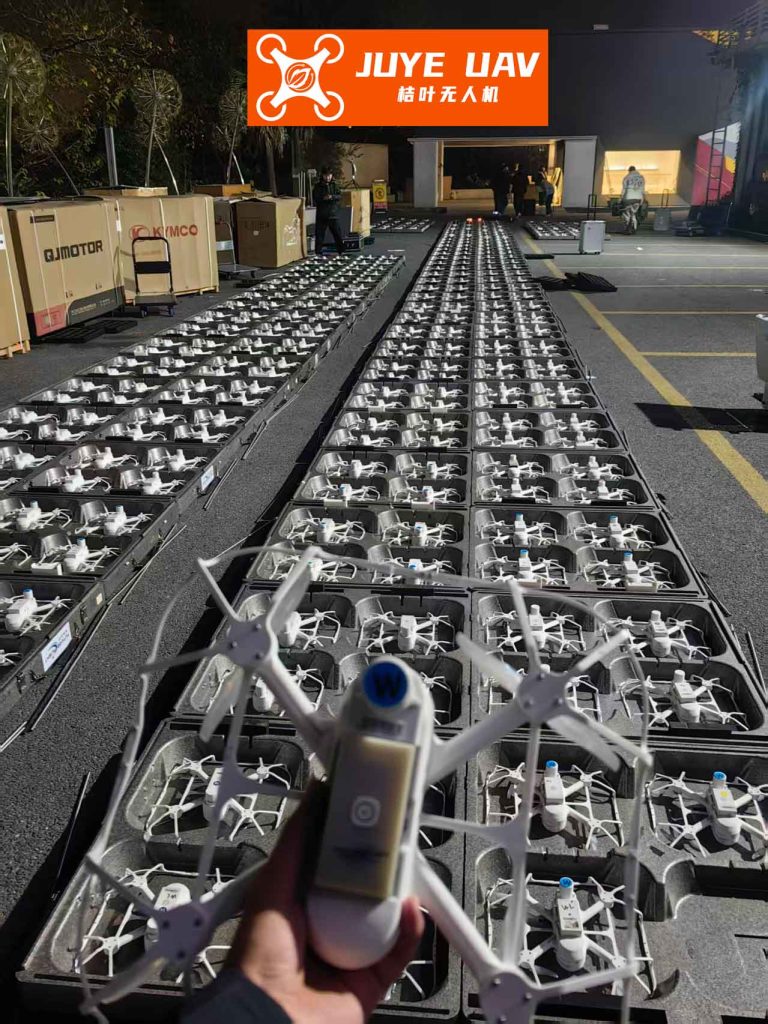
The real-world application of this is staggering, from creating animated logos in the night sky to simulating dynamic, story-driven aerial narratives, all enabled by a formation drone light show. The potential field provides the “why” to move, but it does not define the “how” of maintaining specific shapes. This is where the concept of dynamic constraints becomes paramount. To maintain a formation, we must enforce geometric relationships between the drones. These relationships can be described by a set of constraint equations. For a formation of $n$ drones, we can define a constraint vector $\mathbf{C}(\mathbf{q}, t) = 0$, where $\mathbf{q} = [x_1, y_1, z_1, …, x_n, y_n, z_n]^T$ is the collective state vector. For a rigid triangular formation, as might be seen in a segment of a larger formation drone light show, the constraints between drones A, B, and C could be:
$$
\mathbf{C}(\mathbf{q}, t) =
\begin{bmatrix}
(x_A – x_B)^2 + (y_A – y_B)^2 + (z_A – z_B)^2 – d_{AB}^2(t) \\
(x_B – x_C)^2 + (y_B – y_C)^2 + (z_B – z_C)^2 – d_{BC}^2(t) \\
(x_C – x_A)^2 + (y_C – y_A)^2 + (z_C – z_A)^2 – d_{CA}^2(t)
\end{bmatrix} = \mathbf{0}
$$
The critical insight is that for reconfiguration, the desired distances $d_{ij}(t)$ are not constants but functions of time. By strategically varying these functions, we can dictate the morphing of the formation from one shape (e.g., a line) to another (e.g., a triangle). This transforms the problem from static formation-keeping to dynamic formation-tracking.
To incorporate these constraints into the physics of the system, we model the swarm as a constrained dynamical system. The equation of motion for the unconstrained system under the influence of our virtual forces would be:
$$ \mathbf{M}\ddot{\mathbf{q}} = \mathbf{F}_{total} – K_p \dot{\mathbf{q}} $$
where $\mathbf{M} = \text{diag}\{M_1, M_2, …, M_{3n}\}$ is a diagonal matrix of inertial coefficients, and $-K_p \dot{\mathbf{q}}$ is a damping term. To enforce the constraints $\mathbf{C}(\mathbf{q},t)=\mathbf{0}$, we introduce Lagrange multipliers $\boldsymbol{\lambda}$, leading to the constrained dynamics equation:
$$ \mathbf{M}\ddot{\mathbf{q}} = \mathbf{F}_{total} – K_p \dot{\mathbf{q}} + \mathbf{J}^T(\mathbf{q})\boldsymbol{\lambda} $$
Here, $\mathbf{J}(\mathbf{q}) = \partial \mathbf{C} / \partial \mathbf{q}$ is the Jacobian matrix of the constraints. The term $\mathbf{J}^T\boldsymbol{\lambda}$ represents the generalized forces that ensure the constraints are satisfied. Directly solving for $\boldsymbol{\lambda}$ can be complex. A more practical approach, which I favor, is the penalty method. This method approximates the rigid constraints as very stiff (and damped) virtual springs connecting the drones. In this analogy, the Lagrange multiplier is approximated by:
$$ \boldsymbol{\lambda} \approx K_S \, \mathbf{C}(\mathbf{q}, t) + K_D \, \dot{\mathbf{C}}(\mathbf{q}, t) $$
where $K_S$ and $K_D$ are matrices of spring and damping constants, respectively. The term $\dot{\mathbf{C}}$ is the time derivative of the constraint, ensuring critical damping to prevent oscillations. Substituting this back into the dynamics gives us a solvable ordinary differential equation:
$$
\begin{bmatrix} \dot{\mathbf{q}} \\ \ddot{\mathbf{q}} \end{bmatrix} =
\begin{bmatrix}
\mathbf{0} & \mathbf{I} \\
\mathbf{0} & -\mathbf{M}^{-1}K_p
\end{bmatrix}
\begin{bmatrix} \mathbf{q} \\ \dot{\mathbf{q}} \end{bmatrix} +
\begin{bmatrix} \mathbf{0} \\ \mathbf{M}^{-1} \end{bmatrix} \mathbf{F}_{total} +
\begin{bmatrix} \mathbf{0} \\ -\mathbf{M}^{-1} \mathbf{J}^T(\mathbf{q}) \big( K_S \mathbf{C} + K_D \dot{\mathbf{C}} \big) \end{bmatrix}
$$
This formulation is powerful. The $\mathbf{F}_{total}$ term drives the entire formation towards its goal, while the penalty term $-\mathbf{J}^T (K_S \mathbf{C} + K_D \dot{\mathbf{C}})$ acts as a distributed controller that continuously corrects the relative positions of drones to satisfy the time-varying constraints $\mathbf{C}(\mathbf{q},t)$. This is the mathematical engine that enables a breathtaking, fluid formation drone light show to transform from a soaring eagle into a swirling galaxy.
To validate the performance of this methodology, we can establish two key metrics. First, the formation stability during and after transformation can be measured by the root mean square error (RMSE) of inter-agent distances relative to their desired values:
$$ \Delta_{RMSE} = \sqrt{ \frac{1}{N_c} \sum_{k=1}^{N_c} \left( d_k^{actual} – d_k^{desired}(t) \right)^2 } $$
where $N_c$ is the number of constrained distances. Second, the agility of the system is quantified by the reconfiguration response time $T_{resp}$, defined as the time elapsed between the initiation of a shape-change command and the moment the formation error falls and remains below a specified tolerance. A successful formation drone light show algorithm must minimize both $\Delta_{RMSE}$ and $T_{resp}$.
Let’s consider detailed simulation scenarios. In a basic case, a three-drone formation starts in a scattered pattern and is commanded to first form a line and then transform into an equilateral triangle while moving towards a target. The dynamic constraints for the line-to-triangle phase can be designed using sinusoidal functions to smoothly interpolate the desired distances. The simulation parameters might be as follows:
| Parameter | Symbol | Value |
|---|---|---|
| Spring Constant | $K_S$ | 100 |
| Damping Constant | $K_D$ | 10 |
| Attractive Gain | $\epsilon_{\mathbf{q}}$ | 5 |
| Velocity Alignment Gain | $K_p$ | 2 |
| Mass Coefficient | $\mathbf{M}$ | $\mathbf{I}$ (Identity) |
The results from such a simulation would show the drones quickly assembling into a line (e.g., within 0.5 seconds) and then fluidly transitioning to a triangle. The inter-drone distance plots would converge smoothly to the new setpoints, with a low steady-state $\Delta_{RMSE}$, demonstrating stable maintenance. The response time $T_{resp}$ for the triangle formation would be remarkably short, often under 0.5 seconds, highlighting the system’s reactivity.
The true test of scalability comes with larger swarms. Consider a formation drone light show element consisting of six drones forming a hexagon. A reconfiguration command might break specific edges of the hexagon to transform it into two separate triangles or a long chain. This is achieved by dynamically deactivating certain constraints in the $\mathbf{C}(\mathbf{q},t)$ vector—effectively “releasing” the virtual springs between specific drone pairs—while activating or modifying others. For a six-drone reconfiguration, the parameter stiffness typically needs to be increased to manage the more complex interactions:
| Parameter | Symbol | Value (6-Drone Case) |
|---|---|---|
| Spring Constant | $K_S$ | 1000 |
| Damping Constant | $K_D$ | 100 |
| Attractive Gain | $\epsilon_{\mathbf{q}}$ | 5 |
Even in this extended scenario, the simulation would show cohesive and collision-free transformation. The response time $T_{resp}$ will understandably be longer for more complex transformations—perhaps 2-3 seconds—but the formation integrity, as measured by $\Delta_{RMSE}$ for the active constraints, remains stable throughout. This proves the method’s robustness and suitability for choreographing intricate sequences in a grand-scale formation drone light show.
In conclusion, the fusion of an enhanced artificial potential field with a dynamic constraint-based control strategy, solved via the penalty method, presents a highly effective framework for UAV formation reconfiguration. This approach decouples the global navigation objective (handled by the potential field) from the precise shape-control task (handled by the constraints), yielding a system that is both responsive and stable. It allows for the on-the-fly redefinition of formation geometry through simple updates to the constraint functions $d_{ij}(t)$. The mathematical rigor ensures predictable behavior, while the computational efficiency of the ODE solution facilitates real-time implementation. This methodology directly addresses the core requirements of modern applications, from adaptive military reconnaissance patterns to the dazzling, ever-changing narratives of a world-class formation drone light show. The future of swarm robotics lies in such flexible and reliable control paradigms, enabling increasingly ambitious and coordinated aerial displays and missions.