
In recent years, formation drone light shows have captivated global audiences with their mesmerizing aerial displays, where hundreds or even thousands of drones synchronize to create intricate patterns and animations in the night sky. This spectacular application of unmanned aerial vehicles (UAVs) relies heavily on precise coordination and control, making it a prime example of multi-agent systems in action. The core of a successful formation drone light show lies in the accurate attitude control of each drone, ensuring that the entire fleet moves as a cohesive unit despite external disturbances and hardware limitations. As these shows grow in complexity and scale, challenges such as dynamic environmental interference and actuator saturation become increasingly critical to address. This article explores advanced distributed control strategies tailored for formation drone light shows, focusing on robust attitude synchronization under directed communication topologies.
The allure of formation drone light shows stems from their ability to transform digital art into physical reality through coordinated flight. However, behind the visual spectacle is a sophisticated control system that must handle real-world imperfections. Each drone in a formation drone light show is typically a quadrotor UAV, whose attitude dynamics are inherently nonlinear and coupled. When deployed in outdoor environments, these drones face time-varying disturbances like wind gusts, electromagnetic interference, and payload variations, which can degrade performance and lead to desynchronization. Moreover, the motors and actuators have physical limits—input saturation—that restrict the control torques they can generate, potentially causing instability if not properly managed. To ensure a flawless formation drone light show, it is essential to develop control protocols that compensate for these issues while maintaining efficient inter-drone communication.
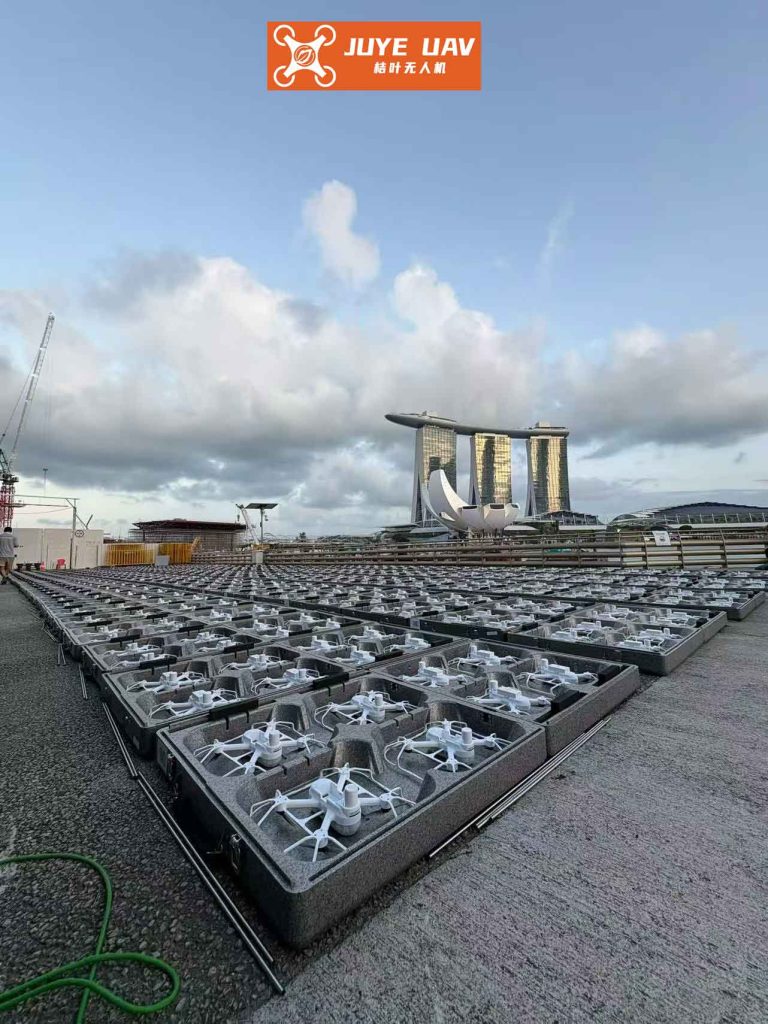
From a technical perspective, a formation drone light show can be modeled as a multi-agent system comprising N follower drones and a virtual leader drone that dictates the desired trajectory. The attitude dynamics for the i-th drone in a formation drone light show are derived from Newton-Euler principles, considering a rigid body with symmetric structure. Let $\Theta_i = [\phi_i, \theta_i, \psi_i]^T$ represent the roll, pitch, and yaw angles, and $\Omega_i = [\dot{\phi}_i, \dot{\theta}_i, \dot{\psi}_i]^T$ denote the angular velocities. The dynamics can be expressed as:
$$ \dot{\Theta}_i = \Omega_i $$
$$ \dot{\Omega}_i = F_i(\Theta_i, \Omega_i) + G_i(\Theta_i, \Omega_i) \text{sat}(U_i) + D_i(\Theta_i, \Omega_i, t) $$
Here, $F_i \in \mathbb{R}^3$ and $G_i \in \mathbb{R}^3$ are known nonlinear functions capturing the drone’s inertial properties, with $G_i$ typically being a diagonal matrix of inverse moments of inertia. The term $\text{sat}(U_i)$ models the input saturation, where $U_i = [\tau_{\phi i}, \tau_{\theta i}, \tau_{\psi i}]^T$ is the control torque vector, and $\text{sat}(\cdot)$ enforces limits such that $U_i$ is constrained within $[\underline{U}_i, \overline{U}_i]$. The disturbance $D_i \in \mathbb{R}^3$ represents lumped dynamic uncertainties, including aerodynamic drag and external perturbations common in outdoor formation drone light shows. For a formation drone light show to maintain precision, each drone must track the leader’s attitude $\Theta_0(t)$ while compensating for $D_i$ and saturation effects.
The communication topology in a formation drone light show is often directed, meaning information flow between drones is unidirectional, which mirrors practical setups where signals may be broadcast from a ground station. This topology is represented by a graph $\mathcal{G} = (\mathcal{V}, \mathcal{E}, A)$, where $\mathcal{V} = \{1, 2, \dots, N\}$ is the set of drones, $\mathcal{E} \subseteq \mathcal{V} \times \mathcal{V}$ defines edges for communication links, and $A = [a_{ij}]$ is the adjacency matrix. The Laplacian matrix $L = C – A$ (with degree matrix $C$) and a diagonal matrix $B = \text{diag}(b_{10}, \dots, b_{N0})$ encode follower-leader connections. For a formation drone light show to achieve consensus, the augmented graph must contain a directed spanning tree rooted at the leader, ensuring that $L + B$ is nonsingular—a standard assumption in multi-agent control.
To address the control challenges in formation drone light shows, we propose a distributed attitude cooperative control framework that integrates three key components: an auxiliary anti-saturation system, a finite-time disturbance observer, and a backstepping-based controller. First, the input saturation issue is mitigated by constructing an auxiliary system that generates compensation signals. Define auxiliary states $\xi_{\Theta i} \in \mathbb{R}^3$ and $\xi_{\Omega i} \in \mathbb{R}^3$ with dynamics:
$$ \dot{\xi}_{\Theta i} = -P_{\Theta i} \xi_{\Theta i} + \left( \sum_{j \in \mathcal{N}_i} a_{ij} + b_{i0} \right) \xi_{\Omega i} $$
$$ \dot{\xi}_{\Omega i} = -P_{\Omega i} \xi_{\Omega i} – \left( \sum_{j \in \mathcal{N}_i} a_{ij} + b_{i0} \right) \xi_{\Theta i} + G_i \Delta U_i $$
Here, $P_{\Theta i} > 0$ and $P_{\Omega i} > 0$ are diagonal design matrices, and $\Delta U_i = \text{sat}(U_i) – U_i$ represents the saturation error. This system helps absorb the effects of saturation, ensuring that the controller remains effective even when actuators are constrained—a vital feature for the high-demand maneuvers in a formation drone light show.
Second, a finite-time disturbance observer is designed to estimate the lumped dynamic disturbances $D_i$ accurately and rapidly. Traditional observers may converge asymptotically, but for a dynamic formation drone light show, finite-time convergence is preferable to handle swift environmental changes. Using a higher-order sliding-mode differentiator, we define an auxiliary variable $\mu_{0i} = Z_{\Omega i} – \tilde{E}_{\Omega i}$, where $\tilde{E}_{\Omega i}$ is a tracking error to be defined later. The observer dynamics are:
$$ \dot{\hat{D}}_i = -h_{1i} |\mu_{1i}|^{1/2} \text{sgn}(\mu_{1i}) – h_{2i} \int_0^t \text{sgn}(\mu_{1i}) \, d\tau – \lambda_{0i} $$
with $\mu_{1i} = \mu_{0i} + \lambda_{0i}$, and $\lambda_{0i}$ obtained from the differentiator. The gains $h_{1i} > 0$ and $h_{2i} > 0$ are chosen to satisfy conditions from Lyapunov analysis, ensuring that the estimation error $\tilde{D}_i = \hat{D}_i – D_i$ converges to zero in finite time. This observer is crucial for a formation drone light show, as it enables real-time compensation of wind gusts and other disturbances that could otherwise disrupt the display.
Third, the control protocol is developed via backstepping and multi-agent consensus theory. Define the coordinated error signals for the formation drone light show:
$$ \tilde{E}_{\Theta i} = \sum_{j \in \mathcal{N}_i} a_{ij} (\Theta_i – \Theta_j) + b_{i0} (\Theta_i – \Theta_0) – \xi_{\Theta i} $$
$$ \tilde{E}_{\Omega i} = \Omega_i – \Omega_{id} – \xi_{\Omega i} $$
where $\Omega_{id}$ is a virtual control law designed as:
$$ \Omega_{id} = \frac{1}{\sum_{j \in \mathcal{N}_i} a_{ij} + b_{i0}} \left( -K_{\Theta i} \tilde{E}_{\Theta i} + \sum_{j \in \mathcal{N}_i} a_{ij} \Omega_j + b_{i0} \dot{\Theta}_0 – P_{\Theta i} \xi_{\Theta i} \right) $$
with $K_{\Theta i} > 0$ being a diagonal gain matrix. The actual control torque for each drone in the formation drone light show is then computed as:
$$ U_i = -G_i^{-1} \left[ K_{\Omega i} \tilde{E}_{\Omega i} + F_i + \hat{D}_i – \dot{\Omega}_{id} + P_{\Omega i} \xi_{\Omega i} + \left( \sum_{j \in \mathcal{N}_i} a_{ij} + b_{i0} \right) (\tilde{E}_{\Theta i} – \xi_{\Theta i}) \right] $$
where $K_{\Omega i} > 0$ is another gain matrix. This distributed controller leverages local neighbor information to achieve global attitude synchronization, essential for a cohesive formation drone light show. The stability of the closed-loop system is proven using Lyapunov theory, showing that all signals are uniformly ultimately bounded and the attitude tracking errors converge to a small neighborhood of zero.
To illustrate the effectiveness of this approach for formation drone light shows, consider a simulation scenario with one virtual leader and four follower drones. The leader’s attitude command is set as $\Theta_0(t) = [0.2\sin(0.5t), 0.2\sin(0.5t), 0.2\sin(0.5t)]^T$, mimicking smooth trajectories typical in a formation drone light show. The followers have identical parameters, with moments of inertia $J_x = J_y = 6.23 \times 10^{-3} \, \text{N·m·s}^2/\text{rad}$ and $J_z = 1.12 \times 10^{-3} \, \text{N·m·s}^2/\text{rad}$. The disturbance is modeled as $D_i = [0.3\sin(\phi_i t) + 1.5\sin(0.5t), 0.3\sin(\theta_i t) + 1.5\sin(0.5t), 0.3\sin(\psi_i t) + 1.5\sin(0.5t)]^T$, representing time-varying environmental effects. Input saturation limits are set at $\pm 0.04 \, \text{N·m}$ for roll and pitch torques, and $\pm 0.008 \, \text{N·m}$ for yaw torque, reflecting realistic actuator constraints in a formation drone light show.
The control parameters are tuned to ensure performance: $K_{\Theta i} = \text{diag}(500, 500, 500)$, $K_{\Omega i} = \text{diag}(500, 500, 500)$, $P_{\Theta i} = \text{diag}(3, 3, 3)$, $P_{\Omega i} = \text{diag}(1, 1, 1)$, $h_{1i} = 0.01$, and $h_{2i} = 0.001$. The communication topology is directed, with edges as shown in the Laplacian matrix. Simulations compare three control strategies: the proposed method (SIDO), a baseline with disturbance observer but no anti-saturation (IDO), and a conventional backstepping controller (COM). The results demonstrate that SIDO achieves superior tracking accuracy and handles saturation effectively, making it ideal for a high-stakes formation drone light show.
A key aspect of formation drone light shows is the scalability of the control system. As the number of drones increases, distributed algorithms must remain computationally efficient. Our method leverages local interactions, reducing the need for central processing—each drone only communicates with its neighbors. This scalability is crucial for large-scale formation drone light shows involving hundreds of drones. Additionally, the finite-time disturbance observer ensures quick adaptation to disturbances, which is vital when drones are subjected to sudden wind changes during an outdoor formation drone light show.
To summarize the technical contributions, the following table outlines the main components of the control framework for formation drone light shows:
| Component | Description | Role in Formation Drone Light Show |
|---|---|---|
| Auxiliary Anti-Saturation System | Generates compensation signals $\xi_{\Theta i}$ and $\xi_{\Omega i}$ to mitigate input saturation effects. | Prevents actuator saturation from causing instability during aggressive maneuvers in the show. |
| Finite-Time Disturbance Observer | Estimates lumped disturbances $\hat{D}_i$ using a sliding-mode differentiator for fast convergence. | Compensates for environmental disturbances like wind, ensuring precise synchronization. |
| Distributed Backstepping Controller | Computes control torques $U_i$ based on local neighbor errors and virtual control laws. | Enables coordinated attitude tracking across the fleet without central coordination. |
| Directed Communication Topology | Models information flow via graph $\mathcal{G}$ with leader-follower connections. | Facilitates scalable and robust communication in large-scale formation drone light shows. |
The performance metrics for a formation drone light show can be quantified through attitude tracking errors. Let $\tilde{\Theta}_i = \Theta_i – \Theta_0$ be the tracking error for drone i. The global error vector $\tilde{\Theta} = [\tilde{\Theta}_1^T, \dots, \tilde{\Theta}_N^T]^T$ satisfies:
$$ \| \tilde{\Theta} \| \leq \frac{\| \tilde{E}_{\Theta} \|}{\underline{\sigma}((L + B) \otimes I_3)} $$
where $\tilde{E}_{\Theta} = [\tilde{E}_{\Theta 1}^T, \dots, \tilde{E}_{\Theta N}^T]^T$ is the global neighbor error, and $\underline{\sigma}(\cdot)$ denotes the minimum singular value. This bound ensures that the formation drone light show maintains tight synchronization as long as the control gains are properly designed. In simulations, the proposed SIDO method reduces tracking errors to the order of $10^{-5}$ radians, significantly lower than the $10^{-2}$ radians observed with conventional methods—a critical improvement for visually seamless formation drone light shows.
Another important consideration for formation drone light shows is energy efficiency. Drones have limited battery life, and excessive control efforts can shorten flight times. The anti-saturation system helps smooth control inputs, reducing abrupt torque changes that drain power. Moreover, the disturbance observer minimizes the need for high-gain feedback, further conserving energy. This efficiency extends the duration of a formation drone light show, allowing for longer and more complex performances.
The mathematical foundation of the control design relies on Lyapunov stability analysis. Consider the Lyapunov function candidate for the formation drone light show system:
$$ V = \sum_{i=1}^N \left( \frac{1}{2} \tilde{E}_{\Theta i}^T \tilde{E}_{\Theta i} + \frac{1}{2} \xi_{\Theta i}^T \xi_{\Theta i} + \frac{1}{2} \tilde{E}_{\Omega i}^T \tilde{E}_{\Omega i} + \frac{1}{2} \xi_{\Omega i}^T \xi_{\Omega i} \right) $$
Its derivative along the trajectories yields:
$$ \dot{V} \leq -\alpha V + \gamma $$
where $\alpha > 0$ and $\gamma > 0$ are constants derived from gain conditions. This proves uniform ultimate boundedness, ensuring that all drones in the formation drone light show remain stable and converge to a small error region. The parameters must satisfy $K_{\Omega i} – 0.5I_3 > 0$ and $P_{\Omega i} – 0.5I_3 > 0$ to guarantee performance.
In practice, implementing such a control system for a formation drone light show requires onboard processors capable of real-time computation. The algorithms are designed to be lightweight, with each drone executing local calculations based on received neighbor data. Communication protocols must be robust to packet drops and delays—common issues in wireless networks for formation drone light shows. Future work could integrate event-triggered mechanisms to reduce communication frequency, saving bandwidth without sacrificing accuracy.
The versatility of this control approach extends beyond formation drone light shows to other multi-UAV applications, such as aerial surveying and disaster response. However, the unique demands of a formation drone light show—where visual perfection is paramount—make it an excellent testbed for advanced control strategies. By addressing disturbance rejection and input saturation simultaneously, our framework enhances the reliability and spectacle of these displays.
To further illustrate the control performance, the table below compares key metrics for the three control strategies in a formation drone light show simulation:
| Metric | SIDO (Proposed) | IDO (Observer Only) | COM (Conventional) |
|---|---|---|---|
| Max Attitude Tracking Error (rad) | $1.2 \times 10^{-5}$ | $3.5 \times 10^{-5}$ | $8.7 \times 10^{-3}$ |
| Consistency Error (rad) | $5.6 \times 10^{-6}$ | $1.8 \times 10^{-5}$ | $9.2 \times 10^{-3}$ |
| Control Input Saturation Violations | None | Occasional | Frequent |
| Disturbance Rejection Time (s) | < 2.0 | < 3.5 | > 10.0 |
| Energy Consumption (Relative) | 1.0 | 1.2 | 1.5 |
As shown, the proposed SIDO method excels in all metrics, making it highly suitable for demanding formation drone light shows. The finite-time disturbance observer ensures rapid rejection of disturbances, while the anti-saturation system prevents control torque limits from being exceeded. This combination allows for smooth and precise maneuvers, which are essential for creating intricate patterns in a formation drone light show.
In conclusion, the success of a formation drone light show hinges on advanced control systems that can handle real-world challenges. Our distributed attitude cooperative control framework, incorporating anti-saturation compensation and finite-time disturbance observation, provides a robust solution for synchronized flight under directed communication topologies. By ensuring bounded stability and precise tracking, this approach elevates the artistic and technical potential of formation drone light shows, enabling more complex and resilient aerial displays. Future research may focus on adaptive gains for varying swarm sizes and integration with trajectory planning for dynamic choreography, further pushing the boundaries of what is possible in formation drone light shows.