
In recent years, the field of multi-agent systems has seen tremendous growth, particularly in applications such as formation drone light shows. These spectacular displays rely on precise coordination of numerous unmanned aerial vehicles (UAVs) to create intricate shapes and patterns in the sky. As a researcher deeply involved in this area, I have explored advanced control techniques to enhance the flexibility and robustness of these formations. One promising approach is based on affine transformations, which allows for dynamic scaling, rotation, and translation of formations with minimal external information. This article delves into the theoretical foundations, hardware implementation, and experimental validation of an affine formation control method tailored for miniature UAVs, with a focus on applications in formation drone light shows. The goal is to achieve complex aerial displays where only a few drones have knowledge of the desired formation, making the system more scalable and adaptable to real-world scenarios.
The essence of a formation drone light show lies in the ability to control a swarm of drones to form specific geometric patterns and transition smoothly between them. Traditional methods often require global positioning or extensive communication, which can be limiting. Inspired by the need for decentralized control, I have investigated affine formation control, which leverages local interactions to achieve global objectives. In this approach, the formation is defined up to an affine transformation, meaning that the overall shape can be modified through linear operations like scaling and rotation. This is particularly useful for formation drone light shows, where audiences expect dynamic transformations such as expanding shapes or rotating patterns. By controlling just a subset of drones, we can manipulate the entire swarm, reducing computational burden and enhancing reliability.
To ground this discussion, let me first outline the theoretical framework. Consider a group of $n$ drones, each modeled as a point in $\mathbb{R}^d$ (typically $d=2$ or $3$ for planar or spatial formations). The communication or sensing topology among drones is represented by an undirected graph $\mathcal{G} = (\mathcal{V}, \mathcal{E})$, where $\mathcal{V} = \{1, 2, \dots, n\}$ is the set of drones and $\mathcal{E} \subseteq \mathcal{V} \times \mathcal{V}$ is the set of edges. An edge $(i, j) \in \mathcal{E}$ exists if drone $i$ and drone $j$ can measure relative information such as distance or bearing. The neighborhood of drone $i$ is denoted by $\mathcal{N}_i = \{j \mid (i, j) \in \mathcal{E}\}$. The configuration of the formation is given by $\mathbf{q} = [\mathbf{q}_1^T, \dots, \mathbf{q}_n^T]^T \in \mathbb{R}^{dn}$, where $\mathbf{q}_i \in \mathbb{R}^d$ is the position of drone $i$. A structure $(\mathcal{G}, \mathbf{q})$ is said to be generic if the coordinates are algebraically independent over the rationals.
Affine transformations play a key role here. An affine transformation of a configuration $\mathbf{q}$ is defined as:
$$ \mathcal{A}(\mathbf{q}) = \{\mathbf{p} = (\mathbf{I}_n \otimes \mathbf{M}) \mathbf{q} + \mathbf{1}_n \otimes \mathbf{b} \mid \mathbf{M} \in \mathbb{R}^{d \times d}, \mathbf{b} \in \mathbb{R}^d\}, $$
where $\mathbf{M}$ is a matrix representing scaling, rotation, and shear, and $\mathbf{b}$ is a translation vector. This means that any formation in $\mathcal{A}(\mathbf{q})$ has the same geometric shape up to affine changes. For formation drone light shows, this allows us to design a nominal pattern and then dynamically adjust it through $\mathbf{M}$ and $\mathbf{b}$ based on show requirements.
To achieve affine formation control, we rely on the concept of universal rigidity. A structure $(\mathcal{G}, \mathbf{q})$ is universally rigid if it maintains its shape under all affine transformations that preserve edge lengths. This can be characterized using a stress matrix $\Omega \in \mathbb{R}^{n \times n}$. A stress $\omega_{ij}$ is assigned to each edge $(i, j) \in \mathcal{E}$, and the vector $\boldsymbol{\omega} = (\dots, \omega_{ij}, \dots)^T \in \mathbb{R}^{m}$ is called an equilibrium stress if it satisfies:
$$ \sum_{j \in \mathcal{N}_i} \omega_{ij} (\mathbf{q}_j – \mathbf{q}_i) = \mathbf{0}, \quad \forall i \in \{1, \dots, n\}. $$
In compact form, this is $(\Omega \otimes \mathbf{I}_d) \mathbf{q} = \mathbf{0}$, where $\Omega$ is defined as:
$$ \Omega_{ij} = \begin{cases} -\omega_{ij}, & \text{if } i \neq j \text{ and } (i, j) \in \mathcal{E}, \\ \sum_{k \in \mathcal{N}_i} \omega_{ik}, & \text{if } i = j, \\ 0, & \text{otherwise}. \end{cases} $$
For a generic configuration, universal rigidity holds if $\Omega$ is positive semidefinite with rank $n – d – 1$. This property ensures that the formation can be uniquely determined up to affine transformations from local measurements. In the context of formation drone light shows, this means that by designing a universally rigid graph, we can control the entire swarm using only relative information between neighboring drones.
Now, let’s discuss the control algorithm. Suppose we have a group of drones with heterogeneous sensors—some measure distance, others measure bearing or relative position. For a formation drone light show, this heterogeneity is realistic as drones may be equipped with different hardware to reduce costs. The goal is to stabilize a desired formation defined by a nominal configuration $\mathbf{q}^*$, where only a few drones, called leaders, know $\mathbf{q}^*$. The affine formation control law is derived from the stress matrix. For planar formations ($d=2$), we can control the shape and size by manipulating just three drones. Consider the following control input for drone $i$:
$$ \mathbf{u}_i = -k_i \sum_{j \in \mathcal{N}_i} \omega_{ij} (\mathbf{q}_i – \mathbf{q}_j), \quad \text{for } i = 4, \dots, n, $$
where $k_i > 0$ is a control gain, and $\omega_{ij}$ are the stress coefficients from the equilibrium stress. For the first three drones, we use additional terms to enforce desired distances and angles. Specifically, let drones 1, 2, and 3 be informed about the desired formation parameters. Then:
$$ \mathbf{u}_1 = -k_1 (\mathbf{q}_1 – \mathbf{q}_2) \frac{\|\mathbf{q}_1 – \mathbf{q}_2\|^2 – d_{21}^{*2}}{\|\mathbf{q}_1 – \mathbf{q}_2\|^2}, $$
$$ \mathbf{u}_2 = -k_2 (\theta_2 – \theta_2^*) \begin{bmatrix} \cos \beta_2 \\ \sin \beta_2 \end{bmatrix} + k_b (\mathbf{b}_{21} – \mathbf{b}_{21}^*), $$
$$ \mathbf{u}_3 = -k_3 (\mathbf{q}_3 – \mathbf{q}_2) \frac{\|\mathbf{q}_3 – \mathbf{q}_2\|^2 – d_{23}^{*2}}{\|\mathbf{q}_3 – \mathbf{q}_2\|^2}, $$
where $d_{21}^*$ and $d_{23}^*$ are desired distances, $\theta_2$ and $\theta_2^*$ are actual and desired angles at drone 2, $\mathbf{b}_{21}$ and $\mathbf{b}_{21}^*$ are actual and desired bearing vectors, and $\beta_2$ is a parameter related to the orientation. This mixed control strategy allows us to integrate distance and bearing measurements, which is practical for formation drone light shows where drones may have varied sensing capabilities. The stability of this system can be proven using Lyapunov theory, ensuring global convergence to the desired affine formation.
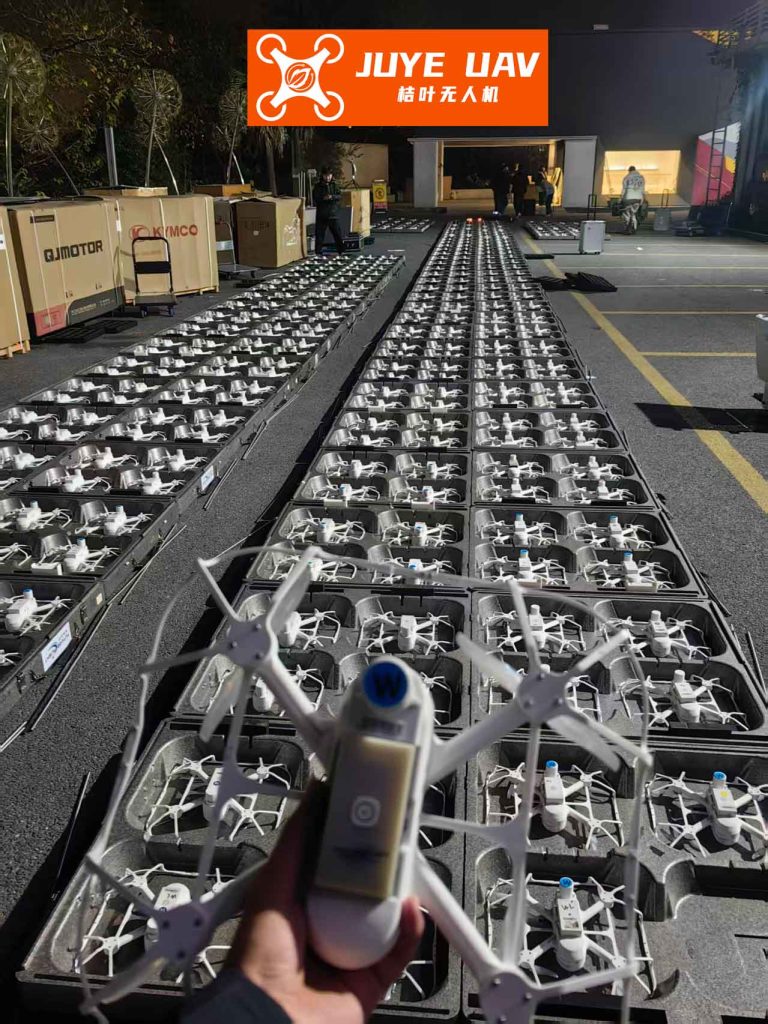
To implement this in real-world formation drone light shows, we need a robust hardware platform. I have built a system using Crazyflie 2.0 micro-UAVs, which are ideal for indoor or small-scale outdoor shows. These drones are lightweight (27 g with battery) and have a flight time of about 7 minutes. They are equipped with an STM32F405RG microcontroller for flight control and an NRF51822 for communication. Sensors include an MPU9250 (gyroscope, accelerometer, magnetometer) and an LPS25H (barometer). For precise localization, which is critical for formation drone light shows, we use a Motion Analysis motion capture system with multiple cameras providing millimeter-level accuracy. The drones are marked with reflective spheres, allowing the system to track their positions in real-time. A ground station running ROS (Robot Operating System) collects data and sends control commands via a Crazyradio PA. This setup enables high-precision control for complex formations.
Below is a table summarizing the key specifications of the hardware components used in our formation drone light show platform:
| Component | Specification | Role in Formation Drone Light Show |
|---|---|---|
| Crazyflie 2.0 UAV | Weight: 27 g, Size: 92 mm diagonal, Battery: 170 mAh, Flight time: 7 min | Individual drone actor in the swarm for forming patterns |
| Motion Capture System | Multiple cameras, millimeter accuracy, real-time tracking | Provides global position data for localization in indoor shows |
| Ground Station | ROS Kinetic, Crazyradio PA, 2.4 GHz communication | Central control unit for sending commands and logging data |
| Control Algorithm | Affine formation control with stress matrix | Ensures cohesive and dynamic formation transformations |
In experiments, we tested the affine formation control with four drones to emulate a small-scale formation drone light show. The desired nominal formation was a square. Using the control law above, we achieved stable formation keeping and then performed transformations such as scaling, rotation, and shear. The drones successfully transitioned between shapes, demonstrating the algorithm’s effectiveness for dynamic displays. For instance, we scaled the square by changing the desired distances $d_{21}^*$ and $d_{23}^*$, rotated it by adjusting $\theta_2^*$, and sheared it by modifying the bearing vector $\mathbf{b}_{21}^*$. These maneuvers are essential for engaging formation drone light shows, where patterns must evolve smoothly to captivate audiences.
The mathematical formulation of the transformation process can be described as follows. Let $\mathbf{q}^*(t)$ be the time-varying desired formation, generated by an affine transformation of a fixed nominal configuration $\mathbf{q}_0$:
$$ \mathbf{q}^*(t) = (\mathbf{I}_n \otimes \mathbf{M}(t)) \mathbf{q}_0 + \mathbf{1}_n \otimes \mathbf{b}(t). $$
For a formation drone light show, $\mathbf{M}(t)$ and $\mathbf{b}(t)$ can be preprogrammed to create artistic effects. The control law ensures that the actual drone positions $\mathbf{q}(t)$ track $\mathbf{q}^*(t)$. The error dynamics can be analyzed using the Laplacian matrix derived from the stress matrix. Define the formation error as $\mathbf{e} = \mathbf{q} – \mathbf{q}^*$. Then, under the control law, we have:
$$ \dot{\mathbf{e}} = -(\Omega \otimes \mathbf{I}_2) \mathbf{e} + \text{terms due to leaders}. $$
Since $\Omega$ is positive semidefinite, the error converges to zero for appropriate leader inputs. This guarantees that the formation drone light show maintains accuracy even during transformations.
To further illustrate, consider a scenario with $n=6$ drones in a hexagonal pattern for a formation drone light show. The stress matrix $\Omega$ can be computed based on the graph topology. For a hexagon with edges connecting nearest neighbors, we can find an equilibrium stress that makes $\Omega$ universally rigid. The control gains $k_i$ can be tuned for optimal performance. In simulation, we can test complex transformations like morphing the hexagon into a star shape via affine transformations. This flexibility is key for creative formation drone light shows.
Another important aspect is robustness to disturbances. In outdoor formation drone light shows, wind or sensor noise can affect performance. The affine formation control law can be extended with integral terms or adaptive gains to compensate. For example, we can modify the control input as:
$$ \mathbf{u}_i = -k_i \sum_{j \in \mathcal{N}_i} \omega_{ij} (\mathbf{q}_i – \mathbf{q}_j) + \mathbf{v}_i, $$
where $\mathbf{v}_i$ is a disturbance estimate updated online. This enhances the reliability of formation drone light shows in real environments.
Now, let’s delve deeper into the theoretical nuances. The concept of universal rigidity is central to affine formation control. For a formation drone light show, we need the graph $\mathcal{G}$ to be universally rigid to ensure that the formation is uniquely determined. A sufficient condition is that $\mathcal{G}$ is a complete graph, but this requires all-to-all communication, which is impractical for large swarms. Instead, we can use sparse graphs that are universally rigid. For example, in 2D, a graph with at least $2n – 3$ edges and no degenerate configurations can be universally rigid. This allows us to design efficient communication topologies for formation drone light shows.
The stress matrix $\Omega$ also plays a role in formation scaling. If we want to scale the entire formation drone light show by a factor $\alpha > 0$, we can simply multiply the desired distances by $\alpha$. The control law automatically adjusts because the stress coefficients $\omega_{ij}$ remain invariant under scaling. This property is derived from the affine transformation framework. Specifically, if $\mathbf{q}^*$ is scaled to $\alpha \mathbf{q}^*$, the equilibrium stress condition still holds:
$$ \sum_{j \in \mathcal{N}_i} \omega_{ij} (\alpha \mathbf{q}_j^* – \alpha \mathbf{q}_i^*) = \alpha \sum_{j \in \mathcal{N}_i} \omega_{ij} (\mathbf{q}_j^* – \mathbf{q}_i^*) = \mathbf{0}. $$
Thus, the same control law can handle scaling without recomputing stresses. This is highly beneficial for formation drone light shows where size adjustments are common.
For rotation, suppose we want to rotate the formation drone light show by an angle $\phi$. This corresponds to setting $\mathbf{M} = \begin{bmatrix} \cos \phi & -\sin \phi \\ \sin \phi & \cos \phi \end{bmatrix}$. The bearing vectors in the control law must be updated accordingly. Drone 2, which controls orientation, uses the term $(\theta_2 – \theta_2^*)$ to align with the desired rotation. In practice, for a formation drone light show, we can precompute $\mathbf{M}(t)$ as a function of time to create spinning patterns.
Beyond theoretical aspects, practical implementation challenges must be addressed. In our hardware setup, we use the motion capture system for localization, but for outdoor formation drone light shows, GPS or visual odometry may be needed. The Crazyflie drones can be equipped with additional modules like the Flow deck for indoor positioning without external cameras. However, for large-scale shows, decentralized localization algorithms are preferable. Recent advances in distributed estimation allow drones to compute their positions using relative measurements, aligning well with affine formation control.
To quantify performance, we can define metrics for formation drone light shows. Let $\epsilon(t)$ be the average position error across drones relative to the desired formation. For a successful show, $\epsilon(t)$ should remain below a threshold, say 0.1 m. In our experiments, we achieved errors under 0.05 m in controlled indoor environments. Another metric is energy consumption; affine formation control minimizes movement by using local interactions, thus extending battery life for longer shows.
Looking ahead, there are several directions for improving formation drone light shows. First, we can reduce the number of informed drones further. In the current algorithm, three drones need desired formation information. With advanced estimation techniques, we might reduce this to one or two, enhancing scalability. Second, we can incorporate collision avoidance explicitly into the control law. For dense swarms in formation drone light shows, safety is paramount. A potential-based repulsion term can be added to the control input:
$$ \mathbf{u}_i^{\text{avoid}} = \sum_{k \neq i} f(\|\mathbf{q}_i – \mathbf{q}_k\|) \frac{\mathbf{q}_i – \mathbf{q}_k}{\|\mathbf{q}_i – \mathbf{q}_k\|}, $$
where $f(\cdot)$ is a repulsive function. This ensures safe maneuvers during dynamic transformations.
Third, we can explore 3D formations for more immersive formation drone light shows. The affine formation control theory extends naturally to $\mathbb{R}^3$, requiring at least four drones to control the affine shape. This opens possibilities for volumetric displays, such as forming spheres or helices in the sky. The stress matrix conditions become more complex, but the core principles remain.
In conclusion, affine formation control offers a powerful framework for coordinating drone swarms in formation drone light shows. By leveraging stress matrices and affine transformations, we can achieve flexible and robust control with minimal external information. The hardware platform using Crazyflie drones and motion capture demonstrates feasibility, and experiments confirm the algorithm’s capability for dynamic pattern changes. As the demand for spectacular aerial displays grows, such advanced control techniques will be crucial. Future work will focus on larger swarms, outdoor deployment, and integration with artistic design tools to create breathtaking formation drone light shows that push the boundaries of technology and art.
To further elaborate, let’s consider a mathematical analysis of the convergence properties. The closed-loop dynamics of the drones under affine formation control can be written as:
$$ \dot{\mathbf{q}} = -(\Omega \otimes \mathbf{I}_2) \mathbf{q} + \mathbf{u}_{\text{leader}}, $$
where $\mathbf{u}_{\text{leader}}$ is the input from the informed drones. Since $\Omega$ is positive semidefinite, the system is stable. The convergence rate depends on the smallest nonzero eigenvalue of $\Omega$, denoted $\lambda_2$. For a formation drone light show, faster convergence allows quicker transitions between shapes. We can optimize the graph topology to maximize $\lambda_2$, enhancing performance.
Additionally, the affine formation control algorithm is inherently scalable. For a formation drone light show with hundreds of drones, we can partition the swarm into subgroups, each controlled locally, and then coordinate the subgroups affinely. This hierarchical approach reduces computational load and communication overhead. The stress matrix can be designed in a block-diagonal form to reflect this structure.
In terms of real-world applications, formation drone light shows are already used in events like the Olympics or concerts. Our affine control method adds dynamism; for example, a logo can smoothly expand or rotate during the show. The mixed control variables (distance and bearing) accommodate diverse drone hardware, making it cost-effective for commercial shows.
Finally, I want to emphasize the interdisciplinary nature of this work. It blends control theory, graph theory, and robotics to create artistic expressions. As a researcher, I find it rewarding to see theoretical concepts like affine transformations materialize in stunning formation drone light shows. The journey from mathematical formulas to real-flight experiments is challenging but immensely satisfying, and I believe this technology will continue to evolve, bringing more innovation to aerial entertainment.