
As I delve into the realm of advanced educational technologies, I recognize that drone technology, as an emerging field integrating remote control, intelligent systems, communication networks, and artificial intelligence, has become a cornerstone for fostering low-altitude economic growth. Within this domain, formation drone light show capabilities, characterized by dynamic collaboration and autonomous decision-making, have emerged as a critical research focus. The integration of virtual-real fusion technology into teaching environments for drone formations presents unprecedented opportunities to enhance learning outcomes. In this article, I explore the construction and optimization of such environments, emphasizing the role of immersive simulations in improving practical skills and theoretical understanding. My discussion will extensively incorporate the concept of formation drone light show as a prime application, highlighting its relevance in educational contexts.
The advent of virtual-real fusion in the 21st century has revolutionized pedagogical approaches, particularly in technical fields like drone operations. By blending virtual reality and augmented reality, educators can create interactive, safe, and flexible learning spaces that transcend traditional limitations of time and space. In my view, this technology not only mitigates risks associated with physical drone training but also amplifies student engagement through realistic simulations. For instance, in a formation drone light show scenario, learners can experiment with complex flight patterns in a virtual setting, gaining hands-on experience without the costs or dangers of real-world trials. This approach aligns with modern educational paradigms that prioritize active, student-centered learning, moving away from passive lecture-based methods. As I analyze these advancements, I aim to demonstrate how virtual-real fusion can transform drone formation education into a more effective and captivating journey.
Virtual-real fusion technology refers to the seamless integration of digital virtual environments with physical reality, leveraging tools like computer graphics, VR, AR, and mixed reality to create enriched experiential platforms. From my perspective, its core components—real-time rendering, user interaction mechanisms, and data analytics—collectively foster a highly immersive learning ecosystem. In education, this addresses longstanding gaps in traditional teaching, where theoretical knowledge often outweighs practical application. By enabling learners to manipulate virtual objects and scenarios, virtual-real fusion encourages exploration and problem-solving, which is especially beneficial for mastering intricate topics like drone formations. When applied to formation drone light show training, for example, students can visualize and adjust flight paths in 3D space, receiving immediate feedback on their choices. This not only deepens comprehension of aerodynamic principles and control algorithms but also cultivates teamwork skills essential for coordinated displays. I believe that such technological infusion is pivotal for preparing the next generation of drone operators and innovators.
In building a teaching environment for drone formations, I emphasize the convergence of simulation software, hardware interfaces, and network infrastructures. A robust platform should incorporate VR headsets, motion sensors, and real-time data streams from IoT-enabled drones to mirror actual flight conditions. For a formation drone light show context, this might involve simulating night skies with lighting effects, where students program drones to execute synchronized maneuvers. The environment must support multi-drone coordination, allowing learners to practice swarm behaviors through virtual counterparts before transitioning to physical units. Key technical elements include 3D modeling engines for terrain and obstacle generation, communication protocols for drone-to-drone and drone-to-control system links, and machine learning modules for performance analytics. As I design such systems, I prioritize scalability and adaptability, ensuring they cater to diverse skill levels—from beginners learning basic formation shapes to advanced users optimizing complex light show choreographies. Below, I outline a framework for this construction process, detailing how each component interplays to create a cohesive learning experience.
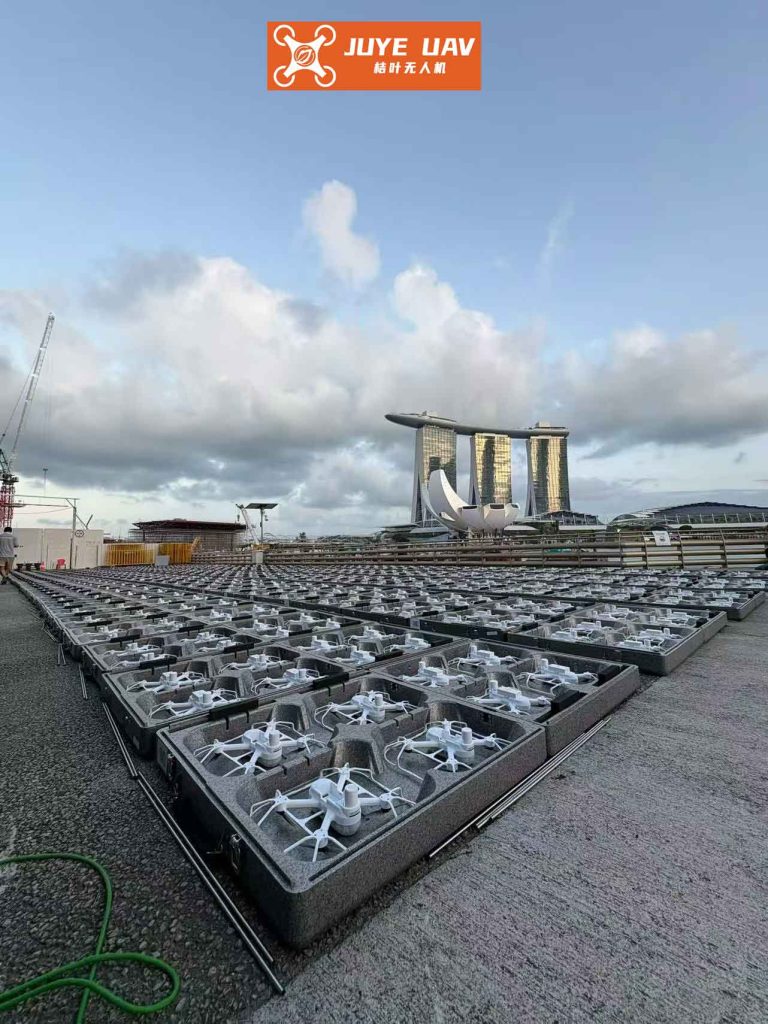
The visualization above exemplifies a typical formation drone light show setup, where drones are orchestrated to form luminous patterns in the sky. In a virtual-real fusion teaching environment, such imagery can be replicated digitally, enabling students to experiment with design and control parameters. I incorporate this visual reference to underscore the practical appeal of drone formations, which often serves as a motivational tool in educational settings. By interacting with simulated versions of these displays, learners gain insights into the technical challenges—such as maintaining formation integrity under wind disturbances or optimizing battery life for extended shows. This hands-on approach, blended with theoretical instruction, fosters a holistic understanding that pure textbook learning cannot achieve. As I proceed, I will discuss how optimization strategies can further refine this learning process, using data-driven methods to personalize training and enhance outcomes.
To optimize teaching strategies for drone formations, I first categorize them into traditional and modern approaches. Traditional methods, like lecture-based instruction, focus on delivering foundational knowledge about drone mechanics and formation theories. While valuable, they often lack interactivity, which can hinder skill retention. Modern strategies, in contrast, leverage virtual-real fusion to promote experiential learning. For a formation drone light show curriculum, this might involve scenario-based simulations where students troubleshoot common issues, such as signal interference or collision avoidance. I advocate for a hybrid model that blends both, ensuring learners grasp concepts before applying them in virtual labs. Optimization goals include boosting comprehension, increasing practice opportunities, fostering collaboration, and nurturing innovation. Below, I present a table summarizing key elements in constructing and optimizing such environments, with a focus on formation drone light show applications.
| Key Element | Design Principle | Implementation Technology | Optimization Strategy |
|---|---|---|---|
| Teaching Environment Needs Analysis | Interactivity, Visual Clarity, Immersion | VR/AR Systems, 3D Simulators | Tailor scenarios to learner proficiency; use adaptive feedback loops. |
| Learning Objectives and KPIs | Measurability, Relevance to Real Tasks | Data Analytics Dashboards, Performance Metrics | Set quantifiable goals (e.g., formation accuracy in light shows). |
| Environmental Adaptability and Flexibility | Dynamic Adjustment, Scalability | Cloud Computing, IoT Sensors | Modify difficulty based on real-time student performance data. |
| Specific Application Scenarios | Contextual Relevance, Engagement | Augmented Reality Overlays, Haptic Feedback Devices | Incorporate formation drone light show projects to motivate learners. |
From this table, I derive that effective optimization hinges on aligning technological tools with pedagogical principles. For instance, using VR to simulate a formation drone light show allows students to visualize spatial relationships and timing sequences, which are crucial for successful executions. To quantify learning outcomes, I employ mathematical models that describe drone dynamics and control laws. Consider a simple formation of n drones, where each drone i has a position vector in 3D space: $$ \mathbf{p}_i = [x_i, y_i, z_i]^T. $$ For a light show, drones must maintain specific relative positions to create patterns. The desired formation can be defined by offset vectors: $$ \mathbf{d}_{ij} = \mathbf{p}_i – \mathbf{p}_j, $$ where $\mathbf{d}_{ij}$ represents the ideal separation between drones i and j. A common control objective is to minimize the error: $$ \mathbf{e}_i = \sum_{j \in \mathcal{N}_i} (\mathbf{p}_i – \mathbf{p}_j – \mathbf{d}_{ij}), $$ with $\mathcal{N}_i$ denoting neighbors in the formation graph. Using a proportional-integral-derivative controller, the velocity command might be: $$ \dot{\mathbf{p}}_i = -K_p \mathbf{e}_i – K_i \int \mathbf{e}_i \, dt – K_d \frac{d\mathbf{e}_i}{dt}, $$ where $K_p$, $K_i$, and $K_d$ are tuning gains. In a virtual environment, students can adjust these parameters and observe effects on formation stability, applying concepts to a formation drone light show simulation where even minor deviations disrupt visual coherence.
Further optimization involves iterative strategy refinement based on learner feedback. I classify teaching methods into discrete categories—such as demonstration-based, collaborative, or exploratory—and assess their impact on skill acquisition. For formation drone light show training, collaborative strategies often excel, as they mirror real-world teamwork required for orchestrating displays. By analyzing performance data, I can identify which methods yield the best results for specific competencies, like path planning or emergency response. This data-driven approach enables dynamic adjustments; for example, if a student struggles with synchronization in a light show scenario, the system might introduce targeted exercises on timing algorithms. I also emphasize the importance of immersive feedback mechanisms, such as haptic vibrations to signal proximity alerts or visual highlights to indicate optimal drone positioning. These elements deepen engagement, making abstract concepts tangible.
Another critical aspect is the integration of real-world data into virtual simulations. By feeding live sensor inputs from physical drones into the virtual environment, students can practice with authentic variables like wind gusts or battery drain. This is particularly relevant for formation drone light show preparations, where outdoor conditions significantly impact performance. I advocate for using machine learning models to predict and simulate these factors, enhancing the realism of training modules. For instance, a neural network trained on historical flight data could generate stochastic disturbances in the virtual world, challenging learners to adapt their control strategies. The optimization loop then involves comparing student responses against benchmark solutions, providing personalized recommendations for improvement. This continuous cycle of practice, feedback, and adjustment accelerates proficiency, ensuring that learners are well-prepared for actual deployments.
In terms of curriculum design, I propose modular units that progressively build complexity, starting with single-drone maneuvers and advancing to multi-drone formations. Each module should incorporate formation drone light show examples to maintain interest and demonstrate practical utility. For example, an introductory module might cover basic flight controls using a virtual drone, while an advanced module tasks students with designing and executing a full light show sequence involving dozens of drones. Assessments can be based on metrics like formation precision, energy efficiency, and creative design—all measurable within the virtual environment. I also encourage peer review and collaborative projects, where teams co-create light show patterns and critique each other’s work, fostering a community of practice. By weaving these elements together, the teaching environment becomes not just a training tool but an incubator for innovation in drone applications.
Looking ahead, I see immense potential in expanding virtual-real fusion to include mixed reality experiences, where digital overlays interact seamlessly with physical drones in real time. This could revolutionize formation drone light show training by allowing students to see virtual waypoints projected onto actual flight fields, bridging the gap between simulation and reality. Moreover, advancements in AI could enable autonomous tutoring systems within these environments, offering instant guidance based on learner behavior. My ongoing research explores these frontiers, with a focus on making drone education more accessible and effective. As I refine these strategies, I remain committed to the core principle that technology should serve pedagogy, not overshadow it. The ultimate goal is to empower learners with the skills and confidence to excel in real-world scenarios, whether they’re orchestrating a breathtaking formation drone light show or deploying drones for industrial inspections.
To conclude, the construction and optimization of virtual-real fusion teaching environments for drone formations represent a significant leap forward in technical education. By leveraging immersive technologies, educators can provide safe, engaging, and effective training that prepares students for the complexities of modern drone operations. The frequent incorporation of formation drone light show scenarios throughout this discourse underscores their value as both a learning tool and a motivational catalyst. Through careful strategy design, data analytics, and iterative improvements, these environments can adapt to individual learner needs, fostering deeper understanding and practical prowess. While challenges remain—such as ensuring equitable access to technology and maintaining curriculum relevance—the benefits are clear. As I continue to explore this field, I am optimistic about its potential to shape the future of drone education, driving innovation in low-altitude economies and beyond.