
In recent years, the formation drone light show has emerged as a captivating spectacle, widely used in entertainment, advertising, and public events. These shows involve a fleet of unmanned aerial vehicles (UAVs) flying in precise formations to create dynamic visual patterns in the sky. However, the reliability of such formation drone light show performances is critical, as failures can lead to disrupted displays, safety hazards, and financial losses. During a formation drone light show, the drones are exposed to various electromagnetic interferences from urban environments, such as Wi-Fi signals, cellular networks, and other electronic devices, as well as natural environmental factors like wind, temperature, and humidity. These factors can affect the communication, navigation, and propulsion systems of the drones, thereby impacting the overall mission reliability. In this paper, I propose a two-layer model to assess the mission reliability of a formation drone light show, considering the combined effects of electromagnetic and environmental stressors. The model integrates fault tree analysis for component-level failures and Markov processes for state transitions during the mission phases, providing a comprehensive framework for reliability prediction and optimization.
The formation drone light show typically consists of multiple drones operating in synchrony, each equipped with frequency-using equipment (e.g., communication modules, GPS receivers) and non-frequency equipment (e.g., motors, batteries). The mission profile for a formation drone light show can be divided into several stages: launch and ascent, pattern formation and display, transition between patterns, and landing. Each stage presents different environmental stresses and electromagnetic exposures. For instance, during the pattern formation stage, drones may be subject to high-density electromagnetic interference from nearby transmitters, while during ascent, mechanical vibrations and temperature variations might dominate. Understanding these influences is essential for building a robust reliability model for formation drone light show operations.
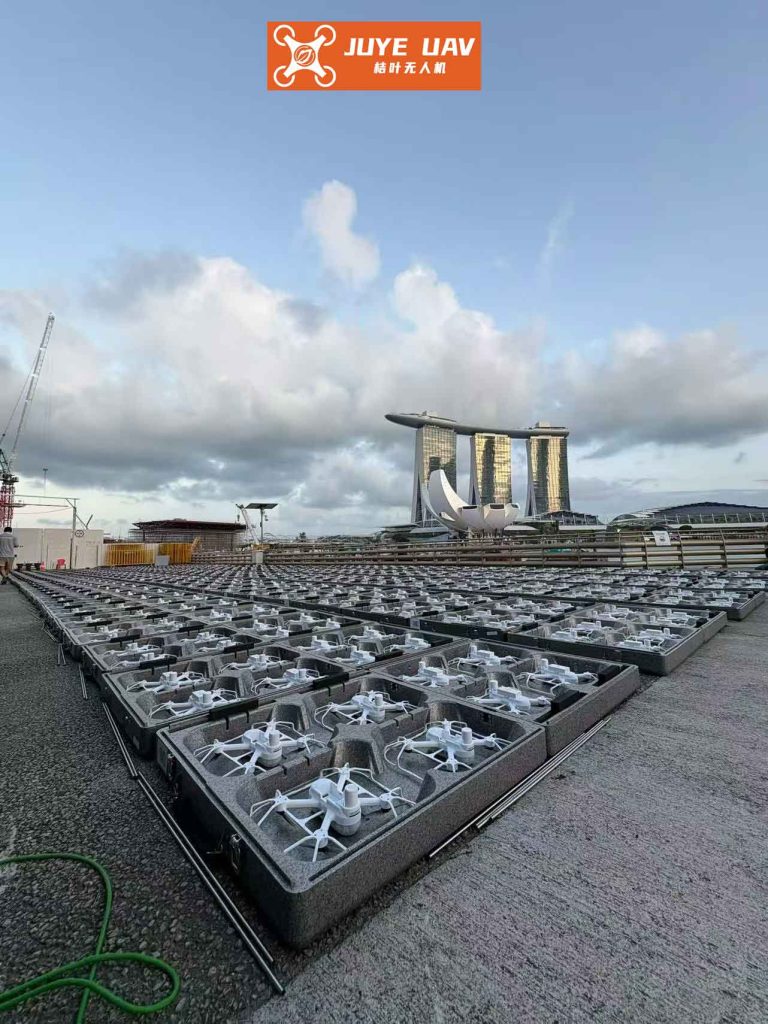
The core of my approach lies in the two-layer model. The lower layer focuses on the fault states of individual drones and their equipment, using fault tree analysis to map the logical relationships between component failures and system failures. The upper layer employs a Markov model to capture the dynamic transitions between different mission stages and states, accounting for repairs and degradations. This dual structure allows for a detailed representation of the formation drone light show’s behavior under realistic conditions. In the following sections, I will analyze the influencing factors, describe the model construction, and present simulation results for a typical formation drone light show scenario. Throughout, the keyword “formation drone light show” will be emphasized to underscore its application context.
Analysis of Influencing Factors on Formation Drone Light Show Reliability
The reliability of a formation drone light show is affected by both electromagnetic and natural environmental factors. These factors can cause performance degradation or complete failure of drone components, leading to mission abort or visual imperfections. Below, I categorize and analyze these influences in detail.
Electromagnetic Environmental Factors
In urban or crowded settings where formation drone light shows are often held, electromagnetic interference (EMI) is prevalent. Sources include commercial radio broadcasts, mobile phone towers, Wi-Fi routers, and Bluetooth devices. For the frequency-using equipment in drones, such as wireless communication links and GPS receivers, EMI can manifest as noise interference, adjacent-channel interference, co-channel interference, and intermodulation interference. For example, during a formation drone light show, a strong nearby transmitter might overwhelm the drone’s receiver, causing loss of control signals or navigation errors. The table below summarizes typical electromagnetic interference modes and their impacts on formation drone light show equipment.
| Interference Mode | Sources | Impact on Formation Drone Light Show |
|---|---|---|
| Noise Interference | Natural sources (e.g., lightning, cosmic rays) and thermal noise | Reduces signal-to-noise ratio, leading to erroneous commands or data loss. |
| Adjacent Frequency Interference | Signals from transmitters on adjacent frequency channels | Causes crosstalk in communication systems, disrupting synchronization. |
| Co-channel Interference | Signals on the same frequency from unauthorized sources | Leads to signal corruption, potentially causing drones to misinterpret instructions. |
| Intermodulation Interference | Non-linear mixing of different frequencies in circuits | Generates spurious signals that can interfere with control frequencies, affecting formation integrity. |
The severity of electromagnetic interference depends on factors like distance from sources, transmission power, and frequency bands used by the formation drone light show. To quantify these effects, I consider the signal-to-interference-plus-noise ratio (SINR) as a performance metric. For a communication link in a formation drone light show, the SINR can be expressed as:
$$ \text{SINR} = \frac{P_r}{N_0 + I} $$
where \( P_r \) is the received power, \( N_0 \) is the noise power, and \( I \) is the interference power. If SINR falls below a threshold \( L \), the link may degrade or fail, impacting the formation drone light show’s reliability.
Natural Environmental Factors
Natural conditions such as temperature, humidity, wind, and vibration also play a significant role in formation drone light show reliability. Drones are often deployed outdoors, where they encounter varying weather. High temperatures can accelerate battery degradation and electronic component aging, while low temperatures may cause battery capacity reduction and material brittleness. Humidity can lead to condensation, short circuits, or corrosion. Wind gusts can destabilize drones, requiring more power and causing navigation errors. Vibration from motors or external sources can loosen connections or damage sensors. The table below outlines these factors and their effects on formation drone light show equipment.
| Factor | Main Effect | Typical Failure Modes in Formation Drone Light Show |
|---|---|---|
| High Temperature | Accelerated aging | Battery swelling, motor overheating, LED driver failure. |
| Low Temperature | Reduced battery efficiency | Shortened flight time, increased risk of motor stall. |
| Humidity | Condensation and corrosion | Circuit board shorting, connector oxidation, sensor malfunction. |
| Wind | Aerodynamic stress | Formation drift, increased power consumption, collision risk. |
| Vibration | Mechanical fatigue | Loose wiring, sensor misalignment, propeller damage. |
To model these effects, I use acceleration factors based on Arrhenius equation for temperature and other empirical models. For instance, the failure rate due to temperature can be expressed as:
$$ \lambda(T) = \lambda_0 \exp\left(-\frac{E_a}{k}\left(\frac{1}{T} – \frac{1}{T_0}\right)\right) $$
where \( \lambda_0 \) is the failure rate at reference temperature \( T_0 \), \( E_a \) is the activation energy, and \( k \) is Boltzmann’s constant. Such models help in predicting reliability under varying environmental conditions for a formation drone light show.
Two-Layer Reliability Model for Formation Drone Light Show
To capture the complexities of a formation drone light show mission, I develop a two-layer reliability model. The lower layer deals with equipment-level fault states, while the upper layer handles mission-stage transitions. This approach allows for detailed analysis of how individual component failures propagate to system-level failures in a formation drone light show.
Lower Layer: Fault Tree Analysis for Equipment States
The lower layer model focuses on determining the states of frequency-using and non-frequency equipment in each drone of the formation drone light show. For frequency-using equipment, such as communication modules, I first predict their performance under electromagnetic interference using effect prediction models. The equipment state \( S \) is classified into three levels: normal (0), degraded (1), and failed (2). The state is determined by comparing the performance metric \( P \) (e.g., SINR) against a threshold \( L \) and considering the duration \( T \) of exceeding the threshold:
$$ S = \begin{cases}
0, & \text{if } P \leq L \\
1, & \text{if } P > L \text{ and } T_1 < T \leq T_2 \\
2, & \text{if } P > L \text{ and } T > T_2
\end{cases} $$
where \( T_1 \) and \( T_2 \) are time thresholds for degradation and failure, respectively. For non-frequency equipment, states are derived from environmental stress models, often using reliability distributions like exponential or Weibull.
Next, I construct a fault tree for the formation drone light show, linking equipment failures to drone failures and then to mission failures. The logical relationships include AND and OR gates. For example, a drone may fail if either its communication system fails OR its motor fails. The formation drone light show mission fails if more than a certain number of drones fail, depending on the redundancy. The fault tree helps compute the probability of mission failure at any given time.
Upper Layer: Markov Model for Mission Stages
The upper layer models the formation drone light show mission as a sequence of stages, each with its own Markov process. The mission stages for a typical formation drone light show include: Stage 1: Launch and Ascent; Stage 2: Pattern Formation and Display; Stage 3: Transition to Next Pattern; Stage 4: Landing. Each stage has different environmental and electromagnetic conditions, leading to varying failure and repair rates.
I define the state of the formation drone light show as a combination of the states of all drones. For a formation with \( N \) drones, each with \( n \) equipment, the total number of states can be large, but I focus on critical states such as all drones normal, some drones degraded, and mission failure. The state transition diagram is built based on Markov assumptions, where future states depend only on the current state. Transitions occur due to equipment failures or repairs. For instance, a drone’s communication system may degrade from normal to degraded with a rate \( \lambda_{deg} \), and repair from degraded to normal with a rate \( \mu_{rep} \).
The Markov model for a single stage is represented by a state transition rate matrix \( Q \). For a simple case with three states (normal, degraded, failed), the matrix is:
$$ Q = \begin{bmatrix}
-\lambda_1 & \lambda_1 & 0 \\
\mu_1 & -(\mu_1 + \lambda_2) & \lambda_2 \\
0 & 0 & 0
\end{bmatrix} $$
where \( \lambda_1 \) is the failure rate from normal to degraded, \( \lambda_2 \) from degraded to failed, and \( \mu_1 \) is the repair rate from degraded to normal. The failed state is absorbing for equipment, but at the formation level, repairs may occur if redundant drones are available.
To connect stages, I use state mapping. The final state of one stage becomes the initial state of the next stage for continuing equipment, while new equipment in a stage starts in the normal state. This ensures continuity across the formation drone light show mission profile.
Mission Reliability Calculation
The mission reliability of the formation drone light show is defined as the probability that the mission is successful up to time \( t \). Using the Markov model, I solve the state probability vector \( \mathbf{v}(t) \) from the Kolmogorov forward equations:
$$ \frac{d\mathbf{v}(t)}{dt} = \mathbf{v}(t) Q $$
Given an initial state probability vector \( \mathbf{v}(0) \), the solution is:
$$ \mathbf{v}(t) = \mathbf{v}(0) e^{Qt} $$
where \( e^{Qt} \) is the matrix exponential. The reliability \( R(t) \) is the sum of probabilities of all successful states at time \( t \). For a formation drone light show, successful states are those where the required number of drones are operational to maintain the visual pattern.
To account for uncertainty, I also compute confidence intervals for reliability. For exponential failure rates, the \( 100(1-\alpha)\% \) confidence interval for reliability \( R(t) \) is:
$$ R_L(t) = e^{-\lambda_U t}, \quad R_U(t) = e^{-\lambda_L t} $$
where \( \lambda_L \) and \( \lambda_U \) are the lower and upper bounds of the failure rate, derived from chi-square distribution with significance level \( \alpha \). This provides a statistical assurance for the formation drone light show reliability estimates.
Simulation and Analysis of Formation Drone Light Show Reliability
To validate the two-layer model, I simulate a typical formation drone light show scenario. The scenario involves a fleet of 10 drones performing a 15-minute show over an urban park. The mission stages are: launch (2 minutes), pattern display (10 minutes), and landing (3 minutes). Each drone is equipped with a communication module, GPS receiver, motor, battery, and LED lights. The environmental conditions include moderate wind (5 m/s), temperature of 20°C, and humidity of 60%. Electromagnetic interference comes from nearby Wi-Fi networks and a mobile phone tower.
Parameter Settings
I define the parameters for equipment failure and repair rates based on historical data and empirical models. For the communication module, the degradation threshold \( L \) is set at SINR = 10 dB, with time thresholds \( T_1 = 5 \) seconds and \( T_2 = 30 \) seconds. The failure rate \( \lambda \) and repair rate \( \mu \) are estimated from simulated interference patterns. The tables below summarize key parameters for the formation drone light show simulation.
| Source | Frequency (MHz) | Power (dBm) | Distance from Show (m) |
|---|---|---|---|
| Wi-Fi Router 1 | 2400 | 20 | 100 |
| Wi-Fi Router 2 | 5200 | 23 | 150 |
| Mobile Tower | 1800 | 40 | 500 |
| Bluetooth Device | 2400 | 10 | 50 |
| Equipment | Base Failure Rate (per hour) | Repair Rate (per hour) | Environmental Factor Sensitivity |
|---|---|---|---|
| Communication Module | 0.01 | 0.5 | High to EMI |
| GPS Receiver | 0.005 | 0.3 | Medium to EMI |
| Motor | 0.02 | 0.2 | High to vibration |
| Battery | 0.015 | 0.1 | High to temperature |
| LED Lights | 0.001 | 0.4 | Low |
The failure rates are adjusted for environmental conditions using acceleration factors. For example, the motor failure rate increases with vibration level \( V \) as:
$$ \lambda_{\text{motor}} = \lambda_0 \left(1 + k_v V^2\right) $$
where \( k_v \) is a constant. Similar adjustments are made for temperature and humidity.
Simulation Results
I implement the two-layer model in a simulation software, computing the mission reliability for the formation drone light show. The state probabilities evolve over time, as shown in the figure below (conceptual representation). During the pattern display stage, the probability of all drones being normal decreases due to cumulative electromagnetic interference, while the probability of degraded states increases. However, repairs occasionally bring drones back to normal, reflecting the resilience of the formation drone light show.
The mission reliability at the end of each stage is calculated and compared with a traditional fault tree method that ignores repair processes. The results are summarized in the table below.
| Stage | Two-Layer Model Reliability | Traditional Fault Tree Reliability |
|---|---|---|
| Launch and Ascent | 0.9995 | 0.9995 |
| Pattern Display | 0.9821 | 0.9696 |
| Landing | 0.9803 | 0.9696 |
As seen, the two-layer model yields higher reliability during the pattern display stage (difference of 0.0125), because it accounts for repair possibilities. This demonstrates the advantage of the Markov approach for formation drone light show reliability assessment. For a significance level \( \alpha = 0.05 \), the confidence interval for the pattern display reliability is [0.975, 0.989], which contains the two-layer model result, validating its credibility.
Furthermore, I analyze the sensitivity of formation drone light show reliability to key parameters. For instance, increasing the number of redundant drones improves reliability, but with diminishing returns. The relationship can be expressed as:
$$ R_{\text{formation}}(t) = 1 – \sum_{k=0}^{K} \binom{N}{k} (1 – R_{\text{drone}}(t))^k R_{\text{drone}}(t)^{N-k} $$
where \( N \) is the total drones, \( K \) is the maximum allowable failures, and \( R_{\text{drone}}(t) \) is single-drone reliability. This helps in optimizing the formation drone light show fleet size for cost and reliability trade-offs.
Conclusion and Future Work
In this paper, I have presented a comprehensive two-layer model for evaluating the mission reliability of a formation drone light show under electromagnetic and environmental influences. The model combines fault tree analysis for equipment-level failures and Markov processes for dynamic stage transitions, providing a realistic representation of formation drone light show operations. Simulation results show that the model captures repair effects, leading to more accurate reliability estimates compared to traditional methods. The confidence intervals confirm the statistical robustness of the results.
The formation drone light show industry can benefit from this model by using it for pre-show risk assessment, maintenance planning, and design optimization. For example, by adjusting drone spacing or frequency bands, electromagnetic interference can be mitigated. Additionally, environmental monitors can provide real-time data to update reliability predictions during a formation drone light show.
Future work could extend the model to include more detailed electromagnetic propagation models, such as those accounting for multipath effects in urban canyons. Also, machine learning techniques could be integrated to predict failure rates from historical show data. Another direction is to consider cooperative behaviors in formation drone light shows, where drones can adapt formations to compensate for failures, enhancing overall reliability. Ultimately, the goal is to ensure that formation drone light shows are not only spectacular but also highly reliable under diverse operating conditions.
Throughout this study, the keyword “formation drone light show” has been emphasized to highlight the application context. The proposed model offers a solid foundation for reliability engineering in this emerging field, paving the way for safer and more resilient aerial displays.