
The spectacle of a formation drone light show has evolved from a novel display into a sophisticated technological ballet, painting the night sky with precision and artistry. As a practitioner and researcher in this field, I have witnessed the convergence of aerospace engineering, real-time computing, and artistic design to create these mesmerizing performances. At its core, a formation drone light show is an extreme application of multi-agent robotic systems, demanding flawless coordination, millimeter-level positioning accuracy, and robust communication under dynamically changing conditions. The shift from single drones to coordinated swarms represents not just an increase in scale but a fundamental leap in system complexity. This article delves into the intricate technological framework that enables hundreds, sometimes thousands, of drones to act as a single, luminous entity, exploring the navigation, control, and orchestration systems that make modern formation drone light show productions possible.
The foundational challenge of any formation drone light show is absolute and relative state estimation—knowing where each drone is in space and in relation to its neighbors. Unlike industrial or military UAV formations that may rely on inertial navigation systems (INS) aided by global navigation satellite systems (GNSS), a formation drone light show operates under unique constraints: extreme density of agents, a need for static hovering precision, and operation in diverse environments often near urban RF interference. The primary technological stack is built upon a hierarchical architecture, typically blending centralized planning with decentralized execution.
I. Technical Foundations and Navigation Sensor Fusion
The reliability of a formation drone light show hinges on a redundant and fault-tolerant navigation suite. Individual show drones are equipped with lightweight, cost-effective sensors whose data is fused to achieve performance surpassing that of any single component.
| Sensor | Role & Principle | Advantages | Limitations & Mitigations |
|---|---|---|---|
| GNSS (GPS, BeiDou, etc.) | Provides absolute global positioning using satellite trilateration. | Global coverage, good absolute accuracy, essential for initialization. | Susceptible to multipath, jamming, and urban canyon effects. Mitigated by using RTK or PPK techniques. |
| Real-Time Kinematic (RTK) GNSS | Uses carrier-phase measurements from a fixed base station to correct drone signals. | Centimeter-level absolute positioning accuracy, crucial for show setup and geo-referencing. | Requires a local base station, limited range, sensitive to signal lock. A backbone for show precision. |
| Inertial Measurement Unit (IMU) | Contains accelerometers and gyroscopes measuring specific force and angular rate. | High-bandwidth, autonomous, provides attitude and short-term velocity/position via dead reckoning. | Errors accumulate rapidly (drift). Must be fused with other sensors at high frequency (100Hz+). |
| Barometer / Rangefinder | Measures atmospheric pressure or time-of-flight to ground. | Provides essential altitude (Z-axis) hold, especially when GNSS vertical accuracy is poor. | Barometers drift with weather; ultrasonic rangefinders have limited range. Used in complementary filtering. |
| Visual / Optical Flow Sensor | Estimates relative motion by analyzing changes between consecutive image frames. | Provides velocity and position hold relative to the ground without GNSS, useful for indoor shows. | Performance degrades in low light, over featureless terrain, or with fast motion. Key for formation drone light show stability. |
The sensor fusion is typically achieved through an Extended Kalman Filter (EKF) or a Complementary Filter running on each drone’s flight controller. The state vector for the $i$-th drone is often defined as:
$$\mathbf{x}_i = [\mathbf{p}_i^T, \mathbf{v}_i^T, \mathbf{q}_i^T, \mathbf{b}_a^T, \mathbf{b}_g^T]^T$$
where $\mathbf{p}_i$ is the 3D position (often in NED coordinates), $\mathbf{v}_i$ is the velocity, $\mathbf{q}_i$ is the attitude quaternion, and $\mathbf{b}_a$, $\mathbf{b}_g$ are the accelerometer and gyroscope biases. The EKF propagates the state using the IMU kinematic model (prediction step) and updates it with measurements from GNSS, barometer, and visual sensors (correction step). For a high-fidelity formation drone light show, the prediction model is critical:
$$\dot{\mathbf{p}}_i = \mathbf{v}_i$$
$$\dot{\mathbf{v}}_i = \mathbf{R}(\mathbf{q}_i)(\mathbf{a}_m – \mathbf{b}_a – \mathbf{\eta}_a) + \mathbf{g}$$
$$\dot{\mathbf{q}}_i = \frac{1}{2}\mathbf{q}_i \otimes \begin{bmatrix} 0 \\ \boldsymbol{\omega}_m – \mathbf{b}_g – \boldsymbol{\eta}_g \end{bmatrix}$$
Here, $\mathbf{R}(\mathbf{q}_i)$ is the rotation matrix from body to world frame, $\mathbf{a}_m$ and $\boldsymbol{\omega}_m$ are raw IMU measurements, $\mathbf{g}$ is gravity, and $\boldsymbol{\eta}_a, \boldsymbol{\eta}_g$ are measurement noises. The filter fuses the high-rate IMU data with the lower-rate, absolute but noisier GNSS fixes to provide a smooth, accurate, and high-frequency pose estimate—the single most important data stream for formation control in a formation drone light show.
II. Core Navigation & Positioning Algorithms for Formation Flight
While individual localization is necessary, the magic of a formation drone light show lies in precise relative positioning. The desired formation is defined as a set of relative vectors $\mathbf{p}_{ij}^{des} = \mathbf{p}_j^{des} – \mathbf{p}_i^{des}$ for all drones $i, j$ in the fleet. The control objective is to minimize the error $\mathbf{e}_{ij} = \mathbf{p}_j – \mathbf{p}_i – \mathbf{p}_{ij}^{des}$. This requires sophisticated cooperative navigation strategies.
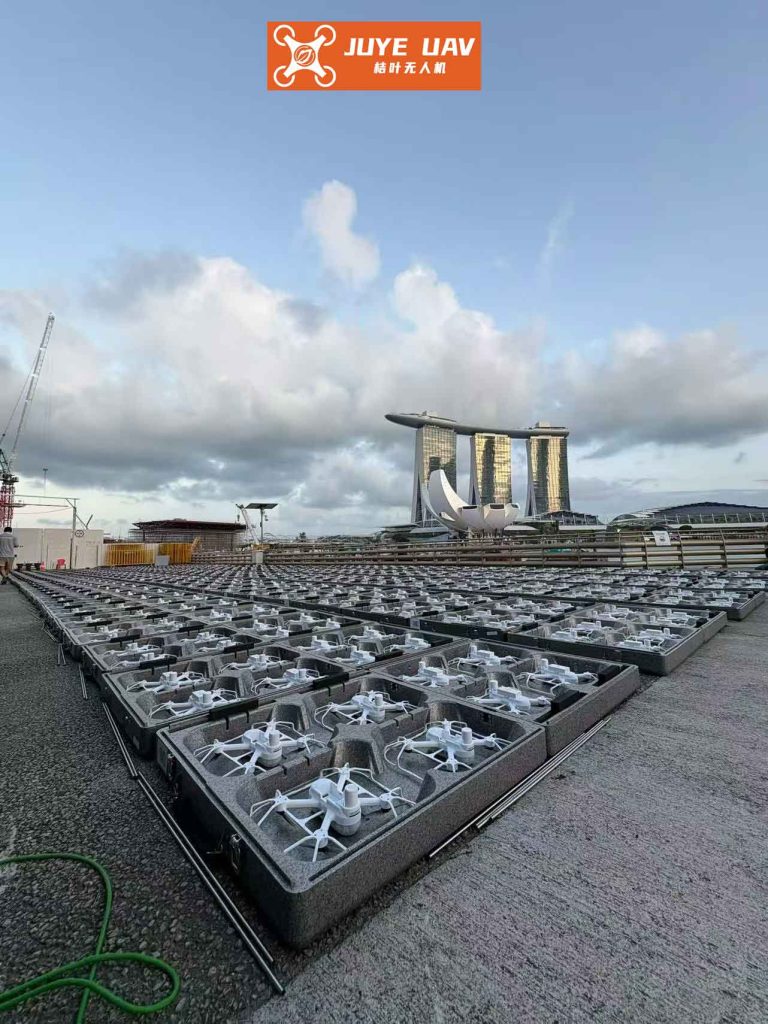
A common architecture for a formation drone light show is the leader-follower or virtual structure approach. In the virtual structure model, the entire formation is treated as a single rigid (or deformable) body. A virtual reference point (VRP) moves along the show’s trajectory. Each drone’s desired position is defined relative to this VRP: $\mathbf{p}_i^{des}(t) = \mathbf{p}_{VRP}(t) + \mathbf{r}_i(t)$, where $\mathbf{r}_i(t)$ is the time-varying offset defining the animated shape. This centralized calculation simplifies control but demands flawless communication of the VRP state to all agents.
For enhanced robustness, especially against individual GNSS failures, relative navigation techniques are employed. Drones can use peer-to-peer ranging technologies like Ultra-Wideband (UWB) to measure inter-drone distances $d_{ij}$. Combining these ranging measurements with individual GNSS/INS estimates in a collaborative filter significantly improves overall swarm accuracy. A simplified relative position update for drone $i$ using measurements from a neighbor $j$ can be modeled. The measured distance is related to the states:
$$d_{ij}^{meas} = ||\mathbf{p}_j – \mathbf{p}_i|| + \nu_{ij}$$
where $\nu_{ij}$ is ranging noise. This non-linear measurement can be linearized and incorporated into a distributed EKF, allowing drones to refine their position estimates cooperatively, making the formation drone light show resilient to temporary GNSS degradation for some members.
The most advanced positioning for indoor or GNSS-denied formation drone light show environments leverages external motion capture (Mocap) systems. Multiple high-speed infrared cameras track reflective markers on each drone, providing millimeter-accurate, low-latency 6-DOF pose data. This data is streamed to a central ground station, which calculates control commands and sends them back to the drones. The system dynamics and control in such a setup can be represented as a high-gain feedback loop. The position error for drone $i$ is $\tilde{\mathbf{p}}_i = \mathbf{p}_i^{des} – \mathbf{p}_i^{mocap}$. A simple yet effective proportional-derivative (PD) controller for acceleration command in the world frame is:
$$\mathbf{a}_i^{cmd} = K_p \tilde{\mathbf{p}}_i + K_d \dot{\tilde{\mathbf{p}}}_i + \ddot{\mathbf{p}}_i^{des} + \mathbf{g}$$
This command is then transformed into body-frame thrust and attitude commands for the drone’s low-level controller. This architecture is what enables the breathtakingly tight formations and complex choreography seen in cutting-edge formation drone light show demonstrations.
III. Communication Architecture and Synchronization
A formation drone light show is a distributed real-time system. The communication network is its nervous system, responsible for delivering trajectory commands, synchronization signals, and emergency stops. Latency, packet loss, and bandwidth are critical constraints.
| Architecture | Description | Pros & Cons for Light Shows |
|---|---|---|
| Centralized Star | A single ground control station (GCS) broadcasts commands to all drones simultaneously. | Pros: Simple logic, guaranteed command consistency. Cons: Single point of failure, limited scalability, requires powerful broadcast radio. |
| Distributed Mesh | Drones relay messages amongst themselves, creating a self-healing network. | Pros: Robust to link failures, scalable. Cons: Complex protocol, potential for latency buildup, higher power consumption. |
| Hybrid (Leader-Relay) | GCS talks to a subset of “leader” drones, which then relay to their “follower” subgroups. | Pros: Balances scalability and control. Common in large-scale shows. Cons: Relies on reliability of leader drones. |
Temporal synchronization is paramount. Every drone must interpret the command “go to position X at time T” with a common understanding of time T. This is achieved using high-precision time-synchronization protocols. The Global Positioning System (GPS) provides a ubiquitous and precise time source through its satellites. Each drone’s GNSS receiver outputs a Pulse Per Second (PPS) signal aligned to UTC. The flight controller uses this to discipline its local clock, ensuring the entire fleet’s clocks are synchronized within microseconds. The show timeline is then defined as an offset from a shared epoch (e.g., GPS time of week). When the GCS broadcasts a command with a future timestamp $T_{target}$, each drone independently waits until its synchronized local clock reaches that moment before executing. This decouples command transmission time from execution time, eliminating jitter caused by variable radio latency and ensuring perfectly synchronized motion—the hallmark of a professional formation drone light show.
IV. Trajectory Generation and Choreography
The artistry of a formation drone light show is encoded in its trajectory. The process begins with artistic design—a storyboard of shapes, transitions, and colors. These artistic intents are then translated into mathematical paths. For smooth, dynamic, and safe motion, minimum-jerk or minimum-snap trajectories are the standard. The objective is to find a path $\mathbf{p}(t)$ that minimizes the integral of the squared $k$-th derivative (jerk is the 3rd, snap is the 4th derivative of position).
For a segment starting at $t=0$ and ending at $t=T$, the trajectory is typically a piecewise polynomial, often a 5th (minimizing jerk) or 7th (minimizing snap) order polynomial:
$$\mathbf{p}(t) = \mathbf{c}_0 + \mathbf{c}_1 t + \mathbf{c}_2 t^2 + \mathbf{c}_3 t^3 + \mathbf{c}_4 t^4 + \mathbf{c}_5 t^5 + \mathbf{c}_6 t^6 + \mathbf{c}_7 t^7$$
The coefficients $\mathbf{c}_0…\mathbf{c}_7$ are solved by imposing boundary conditions on position, velocity, acceleration, and jerk at the start and end of the segment, and ensuring continuity of these derivatives at the junction between segments. This yields buttery-smooth motion that is easy for the drones’ controllers to track and is gentle on the mechanical systems. The generation of thousands of such coordinated trajectories for a massive formation drone light show is a significant computational task, performed offline by the show design software.
Furthermore, collision avoidance must be baked into the trajectory generation. In a dense formation drone light show, the planned paths must satisfy a separation constraint $||\mathbf{p}_i(t) – \mathbf{p}_j(t)|| > d_{safe}$ for all $i \neq j$ and all $t$. This is often handled by planning in relative space or by adding artificial repulsive potential fields between drones during the optimization process, ensuring the spectacular visuals never turn into a mid-air collision.
V. Fault Tolerance and Safety Systems
No discussion of a large-scale formation drone light show is complete without addressing safety. With hundreds of drones flying over audiences, redundant safety systems are non-negotiable. A multi-layer approach is standard:
- Pre-flight Checks: Automated diagnostics verify battery health, sensor calibration, motor responsiveness, and GPS lock for each drone before arming.
- In-flight Monitoring: Each drone continuously self-monitors critical parameters: battery voltage, motor RPM, internal temperature, and estimator consistency. A significant anomaly triggers an automatic “fail-safe” maneuver.
- Communication Heartbeat: The GCS and each drone exchange periodic “heartbeat” signals. Loss of heartbeat from the GCS (e.g., if the operator hits emergency stop) or from an individual drone triggers pre-programmed responses.
- Independent Return-to-Home (RTH): The most common fail-safe. Upon critical failure or loss of command link, a drone will autonomously ascend to a pre-defined safe altitude, navigate to its launch/home location using its onboard GNSS/INS, and land.
- Geofencing: A virtual volumetric fence is programmed. Any drone attempting to leave this volume due to a fault or error is commanded to stop and land immediately.
The fault detection logic often uses statistical methods, like monitoring the innovation sequence of the EKF. The innovation $\boldsymbol{\nu}_k$ at time step $k$ is the difference between the actual sensor measurement and the predicted measurement:
$$\boldsymbol{\nu}_k = \mathbf{z}_k – h(\hat{\mathbf{x}}_{k|k-1})$$
where $h(\cdot)$ is the measurement model. A sudden, sustained increase in the magnitude of $\boldsymbol{\nu}_k$ can indicate a sensor fault. Such advanced monitoring ensures that a single point of failure does not compromise the entire formation drone light show.
VI. Future Trends and Challenges
The technology behind formation drone light show is rapidly advancing. Future trends point towards even greater autonomy, resilience, and creative expression.
| Trend | Potential Impact |
|---|---|
| Onboard AI & Vision-Based Navigation | Drones using cameras and ML to hold formation relative to visual features or each other, reducing dependency on external GNSS/Mocap and enabling adaptive outdoor shows. |
| 5G/Advanced RF Integration | Ultra-reliable low-latency communication (URLLC) from 5G networks could enable real-time streaming of high-bandwidth command data, allowing for dynamic, audience-responsive shows. |
| Advanced Swarm Intelligence | Decentralized algorithms where drones react to local neighbors (flocking algorithms) could create organic, fluid, and emergent patterns not possible with pre-computed scripts. |
| Improved Power Density & Flight Time | Advances in battery chemistry (solid-state) and motor efficiency will allow for longer, more complex shows with brighter payloads or larger drones. |
| Heterogeneous Swarms | Mixing drones of different sizes and capabilities (e.g., carriers with large light payloads, nimble tracer drones) to create multi-layer, truly three-dimensional displays. |
Significant challenges remain. Scaling to 10,000+ drones requires breakthroughs in decentralized coordination and radio frequency management. Robust all-weather operation demands sensors and algorithms that can handle rain, snow, and wind gusts. Ultimately, the goal is to make the technology so seamless that it disappears, leaving only the intended artistic and emotional impact of the formation drone light show. The equation for the future is one where artistic vision ($A$) is less constrained by technical limits ($L$), expressed as maximizing the creative freedom function $C$:
$$C = \int (A(t) – \alpha \cdot L(t)) \, dt$$
where $\alpha$ is a scaling factor representing engineering efficiency. The relentless progress in navigation, communication, and control algorithms is driving $L(t)$ asymptotically toward zero, unlocking unprecedented possibilities for $A(t)$. The synchronized sky is becoming a canvas limited only by imagination.
In conclusion, the modern formation drone light show is a masterpiece of systems engineering. It is a tangible demonstration of how precise multi-agent navigation, robust sensor fusion, fault-tolerant design, and meticulous synchronization can coalesce to create an experience that is both technically profound and aesthetically magical. From the Kalman filter running on a microcontroller to the artist’s storyboard, every layer is essential. As the technology continues to mature, we can expect these aerial ballets to become even more complex, resilient, and integrated into our cultural and entertainment landscapes, forever changing how we think about performance art and collective robotic behavior.