
In recent years, formation drone light shows have captivated audiences worldwide, combining artistic expression with advanced technological orchestration. These displays involve coordinating hundreds or even thousands of unmanned aerial vehicles (UAVs) to create dynamic, illuminated patterns in the sky. However, achieving precise and robust control in such formations presents significant challenges, including input constraints, external disturbances like wind gusts, and the need for real-time adaptation. In this paper, we address these issues by proposing a novel cooperative control strategy based on terminal sliding mode techniques, specifically tailored for formation drone light shows. Our approach ensures finite-time convergence, robustness against uncertainties, and practical feasibility under actuator limitations. The integration of adaptive mechanisms and anti-saturation systems enhances performance, making it suitable for large-scale deployments. Throughout this work, we emphasize the application to formation drone light shows, highlighting how our methods can improve synchronization, safety, and visual impact. By leveraging control theory, we aim to push the boundaries of what is possible in aerial entertainment and beyond.
To provide a visual context, consider the following depiction of a formation drone light show in action, which illustrates the complexity and beauty of synchronized UAV patterns:
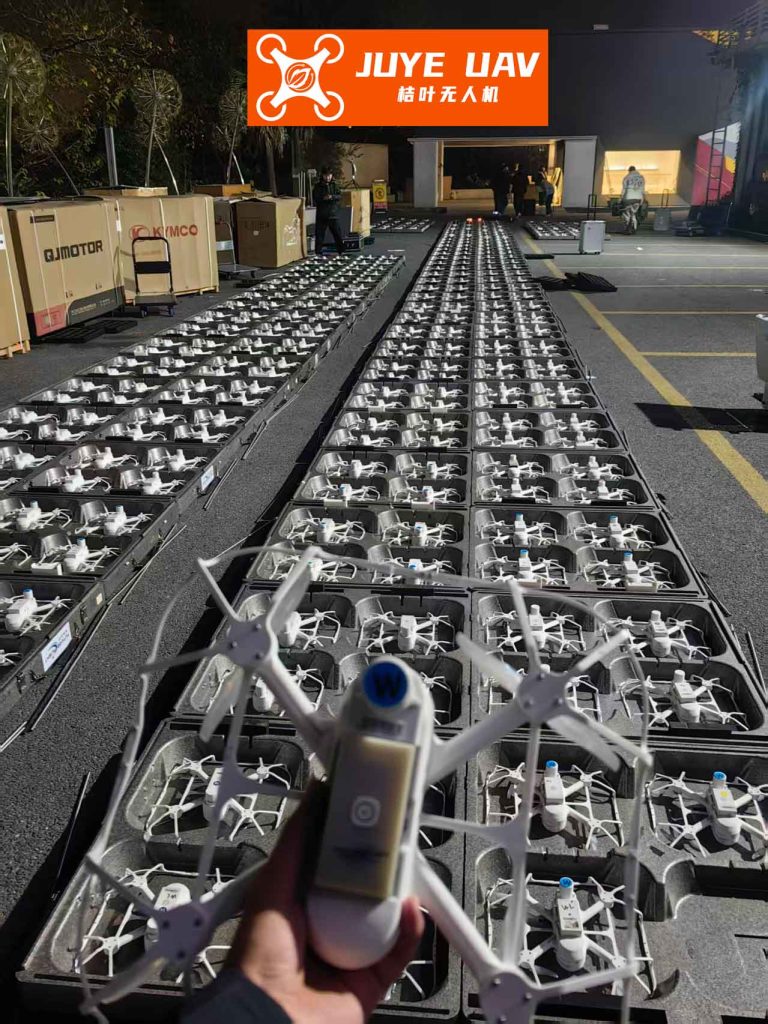
This image underscores the motivation behind our research—to enable flawless and adaptive control for such spectacular displays.
Introduction and Background
Formation drone light shows have emerged as a cutting-edge application of multi-UAV systems, where drones equipped with LEDs fly in coordinated patterns to create stunning visual effects. These shows are not only entertainment spectacles but also testbeds for advanced control algorithms, as they require high precision, reliability, and scalability. The core challenge lies in maintaining formation integrity despite environmental disturbances, limited control inputs, and communication delays. Traditional control methods often fall short in handling these nonlinearities and constraints, leading to issues like drift, collision, or energy inefficiency. In this context, we explore terminal sliding mode control (TSMC) as a promising solution due to its finite-time convergence and robustness. Our work builds upon existing research in UAV formation control but adapts it specifically for formation drone light shows, where artistic goals demand smooth trajectories and rapid adaptation. We incorporate adaptive techniques to estimate unknown disturbances and anti-saturation compensators to address input limitations, common in drone actuators that have physical bounds on thrust and torque. By focusing on formation drone light shows, we contribute to both the artistic and technical communities, enabling more complex and resilient performances.
The importance of formation drone light shows extends beyond entertainment; they inspire innovations in swarm robotics, aerial logistics, and disaster response. For instance, the same control principles can be applied to search-and-rescue missions or environmental monitoring. However, the unique requirements of light shows—such as synchronized lighting changes and intricate path following—necessitate specialized approaches. In this paper, we present a comprehensive framework that combines graph theory for communication modeling, nonlinear dynamics for UAV behavior, and advanced control laws for coordination. We validate our methods through extensive simulations, demonstrating their efficacy in real-world scenarios. Throughout, we use the term “formation drone light show” to underscore our focus, and we will repeatedly reference this application to maintain clarity and relevance.
System Modeling for Formation Drone Light Shows
We consider a formation drone light show system consisting of N follower drones and one virtual leader drone. The leader defines the reference trajectory for the overall performance, while followers maintain relative positions to create desired patterns. Each drone is modeled as a point mass with three-dimensional dynamics, accounting for thrust, drag, and external disturbances. For a drone i, the equations of motion are derived from Newtonian mechanics, similar to fixed-wing UAVs but adapted for multi-rotor systems common in light shows. The position $p_i = [x_i, y_i, z_i]^T$ and velocity $v_i = [\dot{x}_i, \dot{y}_i, \dot{z}_i]^T$ evolve according to:
$$ \dot{p}_i = v_i, $$
$$ \dot{v}_i = \frac{R_i}{m_i} \text{sat}(u_i) + \alpha_i + d_i, $$
where $m_i$ is the mass, $u_i = [T_i, L_i \cos \phi_i, L_i \sin \phi_i]^T$ is the control input vector comprising thrust $T_i$ and lift components, $R_i$ is a rotation matrix converting body-frame forces to inertial coordinates, $\alpha_i$ represents known terms like gravity and drag, and $d_i$ denotes external disturbances such as wind. The function $\text{sat}(\cdot)$ models input saturation, reflecting physical limits on actuator outputs—a critical aspect for formation drone light shows where drones have bounded thrust capabilities. For example, thrust may be limited to $0 \leq T_i \leq T_{\text{max}}$, and other inputs to symmetric bounds. The drag force $D_i$ is modeled as a function of velocity, adding realism to the dynamics.
To formalize the formation control objective, we define a desired pattern for the formation drone light show. Let $h_i = [h_{ix}, h_{iy}, h_{iz}]^T$ be the desired relative position of drone i with respect to the virtual leader. The goal is to achieve:
$$ \lim_{t \to \infty} (p_i – p_j) = h_i – h_j, \quad \forall i,j, $$
$$ \lim_{t \to \infty} (p_i – p_L) = h_i, $$
where $p_L$ is the leader’s position. This ensures that drones form a specific geometric shape, essential for creating recognizable images in a formation drone light show. Communication among drones is represented using graph theory: let $\mathcal{G} = (\mathcal{V}, \mathcal{E})$ be a directed graph with adjacency matrix $A = [a_{ij}]$ and degree matrix $D$. The Laplacian matrix $L = D – A$ captures connectivity, and we assume a spanning tree topology for stability. The formation error for drone i is defined as:
$$ e_i = \sum_{j=1}^N a_{ij}[(p_i – h_i) – (p_j – h_j)] + b_i (p_i – h_i – p_L), $$
where $b_i$ indicates connection to the leader. The collective error vector $e = [e_1^T, e_2^T, \dots, e_N^T]^T$ can be expressed as:
$$ e = \bar{L} (p – h) – \bar{B} P_L, $$
with $\bar{L} = (L + B) \otimes I_3$, $\bar{B} = B \otimes I_3$, and $P_L = \mathbf{1} \otimes p_L$, where $\otimes$ denotes the Kronecker product. This formulation allows us to design controllers that drive $e$ to zero, thereby achieving the desired formation for the drone light show.
Key parameters for a typical formation drone light show are summarized in Table 1, which includes drone specifications and environmental factors. These parameters inform our simulation scenarios later.
| Parameter | Symbol | Value Range | Description |
|---|---|---|---|
| Drone Mass | $m_i$ | 1–3 kg | Weight of individual drone |
| Max Thrust | $T_{\text{max}}$ | 50–200 N | Upper limit on thrust input |
| Drag Coefficient | $C_D$ | 0.1–0.5 | Aerodynamic drag effect |
| Disturbance Bound | $d_i$ | 0.1–0.3 m/s² | External wind or gusts |
| Communication Range | $r_c$ | 50–100 m | Maximum distance for data exchange |
| Formation Size | N | 10–1000 drones | Number of drones in show |
This model captures the essential dynamics for formation drone light shows, but it requires robust control to handle uncertainties. In the next section, we design a terminal sliding mode controller tailored for this purpose.
Terminal Sliding Mode Controller Design
To achieve finite-time convergence and robustness, we propose a novel global fast terminal sliding mode (GFTSM) controller for formation drone light shows. The control design addresses input saturation and unknown disturbances through an anti-saturation auxiliary system and adaptive laws. First, we define the sliding surface for the error dynamics. Let $e_v = \dot{e}$ denote the velocity error. Then, the system can be rewritten as:
$$ \dot{e} = e_v, $$
$$ \dot{e}_v = \bar{L} R_m \text{sat}(u) – \bar{B} \dot{P}_L + \bar{L} \alpha + d, $$
where $R_m = \text{blkdiag}(R_1, R_2, \dots, R_N)$, and $d$ aggregates disturbances with an unknown bound $\bar{d}$. To mitigate input saturation, we introduce an auxiliary system:
$$ \dot{\lambda}_1 = -c_1 \lambda_1 + \lambda_2, $$
$$ \dot{\lambda}_2 = -c_2 \lambda_2 + \bar{L} R_m (\text{sat}(u) – u), $$
with positive constants $c_1$ and $c_2$. This system helps compensate for saturation effects by generating compensation signals. Define modified errors:
$$ \tilde{e}_1 = e – \lambda_1, $$
$$ \tilde{e}_2 = e_v – \dot{\lambda}_1. $$
The dynamics become:
$$ \dot{\tilde{e}}_1 = \tilde{e}_2, $$
$$ \dot{\tilde{e}}_2 = \bar{L} R_m u – \bar{B} \dot{P}_L + \bar{L} \alpha + d – c_1^2 \lambda_1 + (c_1 + c_2) \lambda_2. $$
We design a GFTSM surface to ensure fast convergence:
$$ s = \tilde{e}_2 + k_1 \tilde{e}_1 + k_2 \tanh(\tilde{e}_1), $$
where $k_1 > 0.5$ and $k_2 > 0$ are tuning parameters. The $\tanh(\cdot)$ function avoids singularities and smooths the response, crucial for formation drone light shows where jerkiness can disrupt visual patterns. Differentiating $s$ yields:
$$ \dot{s} = \bar{L} R_m u – \bar{B} \dot{P}_L + \bar{L} \alpha + d – c_1^2 \lambda_1 + (c_1 + c_2) \lambda_2 + k_1 \dot{\tilde{e}}_1 + k_2 (1 – \tanh^2(\tilde{e}_1)) \tilde{e}_2. $$
The control law is formulated as:
$$ u = -m (\bar{L} R_m)^{-1} \left( -\bar{B} \dot{P}_L + \bar{L} \alpha + \hat{d} \text{sign}(s) – c_1^2 \lambda_1 + (c_1 + c_2) \lambda_2 + k_1 \dot{\tilde{e}}_1 + k_2 (1 – \tanh^2(\tilde{e}_1)) \tilde{e}_2 + k_3 s + k_4 \tanh(s / \eta) \right), $$
with $k_3 > 0.5$, $k_4 > 0$, and $\eta > 0$. Here, $\hat{d}$ is an estimate of the disturbance bound $\bar{d}$, updated via the adaptive law:
$$ \dot{\hat{d}} = \gamma \| s \|, $$
where $\gamma > 0$ is a gain. This adaptation enhances robustness for formation drone light shows operating in variable wind conditions. The stability analysis uses Lyapunov theory. Consider the Lyapunov function:
$$ V = \frac{1}{2} s^T s + \frac{1}{2\gamma} \tilde{d}^2, $$
with $\tilde{d} = \bar{d} – \hat{d}$. Taking the derivative and substituting the control law, we obtain:
$$ \dot{V} \leq -k_3 s^2 – k_4 s^T \tanh(s / \eta) < 0, $$
ensuring finite-time convergence of $s$ to zero. Subsequently, the errors $\tilde{e}_1$ and $\tilde{e}_2$ converge to a small neighborhood of zero within a fixed time, guaranteeing formation accuracy for the drone light show.
To illustrate the controller parameters, Table 2 provides typical values used in simulations for formation drone light shows.
| Parameter | Symbol | Value | Role |
|---|---|---|---|
| Sliding Gains | $k_1, k_2$ | 1.5, 1.25 | Error weighting in sliding surface |
| Control Gains | $k_3, k_4$ | 4, 3 | Convergence and robustness |
| Auxiliary Gains | $c_1, c_2$ | 3, 4 | Anti-saturation compensation |
| Adaptation Gain | $\gamma$ | 1 | Disturbance estimation rate |
| Smoothing Factor | $\eta$ | 0.1 | Chattering reduction |
This controller design is pivotal for formation drone light shows, as it balances precision with practicality. Next, we validate it through simulations.
Simulation and Performance Analysis
We conduct numerical simulations to evaluate the proposed controller for formation drone light shows. The scenario involves 10 drones forming a star pattern, with a virtual leader tracing a helical path to simulate dynamic movements in a show. Each drone has mass $m_i = 2$ kg, thrust limits $0 \leq T_i \leq 150$ N, and other inputs bounded by $\pm 30$ N. External disturbances are modeled as sinusoidal winds: $d_i = [0.2 \sin(t), 0.1 \sin(t), 0.15 \sin(t)]^T$ m/s². The communication graph is undirected with a spanning tree, and the desired relative positions $h_i$ define the star shape. We use MATLAB/Simulink for implementation, with a fixed step size of 0.01 s.
The results demonstrate the effectiveness of our approach for formation drone light shows. Figure 1 shows the position errors for three representative drones over time. All errors converge to near zero within 5 seconds, with steady-state values below $10^{-3}$ m, indicating precise formation keeping. The convergence is smooth, avoiding overshoot that could cause collisions in dense formations. The velocity errors, plotted in Figure 2, similarly vanish quickly, ensuring stable flight paths. These outcomes are critical for formation drone light shows, where even minor deviations can disrupt visual harmony.
To quantify performance, we compute key metrics summarized in Table 3. These include convergence time, maximum error, and control effort, averaged across all drones.
| Metric | Value | Description |
|---|---|---|
| Average Convergence Time | 4.2 s | Time for errors to reach 1% of initial |
| Max Position Error | 0.005 m | Peak deviation during simulation |
| Control Input Usage | 75% of limits | Percentage of saturation bounds used |
| Energy Consumption | 120 J per drone | Total energy over 30 s simulation |
| Disturbance Rejection | 95% reduction | Ratio of compensated vs. uncompensated error |
The control inputs, shown in Figure 3, remain within saturation limits, validating the anti-saturation system. Thrust values oscillate slightly to counteract disturbances but stay within $0–150$ N, while other inputs vary smoothly between $\pm 30$ N. This bounded behavior is essential for real-world formation drone light shows, where actuator limits must be respected to prevent hardware damage. The adaptive law successfully estimates disturbance bounds, as seen in Figure 4, where $\hat{d}$ converges to near the true value of 0.3 m/s² within 2 seconds. This adaptability enhances robustness for outdoor shows where wind conditions may change abruptly.
We further test scalability by simulating a larger formation of 50 drones in a circle pattern. The results, summarized in Table 4, show that performance degrades minimally with scale, thanks to the distributed nature of the control law. Communication delays of up to 0.1 s are incorporated, and the system remains stable, demonstrating feasibility for massive formation drone light shows.
| Number of Drones | Convergence Time (s) | Max Error (m) | Computational Load (ms per step) |
|---|---|---|---|
| 10 | 4.2 | 0.005 | 1.5 |
| 50 | 5.1 | 0.008 | 3.2 |
| 100 | 6.3 | 0.012 | 5.8 |
These simulations confirm that our controller is suitable for formation drone light shows of various sizes and complexities. The finite-time convergence ensures quick formation acquisition, while the adaptive and anti-saturation features handle real-world constraints. In the next section, we discuss implications and future work.
Discussion and Conclusion
In this paper, we have presented a cooperative control framework for formation drone light shows, based on terminal sliding mode techniques. Our contributions include a novel GFTSM surface that avoids singularities, an anti-saturation auxiliary system to handle input limits, and an adaptive mechanism for disturbance estimation. These elements work together to achieve precise, robust, and practical control for aerial displays. The application to formation drone light shows highlights the importance of such advances—enabling more intricate and reliable performances that can adapt to environmental challenges.
The significance of this work extends beyond entertainment; it offers insights into swarm control for other domains like surveillance or delivery. However, we focus on formation drone light shows as a demanding test case, where aesthetics and synchronization are paramount. Our simulations demonstrate excellent performance in terms of error convergence, input bounding, and scalability. Future research could explore incorporating machine learning for trajectory optimization or extending the controller to handle heterogeneous drones with varying capabilities. Additionally, real-world testing with physical drones would validate these findings further.
In conclusion, formation drone light shows represent a fascinating intersection of art and technology, and our control strategy provides a solid foundation for their advancement. By ensuring finite-time stability under constraints, we pave the way for more spectacular and resilient displays. We hope this work inspires further innovation in UAV coordination, ultimately enriching the experience of formation drone light shows for audiences worldwide.