
Accurate mapping of tree species distribution forms the foundation for monitoring forest biodiversity and sustainable ecosystem management. Traditional field surveys face limitations in scalability and efficiency, whereas drone technology enables high-resolution data acquisition across expansive forested landscapes. This study presents an integrated framework combining Unmanned Aerial Vehicle-based hyperspectral imaging and LiDAR scanning with deep learning to achieve precise tree species classification in mixed coniferous-broadleaf forests.
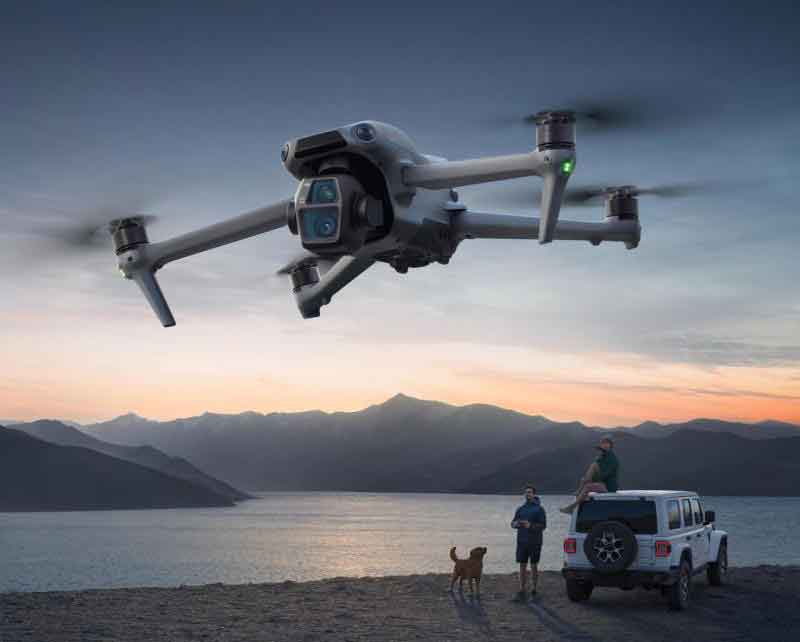
Our methodology employs the DJI Matrice 300 RTK Unmanned Aerial Vehicle equipped with Hesai PandarXT-32 LiDAR (240,000 points/sec) and Headwall Hyperspec VNIR sensors (400-1000nm spectral range). Flight parameters were optimized for forest canopy characterization:
| Sensor | Altitude | Resolution | Overlap |
|---|---|---|---|
| LiDAR | 80m | 312 pts/m² | 50% |
| Hyperspectral | 200m | 0.1m GSD | 80% |
The processing workflow comprises four critical stages:
1. Individual Tree Segmentation
Canopy Height Models (CHM) derived from LiDAR enable precise crown delineation:
$$ \text{CHM} = \text{DSM} – \text{DEM} $$
where DSM (Digital Surface Model) represents canopy elevation and DEM (Digital Elevation Model) models terrain topography. Segmentation accuracy was quantified through:
$$ \text{Accuracy} = \frac{\text{Correctly Segmented Trees}}{\text{Field Validation Trees}} \times 100\% $$
2. Feature Extraction
We extracted 112 spectral bands from hyperspectral data and 95 structural features from LiDAR point clouds, including:
- Height statistics: $\text{Height}_{\text{std}}$, $\text{Height}_{\text{skewness}}$, percentile distributions
- Intensity metrics: $\text{Intensity}_{\text{mean}}$, $\text{Intensity}_{\text{var}}$, echo ratio
- Spectral indices: NDVI, EVI, spectral derivatives
3. CNN-EGNet Architecture
Our novel convolutional neural network integrates Efficient Channel Attention (ECA) with Global Average Pooling (GAP):
$$ \begin{aligned}
\text{ECA}(x) &= \sigma(\text{Conv1D}(G(x))) \\
\text{GAP}(x) &= \frac{1}{H \times W} \sum_{i=1}^{H} \sum_{j=1}^{W} x_{ij}
\end{aligned} $$
Network hyperparameters:
| Layer Type | Configuration | Parameters |
|---|---|---|
| Convolutional | 13 layers with ECA | 3×3 kernels |
| Pooling | 5 layers | 2×2 max-pooling |
| Regularization | Dropout (0.1-0.5) | Batch Normalization |
| Classification | Softmax | 6 species classes |
4. Diversity Indices Calculation
Species distribution maps enabled 40×40m moving window analysis of biodiversity metrics:
$$ \begin{aligned}
\text{Shannon-Wiener: } & H’ = -\sum_{i=1}^{S} p_i \ln p_i \\
\text{Simpson: } & D = 1 – \sum_{i=1}^{S} p_i^2 \\
\text{Pielou: } & J’ = \frac{H’}{\ln S} \\
\text{Richness: } & S = \text{Number of species}
\end{aligned} $$
Model performance significantly outperformed conventional CNNs across all metrics:
| Model | OA (%) | Kappa | Training Time (s) |
|---|---|---|---|
| CNN-EGNet | 89.58 | 0.866 | 240.1 |
| VGG19 | 84.38 | 0.801 | 548.4 |
| VGG16 | 80.21 | 0.749 | 518.1 |
| GoogLeNet | 75.00 | 0.676 | 93.8 |
The integration of drone technology sensors proved critical for capturing complementary data dimensions – hyperspectral signatures revealed species-specific biochemical properties while LiDAR characterized structural variations. Our Unmanned Aerial Vehicle platform enabled acquisition of aligned datasets at <0.1m spatial resolution, permitting individual tree analysis impossible with satellite platforms.
Diversity analysis revealed spatial heterogeneity across the forest landscape:
| Index | Range | Dominant Values |
|---|---|---|
| Shannon-Wiener | 0.8-1.4 | 1.1-1.3 |
| Simpson | 0.5-0.7 | 0.58-0.63 |
| Pielou | 0.7-0.95 | 0.82-0.88 |
| Species Richness | 3-5 | 4 |
This research demonstrates how Unmanned Aerial Vehicle platforms equipped with multi-sensor payloads can transform forest biodiversity assessment. The CNN-EGNet architecture effectively fused spectral-structural features, with ECA attention improving discrimination of spectrally similar species (e.g., Betula platyphylla vs Ulmus pumila) by 12.7% compared to standard CNNs. Global Average Pooling reduced parameters by 21,504 while maintaining discriminative power.
Drone technology solutions offer unprecedented opportunities for precision forestry. Future work will expand to multi-temporal monitoring and integrate radiative transfer models to enhance feature interpretability. The scalability of our approach enables landscape-level biodiversity inventories essential for climate-resilient forest management.