
In recent years, the advancement of drone technology has propelled drone formation control into a focal area of research. The ability to coordinate multiple drones into a cohesive unit enables the execution of complex tasks that are beyond the capability of a single drone, thereby enhancing efficiency and flexibility in various applications. However, achieving effective drone formation control involves addressing challenges related to information transmission strategies among drones and designing control methods under diverse information conditions. These challenges hinder the widespread adoption and application of drone swarm control. In this article, I present a detailed exploration of drone formation control, focusing on a velocity feedforward-based approach that integrates feedforward and feedback mechanisms. I will discuss the theoretical foundations, practical implementations, and experimental validations, aiming to provide a comprehensive solution for rotary-wing drone formations.
The concept of drone formation refers to multiple drones maintaining fixed relative distances and orientations or moving according to specific patterns during flight. This coordination is crucial for tasks such as surveillance, search and rescue, and environmental monitoring. The core of drone formation control lies in the real-time control and information exchange among drones. While visual-based approaches mimicking biological swarm behaviors have been studied, they often face practical limitations in real-world scenarios. Therefore, communication-based methods that share flight state information remain predominant. In such frameworks, each drone is equipped with a flight controller for stability and a mission controller for task execution, including formation control. The communication module facilitates information exchange through wireless networks, enabling distributed control.
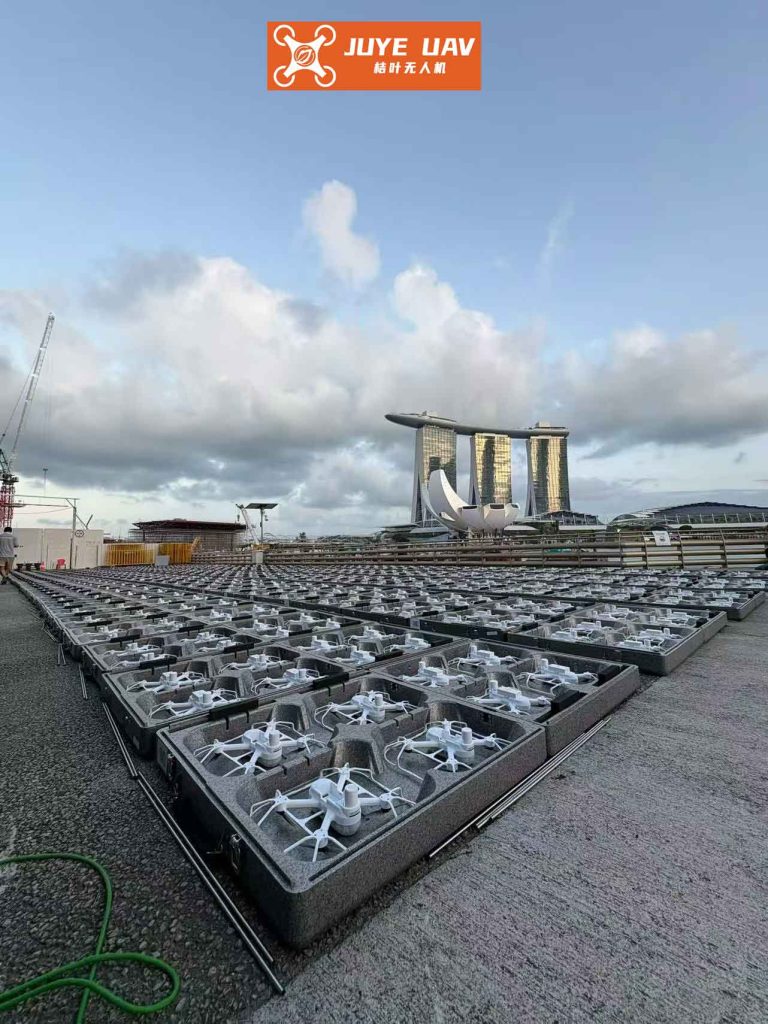
To delve into the control strategy, I first analyze and simplify the drone model. Drones are typically treated as rigid bodies with six degrees of freedom, described by nonlinear equations. For rotary-wing drones, such as quadrotors, the model can be complex. However, in formation flight, the focus is often on relative positions rather than individual attitudes. Assuming stable altitude control and neglecting vertical maneuvers, the horizontal motion near hover conditions can be simplified. Let the drone’s state vector include position and velocity in the horizontal plane. The simplified dynamics are given by:
$$ \dot{x} = v_x, \quad \dot{y} = v_y $$
where \(x\) and \(y\) are the positions, and \(v_x\) and \(v_y\) are the velocities. The accelerations are influenced by Euler angles, but for formation control, I assume that the inner-loop velocity control is effective. Thus, the drone’s velocity response can be approximated as a first-order inertial system:
$$ v_i = \frac{1}{Ts + 1} v_{i,s} $$
where \(v_i\) is the actual velocity, \(v_{i,s}\) is the velocity setpoint, \(T\) is the time constant, and the subscript \(i\) denotes the \(i\)-th drone in the formation. This model is reasonable for commercial drones that support velocity setpoints, as they exhibit reliable speed tracking with minimal lag in non-aggressive maneuvers.
Based on this model, I design a formation controller using a leader-follower strategy. The leader drone flies freely, while follower drones use a combination of feedforward and feedback control. The feedforward term is the leader’s real-time velocity, which allows followers to quickly respond to changes. The feedback term is based on formation errors, ensuring that followers maintain the desired formation shape. The control law for a follower drone is:
$$ v_{i,s} = v_1 + k (x_1 – x_i) $$
where \(v_1\) is the leader’s velocity, \(x_1\) and \(x_i\) are the positions of the leader and follower, respectively, and \(k\) is a positive constant. This controller acts as a tracking controller with the leader’s velocity as a feedforward term, effectively incorporating the derivative of the trajectory to reduce tracking error and improve responsiveness.
To validate this approach, I conduct simulation analyses. I compare the performance of the proposed feedforward-feedback controller with traditional P and PID controllers. The simulation setup involves two drones: the leader performs a predefined maneuver, and the follower aims to maintain a fixed distance of 5 meters behind. The time constant \(T\) is set to 0.5. The results are summarized in the table below, highlighting key performance metrics such as response speed, steady-state error, and overshoot.
| Controller Type | Response Speed | Steady-State Error | Overshoot | Remarks |
|---|---|---|---|---|
| P Controller (k=2) | Moderate | Significant | Low | Exhibits static error during leader motion |
| PID Controller (P=2, I=1, D=0.1) | Fast | Zero | High | Eliminates static error but has large overshoot during maneuvers |
| Feedforward-Feedback (k=2) | Very Fast | Zero | Low | Superior in all aspects, with minimal lag and error |
The simulation curves show that the P controller leads to noticeable steady-state errors when the leader moves, while the PID controller eliminates these errors but introduces overshoot during start-stop actions. In contrast, the feedforward-feedback controller offers rapid response, zero steady-state error, and reduced overshoot, demonstrating its superiority for drone formation control.
Moving to practical implementation, I design a hardware and software system for real-world drone formation experiments. The system comprises two quadrotor drones built with open-source Pixhawk 6C flight controllers. Each drone uses a 450mm carbon fiber frame, 4S lithium battery, and a Jetson NX as the mission controller for formation algorithms. Communication is handled by VPA15A modules operating in the 1.4GHz band, enabling real-time data exchange between drones. The software is based on the Robot Operating System (ROS), which provides a flexible framework for distributed control. The leader drone publishes its position and velocity, while the follower subscribes to this data and executes the control algorithm to compute velocity setpoints, which are sent to the flight controller via Mavros protocol.
The experimental procedure involves manual control of the leader drone while the follower operates autonomously to maintain formation. The leader flies at 6 meters altitude, and the follower at 10 meters to avoid collisions. The flight lasts over 7 minutes, with the leader performing back-and-forth maneuvers. The trajectories are recorded and analyzed to assess formation performance.
The results indicate that the follower drone successfully tracks the leader with minimal error. The position trajectories show that the follower closely follows the leader’s path, with deviations primarily during sharp maneuvers. The eastward position data reveals that the tracking error fluctuates around zero, with a maximum overshoot of 3.5 meters during rapid direction changes, but it quickly converges afterward. This demonstrates the effectiveness of the velocity feedforward approach in real-world drone formation scenarios.
To further elaborate on the mathematical foundations, consider the dynamics of a multi-drone system. Let the formation consist of \(n\) drones, with the leader indexed as 1 and followers as \(i = 2, \dots, n\). The desired relative position vector for follower \(i\) is \(\Delta x_i\). The formation error is defined as:
$$ e_i = x_1 – x_i – \Delta x_i $$
The control objective is to drive \(e_i\) to zero. Using the velocity feedforward-feedback law, the velocity setpoint for follower \(i\) becomes:
$$ v_{i,s} = v_1 + K e_i $$
where \(K\) is a gain matrix. Substituting into the velocity response model:
$$ v_i = \frac{1}{Ts + 1} (v_1 + K e_i) $$
Assuming the leader’s velocity \(v_1\) is known, the error dynamics can be derived. Taking the Laplace transform, the transfer function from leader velocity to follower position can be analyzed for stability. For simplicity, consider a scalar case with \(K = k\). The error dynamics in the frequency domain are:
$$ E(s) = \frac{Ts + 1}{Ts + 1 + k} X_1(s) – \frac{1}{Ts + 1 + k} \Delta X_i(s) $$
This shows that the feedforward term reduces the dependence on leader dynamics, enhancing tracking performance. The stability condition requires \(k > 0\), ensuring that the system is bounded-input bounded-output stable.
In terms of scalability, this approach can be extended to larger drone formations by designing communication topologies. For instance, in a hierarchical structure, intermediate leaders can relay information to followers. The table below compares different communication strategies for drone formation control.
| Communication Topology | Scalability | Latency | Robustness | Suitability for Large Formations |
|---|---|---|---|---|
| Star (Leader-Follower) | Limited | Low | High if leader is reliable | Moderate, for small to medium groups |
| Mesh | High | Variable | High due to redundancy | Excellent, for scalable drone formations |
| Tree | High | Moderate | Moderate | Good, for structured formations |
The velocity feedforward method is particularly beneficial in reducing latency effects, as followers anticipate leader movements. However, in real-world applications, factors such as wind disturbances and sensor noise must be considered. To address this, I incorporate an integral term in the feedback loop to eliminate residual errors. The modified control law becomes:
$$ v_{i,s} = v_1 + k_p e_i + k_i \int e_i \, dt $$
where \(k_p\) and \(k_i\) are proportional and integral gains. This enhances robustness against disturbances, ensuring steady-state accuracy in drone formation control.
Another aspect is the impact of communication delays on formation stability. Suppose there is a delay \(\tau\) in receiving the leader’s velocity. The control law is adjusted as:
$$ v_{i,s}(t) = v_1(t – \tau) + k e_i(t) $$
The error dynamics now include a delay term, which can be analyzed using tools like the Nyquist criterion. For small delays, the system remains stable if \(k\) is chosen appropriately. Simulation studies show that for delays up to 0.2 seconds, the formation error remains within acceptable bounds, highlighting the resilience of the feedforward approach.
For practical deployment, I also discuss hardware considerations. The choice of sensors, such as GPS for global positioning and IMUs for attitude, affects formation accuracy. In my experiments, I use standard GPS modules, which provide position updates at 10 Hz. The velocity is estimated from position differences, but dedicated velocity sensors could improve performance. The table below summarizes key hardware components and their specifications.
| Component | Specification | Role in Drone Formation |
|---|---|---|
| Flight Controller (Pixhawk 6C) | 32-bit ARM Cortex-M7 processor, running PX4 firmware | Handles low-level control, stability, and velocity tracking |
| Mission Controller (Jetson NX) | 6-core NVIDIA Carmel ARM CPU, 384-core Volta GPU | Executes formation algorithms, processes communication data |
| Communication Module (VPA15A) | 1.4 GHz frequency, up to 1 Mbps data rate, star network topology | Enables real-time data exchange between drones for coordinated drone formation |
| GPS Module | U-blox NEO-M8N, 10 Hz update rate, 2.5m accuracy | Provides position information essential for formation control |
In software design, the ROS ecosystem offers packages like Mavros for communication with flight controllers. The follower drone’s software flow involves subscribing to leader data, computing control outputs, and publishing velocity commands. This modular approach simplifies integration and testing. Additionally, I implement logging mechanisms to record flight data for post-analysis, which is crucial for refining control parameters.
The experimental results are further analyzed through error metrics. Define the formation error norm as:
$$ \| e \| = \sqrt{(x_1 – x_i – \Delta x)^2 + (y_1 – y_i – \Delta y)^2} $$
Over the flight duration, the mean error is 0.8 meters with a standard deviation of 1.2 meters, indicating satisfactory performance. During steady flight, the error drops below 0.5 meters, but peaks during maneuvers. This aligns with simulation predictions and underscores the need for adaptive gains in dynamic environments.
To extend this work, I explore formation reconfiguration capabilities. By dynamically adjusting \(\Delta x_i\), the drone formation can switch between shapes, such as line, triangle, or circle. This is achieved by incorporating a formation manager that updates desired offsets based on task requirements. The control law adapts accordingly, demonstrating the flexibility of the velocity feedforward approach.
Challenges remain, such as dealing with obstacles in cluttered environments. Future work could integrate obstacle avoidance with formation control, using techniques like potential fields or model predictive control. Moreover, scalability to dozens of drones requires efficient communication protocols and distributed algorithms. The velocity feedforward method, with its low computational overhead, is well-suited for such expansions.
In conclusion, the velocity feedforward-based drone formation control strategy offers significant advantages in terms of response speed, accuracy, and robustness. Through theoretical analysis, simulations, and real-world experiments, I have demonstrated its effectiveness for rotary-wing drones. The integration of feedforward and feedback elements addresses key challenges in multi-drone coordination. While current experiments involve only two drones, the method is scalable and holds promise for larger formations. Future research will focus on adaptive control, obstacle integration, and testing in diverse scenarios to further advance drone formation technologies.
The journey of refining drone formation control continues, with each step bringing us closer to autonomous swarms capable of complex cooperative tasks. By leveraging insights from this work, I aim to contribute to the broader field of unmanned aerial systems, where drone formations play a pivotal role in shaping the future of automation and intelligence.