
Low altitude drone remote sensing technology revolutionizes water conservancy engineering surveying by offering unparalleled efficiency, high-resolution data capture, and minimal climatic interference. The integration of low altitude UAV systems enables rapid topographic mapping, deformation monitoring, and resource management—critical for reservoir safety and irrigation planning. This technology’s agility in complex terrains, such as steep valleys and vegetated areas, positions it as a superior alternative to traditional surveying methods. This article details a comprehensive workflow for leveraging low altitude drone technology in hydraulic engineering contexts.
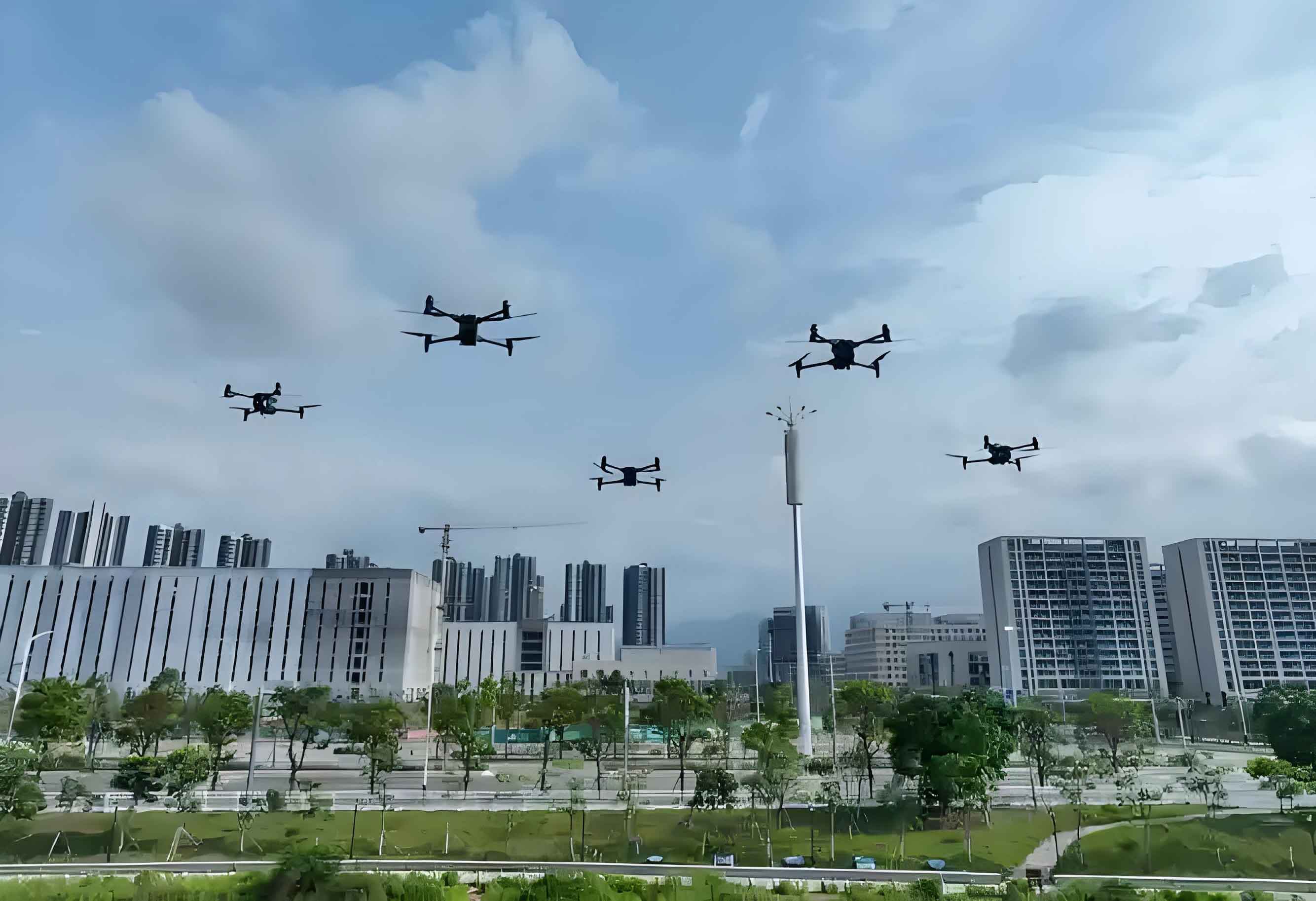
Case Study: Reservoir Surveying
The survey focused on an upstream channel of a medium-sized reservoir with a total capacity of 1.1714 million m³, serving flood control and irrigation functions across 13,800 hectares. The study area spanned 0.72 km² within a mountainous “V”-shaped valley, featuring slopes of 40°–55° and sparse vegetation. Rugged topography and complex ground objects necessitated high-precision data acquisition, making low altitude UAV deployment ideal.
Methodology
UAV System Configuration
The low altitude drone system comprised a KC1600 electric fixed-wing UAV, a SONY A7R high-resolution digital camera (36 MP), ground control stations, and communication modules. Fixed-wing UAVs were selected for extended endurance and stability. Key specifications are summarized below:
| Parameter | Value |
|---|---|
| Wingspan | 1,650 mm |
| Length | 1,080 mm |
| Payload Capacity | 0.8 kg |
| Endurance | 46 min |
| Cruising Speed | 62 km/h |
| Camera Resolution | 7,400 × 4,800 pixels |
Flight Planning and Execution
Pre-flight preparations included site reconnaissance, meteorological assessment, and launch zone selection (open, flat terrain). Five flight paths were designed with the following parameters to ensure 1:1,000 scale map accuracy:
- Heading overlap: 80%
- Side overlap: 70%
- Flight altitude: 377 m
- Ground resolution: 0.06 m
The high overlap compensated for wind-induced instability. After hardware checks, the low altitude UAV captured 127 images, with 118 retained after quality filtering. Flight altitude deviations were constrained within ±30 m using:
$$ \Delta H_{\text{actual}} = H_{\text{design}} \pm \delta, \quad |\delta| \leq 30 \text{ m} $$
Camera Calibration and Distortion Correction
Lens distortions (radial, eccentric) were quantified to enhance geometric accuracy. Calibration parameters included:
- Principal point offset: $x_0 = -0.033$, $y_0 = 0.215$
- Focal length: $f = 35.54$ mm
- Radial distortion coefficient: $k_1 = 6.92 \times 10^{-8}$ mm
- Decentering distortion coefficient: $p_1 = 2.01 \times 10^{-5}$ mm
Correction models applied:
$$ \Delta x = x \left( k_1 r^2 + k_2 r^4 \right) + p_1 \left( r^2 + 2x^2 \right) $$
$$ \Delta y = y \left( k_1 r^2 + k_2 r^4 \right) + p_1 \left( r^2 + 2y^2 \right) $$
where $r = \sqrt{x^2 + y^2}$.
Image Processing and Control Points
Preprocessing involved noise reduction, edge enhancement, and histogram equalization. POS data facilitated rapid stitching via scale-invariant feature transform (SIFT) algorithms. Twenty-five ground control points (GCPs) were placed at identifiable features (e.g., road intersections, building corners), adhering to:
- Minimum coverage: 4 overlapping images per point
- Central image positioning to avoid edge distortion
GCP accuracy was maintained at <5 cm using RTK-GNSS measurements.
Aerial Triangulation with DATmatrix
Bundle adjustment in DATmatrix software ensured precise georeferencing. The workflow comprised:
- Interior Orientation: Reconstructing image coordinate systems using camera parameters.
- Relative Orientation: Automated tie-point matching across overlapping images.
- Bundle Adjustment: Iterative least-squares optimization to minimize reprojection errors.
Adjustment accuracy met CH/T 3003-2021 standards:
| Point Type | Direction | RMSE (m) | Max Residual (m) | Standard Limit (m) |
|---|---|---|---|---|
| Control Points | XY | 0.058 | 0.24 | 0.6 |
| Z | 0.117 | 0.20 | 0.25 | |
| Check Points | XY | 0.104 | 0.25 | 1.0 |
| Z | 0.174 | 0.36 | 0.4 |
Digital Elevation Model and Orthophoto Generation
VirtuoZo software processed aerial triangulation outputs to generate a DEM via dense image matching:
$$ z = f(x,y) $$
where $z$ represents elevation at coordinates $(x,y)$. Subsequent differential correction and digital mosaicking produced the DOM using:
$$ I_{\text{ortho}} = \frac{I_{\text{raw}} \cdot \cos \theta}{H} \cdot \text{DEM}_{\text{grid}} $$
where $\theta$ is the incidence angle and $H$ is flight height. Planimetric accuracy was validated using 14 RTK-surveyed points. The mean square error (MSE) was calculated as:
$$ M_x = \sqrt{ \frac{ \sum_{i=1}^{n} (x_i – X_i)^2 }{n-1} } $$
yielding $M_x = 0.355$ m, below the 0.5 m threshold for 1:1,000-scale maps.
Conclusion
Low altitude drone technology significantly enhances water conservancy engineering surveying by delivering high-precision topographic data efficiently. Critical success factors include rigorous camera calibration, optimal flight planning, and robust bundle adjustment. The 0.355 m planimetric accuracy of DOM outputs demonstrates compliance with international standards, validating low altitude UAVs as indispensable tools for hydraulic infrastructure management. Future work will integrate AI-based feature extraction to automate anomaly detection in reservoir systems.