
In recent years, the application of unmanned aerial vehicles (UAVs) has expanded significantly across civilian and military domains, including surveillance, inspection, and targeted operations. Among various UAV configurations, quadrotors have gained prominence due to their compact size, agility, and maneuverability. However, single quadrotors often face limitations in mission efficiency and operational density, particularly in complex environments. Inspired by collective behaviors in biological systems, multi-agent coordination strategies have been proposed to overcome these limitations, leading to the emergence of drone formation systems. A drone formation, comprising multiple UAVs operating in a coordinated manner, can enhance task performance, robustness, and scalability. However, achieving precise and stable flight in a drone formation presents significant challenges, including external dynamic disturbances, actuator input saturation, and communication constraints under directed topologies. This work addresses the distributed attitude cooperative control problem for a class of quadrotor drone formation systems subject to these challenges, aiming to ensure bounded stability and accurate tracking of a virtual leader’s attitude.
The core of a drone formation lies in its ability to maintain cohesive flight through distributed control protocols, where each UAV relies on local information exchange with neighbors. Attitude control serves as the foundational layer for stable drone formation flight, as it directly influences orientation and maneuverability. Traditional control methods, such as PID and sliding mode control, have been extensively studied for drone formation systems. However, these approaches often struggle with robustness against time-varying disturbances and input saturation limitations, which are prevalent in real-world scenarios. For instance, external winds, payload variations, and model uncertainties can introduce dynamic disturbances that degrade control performance. Additionally, physical constraints on motor thrust and torque lead to input saturation, causing nonlinearities that may destabilize the drone formation if unaddressed. To tackle these issues, we propose a novel distributed control scheme integrating finite-time disturbance observers and anti-saturation mechanisms, ensuring robust attitude synchronization in drone formations under directed communication graphs.
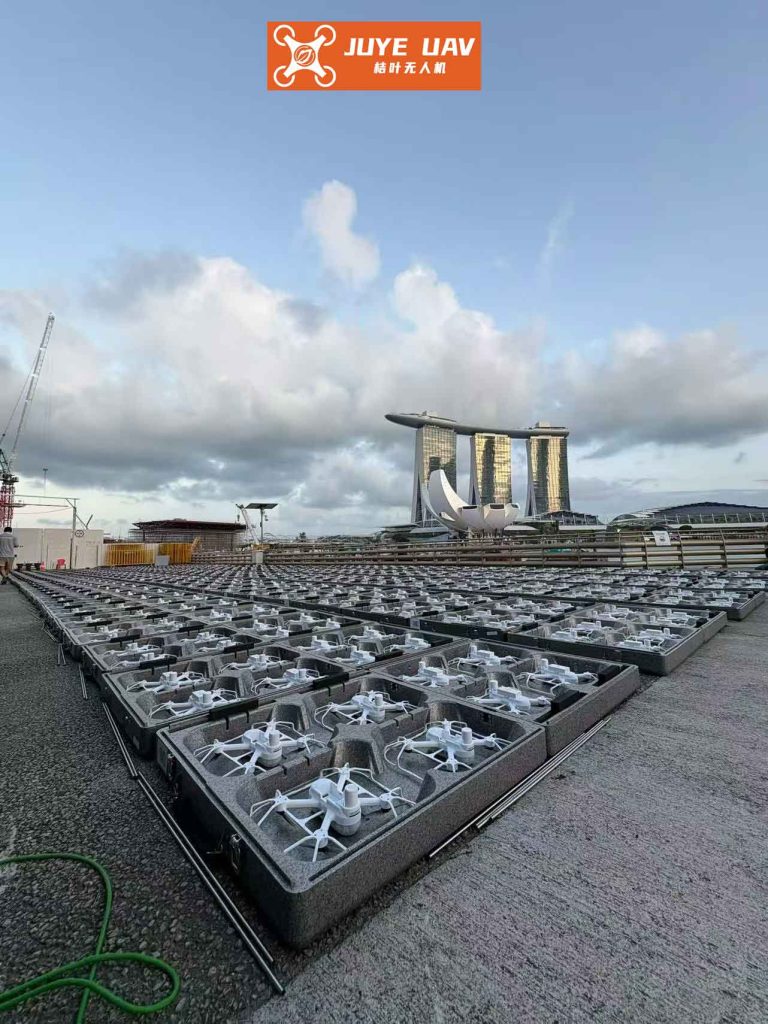
The dynamics of a quadrotor drone formation system are derived from Newton-Euler principles. Consider a formation of N follower quadrotors, each modeled as a rigid body with symmetric structure and coincident center of mass and geometry. For the i-th drone in the drone formation (i = 1, …, N), the attitude dynamics are expressed in terms of roll, pitch, and yaw angles. Let $\Theta_i = [\phi_i, \theta_i, \psi_i]^T$ represent the attitude angles and $\Omega_i = [\dot{\phi}_i, \dot{\theta}_i, \dot{\psi}_i]^T$ denote the angular velocities. The dynamic model, incorporating external disturbances and input saturation, is given by:
$$
\dot{\Theta}_i = \Omega_i
$$
$$
\dot{\Omega}_i = F_i(\Theta_i, \Omega_i) + G_i(\Theta_i, \Omega_i) \text{sat}(U_i) + D_i(\Theta_i, \Omega_i, t)
$$
Here, $U_i = [\tau_{\phi i}, \tau_{\theta i}, \tau_{\psi i}]^T$ is the control input vector representing torques generated by motors, and $\text{sat}(U_i)$ denotes the saturation function limiting these inputs due to physical constraints. The saturation function is defined as:
$$
\text{sat}(U_i) =
\begin{cases}
\overline{U}_i & \text{if } U_i > \overline{U}_i \\
U_i & \text{if } \underline{U}_i \leq U_i \leq \overline{U}_i \\
\underline{U}_i & \text{if } U_i < \underline{U}_i
\end{cases}
$$
where $\overline{U}_i$ and $\underline{U}_i$ are the upper and lower saturation bounds, respectively. The terms $F_i(\Theta_i, \Omega_i) \in \mathbb{R}^3$ and $G_i(\Theta_i, \Omega_i) \in \mathbb{R}^3$ are known nonlinear functions derived from the drone’s inertial properties. For an X-type quadrotor in the drone formation, these are:
$$
F_i(\Theta_i, \Omega_i) =
\begin{bmatrix}
\frac{(J_{yi} – J_{zi}) \dot{\theta}_i \dot{\psi}_i}{J_{xi}} \\
\frac{(J_{zi} – J_{xi}) \dot{\phi}_i \dot{\psi}_i}{J_{yi}} \\
\frac{(J_{xi} – J_{yi}) \dot{\phi}_i \dot{\theta}_i}{J_{zi}}
\end{bmatrix}, \quad G_i(\Theta_i, \Omega_i) = \text{diag}\left( \frac{1}{J_{xi}}, \frac{1}{J_{yi}}, \frac{1}{J_{zi}} \right)
$$
with $J_{xi}, J_{yi}, J_{zi}$ being the moments of inertia. The unknown lumped dynamic disturbance $D_i(\Theta_i, \Omega_i, t) \in \mathbb{R}^3$ encompasses external forces and unmodeled dynamics, which we aim to estimate and compensate for in our control design for the drone formation.
Communication within the drone formation is represented by a directed graph $\mathcal{G} = (\mathcal{V}, \mathcal{E}, \mathcal{A})$, where $\mathcal{V} = \{1, 2, …, N\}$ is the node set for follower drones, $\mathcal{E} \subseteq \mathcal{V} \times \mathcal{V}$ is the edge set, and $\mathcal{A} = [a_{ij}] \in \mathbb{R}^{N \times N}$ is the adjacency matrix with $a_{ij} > 0$ if information flows from drone j to drone i. The Laplacian matrix is $\mathcal{L} = \mathcal{C} – \mathcal{A}$, where $\mathcal{C} = \text{diag}(c_1, …, c_N)$ with $c_i = \sum_{j \in \mathcal{N}_i} a_{ij}$. A virtual leader drone, labeled as node 0, generates the desired attitude trajectory $\Theta_0(t)$ for the drone formation. The augmented graph $\overline{\mathcal{G}} = (\overline{\mathcal{V}}, \overline{\mathcal{E}}, \overline{\mathcal{A}})$ includes the leader, with a diagonal matrix $\mathcal{B} = \text{diag}(b_{10}, …, b_{N0})$ indicating leader-follower connections, where $b_{i0} > 0$ if follower i accesses the leader’s information. The global tracking error for the drone formation is defined as $\overline{\Theta} – \overline{\Theta}_0$, where $\overline{\Theta} = [\Theta_1^T, …, \Theta_N^T]^T$ and $\overline{\Theta}_0 = [\Theta_0^T, …, \Theta_0^T]^T$.
To facilitate control design, we introduce the following assumptions and lemmas essential for stability analysis in drone formation systems:
Assumption 1: The desired attitude $\Theta_0(t)$ from the virtual leader is a smooth, known, and differentiable function of time.
Assumption 2: The lumped disturbance $D_i$ is differentiable and bounded such that $\|D_i\| \leq \overline{D}_i$, where $\overline{D}_i > 0$ is an unknown constant.
Assumption 3: For input saturation, there exists an unknown constant $\Delta \overline{U}_i > 0$ such that $\|\Delta U_i\| \leq \Delta \overline{U}_i$, where $\Delta U_i = \text{sat}(U_i) – U_i$.
Assumption 4: The augmented graph $\overline{\mathcal{G}}$ contains a directed spanning tree with the virtual leader as the root, ensuring that $\mathcal{L} + \mathcal{B}$ is nonsingular for the drone formation.
Lemma 1 (Finite-Time Convergence): Consider the disturbed nonlinear differential equation: $\dot{\upsilon} + \kappa_1 |\upsilon|^{1/2} \text{sgn}(\upsilon) + \kappa_2 \int_0^t \text{sgn}(\upsilon) d\tau = \Xi(t)$ with $|\dot{\Xi}| \leq P$. If $\kappa_1 \geq 1.5\sqrt{P}$ and $\kappa_2 \geq 1.1P$, then $\upsilon$ and $\dot{\upsilon}$ converge to zero in finite time, with convergence time $T \leq 7.6 \upsilon(0) / (\kappa_2 – P)$.
Lemma 2 (High-Order Sliding-Mode Differentiator): For an n-th order differentiator with states $\sigma_{ijk}$ and input $\mu_{0ik}(t)$, if initial deviations are bounded, the output $\lambda_{0ik}$ approximates $\dot{\mu}_{0ik}(t)$ with bounded error, enabling precise disturbance estimation in drone formation control.
Lemma 3 (Young’s Inequality): For positive real numbers $x, y, a, b$ with $1/a + 1/b = 1$, the inequality $xy \leq x^a/a + y^b/b$ holds, useful for Lyapunov analysis.
Lemma 4 (Graph-Based Error Bound): Under Assumption 4, the global tracking error in the drone formation satisfies $\|\overline{\Theta} – \overline{\Theta}_0\| \leq \|\tilde{E}_{\Theta}\| / \underline{\sigma}((\mathcal{L} + \mathcal{B}) \otimes I_3)$, where $\tilde{E}_{\Theta}$ is the global neighbor error and $\underline{\sigma}(\cdot)$ denotes the minimum singular value.
Our control objective is to design a distributed attitude cooperative controller for the drone formation that ensures all follower drones accurately track the virtual leader’s attitude despite dynamic disturbances and input saturation, with all closed-loop signals globally uniformly bounded. To achieve this, we propose a control structure comprising an auxiliary anti-saturation system, a finite-time disturbance observer, and a backstepping-based cooperative control law.
First, to mitigate the effects of input saturation in the drone formation, we construct an auxiliary anti-saturation system with internal states $\xi_{\Theta i} \in \mathbb{R}^3$ and $\xi_{\Omega i} \in \mathbb{R}^3$:
$$
\dot{\xi}_{\Theta i} = -P_{\Theta i} \xi_{\Theta i} + \left( \sum_{j \in \mathcal{N}_i} a_{ij} + b_{i0} \right) \xi_{\Omega i}
$$
$$
\dot{\xi}_{\Omega i} = -P_{\Omega i} \xi_{\Omega i} – \left( \sum_{j \in \mathcal{N}_i} a_{ij} + b_{i0} \right) \xi_{\Theta i} + G_i \Delta U_i
$$
where $P_{\Theta i} = \text{diag}(P_{\Theta i1}, P_{\Theta i2}, P_{\Theta i3}) > 0$ and $P_{\Omega i} = \text{diag}(P_{\Omega i1}, P_{\Omega i2}, P_{\Omega i3}) > 0$ are design parameters. This system helps compensate for saturation-induced deviations, enhancing robustness in the drone formation.
Next, we define transformed tracking errors to incorporate anti-saturation compensation:
$$
\tilde{E}_{\Theta i} = \sum_{j \in \mathcal{N}_i} a_{ij} (\Theta_i – \Theta_j) + b_{i0} (\Theta_i – \Theta_0) – \xi_{\Theta i}
$$
$$
\tilde{E}_{\Omega i} = \Omega_i – \Omega_{id} – \xi_{\Omega i}
$$
where $\Omega_{id} \in \mathbb{R}^3$ is a virtual control law designed via backstepping. Taking the derivative of $\tilde{E}_{\Theta i}$ and substituting the auxiliary system dynamics yields:
$$
\dot{\tilde{E}}_{\Theta i} = \left( \sum_{j \in \mathcal{N}_i} a_{ij} + b_{i0} \right) (\tilde{E}_{\Omega i} + \Omega_{id}) – \sum_{j \in \mathcal{N}_i} a_{ij} \Omega_j – b_{i0} \dot{\Theta}_0 + P_{\Theta i} \xi_{\Theta i}
$$
We design the virtual control law $\Omega_{id}$ to stabilize the attitude error dynamics in the drone formation:
$$
\Omega_{id} = \frac{1}{\sum_{j \in \mathcal{N}_i} a_{ij} + b_{i0}} \left( -K_{\Theta i} \tilde{E}_{\Theta i} + \sum_{j \in \mathcal{N}_i} a_{ij} \Omega_j + b_{i0} \dot{\Theta}_0 – P_{\Theta i} \xi_{\Theta i} \right)
$$
with $K_{\Theta i} = \text{diag}(K_{\Theta i1}, K_{\Theta i2}, K_{\Theta i3}) > 0$ as a design matrix. Substituting this into the error dynamics gives:
$$
\dot{\tilde{E}}_{\Theta i} = -K_{\Theta i} \tilde{E}_{\Theta i} + \left( \sum_{j \in \mathcal{N}_i} a_{ij} + b_{i0} \right) \tilde{E}_{\Omega i}
$$
For the actual control law, we address dynamic disturbances using a finite-time disturbance observer based on a high-order sliding-mode differentiator. Define an auxiliary variable $\mu_{0i} = Z_{\Omega i} – \tilde{E}_{\Omega i}$, where $Z_{\Omega i}$ evolves as:
$$
\dot{Z}_{\Omega i} = F_i + G_i U_i + \hat{D}_i – \dot{\Omega}_{id} + P_{\Omega i} \xi_{\Omega i} + \left( \sum_{j \in \mathcal{N}_i} a_{ij} + b_{i0} \right) \xi_{\Theta i}
$$
Here, $\hat{D}_i = [\hat{D}_{i1}, \hat{D}_{i2}, \hat{D}_{i3}]^T$ is the estimate of $D_i$. The derivative $\dot{\mu}_{0i} = \hat{D}_i – D_i = \tilde{D}_i$ represents the estimation error. Since $\dot{\mu}_{0i}$ is not directly measurable, we employ an n-th order sliding-mode differentiator (Lemma 2) to obtain an estimate $\lambda_{0i}$ such that $\dot{\mu}_{0i} = \lambda_{0i} + \beta_i$, where $\beta_i$ is a bounded estimation error. Then, defining $\mu_{1i} = \mu_{0i} + \lambda_{0i}$, the finite-time disturbance observer for the drone formation is designed as:
$$
\dot{\hat{D}}_i = -h_{1i} |\mu_{1i}|^{1/2} \text{sgn}(\mu_{1i}) – h_{2i} \int_0^t \text{sgn}(\mu_{1i}) d\tau – \lambda_{0i}
$$
where $h_{1i} = \text{diag}(h_{1i1}, h_{1i2}, h_{1i3}) > 0$ and $h_{2i} = \text{diag}(h_{2i1}, h_{2i2}, h_{2i3}) > 0$ are observer gains. According to Lemma 1, if $h_{1ik} \geq 1.5\sqrt{P_i}$ and $h_{2ik} \geq 1.1 P_i$ with $P_i$ bounding $\dot{\Xi}_i$ (where $\Xi_i = \beta_i + \dot{D}_i – \dot{\beta}_i$), then $\mu_{1i}$ and $\dot{\mu}_{1i}$ converge to zero in finite time, ensuring $\tilde{D}_i$ also converges to zero in finite time. This observer provides rapid and accurate disturbance estimation, crucial for maintaining stability in dynamic drone formation environments.
With the disturbance estimate $\hat{D}_i$, we design the actual distributed cooperative control law for the drone formation:
$$
U_i = -G_i^{-1} \left[ K_{\Omega i} \tilde{E}_{\Omega i} + F_i + \hat{D}_i – \dot{\Omega}_{id} + P_{\Omega i} \xi_{\Omega i} + \left( \sum_{j \in \mathcal{N}_i} a_{ij} + b_{i0} \right) (\tilde{E}_{\Theta i} – \xi_{\Theta i}) \right]
$$
where $K_{\Omega i} = \text{diag}(K_{\Omega i1}, K_{\Omega i2}, K_{\Omega i3}) > 0$ is a control gain matrix. Substituting this into the error dynamics for $\tilde{E}_{\Omega i}$ yields:
$$
\dot{\tilde{E}}_{\Omega i} = -K_{\Omega i} \tilde{E}_{\Omega i} – \tilde{D}_i – \left( \sum_{j \in \mathcal{N}_i} a_{ij} + b_{i0} \right) (\tilde{E}_{\Theta i} – \xi_{\Theta i})
$$
To analyze closed-loop stability for the drone formation, consider the Lyapunov function candidate:
$$
V = \sum_{i=1}^N \left( \frac{1}{2} \tilde{E}_{\Theta i}^T \tilde{E}_{\Theta i} + \frac{1}{2} \xi_{\Theta i}^T \xi_{\Theta i} + \frac{1}{2} \tilde{E}_{\Omega i}^T \tilde{E}_{\Omega i} + \frac{1}{2} \xi_{\Omega i}^T \xi_{\Omega i} \right)
$$
Taking its derivative along the trajectories and applying Young’s inequality (Lemma 3) leads to:
$$
\dot{V} \leq \sum_{i=1}^N \left( -\tilde{E}_{\Theta i}^T K_{\Theta i} \tilde{E}_{\Theta i} – \tilde{E}_{\Omega i}^T (K_{\Omega i} – 0.5 I_3) \tilde{E}_{\Omega i} – \xi_{\Theta i}^T P_{\Theta i} \xi_{\Theta i} – \xi_{\Omega i}^T (P_{\Omega i} – 0.5 I_3) \xi_{\Omega i} + \frac{1}{2} \|G_i\|^2 \Delta \overline{U}_i^2 \right)
$$
By selecting design parameters such that $K_{\Omega i} – 0.5 I_3 > 0$ and $P_{\Omega i} – 0.5 I_3 > 0$, we obtain:
$$
\dot{V} \leq -\alpha V + \gamma
$$
where $\alpha = \min\{ \lambda_{\min}(K_{\Theta i}), \lambda_{\min}(K_{\Omega i} – 0.5 I_3), \lambda_{\min}(P_{\Theta i}), \lambda_{\min}(P_{\Omega i} – 0.5 I_3) \}$ and $\gamma = 0.5 \sum_{i=1}^N \|G_i\|^2 \Delta \overline{U}_i^2$. Integrating this inequality shows that $V$ is uniformly ultimately bounded, implying that all tracking errors in the drone formation converge to a small neighborhood of zero. Specifically, the global attitude tracking error satisfies:
$$
\lim_{t \to \infty} \| \overline{\Theta} – \overline{\Theta}_0 \| \leq \frac{\sqrt{2\gamma / \alpha}}{\underline{\sigma}((\mathcal{L} + \mathcal{B}) \otimes I_3)}
$$
Thus, the proposed control scheme ensures bounded stability for the drone formation under directed communication, input saturation, and dynamic disturbances.
To validate the effectiveness of our approach, we conduct numerical simulations for a drone formation consisting of one virtual leader and four follower quadrotors. The communication topology is directed, as depicted in the graph where nodes represent drones and edges indicate information flow. The leader generates a desired attitude trajectory $\Theta_0(t) = [0.2\sin(0.5t), 0.2\sin(0.5t), 0.2\sin(0.5t)]^T$ rad. Each follower in the drone formation has identical parameters: mass 1.3 kg, arm length 0.26 m, moments of inertia $J_{xi} = J_{yi} = 6.23 \times 10^{-3}$ N·m·s²/rad and $J_{zi} = 1.12 \times 10^{-3}$ N·m·s²/rad. The lumped disturbance is set as $D_i = [0.3\sin(\phi_i t) + 1.5\sin(0.5t), 0.3\sin(\theta_i t) + 1.5\sin(0.5t), 0.3\sin(\psi_i t) + 1.5\sin(0.5t)]^T$ to simulate realistic environmental effects. Input saturation limits are $\overline{\tau}_{\phi i} = \overline{\tau}_{\theta i} = 0.04$ N·m, $\underline{\tau}_{\phi i} = \underline{\tau}_{\theta i} = -0.04$ N·m, $\overline{\tau}_{\psi i} = 0.008$ N·m, and $\underline{\tau}_{\psi i} = -0.008$ N·m.
We compare three control protocols for the drone formation:
- SIDO: Our proposed scheme with finite-time disturbance observer and anti-saturation compensation.
- IDO: A scheme with finite-time disturbance observer but without anti-saturation compensation.
- COM: A conventional backstepping-based scheme without disturbance observer or anti-saturation compensation.
Control parameters are tuned as follows: $K_{\Theta i} = \text{diag}(500, 500, 500)$, $K_{\Omega i} = \text{diag}(500, 500, 500)$, $h_{1i} = 0.01$, $h_{2i} = 0.001$, $P_{\Theta i} = \text{diag}(3, 3, 3)$, $P_{\Omega i} = \text{diag}(1, 1, 1)$, and differentiator parameters $\rho_{0ik} = 0.001$, $\rho_{1ik} = 0.01$, $\rho_{2ik} = 0.1$. Initial conditions for all followers are set to zero attitude and angular velocity.
The simulation results demonstrate the performance of the drone formation under each protocol. Key metrics include attitude tracking errors, angular velocity errors, consistency tracking errors, and control inputs. For brevity, we summarize results for two representative drones (e.g., Drone 2 and Drone 4) in the following tables, which highlight the advantages of our SIDO approach in managing disturbances and saturation for robust drone formation flight.
| Control Protocol | Drone 2: Roll Error | Drone 2: Pitch Error | Drone 2: Yaw Error | Drone 4: Roll Error | Drone 4: Pitch Error | Drone 4: Yaw Error |
|---|---|---|---|---|---|---|
| SIDO | 2.5 × 10⁻⁵ | 2.3 × 10⁻⁵ | 2.7 × 10⁻⁵ | 2.6 × 10⁻⁵ | 2.4 × 10⁻⁵ | 2.8 × 10⁻⁵ |
| IDO | 3.1 × 10⁻⁵ | 3.0 × 10⁻⁵ | 3.2 × 10⁻⁵ | 3.2 × 10⁻⁵ | 3.1 × 10⁻⁵ | 3.3 × 10⁻⁵ |
| COM | 1.2 × 10⁻² | 1.1 × 10⁻² | 1.3 × 10⁻² | 1.3 × 10⁻² | 1.2 × 10⁻² | 1.4 × 10⁻² |
The data shows that SIDO and IDO achieve errors on the order of 10⁻⁵ rad, significantly lower than COM’s 10⁻² rad, underscoring the importance of disturbance estimation in drone formation control.
| Control Protocol | Drone 2: Consistency Error | Drone 4: Consistency Error |
|---|---|---|
| SIDO | 1.8 × 10⁻⁶ | 1.9 × 10⁻⁶ |
| IDO | 2.0 × 10⁻⁶ | 2.1 × 10⁻⁶ |
| COM | 8.5 × 10⁻³ | 9.0 × 10⁻³ |
Consistency errors, which measure synchronization within the drone formation, are also minimized by SIDO and IDO, highlighting their efficacy in cooperative control.
| Control Protocol | Drone 2: Saturation Violations (%) | Drone 4: Saturation Violations (%) |
|---|---|---|
| SIDO | 0.0 | 0.0 |
| IDO | 12.5 | 15.3 |
| COM | 28.7 | 30.2 |
SIDO ensures no saturation violations due to its anti-saturation system, whereas IDO and COM exhibit significant violations, potentially leading to actuator damage or instability in the drone formation.
Furthermore, the finite-time disturbance observer in SIDO and IDO demonstrates rapid convergence, with estimation errors $\tilde{D}_i$ reaching zero within approximately 0.5 seconds, as predicted by Lemma 1. The control inputs for SIDO remain within saturation bounds throughout the simulation, validating the anti-saturation design. In contrast, IDO and COM produce inputs that frequently exceed limits, compromising safety and performance in the drone formation. These results collectively confirm that our proposed SIDO protocol offers superior robustness and accuracy for drone formation flight under challenging conditions.
The stability analysis and simulation outcomes emphasize the critical role of integrating disturbance observers and anti-saturation mechanisms in distributed control for drone formations. Our method ensures that each drone in the formation can reliably track the leader’s attitude while compensating for external disturbances and hardware limitations. This is particularly vital for applications requiring precise coordination, such as aerial surveillance, where a drone formation must maintain formation integrity despite environmental uncertainties. The directed communication topology also adds generality, as real-world drone formations often rely on asymmetric information flows due to sensor range or network constraints.
In conclusion, this work presents a comprehensive solution for distributed attitude cooperative control in quadrotor drone formation systems. By designing a finite-time disturbance observer based on high-order sliding-mode differentiators and an auxiliary anti-saturation system, we address key challenges of dynamic disturbances and input saturation under directed communication graphs. The backstepping-based control law, coupled with multi-agent consensus theory, guarantees bounded stability and accurate tracking for the entire drone formation. Simulation experiments validate the feasibility and effectiveness of our approach, showing significant improvements over conventional methods. Future research may extend this framework to address trajectory tracking, collision avoidance, and fault-tolerant control in larger-scale drone formations, further enhancing their applicability in complex missions.