
As a pivotal force in the global low-altitude economy, we, the China drone industry, are witnessing an era of unprecedented expansion and innovation. Our journey from domestic dominance to international leadership is a testament to relentless technological advancement, robust supply chains, and strategic policy support. This article delves into the multifaceted rise of China drone systems, exploring product portfolios, market achievements, competitive edges, and the challenges that shape our path forward. Through detailed analysis, tables, and formulas, we encapsulate the dynamics propelling China drone solutions to the forefront of aviation technology.
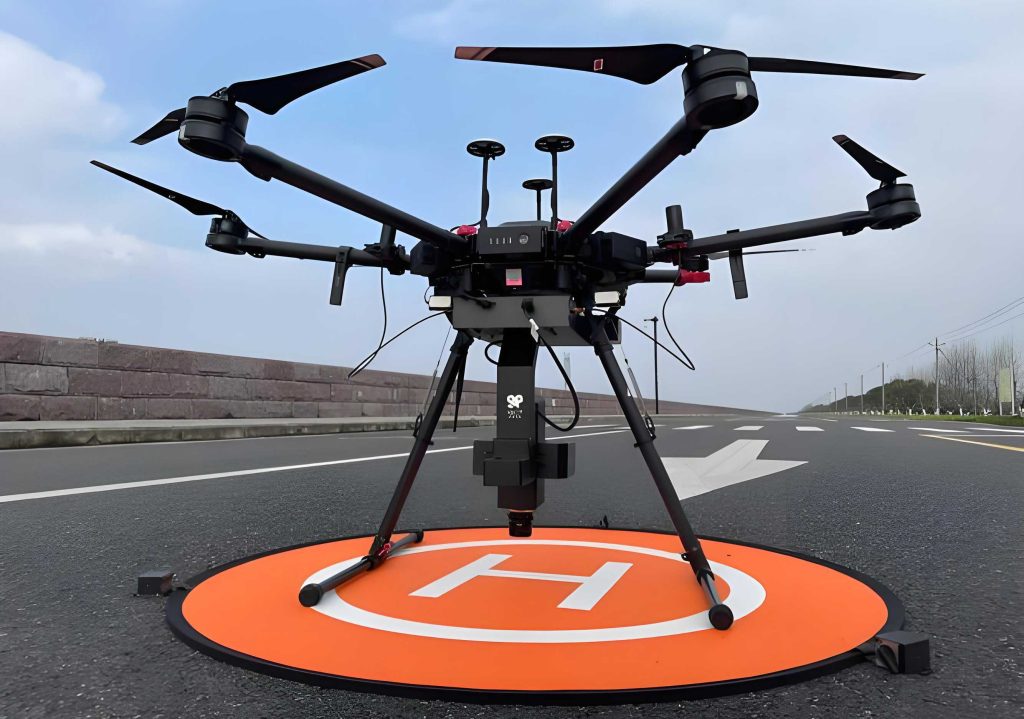
The China drone ecosystem is characterized by a diverse range of unmanned aerial vehicles (UAVs) tailored for varied applications. Our flagship models, such as heavy-lift coaxial helicopters, agricultural drones, and versatile quadcopters, exemplify the engineering prowess driving China drone exports. For instance, the TD550 coaxial unmanned helicopter, with a rotor diameter of 6.4 meters, represents a breakthrough in heavy-lift capabilities. Its electro-mechanical control system enables precise speed adjustment, catering to demanding environments like deserts and high-altitude regions. The payload capacity, defined as a function of altitude, can be expressed as: $$ P(h) = P_0 – k \cdot h $$ where \( P(h) \) is the payload at altitude \( h \) (in meters), \( P_0 = 200 \, \text{kg} \) is the sea-level payload, and \( k = 0.016 \, \text{kg/m} \) is a degradation coefficient, yielding \( P(5000) = 120 \, \text{kg} \). With an endurance of 6.5 hours, the operational range \( R \) in logistics scenarios is given by: $$ R = v \cdot t $$ where \( v \) is the average speed (assumed \( 60 \, \text{km/h} \)) and \( t = 6.5 \, \text{h} \), resulting in \( R = 390 \, \text{km} \). This makes China drone platforms like the TD550 ideal for long-distance missions.
Complementing this, smaller China drone models such as the Q100 agricultural drone and Q20 quadcopter offer specialized functionalities. The Q100 excels in payload stability for crop spraying, while the Q20’s portability enhances efficiency in inspection tasks. Their roles in logistics networks, such as the “city-town-village” three-tier system, have demonstrated a 50% improvement in delivery times, quantified as: $$ \text{Efficiency Gain} = \frac{T_{\text{old}} – T_{\text{new}}}{T_{\text{old}}} \times 100\% = 50\% $$ where \( T_{\text{old}} \) and \( T_{\text{new}} \) are old and new transport times, respectively. The synergy of these China drone products underscores our ability to address global needs from firefighting to precision agriculture.
| China Drone Model | Type | Key Specifications | Primary Applications | Performance Metrics |
|---|---|---|---|---|
| TD550 | Coaxial Helicopter | Rotor Diameter: 6.4 m, Weight: 640 kg | High-rise Firefighting, Energy Inspection, Logistics | Payload: 200 kg (sea level), Endurance: 6.5 h |
| Q100 | Agricultural Drone | Stable Payload Design | Precision Agriculture, Irrigation | Coverage Area: Up to 100 acres per charge |
| Q20 | Quadcopter | Lightweight and Portable | Power Inspection, Last-mile Delivery | Speed: 40 km/h, Range: 50 km |
Our market penetration reflects the soaring demand for China drone technology. Recent orders, including a landmark deal for 1600 heavy-lift industrial drones from a Middle Eastern conglomerate, highlight the global trust in China drone solutions. This aligns with broader trends where China drone exports account for over 70% of global sales, cementing our status as the world’s leading manufacturer and exporter. The growth in trade volume is captured in the following table, based on recent economic reports:
| Period | Total China Drone Export Value (USD) | Year-on-Year Growth | Share of Global Market |
|---|---|---|---|
| 2025 Q1-Q2 | 128.03 billion | 30.5% | Approximately 72% |
| 2024 Annual | Estimated 250 billion | 25% (approx.) | 70% |
The export dynamics can be modeled using a growth formula: $$ E(t) = E_0 \cdot e^{rt} $$ where \( E(t) \) is the export value at time \( t \), \( E_0 \) is the initial value, and \( r \) is the growth rate. For China drone exports, with \( r = 0.3 \) (30% growth), the doubling time \( T_d \) is: $$ T_d = \frac{\ln 2}{r} \approx 2.31 \, \text{years} $$ indicating rapid expansion. This dominance stems from strategic advantages that empower the China drone sector.
Firstly, the China drone supply chain is unparalleled in its completeness and efficiency. Centered in regions like the Guangdong-Hong Kong-Macao Greater Bay Area, we have built an integrated network for components—from flight control systems and chips to sensors and batteries. The cost advantage is quantified by the economies of scale: $$ C(q) = F + v \cdot q $$ where \( C(q) \) is the total cost for producing \( q \) China drone units, \( F \) is fixed cost (lower due to clustering), and \( v \) is variable cost per unit (reduced via localized sourcing). This enables swift iteration, with innovation cycles shortened by up to 40% compared to global competitors.
Secondly, the vast domestic market for China drone applications has fostered deep technological积累. In agriculture, China drone fleets exceed 200,000 units, covering over 400 million mu annually. The productivity gain is expressed as: $$ \text{Productivity} = \frac{A_{\text{covered}}}{N_{\text{drones}} \cdot t} $$ where \( A_{\text{covered}} \) is area covered, \( N_{\text{drones}} \) is number of drones, and \( t \) is time. For logistics, over 20 Chinese cities have regular low-altitude delivery routes, enhancing efficiency by optimizing route algorithms: $$ \text{Optimal Route} = \min \sum_{i,j} d_{ij} x_{ij} $$ subject to constraints like payload and battery limits, where \( d_{ij} \) is distance between points \( i \) and \( j \), and \( x_{ij} \) is a binary variable for route selection. China drone firms lead in patents for core technologies like navigation and obstacle avoidance, with R&D investment growing at 20% annually.
Thirdly, policy support for the China drone industry is systematic and impactful. National strategies designate low-altitude economy as a strategic emerging sector, with regulations such as the Unmanned Aircraft Flight Management Interim条例 streamlining operations. Local initiatives, like green channels for exports, reduce approval times from 60 days to under 2 weeks, boosting competitiveness. The policy effect on export volume \( V \) can be approximated as: $$ V = \alpha + \beta \cdot P + \epsilon $$ where \( P \) represents policy intensity, \( \alpha \) and \( \beta \) are coefficients, and \( \epsilon \) is error term. For China drone exports, \( \beta \) is significantly positive, reflecting enhanced facilitation.
However, the China drone journey faces headwinds in the global arena. Geopolitical tensions and trade barriers, such as import bans in certain countries, pose challenges. The risk index \( R_i \) for a China drone market \( i \) is: $$ R_i = w_1 \cdot G_i + w_2 \cdot T_i $$ where \( G_i \) is geopolitical score, \( T_i \) is trade restriction level, and \( w_1, w_2 \) are weights. Additionally, divergent technical standards across regions increase compliance costs. The compliance cost \( C_c \) for a China drone model in \( n \) markets is: $$ C_c = \sum_{k=1}^{n} (s_k \cdot c_k) $$ where \( s_k \) is standard stringency and \( c_k \) is adaptation cost per market. Data localization requirements further complicate deployments, necessitating agile strategies.
To sustain leadership, the China drone industry is evolving from high-speed growth to high-quality development. We are investing in global rule-making, participating in standards organizations, and building localized ecosystems. For instance, collaboration with partners in Southeast Asia and Africa adapts China drone solutions to local climates, using models like: $$ \text{Adaptation Score} = f(\text{Climate}, \text{Infrastructure}, \text{Regulatory Fit}) $$ Our innovation pipeline includes advancements in tilt-rotor and long-endurance载重 technologies, with R&D expenditure projected to reach $15 billion by 2030. The future roadmap emphasizes sustainability, with electric propulsion reducing carbon footprints: $$ \text{Emission Savings} = \sum (\text{Fuel-based emission} – \text{Electric emission}) $$ per mission.
In conclusion, the China drone phenomenon is reshaping global aviation landscapes. Through synergistic advantages in supply chains, technology, and policy, we have achieved dominance in low-altitude economies. As we navigate challenges, our commitment to innovation and collaboration ensures that China drone systems will continue to soar, driving the future of intelligent manufacturing worldwide. The journey ahead is charted with precision, guided by data and a relentless pursuit of excellence in every China drone that takes flight.