
As a technology enthusiast and practitioner in the field of aerial imaging, I have witnessed firsthand the transformative impact of drone aerial photography on sports events. In this digital age, the integration of unmanned aerial vehicles (UAVs) has redefined how we capture, analyze, and experience sports, offering unprecedented perspectives and capabilities. This article delves into the technical aspects, advantages, and diverse applications of drone technology in sports, with a particular emphasis on the mesmerizing spectacle of drone light shows. Through detailed explanations, tables, and mathematical models, I aim to provide a comprehensive overview that highlights the synergy between innovation and athleticism.
The advent of drone aerial photography marks a paradigm shift in sports media and management. Drones, or UAVs, are remotely controlled or autonomously operated aircraft equipped with cameras, sensors, and communication systems. They come in various types, such as multi-rotor, fixed-wing, and vertical take-off and landing models, with multi-rotor drones being the most prevalent in aerial photography due to their stability, maneuverability, and ability to hover. The evolution of drone technology, driven by advancements in flight control, GPS navigation, and image stabilization, has enabled precise and creative aerial captures. From a personal perspective, I have observed how drones overcome the limitations of traditional ground-based photography, which often struggles with restricted angles, fixed positions, and high costs. Instead, drones offer dynamic, high-altitude views that enhance the visual narrative of sports, making events more immersive and engaging for audiences worldwide.
In sports events, the application of drone aerial photography involves several critical technical considerations. Firstly, safety and regulatory compliance are paramount. I always emphasize the importance of adhering to local aviation laws, such as obtaining flight permits, avoiding no-fly zones, and respecting altitude limits. For instance, regulations like the “Unmanned Aircraft Flight Management Interim Regulations” classify drones based on weight and performance, requiring licenses for operating certain categories. Weather conditions also play a crucial role; while drones can fly in various climates, factors like wind, rain, and visibility must be assessed to ensure safe operations and optimal image quality. Secondly, mastering flight control techniques is essential. This includes planning flight paths meticulously to cover sports venues comprehensively, adjusting for audience safety, and executing maneuvers like orbiting, tracking, and low-altitude flights. The art of aerial photography further involves creative composition—using different angles and movements to capture the essence of sports, such as the speed of a sprinter or the strategy of a team play. Through practice, I have learned to balance technical precision with artistic expression, ensuring that each shot tells a compelling story.
The advantages of drone aerial photography in sports are multifaceted, as summarized in the table below. These benefits not only improve the viewing experience but also contribute to data-driven insights and cost efficiency.
| Aspect | Traditional Photography | Drone Aerial Photography |
|---|---|---|
| Perspective | Limited to ground-level angles; fixed camera positions. | Diverse aerial views (bird’s-eye, low-angle, panoramic); dynamic mobility. |
| Flexibility | Constrained by equipment setup and manual movement. | High maneuverability; real-time tracking of athletes and events. |
| Cost | High expenses for cameras, crew, and helicopters. | Lower equipment and operational costs; reduced need for extensive teams. |
| Data Collection | Slower, often manual data capture; limited to specific metrics. | Rapid, automated data acquisition via sensors; real-time analytics for performance. |
Mathematically, the efficiency of drone data collection can be modeled using equations related to flight dynamics and sensor integration. For example, the position of a multi-rotor drone in three-dimensional space can be described by the following kinematic equations:
$$ \dot{x} = v \cos(\theta) \cos(\psi), $$
$$ \dot{y} = v \cos(\theta) \sin(\psi), $$
$$ \dot{z} = v \sin(\theta), $$
where \( x, y, z \) represent coordinates, \( v \) is velocity, \( \theta \) is pitch angle, and \( \psi \) is yaw angle. These equations help in planning optimal flight paths for capturing sports events, ensuring minimal latency and maximum coverage. Additionally, the data rate \( R \) for image transmission from a drone can be expressed as:
$$ R = B \log_2 \left(1 + \frac{P \cdot G}{N_0}\right), $$
with \( B \) as bandwidth, \( P \) as transmission power, \( G \) as antenna gain, and \( N_0 \) as noise power. This highlights the technical prowess behind real-time streaming in sports broadcasts.
Drone aerial photography finds applications across various domains of sports, each leveraging its unique capabilities. In sports event promotion, drones create captivating宣传 materials by showcasing venues and athletes from aerial perspectives. For instance, I have used drones to film trailers for marathons and skiing competitions, where sweeping shots of landscapes enhance audience appeal. In sports photography, drones extend human vision, allowing for creative compositions that capture the intensity and beauty of athletic movements. A notable example is the use of drones in adventure sports like rock climbing, where aerial shots emphasize both the athlete’s skill and the environmental challenges.
Training and analysis represent another critical area. Equipped with high-resolution cameras and sensors, drones monitor athletes’ physiological parameters and movement patterns. From my experience, this data enables coaches to refine techniques and strategies. For instance, by analyzing drone footage, we can quantify an athlete’s performance metrics, such as acceleration or posture, using formulas like:
$$ a = \frac{\Delta v}{\Delta t}, $$
where \( a \) is acceleration, \( \Delta v \) is change in velocity, and \( \Delta t \) is time interval. This scientific approach enhances training efficacy and injury prevention.
Live broadcasting of sports events has been revolutionized by drones. They provide dynamic, multi-angle coverage that ground cameras cannot achieve, especially in large outdoor events like cycling races or regattas. Drones follow the action seamlessly, offering viewers an immersive experience. For example, in marathon broadcasts, aerial shots track runners across cities, highlighting the scale and excitement of the event. This real-time capability is bolstered by advanced communication systems, ensuring low-latency transmission to global audiences.
Among the most spectacular applications is the drone light show, where synchronized fleets of drones create luminous displays in the sky. These performances have become a staple in major sports events, adding a layer of artistic and technological grandeur. A drone light show involves programming hundreds or thousands of drones to form patterns, logos, and animations, often accompanied by music. The coordination relies on algorithms for swarm control, such as:
$$ \mathbf{p}_i(t+1) = \mathbf{p}_i(t) + \mathbf{v}_i(t) \Delta t, $$
where \( \mathbf{p}_i \) is the position of drone \( i \), \( \mathbf{v}_i \) is its velocity, and \( \Delta t \) is the time step. This ensures precise formation changes, creating visuals like sports mascots or event emblems. The drone light show not only entertains but also promotes events, drawing crowds and media attention. For instance, during international games, these displays have showcased symbols like torches and athlete silhouettes, enhancing the celebratory atmosphere. The integration of drone light shows into sports ceremonies exemplifies how technology merges with tradition, offering a futuristic spectacle that captivates audiences. Below is an example of such a display, illustrating the vibrant patterns achievable through drone light shows.
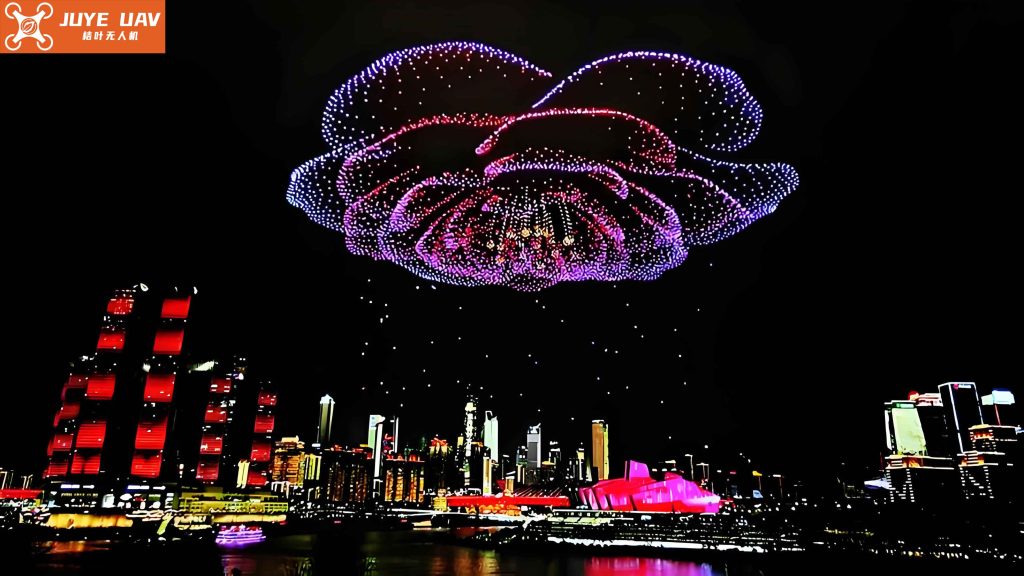
From my perspective, the drone light show represents the pinnacle of creative drone application in sports, blending engineering and art to leave lasting impressions. As drone technology advances, we can expect even more intricate and interactive drone light shows, potentially incorporating real-time data from events to adapt visuals dynamically.
In conclusion, drone aerial photography has indelibly transformed the sports landscape. Through its diverse perspectives, cost-effectiveness, and rapid data capabilities, it enriches everything from training to entertainment. The drone light show, in particular, stands out as a symbol of innovation, turning skies into canvases for celebration. As I look forward, I envision drones playing an even greater role in personalized fan experiences, augmented reality integrations, and sustainable event management. By embracing these technologies, the sports industry can continue to evolve, offering thrilling experiences that resonate across generations. The journey of drones in sports is just beginning, and I am excited to be part of this aerial revolution.