
In recent years, the study of insect flight has garnered significant attention for its potential in advancing micro air vehicle (MAV) technologies. Among insects, butterflies exhibit unique flight characteristics, such as low flapping frequency, large stroke amplitudes, and high wing-body coupling, making them an ideal biological model for developing agile and efficient flying butterfly drones. This article presents a comprehensive investigation into the forward flight mechanics of butterflies through biological observation and the subsequent design, fabrication, and testing of a bio-inspired flying butterfly drone prototype. Our goal is to elucidate the underlying principles that enable butterflies to achieve stable and controlled flight, and to translate these insights into a functional robotic platform.
The flying butterfly drone concept leverages the natural efficiency of butterfly flight, which involves complex kinematic interactions between the wings, thorax, and abdomen. By decomposing butterfly flight into three characteristic motions—wing flapping, thoracic pitching, and abdominal swinging—we can develop a simplified kinematic model that captures the essential dynamics. This model serves as the foundation for designing a lightweight, tailless flying butterfly drone with independent wing control, capable of mimicking the flight patterns observed in nature. Throughout this article, we emphasize the integration of biological insights with engineering innovation, highlighting how the flying butterfly drone can achieve controlled flight through biomimetic design.
Our approach combines high-speed videography for biological observation, advanced manufacturing techniques for wing fabrication, and custom onboard electronics for flight control. The resulting flying butterfly drone prototype demonstrates the feasibility of using butterfly-inspired kinematics for MAV applications, offering potential advantages in maneuverability, stealth, and energy efficiency. Below, we detail the methodologies, designs, and experiments that underpin this work, ensuring that the keyword ‘flying butterfly drone’ is central to our discussion.
Biological Observation of Butterfly Flight
To understand the flight mechanics of butterflies, we conducted systematic observations of live butterflies in controlled environments. The subject species was the Papilio memnon, commonly known as the Great Mormon butterfly, selected for its representative flight characteristics. We defined a coordinate system to quantify the motions of the butterfly during forward flight, as illustrated in Figure 1. The inertial coordinate system $Oxyz$ is fixed to the ground, with the $x$-axis horizontal, $y$-axis vertical, and $z$-axis determined by the right-hand rule. The body-fixed coordinate system $O_b x_b y_b z_b$ is attached to the butterfly’s thorax, with the origin at the center of mass. The wing coordinate system $O_w x_w y_w z_w$ describes wing motion relative to the body, and the abdominal coordinate system $O_a x_a y_a z_a$ captures abdominal movements.
The three characteristic motions are defined as follows:
- Wing Flapping Motion: Described by the flapping angle $\theta_f(t)$, which is the angle between the wing plane and the body’s horizontal plane ($x_b z_b$ plane).
- Thoracic Pitching Motion: Described by the thoracic pitch angle $\theta_t(t)$, which is the angle between the thorax’s longitudinal axis ($x_b$) and the horizontal plane.
- Abdominal Swinging Motion: Described by the abdominal swing angle $\theta_a(t)$, which is the angle between the abdomen’s longitudinal axis ($y_a$) and the horizontal plane.
We set up a high-speed camera system to capture free-flight sequences of butterflies in a transparent enclosure measuring 0.4 m × 0.4 m × 0.4 m. The camera (Motion BLITZ Cube4) operated at 1000 frames per second (fps) with a resolution of 1280 × 1024 pixels, and lighting was optimized to ensure image clarity. We tracked four feature points on the butterfly: the thoracic point, the thorax-abdomen joint G, the abdominal tip, and the wingtip. Using direct linear transformation (DLT) for camera calibration, we obtained two-dimensional coordinates of these points over time, which were then processed to compute displacements, velocities, and accelerations via finite difference methods.
For forward flight analysis, we selected sequences where the butterfly’s centroid displacement satisfied $|dy/dx| < 0.15$ over a flapping cycle. The kinematic data revealed that butterfly forward flight involves periodic variations in flapping, pitching, and swinging motions, with distinct phase relationships. The flapping amplitude ranged from 50° to 70°, thoracic pitch amplitude from 30° to 40°, and abdominal swing amplitude from 20° to 30°. The phase difference between thoracic pitching and wing flapping was approximately $\pi/2$, while that between thoracic pitching and abdominal swinging was near $\pi$. Based on these observations, we derived a simplified kinematic model for butterfly forward flight:
$$
\begin{align*}
\theta_f(t) &= 60^\circ \cos(2\pi f t) + 20^\circ \\
\theta_t(t) &= 30^\circ \cos\left(2\pi f t + \frac{\pi}{2}\right) + 34^\circ \\
\theta_a(t) &= -20^\circ \cos(2\pi f t) – 35^\circ
\end{align*}
$$
where $f$ is the flapping frequency. This model encapsulates the coupled dynamics essential for designing a flying butterfly drone that mimics natural flight.
The observed flight patterns highlight the importance of body motions in augmenting aerodynamic forces. For instance, the thoracic pitch motion modulates the orientation of the flapping plane, effectively controlling lift and thrust generation. Similarly, abdominal swinging may contribute to stability and maneuverability. These insights directly inform the design of our flying butterfly drone, ensuring that the prototype incorporates similar kinematic features.
Design of the Bio-Inspired Flying Butterfly Drone
Drawing from the biological observations, we developed a flying butterfly drone prototype that replicates the key morphological and kinematic attributes of butterflies. The design prioritizes lightweight construction, independent wing actuation, and absence of traditional control surfaces (e.g., tail fins), relying solely on wing motions for lift, thrust, and attitude control. The prototype’s geometric parameters are scaled up from the biological model, with a wingspan of 62.0 cm and a maximum chord length of 38.0 cm, as summarized in Table 1.
| Parameter | Value |
|---|---|
| Wingspan | 62.0 cm |
| Maximum Chord Length | 38.0 cm |
| Flapping Frequency Range | 1.8–3.2 Hz |
| Forewing Sweep Angle | 45° |
| Forewing Area | 575.7 cm² |
| Hindwing Area | 558.1 cm² |
| Maximum Forward Speed | 1.5 m/s |
| Takeoff Mass | 39.60 g |
The overall structure of the flying butterfly drone consists of three main components: the left wing, right wing, and fuselage. The fuselage is an integrated assembly comprising a main carbon fiber rod, servo motor mounts, wing drive servos, onboard flight control electronics, and a micro lithium-polymer battery. Each wing is driven independently by a servo motor (MSK HV75K), which provides precise position control to regulate flapping amplitude, frequency, and phase. The servo delivers a maximum torque of 2.8 kg·cm at 7.4 V, enabling large stroke amplitudes up to 105°. The wing mechanism simplifies the natural butterfly’s flapping by coupling the forewing and hindwing as a single unit, driven via a linkage system that ensures synchronous motion.
A critical aspect of the flying butterfly drone is the biomimetic wing design and fabrication. The wings are constructed using a “rod-membrane” approach, where carbon fiber rods form the wing frame, and thermoplastic polyurethane (TPU) film serves as the wing membrane. This design mimics the venation and flexibility of natural butterfly wings, allowing passive deformation during flapping that enhances aerodynamic performance. The fabrication process involves four steps:
- Create a wing contour mold via 3D printing and secure it on an optical platform.
- Bend carbon fiber rods along the mold contours and attach connectors using adhesive.
- Cut TPU film to size, wrap it over the frame, and heat-seal the edges to form the membrane.
- Reinforce critical joints with tape to complete the wing assembly.
This method ensures symmetry between left and right wings, with mass variations under 0.05 g, crucial for balanced flight of the flying butterfly drone.
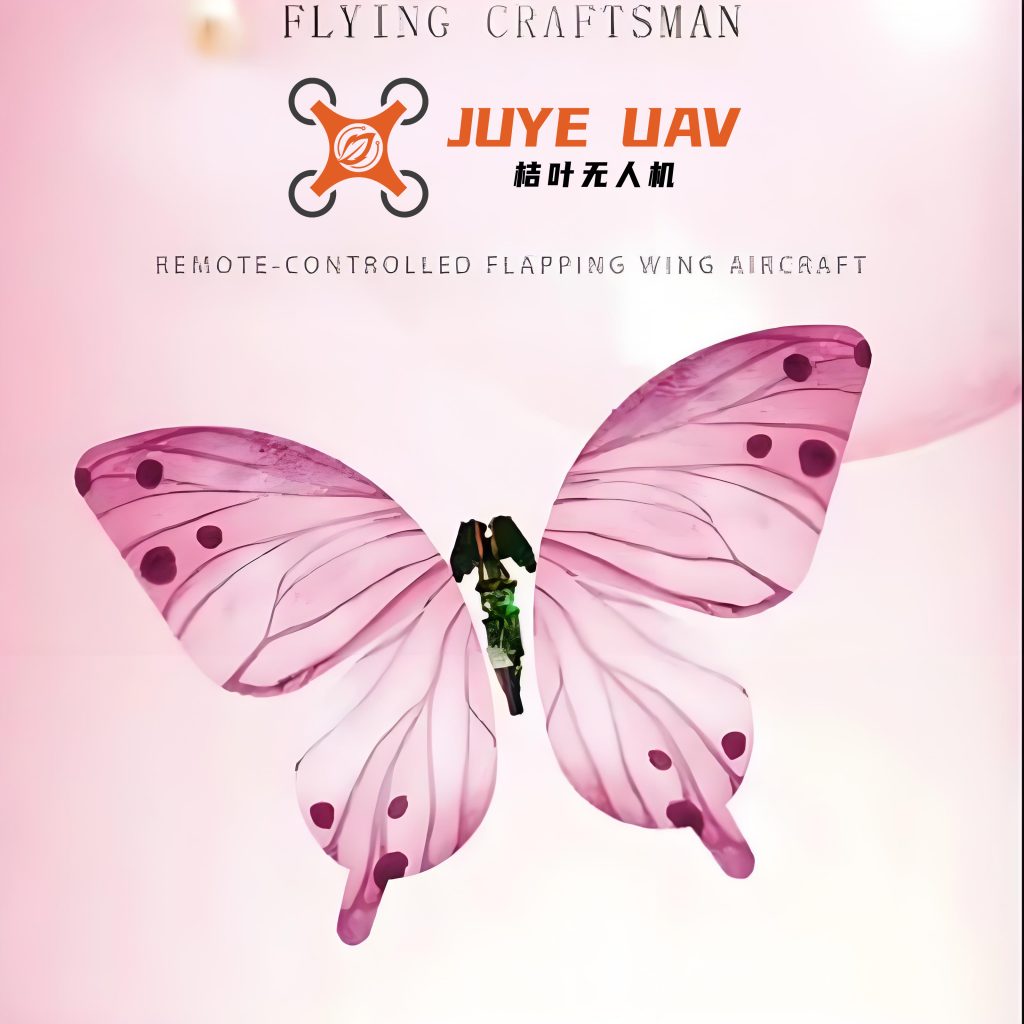
The onboard flight control system is designed for lightweight operation, weighing less than 3 g. It centers on an STM32F411 microcontroller, interfaced with a 915 MHz wireless communication module, a 2.4 GHz RF transceiver (CC2500), an inertial measurement unit (MPU-6000), and four servo control ports. The system implements a proportional-derivative (PD) controller for attitude stabilization, using feedback from roll ($\phi$), pitch ($\theta$), and yaw ($\psi$) angles and their rates ($p$, $q$, $r$). The discrete-time PD control law is given by:
$$
u(k) = k_p e(k) + k_d [e(k) – e(k-1)]
$$
where $u(k)$ is the control output, $e(k)$ is the error between desired and measured attitudes, $k_p$ is the proportional gain, and $k_d$ is the derivative gain. Through tuning, we achieve stable flight control for the flying butterfly drone.
Flight strategies for the flying butterfly drone exploit its underactuated nature. Pitch control is achieved by modulating flapping amplitude while keeping the lower or upper stroke limit fixed. For example, to pitch up, we increase flapping amplitude while holding the downstroke limit constant; to pitch down, we decrease amplitude while holding the upstroke limit constant. Yaw control is accomplished by introducing asymmetry in left and right wing flapping amplitudes. A larger amplitude on the right wing induces left yaw, and vice versa. These strategies enable basic maneuvering without additional control surfaces, aligning with the biological precedent observed in butterflies.
Aerodynamic and Kinematic Modeling
To further optimize the flying butterfly drone, we developed aerodynamic and kinematic models based on the observed butterfly flight data. The aerodynamic forces generated by the flapping wings are influenced by wing morphology, motion parameters, and body interactions. We consider the wing as a flexible membrane that undergoes passive twist and camber during flapping, contributing to unsteady aerodynamic effects such as leading-edge vortices and clap-and-fling mechanisms.
The instantaneous lift ($L$) and thrust ($T$) produced by a wing can be approximated using a quasi-steady model that incorporates wing kinematics and fluid dynamics. For a wing segment with chord length $c(r)$ at radial position $r$, the aerodynamic force per unit span is given by:
$$
dF = \frac{1}{2} \rho C_F V^2 c(r) dr
$$
where $\rho$ is air density, $C_F$ is the force coefficient (dependent on angle of attack and Reynolds number), and $V$ is the local velocity of the wing segment. Integrating over the wing span yields total forces. However, due to the low aspect ratio and large deformations of butterfly-like wings, we employ computational fluid dynamics (CFD) simulations to refine these estimates. Our simulations solve the Navier-Stokes equations for incompressible flow, using the kinematic model from Equation (1) as boundary conditions.
The coupling between wing flapping and body pitching is crucial for net lift generation. In natural butterflies, the thoracic pitch motion ensures that the wings maintain favorable angles of attack during both downstroke and upstroke, reducing force cancellation. We model this coupling by introducing a phase shift $\gamma$ between $\theta_f(t)$ and $\theta_t(t)$, where $\gamma \approx \pi/2$. The effective angle of attack $\alpha(t)$ for the wing is then:
$$
\alpha(t) = \theta_f(t) + \theta_t(t) + \alpha_0
$$
where $\alpha_0$ is a constant offset. This relationship highlights how the flying butterfly drone can achieve positive lift throughout the flapping cycle by emulating the biological phase difference.
Table 2 summarizes key aerodynamic parameters derived from our models and experiments, which guide the design of the flying butterfly drone.
| Parameter | Symbol | Value |
|---|---|---|
| Air Density | $\rho$ | 1.225 kg/m³ |
| Mean Lift Coefficient | $\bar{C}_L$ | 1.2 |
| Mean Thrust Coefficient | $\bar{C}_T$ | 0.8 |
| Reynolds Number | $Re$ | 10,000–20,000 |
| Phase Shift (Flap-Pitch) | $\gamma$ | $\pi/2$ rad |
These models not only validate the biological observations but also provide a framework for optimizing the flying butterfly drone’s performance. For instance, we can adjust flapping frequency, amplitude, and wing stiffness to maximize lift-to-weight ratio or minimize power consumption.
Experimental Verification and Results
We conducted two types of experiments to verify the performance of the flying butterfly drone prototype: ground-based dynamic tests and free-flight tests. These experiments aim to quantify aerodynamic forces, validate the kinematic model, and demonstrate controlled flight capabilities.
Ground-Based Dynamic Tests
Using a six-axis force sensor (ATI Nano17), we measured instantaneous lift, thrust, and pitching moments generated by the prototype under zero freestream conditions. The sensor has a force resolution of 1/320 N and torque resolution of 1/64 N·mm, adequate for the small forces involved. The prototype was mounted with its body horizontal and wing rotation axis aligned, and flapping was driven at various frequencies and amplitudes. Data acquisition was performed at 1 kHz, with filtering to remove noise.
Figure 2 shows sample time histories of thrust and lift over multiple flapping cycles at a flapping frequency of 2 Hz, amplitude of 105°, and wing dihedral angle of 0°. The thrust curve exhibits four positive peaks and one negative peak per cycle, corresponding to mid-downstroke and mid-upstroke phases. The lift curve shows one positive peak during downstroke transition and one negative peak during upstroke transition. The average thrust was 0.238 N, while average lift was only 0.039 N, indicating that body pitching is necessary to generate sufficient net lift, as seen in natural butterflies.
We systematically varied flapping frequency from 1.8 Hz to 3.6 Hz, keeping amplitude at 90° and dihedral at 15°, to assess aerodynamic performance. The results, plotted in Figure 3, reveal that thrust and pitching moment decrease with increasing frequency, whereas lift peaks around 2.25 Hz. Thus, we selected 2.25 Hz as the optimal flapping frequency for the flying butterfly drone.
Additionally, we tested the effects of flapping amplitude and supply voltage on lift and thrust. At 7.4 V, thrust increases with amplitude up to 105° before declining, while lift remains relatively constant. At 5.0 V, thrust is consistently lower due to reduced servo torque. These findings underscore the importance of adequate power delivery for the flying butterfly drone’s actuation system.
Free-Flight Tests
Free-flight tests were conducted in an indoor space using manual launch and remote control via a Futaba T6J transmitter. The onboard PD controller maintained attitude stability, and wing commands were executed according to the flight strategies described earlier. We used a high-speed camera to track the prototype’s motion, focusing on the head point and wingtip for kinematic analysis.
The flying butterfly drone achieved sustained forward flight at speeds up to 1.5 m/s, with flapping amplitudes around 100° and noticeable body pitching oscillations. Figure 4 presents strobed images of a forward flight sequence over 2 seconds, illustrating the periodic nature of wing and body motions. The phase difference between wing flapping and thoracic pitching observed in the biological data is replicated in the prototype, confirming the validity of our kinematic model.
Moreover, the flying butterfly drone demonstrated basic maneuvers such as climbing, descending, and turning via asymmetric flapping. Flight durations exceeded 5 minutes, though slight altitude loss indicated marginally insufficient lift. This could be addressed by further weight reduction or optimizing wing kinematics. Overall, the free-flight tests validate the flying butterfly drone’s ability to emulate butterfly flight patterns and achieve controlled, tailless flight.
Discussion and Future Work
The development of the flying butterfly drone highlights the synergy between biological inspiration and engineering design. By decomposing butterfly flight into characteristic motions and modeling their phase relationships, we created a functional MAV that captures the essence of natural flight. The prototype’s success underscores the potential of butterfly-inspired kinematics for applications requiring agility, low observability, and efficient low-frequency flapping.
However, several challenges remain. The current flying butterfly drone relies on simplified kinematics that neglect active abdominal motion, which in real butterflies may enhance stability and control. Future iterations could incorporate abdominal actuation to explore its effects on flight dynamics. Additionally, aerodynamic efficiency could be improved through wing shape optimization and adaptive stiffness, perhaps using smart materials. Power consumption is another concern; integrating energy harvesting mechanisms, such as solar cells on the wings, could extend flight endurance for the flying butterfly drone.
From a control perspective, advanced algorithms like model predictive control (MPC) or neural networks could enhance maneuvering precision, especially in turbulent environments. Furthermore, swarm behaviors observed in butterfly migrations could inspire coordinated flight of multiple flying butterfly drones, enabling distributed sensing or communication networks.
In conclusion, this work establishes a foundation for bio-inspired flying butterfly drones, combining rigorous biological observation with innovative engineering. The prototype verifies that butterfly flight mechanics can be translated into a viable robotic platform, opening avenues for research in aerodynamics, control, and biomimetics. As technology advances, the flying butterfly drone may evolve into a versatile tool for environmental monitoring, surveillance, or even artistic performances, embodying the elegance and efficiency of nature’s designs.