
The convergence of bionics and micro-aerial vehicle (MAV) technology represents a frontier of innovation, where mimicking nature’s perfected designs offers pathways to overcoming engineering challenges. Among the myriad of biological inspirations, the butterfly stands out for its graceful, efficient, and highly maneuverable flight. This project focuses on the design and fabrication of a bio-inspired flying butterfly drone, an endeavor that synthesizes principles from mechanical engineering, materials science, and electronics. By delving into the unique biological features and flight mechanics of butterflies, this work aims to create a functional prototype that not only validates bionic theories but also contributes novel insights and methodologies to the development of next-generation MAVs. The successful realization of such a flying butterfly drone holds significant promise for applications requiring silent operation, high maneuverability in confined spaces, and aesthetically pleasing integration into natural environments.
Bionics, or biomimetics, is the interdisciplinary field that studies the structures, functions, and processes of biological systems to inspire solutions for human engineering challenges. From the ancient observation of birds leading to dreams of flight to the modern development of gecko-inspired adhesives and shark-skin-derived antifouling surfaces, bionics has been a powerful engine for technological progress. The formal emergence of bionics in the mid-20th century coincided with advances in microscopy, materials science, and computational modeling, allowing for deeper analysis of biological mechanisms at multiple scales. The core philosophy is that through billions of years of evolution, nature has arrived at highly optimized, energy-efficient, and adaptive solutions. Translating these solutions into engineering contexts can lead to breakthroughs in performance, sustainability, and functionality. The development of a flying butterfly drone is a direct application of this philosophy, seeking to capture the aerodynamic secrets of lepidopteran flight.
The butterfly is an exceptionally suitable subject for bionic imitation in aerial robotics due to a combination of morphological, physiological, and behavioral traits that are highly desirable for MAVs.
- Wing Structure and Aerodynamics: Butterfly wings are lightweight, flexible membranes supported by a network of veins. Their large surface area relative to body mass and complex kinematics—involving flapping, twisting, and lead-lag motion—generate lift and thrust through unsteady aerodynamic mechanisms like leading-edge vortices (LEVs) and wake capture. This allows for efficient low-speed flight, hovering, and rapid directional changes, which are challenging for fixed-wing or even conventional rotary-wing drones.
- Material and Sensory Systems: The wings are covered with microscopic scales that not only create color through structural optics but may also influence boundary layer flow and provide water repellency. Butterflies possess sophisticated sensory systems, including compound eyes for wide-field motion detection, antennae for chemosensation, and specialized structures for sensing air currents and vibrations. Integrating even simplified versions of these sensory modalities could greatly enhance a drone’s environmental awareness and autonomy.
- Energy Efficiency and Adaptability: Many butterfly species undertake long migrations, demonstrating remarkable energy efficiency. Their flight strategy often combines active flapping with passive gliding and soaring, leveraging atmospheric energy. Mimicking this mixed-mode propulsion could significantly extend the endurance of a flying butterfly drone.
The flight of a butterfly is a masterpiece of biological engineering, governed by non-steady-state aerodynamics. The primary flight muscles, located in the thorax, drive the wings through a complex, indirect mechanism. Unlike birds, butterflies cannot fold their wings, and the wing stroke plane is often highly inclined. A key aerodynamic phenomenon is the generation and maintenance of a stable Leading-Edge Vortex (LEV) during the downstroke. This vortex, a region of low pressure above the wing, is responsible for producing high lift coefficients, often exceeding those possible under steady-state conditions. The simplified force generation per stroke can be conceptualized by looking at the lift ($L$) and thrust ($T$) components.
The instantaneous lift can be related to the circulation ($\Gamma$) around the wing via the Kutta-Joukowski theorem, adapted for unsteady flow:
$$ L(t) = \rho \cdot \Gamma(t) \cdot v_{wing}(t) $$
where $\rho$ is air density, $\Gamma(t)$ is the time-varying circulation, and $v_{wing}(t)$ is the relative wing velocity. The thrust is generated primarily from the rearward acceleration of air during the wing’s downstroke and pronation/supination motions. The net forward force over a cycle can be estimated by integrating the horizontal component of the aerodynamic force. The wing’s angle of attack ($\alpha$) and flapping frequency ($f$) are critical parameters:
$$ \alpha(t) = \alpha_0 + \alpha_1 \sin(2\pi f t + \phi) $$
where $\alpha_0$ is the mean angle, $\alpha_1$ is the amplitude of variation, and $\phi$ is a phase shift. The body of the butterfly often undergoes significant pitching motions synchronized with the wingbeat to further modulate forces and control attitude.
The design of the flying butterfly drone is centered on replicating the key morphological and kinematic features of a butterfly while accommodating the constraints of artificial actuation and control.
Overall Architecture: The drone employs a monocoque or frame-based body structure housing all electronics. The wings are attached to a central “thorax” module. The primary design goal is to minimize weight while maintaining structural integrity for force transmission. A major trade-off exists between wing size (for lift) and flapping frequency (dictated by actuator capability).
Wing Design: The wing shape is inspired by the Monarch butterfly (Danaus plexippus), known for its efficient migratory flight. The wing planform is recreated using a lightweight, flexible membrane (e.g., polyester film or silicone elastomer) supported by a skeleton of carbon fiber rods. The vein pattern of the carbon skeleton is crucial as it dictates the wing’s flexural and torsional stiffness distribution, enabling passive, aeroelastically beneficial deformation during flapping. The wing root is designed to allow for both flapping (up-down) and a limited degree of twisting motion.
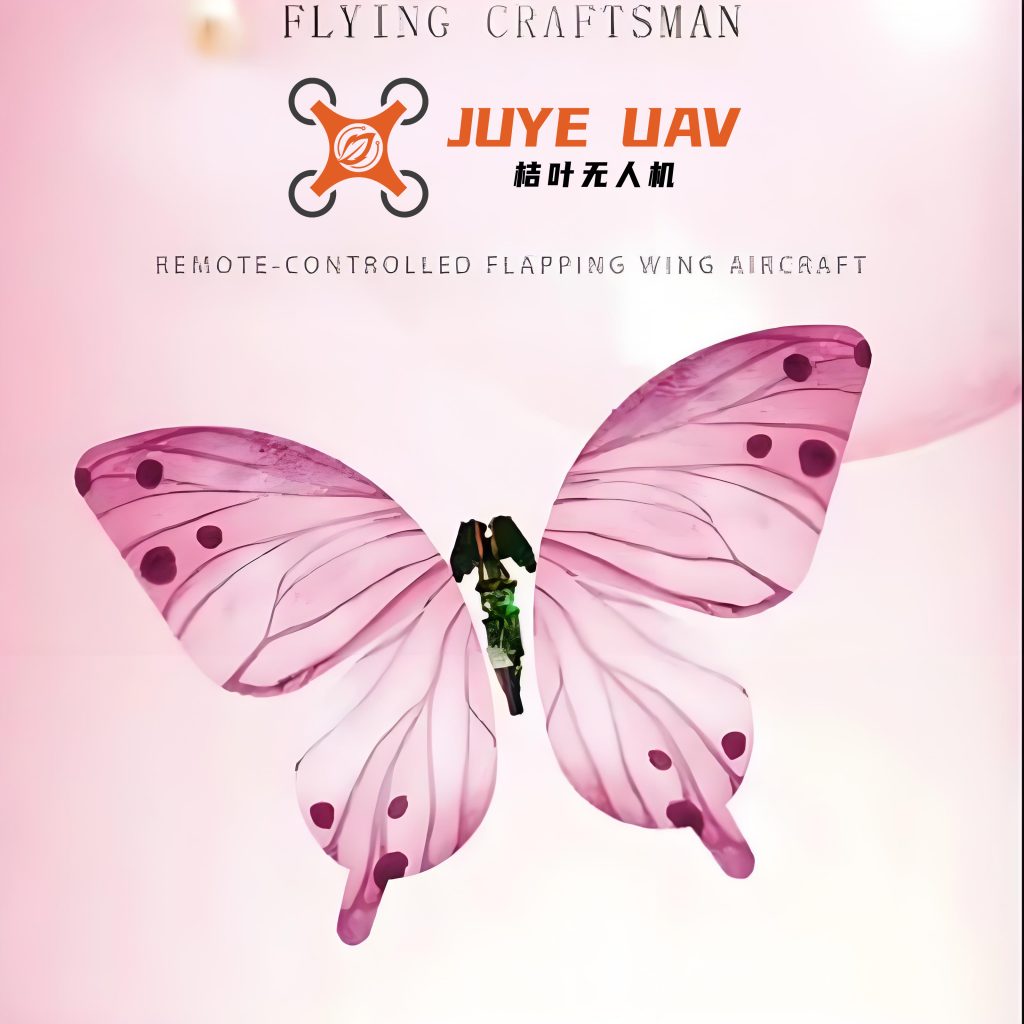
Actuation System: The core challenge is achieving the low-frequency, high-amplitude flapping motion characteristic of butterflies. A geared DC motor or a servo motor coupled with a four-bar linkage or a slider-crank mechanism is typically used to convert rotary motion into oscillatory flapping. The kinematic equations of a simplified crank-rocker mechanism can describe the wing stroke angle $\theta$:
$$ \theta = \arcsin\left(\frac{l_2 \sin(\psi)}{l_3}\right) – \arcsin\left(\frac{l_1 \sin(\omega t)}{l_3}\right) $$
where $l_1$, $l_2$, $l_3$ are link lengths, $\omega$ is the motor angular velocity, $t$ is time, and $\psi$ is a fixed offset angle. The mechanism is symmetrically mirrored to drive both wings. Tailoring the linkage ratios allows control over the flapping amplitude and the shape of the stroke profile.
Control System: Basic control involves independent adjustment of the flapping amplitude and frequency for each wing to generate differential thrust for yawing turns. A small microcontroller (e.g., ATmega328P or STM32) receives commands via a radio receiver. Asymmetric wing kinematics generate a roll moment, while changes in the average stroke angle or the activation of a small tail rudder can control pitch. The control inputs for generating a rolling moment ($M_{roll}$) can be modeled as proportional to the difference in lift between the two wings:
$$ M_{roll} \propto (L_{right} – L_{left}) \cdot d $$
where $d$ is the lateral distance from the body centerline to the wing’s center of pressure. Lift on each wing is a function of the commanded flapping parameters (frequency $f$, amplitude $A$).
The selection of materials is paramount for achieving flight with limited power. The table below summarizes key material choices and their functions.
| Component | Material Options | Key Properties | Role |
|---|---|---|---|
| Wing Membrane | Polyethylene Terephthalate (PET), Polyimide (Kapton), Silicone Rubber | Ultra-lightweight, High Tensile Strength, Flexible | Generates aerodynamic forces, allows passive deformation. |
| Wing Skeleton | Carbon Fiber Rods (0.3-1mm diameter) | High Stiffness-to-Weight Ratio, Can be Shaped | Defines wing shape, transmits actuation forces, controls flexural behavior. |
| Body Frame | 3D-Printed Polymer (PLA, ABS, Nylon), Lightweight Balsa Wood | Low Density, Easily Fabricated into Complex Shapes | Houses electronics, provides mounting points for actuators and wings. |
| Actuation Linkage | Nylon, Acetal (Delrin), Thin Steel Wire | Wear Resistance, Low Friction, Sufficient Strength | Transfers and converts motor motion into wing flapping. |
The fabrication process involves laser-cutting or manually cutting the wing membrane according to the designed planform. The carbon fiber vein pattern is then adhered to the membrane using a flexible cyanoacrylate adhesive, ensuring the joints are robust yet allow for subtle flexing. The body is 3D-printed, and the mechanical linkages are assembled with miniature pins and bearings to minimize friction. The electronic components (motor, receiver, battery) are carefully positioned to balance the center of gravity along the longitudinal axis.
Extensive iterative testing and optimization are required to transition from a static model to a stable flying butterfly drone. The process involves systematic variation of parameters to achieve desired flight characteristics.
Kinematic and Aerodynamic Tuning: Initial bench tests focus on verifying smooth, symmetrical wing motion without binding. The wing’s neutral position (resting angle relative to the body) is adjusted. A slight positive dihedral or anhedral can be introduced to influence inherent roll stability. The flapping frequency is tuned to find a resonance point where lift production is maximized for a given power input. This can be expressed as maximizing the lift-to-power ratio:
$$ \text{Maximize: } \eta = \frac{\bar{L}}{P_{in}} $$
where $\bar{L}$ is the average lift over a cycle and $P_{in}$ is the electrical input power to the motor.
Flight Performance Optimization via Design of Experiments: To objectively improve flight performance metrics such as flight time, stability, and forward speed, an orthogonal experimental design combined with Grey Relational Analysis can be employed. Key controllable factors (e.g., wing stiffness, flapping frequency, battery position) are varied at different levels. The performance outcomes are then normalized, and grey relational grades are calculated to determine the optimal parameter combination that best satisfies all objectives simultaneously. This data-driven approach moves beyond trial-and-error.
Results from a Parametric Study: The following table illustrates how varying the motor speed (related to flapping frequency) and the gear ratio of the transmission (affecting torque and amplitude) influences key flight metrics for a prototype. A balance must be struck between speed/altitude and endurance.
| Motor Speed (RPM) | Gear Ratio | Avg. Flight Speed (m/s) | Max Attainable Height (m) | Flight Endurance (min) |
|---|---|---|---|---|
| 5000 | 1:5 | 1.2 | 2.5 | 8 |
| 6000 | 1:4 | 1.5 | 3.0 | 7 |
| 7000 | 1:3 | 1.8 | 3.5 | 6 |
Control and Stability Enhancement: The basic open-loop remote control is augmented by tuning the control response curves. The relationship between the transmitter stick input ($u$) and the change in motor command ($\Delta C$) is often linear but can be modified:
$$ \Delta C = K_p \cdot u + K_d \cdot \frac{du}{dt} $$
where $K_p$ and $K_d$ are proportional and derivative gains, respectively. Adding a derivative term can help dampen oscillatory motions. Furthermore, the mechanical design can be optimized to reduce play in linkages, which is a major source of control lag and instability in a flapping-wing flying butterfly drone.
This project successfully demonstrates the feasibility of constructing a bio-inspired flying butterfly drone. The prototype validates core principles of insect-scale unsteady aerodynamics, particularly the critical role of wing flexibility and kinematics in force generation. While the current model achieves basic controlled flight, it highlights several areas for future development. These include integrating micro-sensors (gyroscopes, accelerometers) for active stabilization, employing smart materials like piezoelectric composites for more efficient and silent actuation, and exploring advanced wing materials that mimic the multifunctionality of natural scales (self-cleaning, communication). The pursuit of such a flying butterfly drone is more than an engineering exercise; it is a step towards a new class of MAVs that are efficient, agile, and capable of seamless interaction with complex natural and human-made environments. The knowledge gained feeds back into both robotics and biology, offering a deeper understanding of flight itself.