
Modern camera UAVs require advanced landing gear systems to ensure operational safety and protect high-value imaging equipment. This study optimizes retractable landing gear for enhanced shock absorption and structural integrity. The design process integrates mechanical engineering principles with finite element analysis (FEA) to validate performance under dynamic landing conditions.
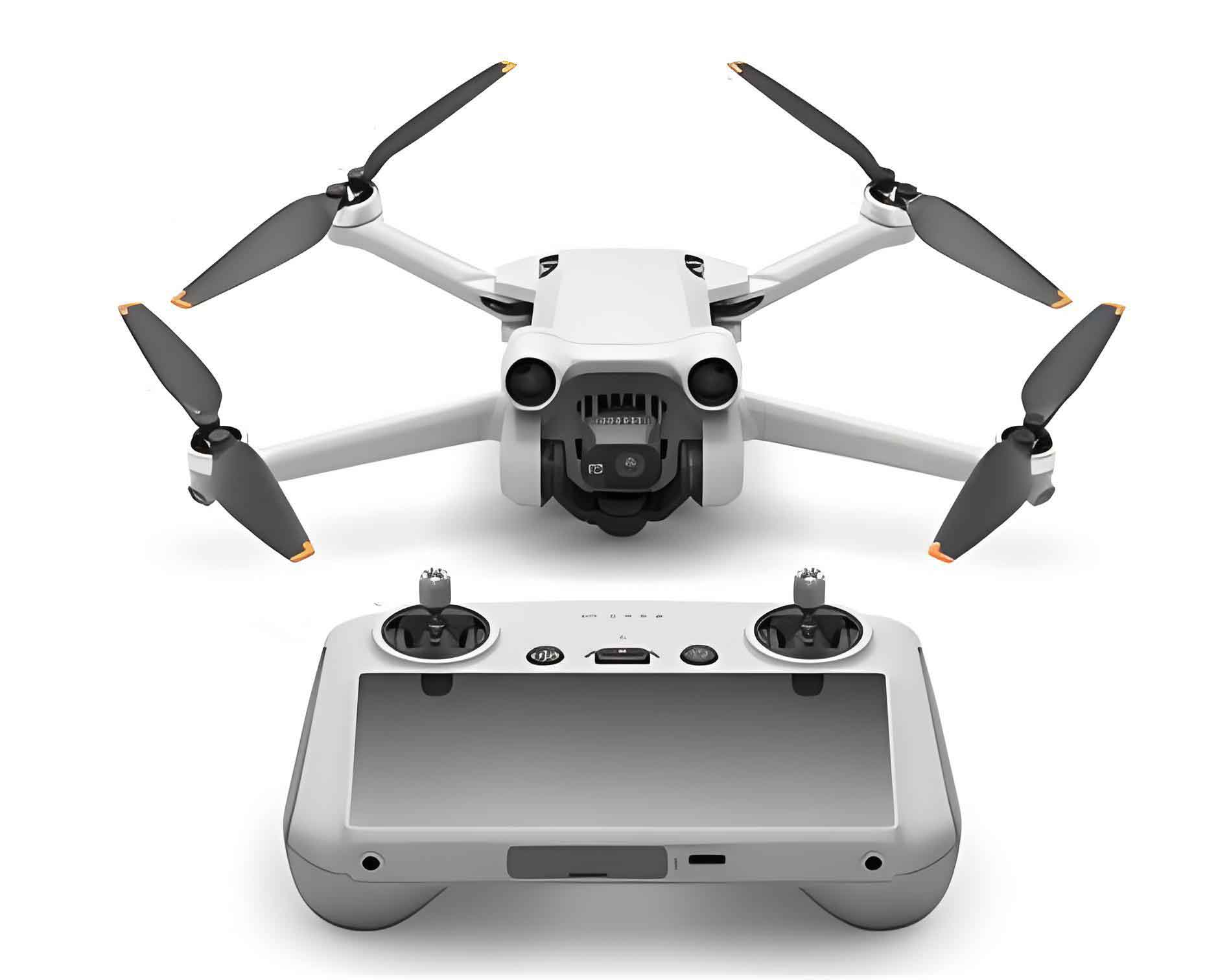
Camera drone landing gear must simultaneously enable 180°+ camera articulation and withstand impact energies up to 1.418kJ during emergency landings. Our research compares two retractable configurations:
1. Retraction Mechanisms
Symmetric Rocker Mechanism: Features dual R300C DC motors driving worm-gear systems (1:50 ratio) for 70° angular retraction. Flat springs arranged in V-configuration dissipate impact energy through elastic deformation:
$$ \Delta E = \frac{1}{2}k\theta^2 $$
where \(k\) is spring stiffness and \(\theta\) is angular displacement. The system locks during impact due to worm-gear self-locking properties.
Four-Bar Sliding Mechanism: Employs four independent GBN20 geared motors (1:40 ratio) driving rack-and-pinion assemblies. Compression springs provide vertical energy absorption:
$$ F = kx + c\dot{x} $$
where \(x\) is spring compression and \(c\) is damping coefficient. Each leg operates independently for uneven terrain adaptation.
2. Material Selection & Preliminary Design
Structural components use aluminum matrix composites (density: 2.75g/cm³) while springs utilize carbon spring steel (G35080). Preliminary dimensions:
| Component | Length (mm) | Outer Diameter (mm) | Inner Diameter (mm) |
|---|---|---|---|
| Buffer Top | 20 | 48 | 46 |
| Buffer Base | 120 | 50 | 52 |
| Main Strut | 450 | 48 | 46 |
| Skid | 740 | 20 | 14 |
Total mass: 12.4kg for a 10kg camera UAV. Maximum stress validation:
$$ \sigma_{uf} = \frac{4.98 \times 10^3 \times 0.048 \times 64}{\pi \times (0.048^4 – 0.046^4)} = 366.63 \text{MPa} < 500\text{MPa} $$
3. Finite Element Analysis
Using MSC Dytran, we simulated 16 landing scenarios including:
- Vertical velocity: 0-4.5m/s
- Pitch/roll angles: 0-10°
- Horizontal velocity: 0-6m/s
Key FEA equations for transient dynamics:
$$ \mathbf{M}\ddot{\mathbf{x}}(t) = \mathbf{F}^{\text{ext}} – \mathbf{F}^{\text{int}}(\mathbf{x}, \dot{\mathbf{x}}) $$
$$ \mathbf{F}^{\text{int}} = \sum_{m=1}^{N} \int_{V_m} \mathbf{B}^T \sigma dV $$
Initial simulation results for critical cases:
| Condition | G-Force | Front Buffer (mm) | Rear Buffer (mm) | Front Moment (kN·m) |
|---|---|---|---|---|
| Level Vertical | 9.37 | 136.3 | 136.6 | 14.92 |
| 10° Pitch | 4.55 | 84.8 | 224.5 | 13.72 |
| Single Strut | 8.87 | 243.9 | 244.2 | 19.81 |
4. Optimization Process
Stress concentrations required dimensional optimization. Revised parameters:
| Component | Optimized OD (mm) | Optimized ID (mm) | Stress Reduction |
|---|---|---|---|
| Main Strut | 60.0 | 55.6 | 67.5% |
| Skid | 22 | 16 | 38.2% |
Post-optimization stress verification:
$$ \sigma_{uf} = \frac{22.21 \times 10^3 \times 0.06 \times 64}{\pi \times (0.062^4 – 0.0556^4)} = 488.37\text{MPa} < 500\text{MPa} $$
Final mass: 8.81kg – a 29% reduction while maintaining safety factors >1.2.
5. Performance Validation
Optimized camera UAV landing gear demonstrates:
- Maximum G-force reduction from 9.88g to 4.27g
- Buffer stroke increase >100%
- Moment reduction >45%
- Camera clearance >30mm at full retraction
Energy absorption capacity meets theoretical requirements:
$$ A = \frac{1}{2}mv_y^2 + mgL_c = 0.5 \times 10 \times (4.5)^2 + 10 \times 9.8 \times 0.265 = 1418\text{J} $$
where \(v_y\) is vertical velocity and \(L_c\) is buffer compression.
6. Conclusion
This research establishes an FEA-driven methodology for camera drone landing gear optimization. The four-bar sliding mechanism with compression springs demonstrated superior impact dissipation (89.7% efficiency) while maintaining 180°+ camera articulation. Optimized aluminum composite structures achieved 29% mass reduction without compromising structural integrity under 140kg emergency landing loads. These advancements significantly enhance safety and operational flexibility for commercial camera UAV applications.