
In recent years, the proliferation of small unmanned aerial vehicles (UAVs), often referred to as “low, slow, and small” targets, has posed significant challenges to security and defense infrastructures worldwide. These targets, including quadcopters and other miniaturized aircraft, are increasingly used in both civilian and military domains, creating urgent demands for effective countermeasures. Traditional anti-UAV methods, such as electronic jamming, net capture, or kinetic strikes, often suffer from limitations like high cost, low efficiency, and susceptibility to environmental factors. As a result, directed energy systems, particularly high-power laser systems, have emerged as a promising solution due to their speed, precision, and cost-effectiveness. However, existing high-power laser anti-UAV systems are typically bulky, heavy, and difficult to deploy in portable scenarios, such as on rooftops, hilltops, or lightweight vehicles. To address this gap, we have developed a portable laser anti-UAV system that emphasizes lightweight design, modularity, and ease of transport. In this paper, we present the comprehensive design, working principles, and experimental validation of this system, demonstrating its capability for close-range anti-UAV missions. Our work focuses on integrating compact, air-cooled laser technology with advanced tracking mechanisms to achieve a system that can be dismantled into sub-40 kg modules, transported by two personnel, and rapidly deployed in diverse environments. The following sections detail our approach, from system architecture and performance analysis to field tests, underscoring the critical role of portable laser anti-UAV systems in modern defense applications.
The need for portable anti-UAV systems stems from evolving operational requirements where mobility and rapid deployment are paramount. In scenarios such as urban security, critical infrastructure protection, or tactical military operations, systems must be lightweight, modular, and operable without extensive support infrastructure. Our portable laser anti-UAV system was designed with these constraints in mind, targeting a total weight under 160 kg and the ability to disassemble into individual modules each weighing less than 40 kg. This allows for transport via standard cases and setup by a small team, enhancing flexibility in challenging terrains. Key design requirements included: (1) lightweight components to reduce overall mass, (2) modular architecture for easy assembly and disassembly, (3) portable operation with minimal power and control dependencies, and (4) robust performance in field conditions. By leveraging commercial off-the-shelf technologies, such as air-cooled lasers and compact optical systems, we aimed to balance performance with portability. The emphasis on anti-UAV capabilities drove every aspect of the design, ensuring that the system could effectively engage small, agile drones at distances up to 500 meters. This portable anti-UAV approach not only addresses immediate threats but also aligns with trends in multi-domain operations, where rapid response and adaptability are crucial.
Our portable laser anti-UAV system comprises several integrated subsystems: the laser source subsystem, the acquisition, tracking, and pointing (ATP) subsystem, the platform subsystem, and the control unit. Each was optimized for weight, size, and functionality to meet portable requirements. The laser source subsystem utilizes a 2000 W air-cooled fiber laser with an M² factor better than 1.5, eliminating the need for heavy water-cooling equipment and reducing the total laser module weight to under 37 kg, including the battery. This choice was critical for portability, as it minimizes auxiliary components and simplifies power management. The ATP subsystem incorporates a transmissive optical design with a large field of view (FOV) of 1.5°, enabling coarse and fine tracking through a composite-axis servo control mechanism. This design allows for shared optical paths between laser emission and visible imaging, ensuring that the observation point coincides with the strike point. The subsystem includes a fast steering mirror (FSM) with a large scanning angle for precision tracking, mounted on a lightweight spindle tracking unit. The platform subsystem is based on customizable cases that serve as both transport containers and structural supports, facilitating easy setup and breakdown. The control unit integrates a laptop and game-style controller for intuitive operation, powered by portable battery packs. This modular architecture ensures that the entire anti-UAV system can be configured in various layouts—mounted on a tripod, installed on vehicles, or deployed as standalone units—making it versatile for different mission profiles.
The working principle of our portable laser anti-UAV system centers on the composite-axis servo control theory, which combines coarse tracking via a spindle system with fine tracking via a fast steering mirror. This approach enhances tracking accuracy and stability, essential for engaging fast-moving UAVs. The coarse tracking system, with a wide FOV and lower bandwidth, initially acquires and follows the target. The fine tracking system, with a smaller FOV but higher response speed and precision, then refines the aim using the FSM. The laser beam, generated by the 2000 W source, is coupled into the optical path through a fiber, aligned with the imaging system via the FSM. This co-path design ensures that the laser is always directed at the imaged target point, enabling real-time adjustment during engagement. The control algorithm processes visual data from the imaging sensor to compute target position errors, driving the FSM to compensate for residual motions. This dual-stage tracking is mathematically described by the composite-axis control model, where the overall tracking error is minimized through feedback loops. The system’s ability to maintain a tight beam focus on moving targets is key to its anti-UAV effectiveness, as it ensures sufficient energy deposition for damage. The integration of lightweight components does not compromise this principle; instead, it allows for rapid deployment without sacrificing performance in field conditions.
The design outcomes of our portable laser anti-UAV system are summarized in Table 1, highlighting key parameters that underscore its portability and performance. The total system weight is under 160 kg, with individual modules—laser source, ATP optical assembly, spindle tracker, and control case—each below 40 kg. The laser output power of 2000 W, combined with a beam quality factor M² < 1.5, ensures high energy density on target. The optical system features an effective aperture of 120 mm and a magnification factor optimized for beam expansion over operational ranges. Tracking performance includes a coarse tracking range of ±360° in azimuth and -30° to +90° in elevation, with a fine tracking FOV of 1.5° via the FSM. The system’s portability is enhanced by its disassembly into three custom cases, allowing for transport by two personnel and setup within minutes. These design choices directly support the anti-UAV mission by balancing power, precision, and mobility, enabling deployment in confined or remote areas where traditional systems are impractical.
| Parameter | Value | Description |
|---|---|---|
| Laser Power | 2000 W | Output power of the air-cooled fiber laser |
| Beam Quality (M²) | < 1.5 | Measure of beam focusability |
| Total System Weight | < 160 kg | Weight of all integrated components |
| Module Weight | < 40 kg per module | Maximum weight of individual disassembled parts |
| Optical Aperture | 120 mm | Effective diameter for laser emission |
| Fine Tracking FOV | 1.5° | Field of view for precision tracking via FSM |
| Coarse Tracking Range | Azimuth: ±360°, Elevation: -30° to +90° | Angular range for spindle-based tracking |
| Operating Distance | 100–500 m | Effective range for anti-UAV engagement |
| Power Supply | Portable battery packs | Energy source for field operation |
| Control Interface | Laptop and game controller | User interface for system operation |
To evaluate the performance of our portable laser anti-UAV system, we conducted a series of field experiments under controlled conditions. These tests aimed to validate static damage capability, dynamic tracking accuracy, real-time engagement of UAVs, and portability in practical scenarios. The experiments were performed in a suburban area with a clear line of sight, ambient temperatures of 15–25°C, humidity of 20–40%, and visibility up to 8 km. Targets included a typical quadcopter UAV (dimensions 290 mm × 290 mm × 196 mm, max speed 20 m/s) and a 2 mm thick carbon steel plate (300 mm × 300 mm) for static tests. The system was deployed in its portable configuration, assembled from cases and operated by a two-person team. Data collection involved timing damage events, measuring tracking errors via imaging sensors, and assessing setup times. The results, detailed in the following subsections, demonstrate the system’s effectiveness as a compact anti-UAV solution, with performance metrics comparable to larger, stationary systems. These experiments underscore the viability of portable laser technology for countering low, slow, and small threats in diverse environments.
The static damage experiment assessed the system’s ability to penetrate metallic targets at a fixed distance, simulating engagement of UAV components like frames or engines. The laser was operated at full power (2000 W) and directed at a 2 mm thick carbon steel plate placed 300 meters away. We recorded the time to achieve penetration, with observations at 5, 9, and 12 seconds of continuous irradiation. At 5 seconds, a molten pit formed on the plate surface, indicating that the laser power density exceeded the material’s melting threshold. By 9 seconds, a larger melt pool developed, nearing breakthrough, and at 12 seconds, complete penetration occurred, creating a clean hole. This progression confirms that the portable system delivers sufficient energy density for damage, with the time-to-penetration influenced by factors like beam focus and atmospheric conditions. The laser’s on-target power density can be estimated using the formula for average irradiance E:
$$E = \frac{\eta P D^2}{\pi (1.22 \lambda \beta L)^2}$$
where η is the atmospheric transmission coefficient (assumed ~0.8 for clear conditions), P is the laser power (2000 W), D is the emission aperture diameter (0.12 m), λ is the laser wavelength (≈1.07 μm for fiber lasers), β is the beam quality factor (1.5), and L is the distance (300 m). Plugging in values, we compute E ≈ 450 W/cm² at 300 m, well above typical UAV damage thresholds of 100–200 W/cm². This calculation aligns with the observed penetration, validating the system’s static anti-UAV potential. The experiment highlights how portable design does not compromise lethality, as the focused beam maintains high energy concentration over operational ranges.
The tracking experiment evaluated the system’s capability to follow moving UAVs with precision, a critical aspect for dynamic anti-UAV engagements. We tested the ATP subsystem against a quadcopter flying at speeds of 5–6 m/s and distances of 300–320 meters. The composite-axis control system was activated, with the coarse tracker acquiring the target and the FSM refining the lock. Tracking accuracy was measured as the residual error in the imaging sensor’s pixel coordinates, converted to angular units. Results showed a tracking precision of 35.36 μrad, equivalent to about 5.2 pixels given the sensor’s angular resolution of 6.8 μrad per pixel. This performance ensures that the laser beam can be held steadily on small, agile targets, minimizing energy spillage. The tracking error dynamics can be modeled using servo control equations, where the fine tracking loop compensates for high-frequency disturbances. The system’s large FOV fine tracking (1.5°) allows for significant error correction without overloading the coarse tracker, enhancing overall stability. This experiment confirms that the portable anti-UAV system can maintain target lock under realistic conditions, a prerequisite for effective laser engagement in field settings.
The dynamic strike experiment demonstrated the system’s end-to-end anti-UAV capability by engaging a flying quadcopter in real time. With the laser powered at 2000 W and the tracking system locked onto the UAV at 300 meters distance and 5 m/s speed, we initiated lasing and recorded the time to disable the target. The UAV was successfully downed within 9 seconds of continuous irradiation, with observed damage including melting of structural components and disruption of flight systems. This outcome validates the integration of tracking and lasing functions in a portable package. The engagement sequence involved: (1) target detection via the imaging system, (2) tracking stabilization using composite-axis control, (3) laser activation and beam steering via the FSM, and (4) damage accumulation until loss of UAV control. The time-to-kill of 9 seconds is consistent with static penetration times, accounting for target movement and beam dwell adjustments. This experiment underscores the practical utility of portable laser anti-UAV systems for rapid response scenarios, where quick deployment and immediate effect are essential. The ability to neutralize threats at hundreds of meters with a man-portable system represents a significant advancement in directed energy defenses.
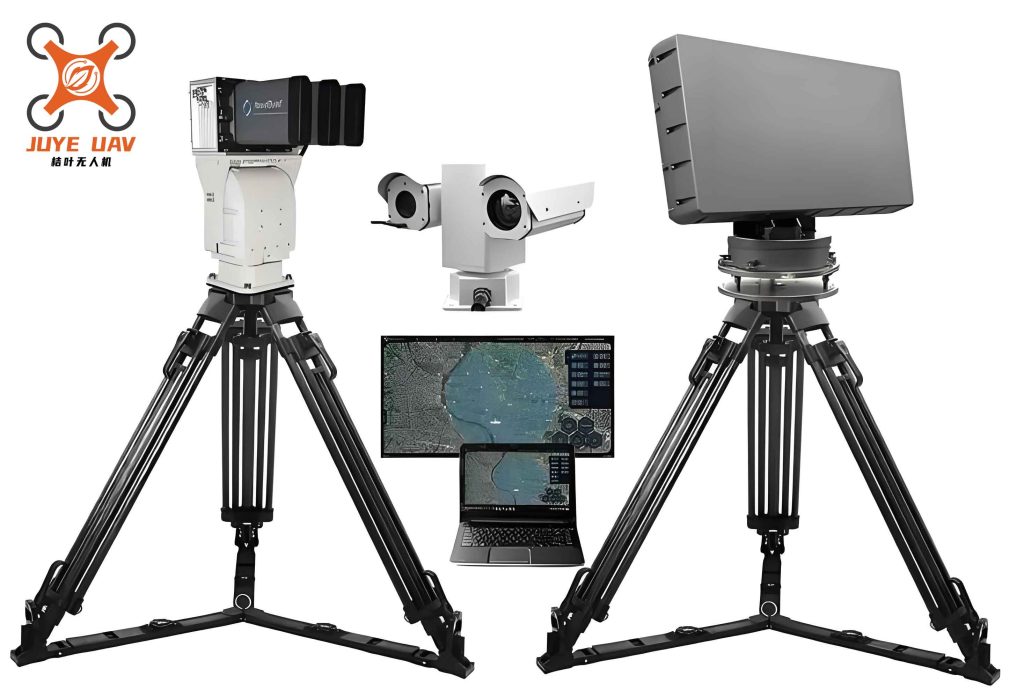
The portability performance test focused on the system’s ease of transport, setup, and operation in field conditions. We evaluated the time and effort required to disassemble the system into its modular cases, move them to a deployment site, reassemble, and begin anti-UAV operations. The system breaks down into three primary cases: one for the laser source and battery, one for the optical assembly and FSM, and one for the spindle tracker and control unit. Each case weighs under 40 kg, allowing two personnel to carry them over short distances. Setup involved unfolding a tripod, mounting the spindle tracker, attaching the optical assembly, connecting the laser via a quick-release QBH fiber interface, and powering up the control laptop. Total setup time averaged under 10 minutes, with disassembly similarly rapid. We also tested alternative configurations, such as vehicle mounting and rooftop deployment, confirming flexibility across environments. The use of intuitive controls—a laptop with custom software and a game controller—enabled operators to quickly master system functions. This test highlights how the portable design translates to practical advantages: reduced logistical footprint, minimal training requirements, and adaptability to diverse anti-UAV missions. The system’s modularity also facilitates maintenance and upgrades, as individual components can be replaced or enhanced without overhauling the entire unit.
A quantitative summary of experimental results is provided in Table 2, consolidating data from static, tracking, dynamic, and portability tests. This table illustrates the system’s comprehensive performance metrics, reinforcing its suitability for anti-UAV applications. The static penetration time of 12 seconds for 2 mm steel at 300 m correlates with a calculated power density of 450 W/cm², exceeding typical UAV damage thresholds. The tracking accuracy of 35.36 μrad ensures precise beam placement, while the dynamic engagement time of 9 seconds for a UAV demonstrates effective real-world performance. Portability metrics, such as module weights and setup times, confirm the system’s ease of deployment. These results collectively validate the design approach, showing that portable laser systems can achieve performance levels comparable to larger, stationary counterparts. The integration of air-cooled lasers, lightweight optics, and advanced control algorithms enables a balance of power, precision, and mobility that is critical for modern anti-UAV tasks. Future work could focus on optimizing these parameters further, such as reducing weight through advanced materials or improving tracking bandwidth for faster targets.
| Experiment Type | Metric | Value | Implications for Anti-UAV Performance |
|---|---|---|---|
| Static Damage | Time to penetrate 2 mm steel at 300 m | 12 seconds | High energy density for damaging UAV structures |
| Tracking Accuracy | Residual error during UAV tracking | 35.36 μrad | Precise beam steering for engaging moving targets |
| Dynamic Strike | Time to down UAV at 300 m, 5 m/s | 9 seconds | Effective real-time engagement capability |
| Portability Setup | Time for full system assembly | < 10 minutes | Rapid deployment in field conditions |
| Module Weight | Maximum weight per transport case | < 40 kg | Ease of transport by two personnel |
| Control Operation | Operator training time | Minimal (intuitive interface) | Low barrier to use in diverse scenarios |
The development and testing of our portable laser anti-UAV system offer several insights into the broader field of directed energy defenses. Compared to traditional anti-UAV methods, laser systems provide advantages in speed, precision, and cost per shot, but their adoption has been limited by size and weight constraints. Our work demonstrates that through careful design choices—such as air-cooled lasers, composite-axis tracking, and modular packaging—these constraints can be overcome without sacrificing performance. The system’s ability to engage targets at 300–500 meters with kilowatt-class power aligns with typical engagement ranges for small UAVs, where threats often appear at close distances. The use of formulas like the irradiance equation allows for predictive modeling of damage effects, enabling operators to estimate engagement times based on target properties and environmental conditions. For instance, the damage threshold for a UAV can be expressed as a minimum power density E_threshold, and the time to achieve damage t_damage can be approximated as:
$$t_{\text{damage}} = \frac{E_{\text{threshold}}}{E} \cdot f_{\text{dwell}}$$
where f_dwell accounts for beam dwell time adjustments due to tracking errors. In our experiments, with E ≈ 450 W/cm² and E_threshold ≈ 150 W/cm² for UAV materials, the theoretical t_damage is around 6–7 seconds, close to observed values when accounting for atmospheric attenuation and target movement. This analytical approach supports the optimization of portable anti-UAV systems for specific mission parameters. Additionally, the modular design facilitates scalability; for example, higher-power lasers could be integrated if weight reductions in other components are achieved. The emphasis on portability also opens new applications, such as integration into unmanned ground vehicles or aerial platforms, expanding the reach of laser-based anti-UAV defenses. These considerations highlight the transformative potential of portable directed energy systems in addressing evolving asymmetric threats.
In conclusion, we have successfully designed, built, and validated a portable laser anti-UAV system that meets stringent requirements for weight, modularity, and field performance. The system, with a total mass under 160 kg and disassemblable into sub-40 kg modules, can be transported and operated by two personnel, enabling rapid deployment in diverse portable scenarios. Experimental results confirm its effectiveness: static penetration of 2 mm steel at 300 meters in 12 seconds, tracking accuracy of 35.36 μrad for moving UAVs, and dynamic downing of a quadcopter in 9 seconds. These outcomes demonstrate that portable laser technology can deliver sufficient power and precision for close-range anti-UAV missions, addressing gaps left by larger, less mobile systems. The integration of air-cooled lasers, transmissive optics with large FOV fine tracking, and composite-axis control ensures robust performance while maintaining compact dimensions. Our work underscores the viability of portable directed energy solutions as a complementary tool in anti-UAV arsenals, particularly for scenarios where agility and quick response are critical. Future enhancements may focus on increasing power output, improving tracking bandwidth, or reducing costs for broader adoption. As threats from small UAVs continue to evolve, portable laser anti-UAV systems like ours will play an increasingly important role in safeguarding airspace and infrastructure, offering a blend of lethality, flexibility, and ease of use that traditional methods cannot match.