
The proliferation and technological advancement of Unmanned Aerial Vehicles (UAVs) have fundamentally altered the modern battlespace. Their ability to conduct persistent, low-risk intelligence, surveillance, and reconnaissance (ISR) poses a critical and escalating threat to high-value assets, with artillery positions being a primary target. The lessons from recent conflicts underscore the devastating effectiveness of UAV-directed fires. Therefore, developing and implementing robust anti-UAV measures is not merely a tactical consideration but a strategic imperative for ensuring the survivability and operational effectiveness of artillery units. This analysis delves into the UAV threat spectrum, evaluates current countermeasure limitations, and proposes a multi-layered, integrated framework for countering UAV reconnaissance against artillery positions.
The core vulnerability of an artillery position lies in its relative static nature post-deployment. Modern self-propelled artillery, while mobile, requires time to displace. This window of exposure is exploited by adversarial UAVs. Their primary ISR methods can be categorized and analyzed for effective countermeasure design.
UAV Reconnaissance Modalities and the Associated Threat Calculus
Understanding the sensor suite of enemy UAVs is the first step in crafting effective countermeasures. Each modality presents unique challenges requiring tailored anti-UAV responses.
| Reconnaissance Modality | Primary Technology | Key Capabilities & Advantages | Inherent Vulnerabilities & Limitations |
|---|---|---|---|
| Electro-Optical/Visual (EO/IR) | High-resolution cameras, low-light/thermal imaging (IR) | Real-time imagery, high detail for target identification, effective in day/night (via IR), relatively low cost. | Line-of-sight dependent, degraded by weather (fog, rain, smoke), can be deceived by camouflage and decoys. |
| Radar-based (SAR/MMW) | Synthetic Aperture Radar (SAR), Millimeter-Wave (MMW) Radar | All-weather, day/night capability, penetration of light foliage/camouflage nets, high-resolution mapping. | Emits detectable RF signals, complex data processing, certain stealth materials/designs can reduce cross-section. |
| Signals Intelligence (SIGINT) | Radio frequency (RF) detectors and direction finders | Passive detection (non-emitting), geolocation of communication/radar emitters (e.g., fire control radars, command nets). | Requires target emissions to be active; effectiveness depends on emission control (EMCON) discipline. |
The probability of a UAV successfully detecting and identifying a target is a function of the sensor’s capability versus the target’s signature management. We can model a simplified detection probability \(P_d\) for a specific sensor type as:
$$
P_d = 1 – e^{-\lambda \cdot \frac{A_{target}}{R^2 \cdot \sigma_{camouflage}}}
$$
Where \(\lambda\) is the sensor’s sensitivity coefficient, \(A_{target}\) is the effective signature area of the target, \(R\) is the range to the target, and \(\sigma_{camouflage}\) is the signature reduction factor provided by camouflage (where \(\sigma_{camouflage} > 1\)). This illustrates the direct impact of signature control (anti-UAV through stealth) on survival odds.
Systemic Gaps in Current Counter-UAV Postures
While awareness of the UAV threat has grown, existing anti-UAV efforts for artillery positions often suffer from a piecemeal, reactive approach. The following analysis highlights critical systemic gaps.
1. The Detection and Tracking Deficit: The “see first” advantage remains with the UAV. Traditional air defense radars are optimized for larger, faster targets and frequently fail to consistently track small, low-flying, low-radar-cross-section (RCS) UAVs, especially in cluttered environments. The lack of a dedicated, integrated sensor net for “low, slow, small” (LSS) targets creates a critical blind spot.
2. Over-reliance on Kinetic “Hard-Kill” Solutions: Engaging a $1,000 commercial drone with a $100,000+ missile is a losing economic proposition. This cost imbalance is the central dilemma of modern anti-UAV warfare. The equation for sustainable defense is unfavorable:
$$
\text{Defender Cost Exchange Ratio} = \frac{C_{interceptor} \cdot N_{interceptors}}{C_{UAV} \cdot N_{UAVs}} \gg 1
$$
Where a ratio significantly greater than 1 indicates an unsustainable defense against massed, cheap UAV swarms.
3. Inadequate Focus on “Soft-Kill” and Domain Denial: Electronic warfare (EW) and cyber capabilities are often under-resourced or not fully integrated into artillery unit tactical standing operating procedures (SOPs). Jamming requires precise threat library data and risks affecting friendly systems. Cyber takeover is highly complex but offers a high payoff.
4. The “Swarm” Challenge: A UAV swarm is not merely multiple UAVs; it is a distributed, resilient network. Destroying individual nodes has minimal impact on the collective mission. This requires a paradigm shift from platform-centric to network-centric anti-UAV warfare, targeting the swarm’s command, control, and communication (C3) coherence.
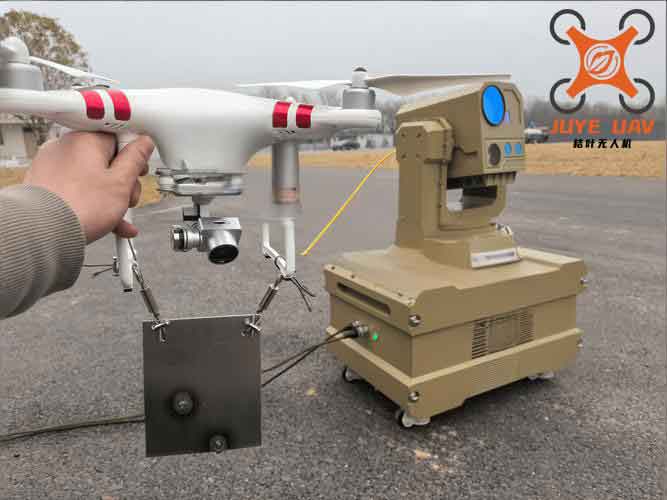
Proposed Integrated Anti-UAV Framework for Artillery Positions
An effective anti-UAV strategy must be proactive, layered, and synergistic, moving beyond isolated solutions to a system-of-systems approach. The core pillars are: Detect, Decide, Deny, Disrupt, and Destroy.
Pillar 1: Enhanced and Multi-Domain Detection (Detect)
Defeating UAVs begins with persistent, wide-area surveillance. Artillery units must deploy or be supported by a dedicated LSS-target detection grid. This involves sensor fusion:
- Low-Cost Radar Nets: Deploying short-range, multi-mode radars specifically tuned for small RCS.
- Electro-Optical/Infrared (EO/IR) Towers: Fixed or mobile panoramic EO/IR systems with automated tracking algorithms.
- RF Detection and Geolocation: Passive sensors to detect UAV command & control (C2) and video downlink signals, providing cueing and targeting data for other systems.
- Acoustic Sensors: For very small UAVs in the immediate vicinity, acoustic signatures can provide early warning.
The fusion of these data streams into a Common Operational Picture (COP) dramatically increases the probability of correct identification and track initiation, formalized as:
$$
P_{ID,fused} = 1 – \prod_{i=1}^{n} (1 – P_{ID,sensor_i})
$$
Where \(P_{ID,sensor_i}\) is the probability of correct identification from sensor \(i\). Fusion reduces overall error.
Pillar 2: Coordinated Electronic Warfare and Signature Management (Deny/Disrupt)
This pillar focuses on preventing the UAV from completing its mission by denying information or control.
| Technique | Mechanism | Artillery Unit Application |
|---|---|---|
| Radio Frequency Jamming (Suppression) | Overwhelms the UAV’s GPS and C2 links with high-power noise. | Area denial using vehicle-mounted or man-portable jammers. Risk of fratricide requires careful EW coordination. |
| Spoofing (Deception) | Transmits false but stronger GPS or C2 signals to take control or redirect the UAV. | Highly effective but technically demanding. Could be a higher-echelon asset providing support. |
| Camouflage, Concealment, and Deception (CCD) | Reduces visual, IR, and radar signatures using nets, paints, and thermal blankets; employs realistic decoys. | Fundamental and cost-effective. Requires discipline and materials. Decoys must emit realistic thermal and RF signatures. |
| Emissions Control (EMCON) | Strictly limiting all electronic emissions (radios, radars). | The most basic defense against SIGINT UAVs. Requires rigorous drills and alternative communication plans. |
The effectiveness of an RF jamming system can be modeled using the jamming-to-signal ratio (J/S) required to break the link:
$$
\frac{J}{S} = \frac{P_j G_j R_s^2 B_s}{P_s G_s R_j^2 B_j} \cdot L
$$
Where \(P\) is power, \(G\) is antenna gain, \(R\) is range, \(B\) is bandwidth, subscripts \(j\) and \(s\) refer to jammer and signal source, and \(L\) is loss factor. This dictates jammer placement and power requirements.
Pillar 3: Layered, Cost-Effective Kinetic and Directed Energy Intercept (Destroy)
When denial fails, hard-kill options must be available, prioritized by cost and applicability.
- Layer 1 (Point Defense): Automated small-caliber guns (e.g., 30mm) or microwave-directed energy weapons (DEWs) to counter close-range drones and swarm elements. DEWs offer a very low cost-per-shot.
- Layer 2 (Area Defense): Vehicle-mounted high-power laser systems or electronically fused artillery/mortar airburst munitions to engage multiple UAVs within a battalion’s area.
- Layer 3 (Network Attack): This is the strategic layer. Targeting the swarm’s ground control station (GCS) or its communication relay nodes (satellites, aircraft) via long-range fires, cyber-attacks, or special operations forces.
The key is to match the effector cost to the threat. The goal is to invert the cost exchange ratio for swarms:
$$
\text{Targeted CER} = \frac{(C_{DEW} \cdot t_{engagement}) + (C_{munition} \cdot N_{munitions})}{C_{UAV-swarm} \cdot N_{UAVs}} < 1
$$
Where directed energy weapons (DEW) with low \(C_{munition}\) are critical for achieving a sustainable ratio against numerous low-cost threats.
Pillar 4: Agile Tactics, Training, and C2 (Decide)
Technology is useless without the doctrine and personnel to wield it effectively.
- Shoot-and-Scoot Tactics: Drilling ultra-rapid displacement sequences to minimize exposure time, making the ISR-to-fire cycle irrelevant.
- Dedicated Anti-UAV Cells: Each artillery battalion/brigade should have an integrated cell responsible for operating sensors, EW, and coordinating air defense alerts.
- Realistic Training: Frequent exercises against realistic drone threats, including swarms, to build muscle memory and develop tactical best practices.
- Decentralized Decision-Making: Pre-delegated engagement authority for confirmed UAV threats within a defined weapon engagement zone (WEZ) to overcome decision-making latency.
Synthesis and Future Outlook
The threat posed by UAVs to artillery positions is asymmetric, persistent, and evolving. A single-layered defense is destined to fail. Victory in the anti-UAV fight will belong to those who implement a resilient, adaptive system that seamlessly blends sensor networks, electronic warfare, innovative hard-kill mechanisms, and agile tactics. The future lies in autonomous sensor-shooter networks that can detect, classify, and engage UAV swarms within seconds, with minimal human intervention, using the most cost-effective effector available. For artillery forces, investing in this integrated anti-UAV capability is not an optional upgrade; it is the fundamental prerequisite for maintaining their decisive role on the future battlefield. The continuous cycle of threat adaptation and countermeasure innovation will define the survivability calculus for all exposed high-value units.