
As a researcher focused on modern warfare dynamics, I have observed that the evolutionary trajectory of military unmanned platforms reflects profound transformations in the nature of conflict. From the early trials of manned-unmanned teaming in the Bekaa Valley to the validation of swarm penetration in Syria, the Nagorno-Karabakh conflict’s demonstration of reconnaissance-strike systems against traditional armor, and the full-spectrum unmanned operations in the Russia-Ukraine theater, each stage underscores a shift toward intelligent, distributed warfare. The 2024 multi-axial saturation attacks by Iran laid bare the critical inefficiencies of traditional air defense systems when confronting intelligent clusters. Initiatives like the U.S. Department of Defense’s “Gremlins” and OFFSET projects aim to build distributed kill networks with cognitive superiority, centered on compressing the OODA (Observe, Orient, Decide, Act) loop cycle to reconfigure kill-chain topology. In this paper, we explore the intertwined对抗 in the electromagnetic spectrum and cyber-information domains, focusing on systemic disruption to examine phased destruction mechanisms against UAV clusters, thereby providing multidimensional computational models for constructing dynamic, resilient defense systems.
The proliferation of UAV swarms presents a非线性 threat, but their inherent dependencies on information links and network nodes expose critical vulnerabilities. We, as practitioners in cyber-electronic warfare, recognize that anti-UAV operations must leverage these weaknesses through integrated, multi-domain approaches. Below, I analyze the key aspects, employing tables and formulas to summarize and elaborate on anti-UAV strategies.
Key Vulnerability Analysis of UAV Swarm Operational Systems
From my perspective, defeating UAV swarms begins with understanding their fragility. These systems rely heavily on coordinated functions that can be exploited. I have categorized the primary vulnerabilities into five areas, as summarized in Table 1.
| Vulnerability Category | Description and Anti-UAV Implications |
|---|---|
| Communication Dependency | UAV formations depend on internal and external communication systems, where limited bandwidth and high latency directly impact efficacy. Encryption adds transmission load, while electromagnetic interference (EMI) against line-of-sight or satellite relays can disrupt command flow, leading to swarm disintegration. This dependency is a prime target for anti-UAV electronic attack. |
| Control Complexity | Multi-agent coordination involves dynamic balancing mechanisms; environmental perturbations and adversarial博弈 exacerbate control algorithm design. Local failures may propagate via拓扑 networks, causing collisions or mission logic chaos, demanding high fault tolerance and response speed in distributed decision architectures. Anti-UAV measures can inject uncertainties to amplify this complexity. |
| Navigation Precision | Satellite positioning signals are susceptible to electronic suppression and spoofing; low-precision receivers increase定位偏差 risks. Inertial navigation errors accumulate exponentially without satellite correction, with geomagnetic interference and multipath effects degrading timing accuracy, threatening swarm spatial coherence. Anti-UAV navigation warfare exploits this weakness. |
| Platform Limitations | Micro-UAVs face physical constraints in energy density and payload space, limiting reconnaissance radius and lethality. Forward deployment of carrier aircraft increases exposure, and weak防护 designs are vulnerable to conventional防空 fire, restricting sustained operations. Anti-UAV systems can capitalize on these limitations through endurance targeting. |
| Data Security | Dynamic self-organizing networks lack stable拓扑, making traditional encryption- authentication ill-suited for rapid node turnover. Open wireless channels expose data links to threats like malicious code injection and routing hijacks, compromising information integrity and causing command-chain paralysis. This invites anti-UAV cyber penetration. |
These vulnerabilities highlight opportunities for anti-UAV actions. For instance, communication jamming can be modeled using the signal-to-interference ratio formula: $$ \frac{S}{I} = \frac{P_t G_t / L_s}{P_j G_j / L_j} $$ where \( P_t \) and \( P_j \) are transmitter and jammer powers, \( G_t \) and \( G_j \) are gains, and \( L_s \) and \( L_j \) are path losses. By maximizing \( I \), anti-UAV systems can disrupt links effectively.
Core Capabilities of Cyber-Electronic Forces in Anti-UAV Swarm Operations
We possess diverse capabilities to counter UAV swarms, focusing on electromagnetic and cyber domains. I have grouped these into three core areas, supported by formulas for technical depth.
Electromagnetic Situation Awareness Systems: Multi-dimensional spectrum monitoring networks form the physical basis, integrating radar arrays, radio frequency sensors, and electro-optical detectors. Heterogeneous data fusion engines parse signal features in real-time, using machine learning to identify communication protocols and navigation patterns. This enables target classification, crucial for early anti-UAV warning. The detection probability can be expressed as: $$ P_d = 1 – \exp\left(-\frac{SNR \cdot T_{int}}{K}\right) $$ where \( SNR \) is signal-to-noise ratio, \( T_{int} \) is integration time, and \( K \) is a constant dependent on sensor characteristics.
Electromagnetic Spectrum Countermeasure Systems: These include EMI techniques to paralyze communication relays. For example, barrage jamming power required can be estimated as: $$ P_j = \frac{P_s G_s L_j}{G_j R_j^2} \cdot JSR_{min} $$ where \( JSR_{min} \) is the minimum jamming-to-signal ratio for disruption. Navigation spoofing modules simulate GPS signals to deviate UAV trajectories, modeled by position error \( \Delta x = v \cdot \Delta t \) where \( v \) is velocity and \( \Delta t \) is timing drift. Cyber attacks, such as protocol reverse-engineering and DDoS, consume onboard resources, with effectiveness scaling as: $$ E_{attack} = \frac{N_{requests}}{C_{processing}} $$ where \( N_{requests} \) is request volume and \( C_{processing} \) is computational capacity.
Directed Energy Strike Systems: High-power microwave (HPM) and solid-state laser weapons offer hard-kill options. HPM pulses can penetrate shielding, causing集成电路 failure. The required field strength is: $$ E = \frac{V_{breakdown}}{d} $$ where \( V_{breakdown} \) is breakdown voltage and \( d \) is insulation distance. Laser thermal damage follows: $$ Q = \alpha I t $$ with \( \alpha \) as absorption coefficient, \( I \) as intensity, and \( t \) as exposure time. For anti-UAV applications, these systems form layered defenses, as summarized in Table 2.
| Capability | Mechanism | Anti-UAV Impact |
|---|---|---|
| EM Sensing | Multi-spectrum fusion and AI-driven analysis | Enables early detection and tracking of swarms |
| EM Countermeasures | Jamming, spoofing, and cyber intrusion | Disrupts communication, navigation, and control |
| Directed Energy | HPM and laser-based physical destruction | Provides precise, scalable hard-kill options |
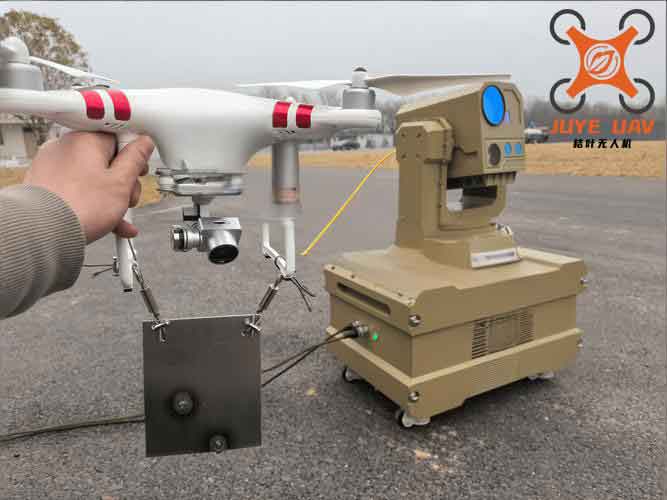
This image illustrates the integration of these capabilities in a holistic anti-UAV defense scenario, emphasizing the synergy between soft and hard measures.
Employment Strategies for Cyber-Electronic Forces
In my experience, effective anti-UAV swarm operations require tailored strategies. We propose five interconnected approaches, detailed below with illustrative formulas.
Constructing Cyber-Electronic Reconnaissance and Early Warning Systems: We must build deep, integrated sensor networks for early detection. This involves long-range VHF/P-band radars, airborne预警 platforms, ground-based X/Ku-band phased arrays, passive RF detection from L to X bands, and high-resolution electro-optical infrared systems. The coverage area \( A \) can be approximated as: $$ A = \pi R^2 \sum_{i=1}^{n} \eta_i $$ where \( R \) is detection range and \( \eta_i \) is efficiency per sensor type. This layered sensing is foundational for all anti-UAV actions.
Implementing Cyber-Electronic Interference and Suppression: Targeting enemy swarm electronics aims to break networks and induce迷茫. We prioritize disrupting command links and data chains via precise EMI on uplinks and协同 frequencies. The degradation in communication throughput can be modeled as: $$ T = B \log_2\left(1 + \frac{S}{N+I}\right) $$ where \( B \) is bandwidth, \( S \) is signal power, \( N \) is noise, and \( I \) is interference power. By increasing \( I \), we reduce \( T \), crippling swarm coordination. Additionally, spoofing PNT signals causes navigation errors, with position deviation given by: $$ \delta = \int (v_{real} – v_{spoof}) dt $$ This strategy aligns with anti-UAV goals of cost-effective neutralization.
Penetrating and Disintegrating Swarm Networks: We seek to瓦解 clusters from within by exploiting network vulnerabilities. After拓扑 reconnaissance and protocol analysis (e.g., Ad-hoc variants), we identify flaws like weak encryption or authentication gaps. Attack success probability \( P_s \) can be expressed as: $$ P_s = 1 – (1 – p_{vuln})^{m} $$ where \( p_{vuln} \) is vulnerability per node and \( m \) is number of nodes. Wireless injection of malicious payloads via伴飞 UAVs or ground stations enables remote anti-UAV disruption.
Employing Cyber-Electronic Deception and Induction: Deception involves simulating high-value targets or false swarm signatures to lure enemy火力. Signal generation techniques inject伪造 data into radar or RF seekers, causing false locks or target loss. The deception effectiveness \( E_d \) relates to signal realism: $$ E_d = \frac{\sum w_i \cdot sim_i}{\sum w_i} $$ where \( sim_i \) is similarity metric and \( w_i \) is weight for feature i. Navigation spoofing subtly guides swarms into kill zones, exemplifying “winning without fighting” in anti-UAV contexts.
Synergizing Soft and Hard Kill Measures: We advocate a multi-layer defense integrating soft (e.g., jamming) and hard (e.g., lasers) kills. The engagement sequence starts with wide-area sensing, followed by远程 interference and cyber attacks to degrade penetration. If swarms persist, mid-short range systems activate. The overall拦截 probability \( P_k \) for a layered defense is: $$ P_k = 1 – \prod_{i=1}^{n} (1 – p_{ki}) $$ where \( p_{ki} \) is kill probability per layer i. This synergy maximizes anti-UAV efficacy, as summarized in Table 3.
| Strategy | Key Actions | Anti-UAV Outcome |
|---|---|---|
| Reconnaissance Warning | Deploy heterogeneous sensor networks | Early detection and tracking of swarms |
| Interference Suppression | Jam communications and spoof navigation | Disruption of swarm coherence and guidance |
| Network Penetration | Exploit protocol vulnerabilities via cyber means | Internal瓦解 of swarm command and control |
| Deception Induction | Use electronic decoys and false signals | Misdirection and resource depletion of enemy |
| Soft-Hard Kill Synergy | Layer EW, cyber, and kinetic effects | Comprehensive neutralization of swarm threats |
These strategies underscore that anti-UAV operations are not monolithic but require adaptive, multi-domain coordination.
Key Enablers for Enhancing Cyber-Electronic Force Effectiveness
To sustain anti-UAV superiority, we must invest in foundational enablers. I emphasize four pillars, with formulas to quantify progress.
Equipment System Construction: We need integrated systems spanning wideband sensing, high-power intelligent jamming, covert cyber penetration, and reliable directed energy. Technological advancement hinges on multi-spectrum fusion perception, cognitive EW, and advanced navigation warfare. Modular, software-defined platforms with AI辅助 decision-making are crucial. Interoperability can be measured by data sharing rate \( R_{share} = \frac{D_{shared}}{T_{total}} \), where \( D_{shared} \) is data volume and \( T_{total} \) is time. This闭环 ensures persistent anti-UAV innovation.
Command Control and Information Sharing: We require automated, intelligent C2 systems that fuse multi-source sensor data in real-time. Using big data and AI, threat assessment and target识别 accelerate, with response time minimized. The OODA cycle time \( T_{OODA} \) is critical: $$ T_{OODA} = T_{obs} + T_{ori} + T_{dec} + T_{act} $$ By reducing each component through automation, we gain anti-UAV decision superiority. Secure, resilient battlefield networks enable real-time共享, supporting跨域协同.
Talent Development and Training: Cultivating复合型 professionals with expertise in EM spectrum, cyber攻防, and战术 is vital. High-fidelity virtual simulations train personnel in complex environments. Skill retention can be modeled as: $$ S(t) = S_0 e^{-\lambda t} + C $$ where \( S_0 \) is initial skill, \( \lambda \) is decay rate, and \( C \) is constant from continuous training. Regular certification ensures proficiency in latest anti-UAV tactics.
Tactical and Methodological Innovation: We must track swarm tech trends like群体智能 and抗干扰通信, refining countermeasures via war-gaming and experiments. Innovation in TTPs (Tactics, Techniques, Procedures) is continuous. For instance, cognitive对抗 effectiveness \( E_c \) can be expressed as: $$ E_c = \frac{\Delta U_{enemy}}{\Delta U_{own}} $$ where \( \Delta U \) is utility change. Dynamic战法 libraries ensure adaptive anti-UAV responses.
These enablers are interlinked, as shown in Table 4, forming a holistic ecosystem for anti-UAV dominance.
| Enabler | Components | Impact on Anti-UAV Operations |
|---|---|---|
| Equipment Systems | Multi-spectrum sensors, cognitive EW, directed energy | Provides technological edge for detection and engagement |
| Command Control | AI-driven C2, secure data networks | Enables rapid, coordinated responses to swarm threats |
| Talent Development | Specialized training, simulation environments | Ensures human expertise to operate complex systems |
| Tactical Innovation | Research on swarm countermeasures, TTP evolution | Fosters adaptability against evolving UAV threats |
Conclusion
In summary, UAV swarm systems epitomize new战争 paradigms, but their信息链路 dependencies reveal inherent vulnerabilities. Cyber-electronic forces, through diversified means like precise reconnaissance,高效干扰, covert penetration, and directed energy strikes, offer a cost-effective anti-UAV countermeasure pathway. We emphasize that building integrated reconnaissance-warning networks is the first step, followed by multi-domain协同 suppression and cyber攻防, complemented by systemic soft-hard kill联动. This approach can effectively paralyze swarm operational capabilities. As we advance, continuous innovation in technology, strategy, and training will be paramount to maintaining superiority in the anti-UAV domain. The formulas and tables presented herein provide a framework for quantifying and optimizing these efforts, ensuring resilient defense architectures against evolving swarm threats.