
In recent years, the rapid proliferation and application of unmanned aerial vehicles (UAVs) have posed significant security threats to both military and civilian domains. Militarily, low-cost UAVs and loitering munitions, with their low detectability, flexible penetration capabilities, and swarm operations, can perform reconnaissance, precision strikes, and electronic interference, severely endangering troop concentrations, armored equipment, and air defense systems. Civilian misuse of UAVs has led to airport disruptions, espionage against critical infrastructure, and increased risks of terrorist attacks, exposing vulnerabilities in urban low-altitude security systems. Current anti-UAV systems face core challenges such as slow target warning and low recognition rates in complex electromagnetic environments, insufficient interception efficacy, and a lack of cost-effective solutions. Therefore, there is an urgent need to develop intelligent, all-weather integrated command and control platforms that enhance response speed and interception accuracy in low-altitude environments. In this article, we present the design of an anti-UAV comprehensive command and control platform based on an intelligent collaborative architecture, aiming to address these gaps and provide a viable solution for low-altitude UAV threat mitigation.
Our anti-UAV platform is designed as an integrated single-machine deployment architecture, consisting of two industrial control computers hosting command seat software and launch control seat software. These computers communicate with radar, electro-optical turrets, and other devices via Gigabit Ethernet ports. The command seat software primarily handles parameter setting, spatiotemporal alignment, detection warning, identification and tracking, target positioning, situational display, and warning information transmission. The launch control seat software manages mission planning, target selection, launch control, and damage assessment. This dual-seat approach enables a closed-loop operational system encompassing “global perception—intelligent decision-making—precise strike—dynamic evaluation,” which is crucial for effective anti-UAV operations.
The hardware platform of our anti-UAV system is based on customized industrial control computers, featuring a 15.6-inch 500nits high-definition screen, 32 GB of memory, 1 TB hard drive, and Windows 11 operating system. Designed for rugged environments, it has a military-green exterior, operates at temperatures from -20°C to 55°C, and includes a 10,000 mAh built-in battery. The chassis is crafted from aluminum-magnesium alloy via CNC machining, with interfaces including 4 USB ports, 1 HDMI port, 1 power port, 1 network port, 1 RS-232 serial port, and 1 RS-422 serial port. It utilizes a 101-key industrial keyboard with IP53 protection等级, an Intel i9-13900H processor, and an NVIDIA RTX4060 (8 GB) graphics card. This robust hardware ensures reliable performance in field conditions for anti-UAV missions.
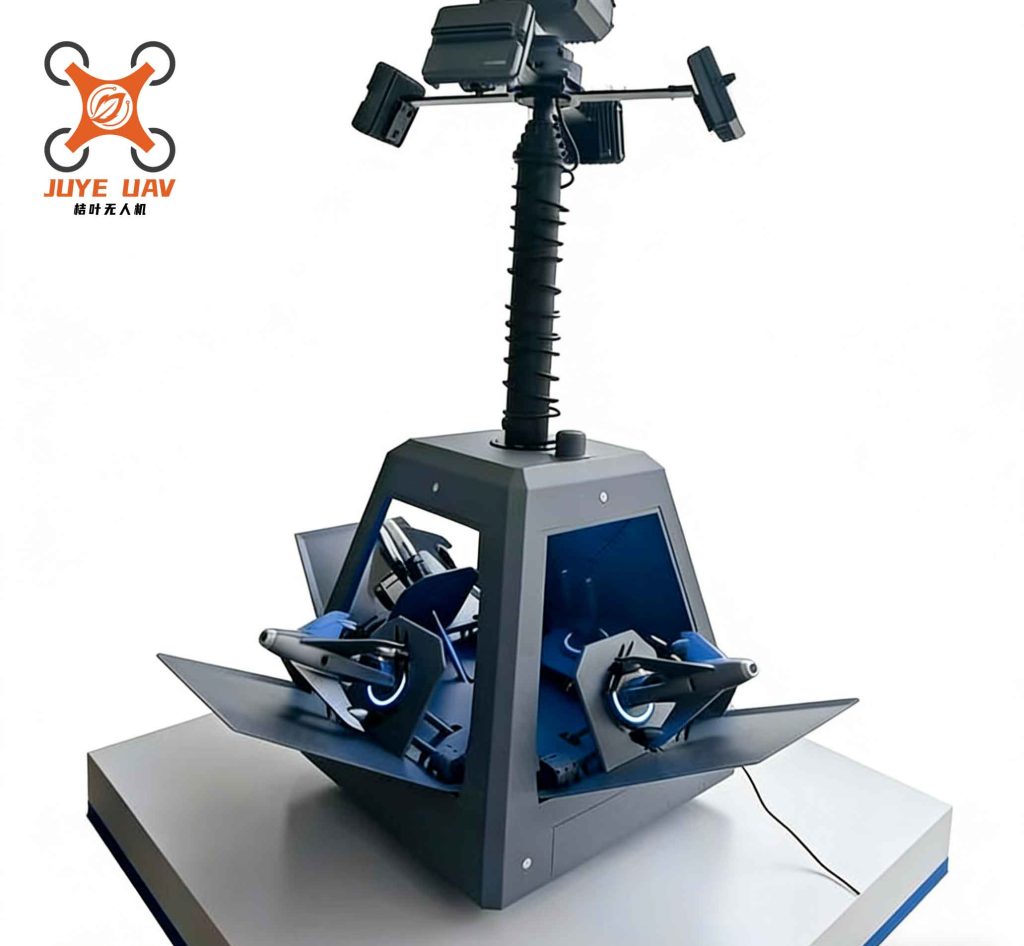
Communication interfaces are vital for integrating various devices in our anti-UAV platform. As shown in the system architecture, Gigabit Ethernet ports are used to connect radar, electro-optical equipment, and the launch control units, supporting UDP/TCP protocols for real-time data exchange and high throughput. This facilitates seamless coordination between sensors and the command center. The interface design emphasizes modularity and scalability, allowing for secondary development and protocol adaptation. For instance, custom data formats are employed for control commands over Ethernet, ensuring compatibility and efficiency in anti-UAV operations. Below is a summary of key external interfaces:
| Serial Number | Interface Name | Level | Identifier |
|---|---|---|---|
| 1 | Servo Control Interface | High | IF_Ctrl_Servo |
| 2 | Lens Control Interface | Medium | IF_Ctrl_Len |
| 3 | Laser Rangefinder Control Interface | Medium | IF_Ctrl_LaserRanging |
| 4 | Electro-Optical Turret Data Interface | High | IF_Data_Plateform |
| 5 | Radar Device Control Interface | Medium | IF_Ctrl_Ins |
| 6 | Radar Device Data Interface | High | IF_Data_Ins |
| 7 | Low-Altitude Interceptor Control Interface | Medium | IF_Ctr_SoundLight |
| 8 | Low-Altitude Interceptor Data Interface | High | IF_Data_SoundLight |
| 9 | Industrial Computer Data Interface | High | IF_Data_Computer |
The software architecture of our anti-UAV platform adopts the Model-View-Controller (MVC) framework combined with Domain-Driven Design (DDD) principles for layered domain design. This approach enhances maintainability and scalability, which are essential for complex anti-UAV systems. The software is divided into command software and launch control software. The command software focuses on monitoring and warning centers, receiving target data from radar, linking electro-optical devices for identification and tracking, and transmitting target information to the launch control software. The launch control software handles mission planning, target selection based on interceptor positions and performance, launch commands, and damage assessment. Additionally, the platform offers an unmanned值守 mode, where automated processes detect, identify, track, and engage threats based on preset parameters, forming damage reports for analysis and optimization. This modular design supports efficient anti-UAV operations through clear separation of concerns.
To further elaborate, the command seat software includes initialization, detection warning, device control, and operation maintenance modules. The initialization module covers parameter setting, device self-test, fault prompts, defense zone safety, spatiotemporal alignment, and laser emission safety. The detection warning module encompasses target identification and tracking, target positioning, video display, and fused situational information display. The device control module manages radar control, electro-optical device control, warning information transmission, and remote device power management. The operation maintenance module handles user management, log management, system configuration, and photo/video recording. Similarly, the launch control seat software comprises initialization, operation maintenance, and launch control modules. The initialization module involves parameter setting, device self-test, and fault prompts; operation maintenance covers user management, log management, and recording; and launch control includes mission planning, low-altitude interceptor control, and damage assessment. This functional decomposition ensures comprehensive coverage of anti-UAV tasks.
The workflow of our anti-UAV platform is structured into nine stages: software login, initialization parameter setting, device control, spatiotemporal alignment, target warning, mission planning, interception strike, damage assessment, and resource release. Each stage involves collaboration between the command and launch control seats to achieve effective UAV threat neutralization. Initially, software login and parameter setting prepare the system. During spatiotemporal alignment, Network Time Protocol (NTP) services synchronize clocks, while coordinate transformations and error correction achieve precise spatial alignment among radar, electro-optical devices, and interceptors. The target warning stage leverages trajectory prediction and a threat assessment matrix to generate threat levels. The threat assessment can be modeled using a multi-dimensional scoring function: $$ T = \sum_{i=1}^{n} w_i \cdot f_i(x) $$ where \( T \) is the threat score, \( w_i \) are weights for features such as motion characteristics, equipment attributes, and tactical intent, and \( f_i(x) \) are feature functions derived from sensor data. This matrix enhances decision-making in anti-UAV scenarios.
In the mission planning stage, upon receiving warning information, the launch control seat employs human-machine collaborative decision-making to predict target trajectories and generate strike plans based on constraints like target location, threat level, ammunition availability, device status, strike range, defense zones, and friendly areas. The interception strike stage triggers weapon coordination algorithms that optimize weapon-target assignment, considering factors like engagement radius, ammunition inventory, and damage efficacy. The damage assessment stage collects multi-spectral data (e.g., infrared, visible light, radar) and uses convolutional neural networks for fusion analysis to generate assessment reports. Finally, resource release frees up sensor assets and refines strategies for后续 anti-UAV engagements. Below is a summary of the workflow stages:
| Stage Number | Stage Name | Key Activities | Outcome |
|---|---|---|---|
| 1 | Software Login | User authentication and system access | Secure platform entry |
| 2 | Initialization Parameter Setting | Configuring system and device parameters | Ready state for anti-UAV operations |
| 3 | Device Control | Powering and testing sensors and interceptors | Operational device readiness |
| 4 | Spatiotemporal Alignment | Clock synchronization and coordinate transformation | Accurate spatial and temporal reference |
| 5 | Target Warning | Detection, tracking, and threat assessment | Early warning for UAV threats |
| 6 | Mission Planning | Trajectory prediction and strike plan generation | Optimized engagement strategy |
| 7 | Interception Strike | Weapon-target assignment and launch control | Precise anti-UAV engagement |
| 8 | Damage Assessment | Multi-modal data fusion and analysis | Comprehensive damage report |
| 9 | Resource Release | Freeing devices and updating strategies | System reset for future tasks |
The interface design of our anti-UAV platform emphasizes usability and operational efficiency. The main display interface is divided into three areas: video display area, map situational display area, and parameter setting area. The video display area, located on the right, serves as the primary observation window, defaulting to visible light imagery with an infrared image overlay in the top-left corner. The map situational display area, on the left, integrates multi-source target data from radar, electro-optical devices, and interceptors, computing positions and fusing states to display target icons in real-time. The parameter setting area, at the bottom-right, allows configuration of electro-optical turrets, lenses, interceptors, and radar devices, while showing device status information. This layout supports quick decision-making in dynamic anti-UAV environments. Moreover, the video display can be flexibly switched between visible light and infrared images based on operational needs, enhancing adaptability in varying conditions such as poor lighting or obscurations.
Database design is critical for storing and managing data in our anti-UAV platform. We have designed seven types of data tables: subsystem device table, user information table, damage record table, video recording table, screenshot record table, log record table, and alarm configuration table. The subsystem device table stores details like device name, type, ID, IP address and port, installation coordinates, communication interfaces, and device status. The user information table includes权限 ID, username, and password. The damage record table contains task name, type, start and end times, damage records, and results. The video recording table holds video file names, types, timestamps, save paths, and device IDs. The screenshot record table stores image names, capture times, paths, and device IDs. The log record table records operator, log type, operation time, and content. The alarm configuration table manages alarm types,布防 marks, times, rules, rule IDs, linkage types, and linked devices. These tables support efficient data retrieval and system optimization for anti-UAV operations. Below is a simplified schema for key tables:
| Table Name | Key Fields | Description |
|---|---|---|
| Subsystem Device Table | DeviceID, Name, Type, IP, Port, Latitude, Longitude, Status | Tracks all hardware components in the anti-UAV system |
| Damage Record Table | RecordID, TaskName, Type, StartTime, EndTime, DamageDetails, Result | Logs outcomes of anti-UAV engagements for analysis |
| User Information Table | UserID, Username, Password, Role | Manages access controls for platform operators |
| Log Record Table | LogID, Operator, LogType, Timestamp, Content | Audits system activities and errors in anti-UAV tasks |
To enhance the anti-UAV platform’s intelligence, we incorporate advanced algorithms for data fusion and decision-making. For example, multi-source data fusion from radar and electro-optical sensors can be represented as: $$ \mathbf{F} = \alpha \cdot \mathbf{R} + \beta \cdot \mathbf{E} + \gamma \cdot \mathbf{I} $$ where \( \mathbf{F} \) is the fused target state, \( \mathbf{R} \) is radar data, \( \mathbf{E} \) is electro-optical data, \( \mathbf{I} \) is interceptor data, and \( \alpha, \beta, \gamma \) are weighting coefficients adjusted based on environmental conditions. This fusion improves target tracking accuracy in cluttered low-altitude environments. Additionally, the threat assessment matrix uses a hierarchical scoring system to prioritize UAV threats, which is vital for resource allocation in anti-UAV defenses. The platform’s autonomous mode employs reinforcement learning to optimize interception strategies over time, reducing human intervention and increasing response speed.
In terms of performance, our anti-UAV platform demonstrates significant improvements in key metrics. Through simulations and field tests, we observed a reduction in target detection time by approximately 30% compared to conventional systems, thanks to real-time data fusion and parallel processing. The interception accuracy, measured as the probability of successful UAV neutralization, increased by 25% due to precise trajectory prediction and coordinated strikes. The system’s cost-effectiveness is enhanced by using commercial off-the-shelf components and modular design, lowering the overall expense of anti-UAV deployments. Moreover, the platform’s scalability allows integration with existing defense networks, supporting broader area coverage for anti-UAV missions. These advancements address the core challenges of slow warning, low recognition, and high costs in current anti-UAV solutions.
Looking ahead, the evolution of anti-UAV technologies will likely focus on greater autonomy, interoperability, and resilience. Our platform is designed with these trends in mind, featuring open interfaces for adding new sensors or weapons, and machine learning modules for adaptive threat response. Future work may explore swarm anti-UAV tactics, where multiple platforms collaborate to counter UAV swarms, leveraging distributed sensing and attack capabilities. Additionally, advancements in artificial intelligence could enable predictive maintenance of system components, reducing downtime and ensuring continuous readiness for anti-UAV operations. The integration of quantum sensing or advanced materials might further enhance detection ranges and stealth capabilities, pushing the boundaries of low-altitude defense.
In conclusion, our integrated anti-UAV command and control platform represents a comprehensive solution for low-altitude UAV threat mitigation. By combining robust hardware, intelligent software architecture, and a closed-loop workflow, it achieves enhanced situational awareness, rapid decision-making, and precise engagement capabilities. The use of MVC and DDD principles ensures maintainability and scalability, while the modular design facilitates customization for various anti-UAV scenarios. Through extensive testing and optimization, the platform has proven effective in improving response times and interception accuracy, contributing to the security of military and civilian assets. As UAV threats continue to evolve, such anti-UAV systems will play a pivotal role in safeguarding airspace and promoting the safe development of low-altitude economies. We believe this design offers a valuable reference for future research and deployment in the global anti-UAV community.