
The evolution towards intelligent warfare has brought asymmetric threats to the forefront of modern conflict. Among these, Unmanned Aerial Vehicle (UAV) swarms have demonstrated formidable and disruptive potential in recent armed engagements. Coastal cities, by their very nature as open, economically vital, and strategically exposed entities, represent prime targets for such harassment campaigns. Positioned on the frontline, these urban centers face unique challenges that amplify the threat posed by低成本, intelligent drone clusters. This analysis, from my perspective as a researcher in tactical urban defense, examines the convergence of coastal urban vulnerabilities and UAV swarm capabilities. It proposes a multi-layered, integrated framework for effective anti-UAV swarm defense, emphasizing the critical need for proactive, technologically advanced, and socially embedded countermeasures.
The Coastal Urban Battlespace: A Complex Defense Environment
Coastal cities are not merely urban landscapes adjacent to water; they are complex, multi-dimensional battlespaces where social, economic, and physical factors critically constrain military options. The traditional principles of urban defense are compounded by maritime accessibility and international exposure. The primary characteristics defining anti-harassment operations in these environments can be summarized as follows, highlighting the inherent disadvantages for defenders.
| Characteristic | Description | Impact on Anti-UAV Operations |
|---|---|---|
| Short Reaction Time | High permeability due to international travel, commerce, and potential presence of embedded hostile intelligence elements conducting long-term surveillance. Attack planning can be meticulous and launch signals minimal. | Makes pre-emptive strikes or rapid interception against launched swarms extremely difficult. Early warning becomes paramount. |
| Constrained Force Mobility | Dense architecture, complex street grids, high civilian population density, and critical infrastructure limit the rapid physical movement and deployment of counter-swarm assets. | Hinders the repositioning of kinetic kill systems (e.g., mobile guns, laser units) to engage swarms from optimal angles or locations. |
| Restricted Firepower Application | Presence of diplomatic compounds, cultural heritage sites, economically vital infrastructure, and civilians imposes severe rules of engagement. Risk of collateral damage is politically and socially unacceptable. | Limits the use of area-effect weapons or powerful kinetic interceptors. Demands highly precise, low-collateral anti-UAV measures. |
| Cluttered Sensor Environment | High levels of civilian RF noise (Wi-Fi, cellular), abundant visual clutter, and radar reflections from buildings create a high-noise background for detection systems. | Reduces the effective detection range and classification accuracy for small, low-flying UAVs, providing cover for swarm infiltration. |
These constraints create a permissive environment for harassment tactics. An adversary can exploit these very limitations to magnify the impact of a UAV swarm, which is inherently designed to thrive in complex, denied environments.
The UAV Swarm Threat: Exploiting Urban Complexity
UAV swarm harassment is a potent evolution of traditional nuisance raids. It synthesizes the collective power of distributed systems with the agility of individual drones. Its characteristics align perfectly with the goal of exhaustion, distraction, and incremental degradation.
| Swarm Characteristic | Military Advantage | Exploitation of Coastal Urban Weakness |
|---|---|---|
| Flexible & Diverse Tactics | Can perform coordinated reconnaissance, electronic warfare, precision strikes (kamikaze), or spoofing simultaneously. Swarm geometry can shift from a concentrated mass to a dispersed net. | Overwhelms point defenses. A single swarm can harass a port, a government district, and a communications hub concurrently, stretching thin defensive resources already hampered by mobility constraints. |
| Persistence & Affordability | Low cost per unit enables attritional tactics. “Swarms of swarms” can be launched in waves, forcing defenders into a constant, exhausting state of high alert. | Directly targets the defender’s will and logistical stamina. The economic and psychological cost of sustained defense may outweigh the attacker’s investment, a critical calculus in politically sensitive coastal cities. |
| Stealth & Suddenness | Small radar cross-section, low acoustic signature, and low-altitude flight profiles allow penetration through sensor gaps. Launch can be decentralized and concealed (e.g., from vans, boats). | Exploits short reaction times and cluttered sensor environments. A swarm can emerge seemingly from within the urban fabric itself, bypassing traditional perimeter defenses. |
| Autonomous Coordination | Advanced algorithms enable robust, decentralized control. Loss of individual drones or communication nodes does not cripple the mission, providing resilience against electronic attack. | Complicates the “defeat the brain” strategy. A purely network-centric anti-UAV approach focused on jamming the command link may be insufficient against goal-driven, collaborative autonomy. |
The mathematical model for swarm saturation defense illustrates the challenge. If a defense system has a probability $P_k$ of killing a single UAV per engagement cycle, and the swarm contains $N$ UAVs, the probability of the swarm being completely neutralized in one perfect engagement is $P_{kill-all} = (P_k)^N$. For a swarm of just 10 drones with a high $P_k$ of 0.9, $P_{kill-all} = (0.9)^{10} ≈ 0.35$. This highlights the necessity for layered defenses and non-kinetic area denial.
A Multi-Domain Framework for Coastal Urban Anti-UAV Swarm Defense
Countering this threat requires moving beyond isolated point defense. It demands a holistic system-of-systems approach that integrates detection, denial, destruction, and recovery across military and civil domains. The core pillars of this anti-UAV framework are: Enhanced Intelligence and Early Warning, Optimized Tactical Deployment, and Deep Civil-Military Fusion.
Pillar 1: Strengthening ISR and Early Warning – The “Identify” Layer
Given the short reaction time, superior situational awareness is the cornerstone of effective defense. The objective is to shift from reaction to pre-emption by identifying the threat in its preparatory or initial launch phase.
- Expanded Intelligence Gathering: Focus on the swarm’s “kill chain” long before launch. This involves monitoring supply chains for commercial drone components, analyzing training patterns via cyber intelligence, and employing human intelligence (HUMINT) networks within the complex social fabric of coastal cities to detect clandestine planning cells.
- Fused Multi-Modal Detection: No single sensor is sufficient. A data-fusion architecture is critical. Key technologies and their fusion matrix are outlined below:
| Detection Modality | Strength | Weakness | Role in Fusion |
|---|---|---|---|
| RF Scanning | Detects control & video links at long range; can classify models. | Ineffective against pre-programmed/autonomous drones; polluted in urban RF environment. | Provides initial cue and signature intelligence. |
| Radar (AESA) | All-weather, long-range detection of moving objects. | Struggles with small, slow, low-flying objects in cluttered urban canyons; high false-alarm rate. | Provides track data and velocity vectors for confirmed targets. |
| Electro-Optical/Infrared (EO/IR) | Provides positive visual identification (PID); effective for terminal tracking. | Range limited by weather (fog, rain) and line-of-sight. | Critical for PID, intent analysis (e.g., payload identification), and fire control. |
| Acoustic Sensing | Passive, low-cost; can detect drones in visual/RF-denied conditions. | Very short range; highly degraded by urban background noise. | Useful as a last-perimeter, confirmatory sensor for critical assets. |
The fusion process can be conceptualized by a Bayesian update formula, where the posterior probability of a drone’s presence given sensor data $D$ is:
$$ P(\text{Drone} | D) = \frac{P(D | \text{Drone}) P(\text{Drone})}{P(D)} $$
Here, $P(\text{Drone})$ is the prior probability from intelligence, and $P(D | \text{Drone})$ is the likelihood from fused sensor data, continuously refining the threat picture.
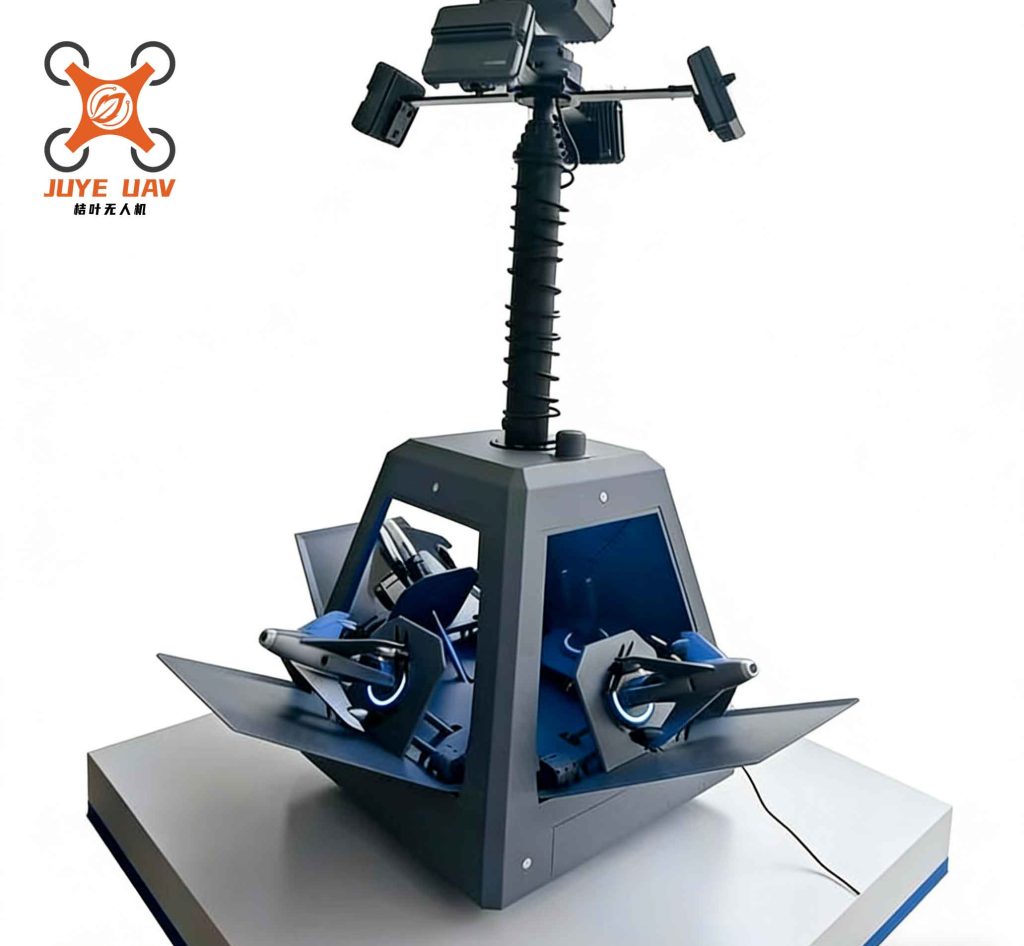
The integration of these systems into a Common Operational Picture (COP) is vital. The depicted anti-UAV system exemplifies the networked sensor and command architecture required, fusing inputs for coordinated response.
Pillar 2: Optimizing Tactical Deployment – The “Deny and Destroy” Layer
Deployment must be proactive, adaptive, and leverage the defender’s inherent advantages: detailed terrain knowledge and prepared positions.
- Proactive and Adaptive Zoning: Establish dynamic Anti-Access/Area Denial (A2/AD) bubbles around critical assets. Zones should be layered:
- Outer Detection Zone: Extended range using radar and high-altitude surveillance platforms.
- Mid-course Interdiction Zone: Employ electronic warfare (EW) and directed-energy weapons (DEW) for soft-kill.
- Inner Terminal Defense Zone: Use kinetic effectors (microwave, nets, interceptors) for hard-kill.
- Hardening and Deception: Physically protect vital points with nets, cages, and angled surfaces. Deploy extensive decoy networks (RF, thermal) to dilute swarm attacks and waste their payloads. The effectiveness of hardening can be modeled as a reduction in the swarm’s probability of mission success $P_{success}$:
$$ P_{success} = 1 – (1 – P_{kill})^{N_{eff}} $$
where $N_{eff}$ is the effective number of drones reaching the target after deception and hardening measures have attrited and misdirected a portion of the swarm.
Pillar 3: Deepening Civil-Military Fusion – The “Sustain and Integrate” Layer
This is the most critical, yet often underdeveloped, component for coastal cities. The technological and human resources required for effective anti-UAV defense exceed military capabilities alone.
- Technological Fusion: Leverage the city’s commercial tech sector. Key areas for collaboration include:
- AI/ML for Pattern Recognition: Adapting commercial visual AI for drone identification in video feeds.
- Communications Security: Using 5G/6G network slicing expertise to secure command links against swarm hijacking.
- Cybersecurity: Partnering with firms to develop offensive cyber tools to disrupt swarm logistics (e.g., ground control station software) and spoof navigation signals (GPS spoofing). The spoofing signal power required to overcome legitimate GPS can be expressed as a jamming-to-signal ratio: $J/S = \frac{P_j G_j R_s^2}{P_s G_s R_j^2}$, where $P$ is power, $G$ is antenna gain, and $R$ is range from receiver to jammer ($j$) or satellite ($s$).
- Operational Fusion – The “Neighborhood Watch” Model: Establish a coordinated reporting and response protocol integrating civil authorities.
- Public Awareness Campaigns: Educate citizens on identifying suspicious drone activities and reporting channels.
- Integrate Law Enforcement: Police and harbor patrol units can be equipped with basic RF detectors and net guns for low-level threats, freeing military assets for complex swarm engagements.
- Critical Infrastructure Coordination: Private operators of power plants, refineries, and telecom hubs must have integrated anti-UAV plans, including emergency shutdown procedures and on-site countermeasures.
In conclusion, the defense of coastal cities against UAV swarm harassment is a defining challenge of contemporary asymmetric conflict. It cannot be solved by military technology or tactical adjustment alone. It requires a paradigm shift towards an integrated, resilient defense ecosystem. Success hinges on fusing advanced, multi-source detection with proactive, layered denial measures, all underpinned by deep civil-military cooperation that turns the city’s inherent complexity from a vulnerability into a strength. The goal is to create an anti-UAV environment so dense and reactive that the cost and risk of swarm harassment become prohibitive, thereby preserving the security and stability of these vital urban centers.