
As I explored the 15th Zhuhai Airshow in November 2024, I was struck by the extensive array of ground-based anti-UAV systems on display. The proliferation of drones and loitering munitions in modern conflicts, such as the Nagorno-Karabakh conflict in 2020 and the ongoing Russia-Ukraine war, has fundamentally altered battlefield dynamics. These “low, slow, and small” (LSS) targets pose significant challenges to traditional detection and interception methods. In response, Chinese defense industries, including state-owned enterprises and qualified private companies, have developed a holistic suite of anti-UAV solutions tailored for various military echelons. This article, from my first-hand perspective, delves into these systems, emphasizing their technological advancements and operational applications, with a focus on the keyword “anti-UAV” throughout.
The evolution of warfare has exposed critical gaps in countering UAV threats. Modified commercial drones, with hacked “geo-fencing” restrictions, and even homemade assemblies using off-the-shelf components, have rendered traditional electronic jamming guns less effective. Consequently, there is a burgeoning global demand for integrated anti-UAV capabilities to protect ground forces. At Zhuhai, this demand was met with systems designed for platoon, company, battalion, brigade, and division levels, forming a layered defense network. Below, I analyze these systems, incorporating tables and formulas to summarize key aspects.
Anti-UAV Systems for Platoon and Company-Level Units
From my observations, platoon-level units require cost-effective and adaptable anti-UAV solutions. These units often lack dedicated platforms, necessitating modifications to existing vehicles. For instance, software-defined radios (SDRs) with appropriate antennas can be installed and pre-programmed for electronic attacks against specific UAV classes. This allows operators to execute jamming without deep technical expertise. Additionally, such systems can disrupt Global Navigation Satellite System (GNSS) signals to prevent precision strikes. However, operational limitations exist, as these units must balance electronic warfare with avoiding detection.
At the Zhuhai Airshow, I noted several products addressing these needs. Mobile detection and jamming systems, integrating radio frequency detection, navigation spoofing, and interference suppression, were prominent. These systems enable 24/7 unmanned operation and can be rapidly deployed on vehicles without extensive modifications. For company-level units, enhanced sensor capabilities are crucial. Light vehicles equipped with masts featuring passive and electro-optical sensors improve UAV detection and classification. While companies cannot heavily expand their vehicle inventories, they can integrate these sensors with platoon-level assets to provide commanders with a detailed operational picture.
To summarize the capabilities at this level, I present the following table:
| Unit Level | Primary Anti-UAV Needs | Example Systems Observed | Key Features |
|---|---|---|---|
| Platoon | Low-cost, adaptable electronic attack; GNSS disruption | Vehicle-mounted SDR jammers; integrated detection/jamming units | Pre-programmed attacks; rapid deployment; minimal vehicle modification |
| Company | Enhanced detection and classification; sensor integration | Mast-mounted passive/EO sensors on light vehicles | Improved situational awareness; compatibility with platoon assets |
In terms of detection probability, a simplified formula for UAV detection at this level can be expressed as:
$$ P_d = 1 – e^{-\lambda \cdot A \cdot t} $$
where \( P_d \) is the probability of detection, \( \lambda \) is the arrival rate of UAV threats, \( A \) is the effective sensor coverage area, and \( t \) is time. This underscores the importance of sensor coverage for company-level anti-UAV operations.
Anti-UAV Systems for Battalion-Level Units
Moving to battalion-level units, I found that these formations possess the logistical support to field dedicated anti-UAV platforms. Here, anti-UAV missions extend beyond defense to include counter-reconnaissance, actively hunting and destroying enemy UAVs to degrade sensor capabilities. A battalion typically requires an electronic warfare cell and an anti-UAV platoon. The electronic warfare cell manages spectrum awareness and software updates for SDRs, while the anti-UAV platoon provides hard-kill intercept capabilities.
At the airshow, systems like the VE37 integrated electronic reconnaissance and jamming vehicle and the VE38 terminal guidance protection vehicle caught my attention. The VE37 features升降 antennas for communication and radar jamming, targeting UAV links, tactical radios, and navigation terminals. The VE38 uses radar and electro-optical systems to detect and jam incoming threats like drones and guided munitions. These vehicles represent a shift from relying solely on armor to specialized electronic protection.
For the anti-UAV platoon, the PLB625E combined gun-missile system is tailored. It integrates a 6-barrel 25mm cannon and short-range missiles with search/track radars and electro-optical trackers. The system automates target tracking and engagement, with programmable ammunition for enhanced effectiveness against UAVs. Similarly, the HQ-17AE unmanned fire support vehicle, derived from the HQ-17 air defense system, offers a modular approach with multiple missile launchers for engaging swarm threats. When networked, these systems can provide battalion-wide coverage.
The following table compares key battalion-level anti-UAV systems:
| System | Primary Role | Anti-UAV Capabilities | Notable Features |
|---|---|---|---|
| VE37 | Electronic reconnaissance and jamming | Disrupts UAV communications and navigation | 升降 antennas; software-defined radio integration |
| VE38 | Terminal protection | Jams guided munitions and drones | Multi-sensor tracking; laser warning and deception |
| PLB625E | Hard-kill interception | Engages UAVs with guns and missiles | Automated fire control; programmable ammunition |
| HQ-17AE unmanned vehicle | Swarm defense | High-density missile launches against LSS targets | Networkable; modular missile pods |
The effectiveness of such hard-kill systems can be modeled using an interception probability formula:
$$ P_i = \frac{n_{engagements}}{n_{threats}} = \frac{R_{fire} \cdot T_{engagement}}{D_{swarm}} $$
where \( P_i \) is the interception probability, \( R_{fire} \) is the rate of fire, \( T_{engagement} \) is the engagement time, and \( D_{swarm} \) is the drone swarm density. This highlights the importance of high fire rates for battalion-level anti-UAV defense.
Anti-UAV Systems for Brigade and Division-Level Units
At the brigade level, I observed that these units maintain independent anti-UAV capabilities, with dedicated electronic warfare companies and anti-UAV companies for area defense. They require comprehensive air picture integration and the ability to counter medium-altitude ISR drones. Systems like the HQ-17AE field air defense system, optimized for UAV threats, are key. Additionally, mobile integrated anti-UAV systems with passive detection capabilities were displayed, using silent reconnaissance similar to passive anti-stealth radar to avoid detection by anti-radiation munitions.
For division-level units, the focus shifts to protecting critical assets from cruise missiles, ballistic missiles, and high-end suicide drone swarms. Here, directed energy weapons (DEWs) become vital due to their cost-effectiveness and ability to handle saturation attacks. At Zhuhai, I was particularly impressed by the LW-60 laser defense system, with a hard-kill range of over 6 km against drones, and high-power microwave (HPM) systems like the “Hurricane” 3000 and PLB-625E车载 microwave weapon. These DEWs offer scalable solutions for point and area defense.
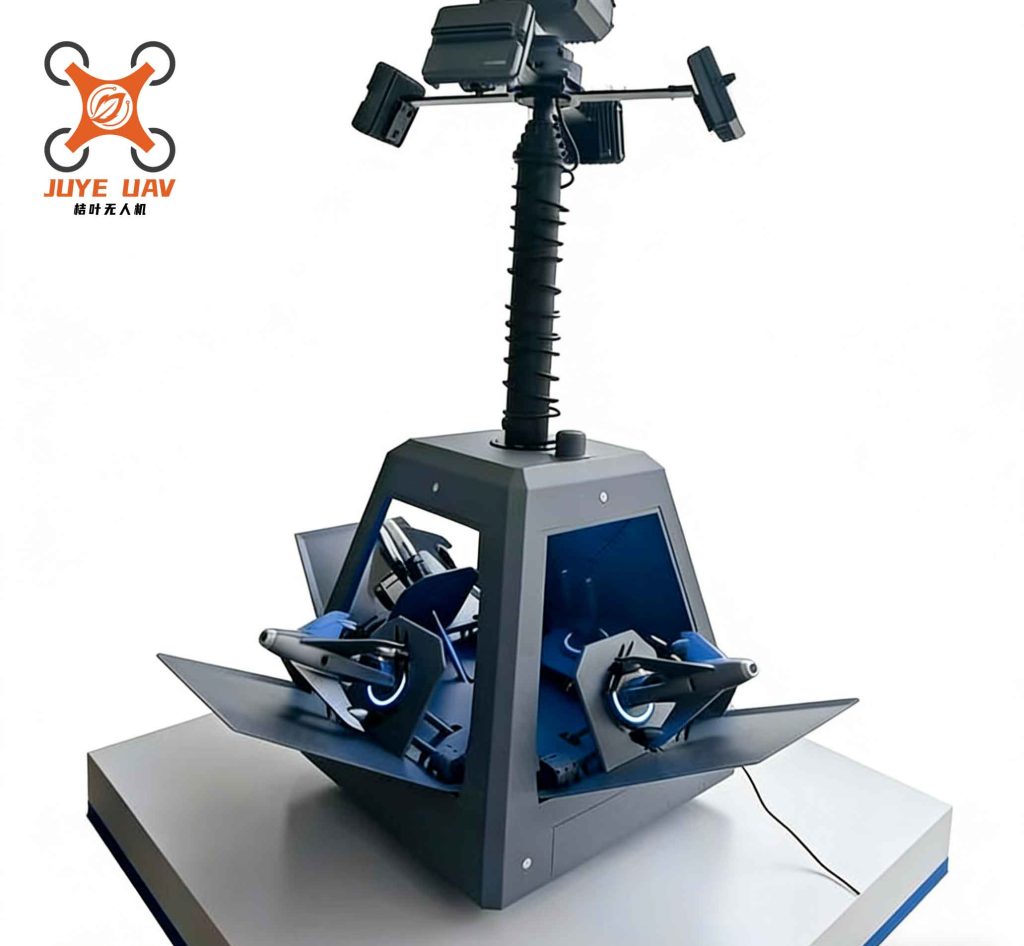
The image above exemplifies the advanced nature of these anti-UAV systems, showcasing integrated sensor and effector arrays. In my assessment, HPM weapons operate by emitting high-energy electromagnetic pulses to disrupt drone electronics. The energy density at a distance \( r \) can be approximated by:
$$ I = \frac{P_{tx} \cdot G}{4 \pi r^2} $$
where \( I \) is the power density, \( P_{tx} \) is the transmitted power, and \( G \) is the antenna gain. This formula underscores the inverse-square law challenge in HPM anti-UAV engagements.
A comparison of directed energy anti-UAV systems is tabulated below:
| Directed Energy Type | Example System | Anti-UAV Mechanism | Advantages | Limitations |
|---|---|---|---|---|
| High-Energy Laser (HEL) | LW-60 Laser Defense | Thermal damage via focused beam | Precision point kill; low cost per shot | Atmospheric attenuation; requires precise tracking |
| High-Power Microwave (HPM) | “Hurricane” 3000 HPM | Electromagnetic pulse to damage electronics | Area coverage; engages multiple targets simultaneously | Limited range compared to lasers; potential collateral effects |
Countering UAV Swarms with Directed Energy
In my analysis, UAV swarms represent a complex system where emergent behaviors arise from interactions between individual drones. Traditional air defense struggles with swarms due to cost, detection, and saturation issues. Directed energy weapons, however, excel here. HEL systems can thermally damage drone sensors, while HPM systems can blanket an area with electromagnetic energy, disrupting entire swarms. The effectiveness against swarms can be modeled using a swarm degradation formula:
$$ N_{surviving} = N_0 \cdot e^{-k \cdot E \cdot t} $$
where \( N_{surviving} \) is the number of drones surviving, \( N_0 \) is the initial swarm size, \( k \) is a constant based on weapon efficiency, \( E \) is the energy output, and \( t \) is exposure time. This demonstrates the exponential decay possible with DEW anti-UAV systems.
Moreover, the cost-benefit ratio favors DEWs. For example, a laser shot may consume under 2 kWh of electricity, costing roughly $1, while destroying a drone worth thousands. This economic advantage is crucial for sustained anti-UAV operations. During the airshow, I learned that systems like the “Hurricane” 2000, mounted on wheeled armor, provide mobile protection for mechanized units, while the larger “Hurricane” 3000 on an 8×8 truck chassis is suited for base defense. Both can operate independently or within integrated air defense networks.
The U.S. has similarly invested in DEW anti-UAV technologies, such as the THOR microwave system and “Leonidas” HPM system, but China’s displays at Zhuhai indicate rapid progress. The integration of DEWs with traditional kinetic systems forms a multi-layered anti-UAV architecture, enhancing resilience against evolving threats.
Comprehensive Anti-UAV Technology Paths
Reflecting on the exhibits, I categorize anti-UAV technologies into four paths: detection and tracking, hard kill, interference and jamming, and deception and control. The Zhuhai Airshow covered all these paths extensively. For detection, systems employ radar, electro-optical, and passive RF sensors. Hard kill includes guns, missiles, and DEWs. Jamming spans communication and navigation disruption, while deception involves spoofing and cyber takeovers. The following table summarizes these paths:
| Technology Path | Anti-UAV Methods | Example Systems from Zhuhai | Key Challenges |
|---|---|---|---|
| Detection and Tracking | Radar, EO/IR, passive RF | Mobile integrated anti-UAV systems; sensor masts | Identifying LSS targets in cluttered environments |
| Hard Kill | Kinetic interceptors, DEWs | PLB625E; LW-60 laser; HPM vehicles | Cost-effectiveness against swarms; engagement speed |
| Interference and Jamming | RF jamming, GNSS disruption | VE37; vehicle-mounted jammers | Adapting to frequency-hopping drones |
| Deception and Control | Spoofing, cyber attacks | Navigation deception systems | Ethical and legal considerations; technical complexity |
To optimize anti-UAV deployments, a systems engineering approach is essential. The overall effectiveness \( E_{total} \) of an anti-UAV network can be expressed as:
$$ E_{total} = \sum_{i=1}^{n} w_i \cdot C_i $$
where \( w_i \) are weighting factors for different capabilities (e.g., detection, interception), and \( C_i \) are corresponding performance metrics. This holistic view ensures that systems are tailored to specific echelons, as seen at Zhuhai.
Conclusion
In conclusion, the 15th Zhuhai Airshow presented a robust and layered portfolio of ground-based anti-UAV systems. From platoon-level jammers to division-directed energy weapons, the exhibits addressed the full spectrum of drone threats. The integration of detection, electronic warfare, kinetic interceptors, and directed energy reflects a mature understanding of modern battlefield requirements. As UAV technology continues to evolve, with swarms becoming more intelligent, the anti-UAV solutions displayed at Zhuhai offer scalable and cost-effective responses. My firsthand observation confirms that these systems will significantly enhance the competitiveness of Chinese defense exports in the global market, providing comprehensive anti-UAV capabilities to allied forces worldwide. The emphasis on keyword “anti-UAV” throughout this analysis underscores the centrality of counter-drone technology in contemporary defense planning.