
The proliferation of Unmanned Aerial Vehicles (UAVs) is an irreversible trend, poised to reshape urban landscapes. From entertainment and logistics to infrastructure inspection, UAVs offer unprecedented convenience. However, this technological boon is a double-edged sword, presenting significant risks such as privacy invasion, illicit surveillance, and potential security threats. Consequently, the management and control of UAVs in urban low-altitude airspace have become a critical and unavoidable challenge for future city governance. While current anti-UAV systems demonstrate efficacy in open environments, their performance is severely degraded in complex urban settings. Detection systems struggle with signal occlusion and electromagnetic clutter, while kinetic or radio frequency (RF) countermeasures pose risks of collateral damage and disruption to daily life. This article analyzes the current state of anti-UAV technology, highlights the unique difficulties of urban deployment, and proposes a forward-looking development framework leveraging advancements in electronic and information technology.
Current Landscape of Anti-UAV Technologies
Modern anti-UAV systems typically employ a layered approach, integrating detection and mitigation technologies. The effectiveness of any system hinges on its ability to first reliably detect, classify, and track a UAV before applying an appropriate countermeasure.
Detection Technologies: The Quest for the “Low, Slow, and Small”
Urban UAVs are characteristically “low, slow, and small” (LSS), presenting a formidable detection challenge. The primary sensing modalities each have distinct strengths and weaknesses, as summarized in the table below.
| Technology | Principle | Key Advantages | Key Limitations (Urban Context) |
|---|---|---|---|
| Radar | Active emission and reception of RF waves to detect object range, velocity, and angle. | All-weather, day/night capability; long range; provides tracking data. | High false alarm rate from clutter (birds, debris); limited non-cooperative target recognition (NCTR); active emission may cause interference. |
| Electro-Optical/Infrared (EO/IR) | Passive imaging in visible and infrared spectra. | Provides positive visual identification (ID); high accuracy for tracking. | Limited field of view for search; performance degraded by weather (fog, rain); requires cueing for wide-area search. |
| RF Sensing (Passive) | Passive detection and analysis of UAV command & control (C2) and video downlink signals. | Passive (non-emitting); provides specific signal ID; can geolocate via TDOA/AOA. | Ineffective against pre-programmed or autonomous UAVs; challenged by dense urban RF noise; requires prior signal library. |
| Acoustic Sensing | Detection of characteristic acoustic signatures from UAV motors and propellers. | Passive; omnidirectional; low cost. | Very short effective range; highly susceptible to urban ambient noise; poor performance in wind. |
A synergistic, sensor-fused approach is essential. For instance, a wide-area radar may detect a potential track, cueing a narrow-field EO/IR camera for visual confirmation, while RF sensors work to classify the UAV type. Geolocation, particularly for RF signals, often relies on Time Difference of Arrival (TDOA) algorithms. If multiple sensors at known locations detect the same signal, the TDOA between pairs can be used to calculate the source location. For sensors at positions $\vec{p}_i = (x_i, y_i, z_i)$ and source at $\vec{s} = (x_s, y_s, z_s)$, the measured time difference $\Delta t_{ij}$ between sensor *i* and a reference sensor *j* defines a hyperboloid:
$$c \cdot \Delta t_{ij} = \|\vec{s} – \vec{p}_i\| – \|\vec{s} – \vec{p}_j\|$$
where $c$ is the speed of light. Solving this set of hyperbolic equations yields the UAV’s position.
Mitigation Technologies: From Soft-Kill to Hard-Kill
Once a UAV is confirmed as a threat, mitigation strategies are deployed. These range from non-destructive “soft-kill” to physical “hard-kill” methods.
| Category | Technology | Mechanism | Urban Deployment Concerns |
|---|---|---|---|
| Soft-Kill (Electronic) | Radio Frequency Jamming | Overwhelms UAV C2 and GNSS (GPS) links with high-power noise, forcing hover, land, or return-home. | Broad-spectrum jamming causes significant collateral interference to legitimate communications (Wi-Fi, Bluetooth, cellular). |
| Spoofing / Deception | Transmits forged GNSS or C2 signals to take control or redirect the UAV. | More selective than jamming but complex to implement; risk of affecting nearby GNSS receivers. | |
| Hard-Kill / Interdiction | Kinetic (Nets, Projectiles) | Physical capture or collision to disable the UAV. | Risk of falling debris causing injury or damage; limited range; typically single-target engagement. |
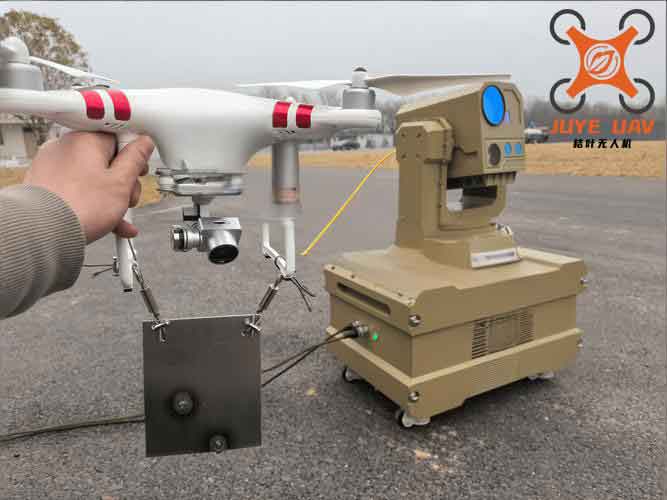
| High-Energy Laser (HEL) | Concentrated laser beam to melt or burn critical components. | Extreme safety hazard in populated areas; line-of-sight required; atmospheric attenuation. | |
| High-Power Microwave (HPM) | Broad or directed electromagnetic pulse to fry electronic circuits. | Extremely high risk of widespread electronic collateral damage; indiscriminate effects. |
The fundamental equation for the effectiveness of a directed energy weapon like a laser considers the power density $I$ at the target range $R$:
$$I = \frac{P \cdot \tau}{A_{beam}} \approx \frac{P \cdot \tau}{\pi (\theta_{div} R / 2)^2}$$
where $P$ is laser power, $\tau$ is dwell time, $A_{beam}$ is beam area at range, and $\theta_{div}$ is beam divergence. This shows the challenge of maintaining a damaging power density over increasing urban ranges without immense power.
The Urban Crucible: Core Challenges for Anti-UAV Systems
Deploying anti-UAV systems in cities is not merely a matter of installing military-grade equipment. The urban environment introduces a unique set of constraints that fundamentally alter system design requirements.
1. Severe Occlusion and Multipath: Dense building canyons create massive radar and RF shadows, breaking line-of-sight for most sensors and countermeasures. Signals bounce and scatter, creating multipath effects that degrade radar accuracy and confuse TDOA geolocation algorithms. A UAV flying between buildings may be invisible to a ground-based sensor until it is dangerously close.
2. Congested and Dynamic Electromagnetic Spectrum: The urban RF environment is a cacophony of legitimate signals—cellular (4G/5G), broadcast, Wi-Fi, IoT—making the detection of specific UAV signals akin to finding a needle in a haystack. This raises the noise floor for RF detection and increases false alarms for radar systems.
3. Stringent Operational and Safety Constraints: This is the paramount challenge. Urban anti-UAV operations must prioritize public safety and minimal disruption.
- Collateral Interference: Wideband jamming is unacceptable as it would cripple city communications.
- Physical Safety: Kinetic intercepts and directed energy weapons pose unacceptable risks of injury from falling debris or beam exposure.
- Electromagnetic Pollution: Persistent, active radiating sensors (like certain radars) may face public health concerns and regulatory hurdles.
4. Evolving UAV Adversaries: UAV technology advances rapidly, directly countering existing anti-UAV methods. The integration of 4G/5G modules for C2 bypasses traditional RF detection in ISM bands. Advanced navigation using visual odometry, SLAM (Simultaneous Localization and Mapping), and AI-based path planning reduces reliance on GNSS, nullifying spoofing and some jamming tactics. Swarm technology further complicates the threat picture.
Future Vision I: Pervasive and Intelligent Urban Detection Networks
To overcome occlusion and cost barriers, future urban anti-UAV detection must shift from expensive, sparse, monolithic sensors to dense, low-cost, and intelligent networks. The goal is pervasive situational awareness.
1. 5G/6G Communication-Perception Integration: The most promising path is to leverage existing and future communication infrastructure. 5G and nascent 6G networks envision native integrated sensing and communication (ISAC). Base stations, with their dense urban deployment, could perform bistatic or multistatic radar functions using communication waveforms. A network of 5G cells could collaboratively sense the low-altitude volume, creating a continuous detection web. The key advantage is infrastructure reuse, enabling cost-effective, ubiquitous coverage. The sensing performance is linked to communication parameters like bandwidth $B$ and carrier frequency $f_c$. The range resolution $\Delta R$ and velocity resolution $\Delta v$ achievable are given by:
$$\Delta R = \frac{c}{2B}, \quad \Delta v = \frac{c}{2 f_c T_c}$$
where $T_c$ is the coherent processing interval. Wide bandwidths in 5G mmWave bands promise fine resolution for distinguishing small UAVs.
2. Intelligent Reflecting Surfaces (IRS) for Coverage Extension: IRS, or reconfigurable intelligent surfaces, are arrays of passive metamaterial elements that can dynamically manipulate incident electromagnetic waves. In an anti-UAV context, IRS panels mounted on building facades could act as “signal mirrors.” They could extend the effective coverage of a few master RF sensors or communication-perception nodes into occluded zones by reflecting detection signals around corners, creating virtual line-of-sight paths. The IRS configuration can be optimized in real-time to track dynamic coverage gaps.
3. AI-Enabled Distributed Video and Audio Mesh: The vast network of urban security and traffic cameras can be upgraded with lightweight AI models for UAV detection. A distributed system would process video feeds locally at the edge, sharing only detection alerts and metadata (type, location, trajectory) with a central fusion center. This reduces bandwidth needs and enables rapid response. Similarly, distributed acoustic sensor nodes, processed with advanced Deep Neural Networks (DNNs) trained to filter urban noise, could provide a secondary, passive detection layer in critical areas like parks or quiet zones.
4. Advanced Signal Intelligence (SIGINT) and Separation: To operate in the cluttered RF spectrum, next-gen RF sensors must employ sophisticated signal processing. Blind Source Separation (BSS) techniques, such as Independent Component Analysis (ICA), will be crucial. The observed mixed signal $\mathbf{x}(t)$ from $M$ antennas is modeled as:
$$\mathbf{x}(t) = \mathbf{A}\mathbf{s}(t) + \mathbf{n}(t)$$
where $\mathbf{s}(t)$ contains the $N$ unknown source signals (UAV C2, Wi-Fi, LTE, etc.), $\mathbf{A}$ is the mixing matrix, and $\mathbf{n}(t)$ is noise. The goal of ICA is to find a separating matrix $\mathbf{W}$ to recover estimates of the sources: $\mathbf{y}(t) = \mathbf{W}\mathbf{x}(t) \approx \mathbf{s}(t)$. This allows the isolation and classification of UAV signals even in dense interference.
Future Vision II: Safe, Precise, and Adaptive Countermeasures
The mitigation pillar must evolve towards surgical precision, minimizing collateral effects while countering more autonomous threats.
1. Autonomous Aerial Interdiction Platforms: UAV-vs-UAV combat is a logical evolution. Dedicated interceptor UAVs, launched from rooftops or mobile units, can engage threat UAVs in the airspace they occupy. Equipped with nets, projectiles (e.g., frangible bullets), or filament entanglement systems, they can perform kinetic neutralization with controlled descent over a safe area. Their major advantage is mobility, allowing them to pursue a target while keeping the engagement footprint localized away from crowds.
2. Generative Adversarial Networks (GANs) for Intelligent Spoofing: To counter autonomous UAVs that ignore simple jamming, AI-driven deception will be key. A GAN framework can be trained for specific UAV models. The generator network $G$ learns to produce sophisticated, modulated signals that mimic the authentic C2 link. The discriminator network $D$ tries to distinguish real signals from generated ones. Through adversarial training, $G$ becomes highly proficient at creating believable spoofing signals. The objective can be expressed as:
$$\min_G \max_D V(D, G) = \mathbb{E}_{x \sim p_{data}(x)}[\log D(x)] + \mathbb{E}_{z \sim p_z(z)}[\log(1 – D(G(z)))]$$
where $z$ is a noise vector input to the generator. Once trained, the system can attempt to inject forged but valid-seeming navigation or command data into the target UAV, either to seize control or to induce a safe, guided landing in a designated zone.
3. Adaptive and Containment-Focused Jamming: Instead of wideband barrage jamming, future systems will use cognitive, “smart-jamming” techniques. Upon RF detection and classification, the system will generate a tailored jamming waveform that targets only the specific modulation, coding, and frequency hop pattern of the identified UAV. This minimizes the energy broadcast and confines the disruptive effect. Techniques like reactive jamming, which only transmits when the target UAV’s signal is detected, further reduce the system’s electromagnetic footprint.
Integrative Framework and Conclusion
The future of urban anti-UAV defense lies in an integrated, intelligent, and infrastructure-based ecosystem. This envisioned system would feature:
- A Sensing Substrate: Built upon 5G/6G ISAC nodes, IRS-augmented coverage, and AI-powered camera/audio grids, providing persistent, wide-area low-altitude surveillance.
- A Cognitive Core: A central AI fusion engine that correlates data from all sources, maintains a real-time Common Operational Picture (COP), performs threat assessment, and coordinates responses.
- A Surgical Response Layer: Comprising autonomous interceptors and AI-driven spoofing/jamming systems, capable of executing calibrated, proportional, and geographically contained mitigation under the guidance of the cognitive core.
This approach moves away from the paradigm of standalone “anti-drone guns” and towards a smart city utility—a Urban Airspace Security (UAS) service. It respects the urban environment’s constraints by maximizing passive detection, leveraging existing infrastructure, and employing countermeasures with surgical precision. The development of such systems requires deep collaboration across telecommunications, AI, robotics, and cybersecurity domains. As UAVs become ingrained in urban life, a proportional, effective, and safe anti-UAV capability is not just a security measure but a critical enabler for the managed and beneficial integration of drones into our future cities.