
The security paradigm for correctional facilities has long been anchored in the physical “ground” domain, focusing on perimeter walls, access control, and personnel screening. However, the rapid proliferation of civilian Unmanned Aerial Vehicles (UAVs), driven by advancements in mobile communication, artificial intelligence, and the Internet of Things, has decisively extended the threat landscape into the third dimension—the airspace above. Incidents of UAVs being used to breach prison security are no longer speculative fiction but a recurring global reality. This new aerial vector poses severe and immediate threats, compelling a fundamental re-evaluation of traditional security models. The development and integration of robust low-altitude anti-UAV defense capabilities are therefore not merely an option but an urgent imperative for modern penitentiary management, aligning with the broader trends of smart policing and technological innovation in the correctional sector.
The Evolving Aerial Threat to Correctional Security
The accessibility and capabilities of commercial drones have created novel vulnerabilities. Malevolent actors now exploit UAVs for a range of purposes that directly compromise institutional integrity and safety. The primary threat manifestations can be systematically categorized as follows.
Contraband Delivery: This is the most prevalent and documented threat. Sophisticated networks use UAVs as aerial couriers to bypass ground-based security, delivering items such as narcotics, mobile phones, weapons, tools, and other prohibited goods directly into prison yards or onto building rooftops. These operations often occur at night, exploiting gaps in traditional surveillance.
Information Reconnaissance and Theft: UAVs equipped with high-resolution cameras provide a discreet platform for surveilling facility layouts, security patrol patterns, surveillance camera locations, and operational routines. This intelligence can be used to plan escapes, coordinate internal disturbances, or simply leak sensitive information to the outside.
Assistance in Escape Plots: Beyond reconnaissance, UAVs can physically aid escape attempts. There have been instances of drones being used to drop tools (e.g., wire cutters, ropes), maps, cash, and even firearms to inmates. This transforms the drone from an intelligence tool into a direct logistics and armament supply chain for organized escape conspiracies.
Terrorist and Disruptive Attacks: While less common, the potential for weaponized UAVs poses a catastrophic risk. Drones can be modified to carry explosive, incendiary, or chemical payloads to target staff, inmates, or critical infrastructure within the facility, aiming to cause mass casualty events or severe disruption.
The frequency of these incidents is alarming. The table below consolidates reported global events, illustrating the scale and nature of the threat.
| Year | Country | Facility Type | Reported Activity | Implication |
|---|---|---|---|---|
| 2015 | United Kingdom | Multiple Prisons | 33 incidents of UAVs smuggling contraband (“drops”). | Systematic, organized smuggling operations. |
| 2016 | China | Provincial Prison | UAVs frequently hovered over housing units, admin blocks, and guard quarters at night. | Persistent surveillance and probable reconnaissance. |
| 2017 | USA | State Prison | UAV delivered tools, cash, and a firearm to an inmate, facilitating an escape. | Direct logistical support for a major security breach. |
| 2018 | Australia | Multiple Correctional Centers | UAV incursions forced full lockdowns of four major facilities. | Significant operational disruption and resource diversion. |
| 2019-2023 | Global Trend | N/A | Rapid increase in procurement of anti-UAV systems by correctional departments. | Formal recognition of the threat and shift towards active countermeasures. |
The Imperative for Low-Altitude Anti-UAV Defense: A Multi-Faceted Demand
The convergence of policy direction, practical necessity, and technological opportunity creates a powerful mandate for the deployment of aerial defense systems within correctional facilities.
Policy and Reform Drivers: National and regional security strategies increasingly emphasize multidimensional safety. While existing building standards for high-security prisons may only vaguely mention “facilities to prevent aerial hijacking,” the strategic direction is clear. Plans such as the “13th Five-Year Plan for the Construction of a Safe China” explicitly call for the comprehensive development of social management service equipment systems, including for custodial settings. The integration of “frontier technologies such as UAV monitoring and prevention to全面提升 (comprehensively upgrade) the technological level of prison safety prevention and control” is a stated key task. This policy environment actively encourages and funds the technological modernization of prison security, creating a clear path for anti-UAV solutions.
Practical Security Imperative: The statistical reality is undeniable. With millions of drones sold annually, the probability of incursions—whether malicious or accidental—increases exponentially. Correctional administrators worldwide are actively shifting from a purely planar security mindset to a three-dimensional, “air-ground” integrated defense concept. This is evidenced by the growing number of prisons conducting anti-UAV system demonstrations, specialized training programs for staff on drone countermeasures, and the notable rise in procurement of relevant hardware as seen in public bidding portals. The operational need has been decisively proven by recurrent incidents.
Technological and Innovative Synergy: The market for correctional security is vast and specialized. Technology firms are increasingly offering tailored anti-UAV packages designed for the unique needs of prisons, such as protecting specific “point” targets (e.g., a cell block), “area” targets (the entire compound), or “linear” targets (perimeter walls). Simultaneously, forward-thinking facilities are partnering with these companies to pilot new applications, such as using friendly UAVs for internal patrols, emergency response, and forest fire monitoring, thereby creating a balanced ecosystem of aerial technology use and counter-use. This symbiotic relationship between demand and supply accelerates innovation and practical implementation.
Constructing a Robust Anti-UAV Defense System: A Three-Pillar Framework
Developing an effective low-altitude defense capability requires a holistic approach that integrates regulatory, technical, and operational dimensions. We propose the following structured path for construction and implementation.
Pillar I: Expanding the Multidimensional Security Perspective
Aerial security cannot exist in a silo. It must be part of a coherent, layered strategy.
- Enforcing “No-Fly Zones” from the Top: While prisons are legally designated as no-fly zones, this must be technologically enforced. Collaboration with aviation authorities is key to implement and refine “Geofencing” using technologies like 3D geospatial mapping and electronic barriers. Legislation must be bolstered to impose severe penalties for unauthorized flights over critical infrastructure, and law enforcement must be empowered for strict enforcement.
- Building External Alliance Networks: Defense requires collaboration. Prisons must develop detailed anti-UAV response protocols that define roles for internal command, security teams, and external partners. Law enforcement agencies must enforce drone registration and tracking. Manufacturing standards should mandate built-in geofencing and remote identification in drones. Industry associations must promote pilot education and safety. A whole-of-society approach is necessary.
- Ensuring Coordinated Internal-External Response: Detection must trigger an immediate, seamless response. Internally, the command center must coordinate isolation of the drop zone, search for contraband, and manage inmate movement. Externally, alerts must instantly go to perimeter guards and local police to track and apprehend the ground-based pilot. The anti-UAV system must integrate with the prison’s existing Physical Security Information Management (PSIM) platform for real-time alerting, video tracking, evidence recording, and hierarchical reporting.
Pillar II: Perfecting Technologically Customized Solutions
The selection of technology must be dictated by the specific environment of a correctional facility: fixed location, dense infrastructure, and high sensitivity to collateral effects.
1. Scientific Selection of Detection Technologies: The core of any anti-UAV system is reliable detection. The main options each have strengths and weaknesses, as summarized below.
| Technology | Principle | Pros for Prisons | Cons for Prisons | Suitability |
|---|---|---|---|---|
| RF (Radio Frequency) Sensing | Detects communication signals between drone and controller. | High accuracy for common drones; cost-effective; passive operation; good range; works in most weather. | May not detect pre-programmed (GPS-waypoint) drones; crowded RF environments can cause clutter. | High. Ideal for fixed-site perimeter deployment on guard towers. |
| Radar | Active detection via reflected radio waves. | Long range; detects all objects, including pre-programmed drones. | High cost; can be affected by terrain and weather; high false-alarm rate for small birds; radiation concerns. | Medium. Good for wide-area coverage but may be overkill and complex. |
| Electro-Optical/ Infrared (EO/IR) | Visual and thermal camera recognition. | Provides visual confirmation and tracking; excellent for evidence. | Limited by weather (fog, rain) and light; shorter effective range; requires line-of-sight. | Medium-High. Best used as a secondary, confirming sensor paired with RF or radar. |
| Acoustic Sensing | Detects unique acoustic signature of drone motors. | Passive; works in all weather; can detect stealthy drones. | Very limited range; highly sensitive to ambient noise; difficult to deploy in noisy urban areas. | Low. Not practical for most prison environments. |
For most correctional facilities, a primary network of RF sensors, supplemented by EO/IR cameras for verification, offers the optimal balance of performance, cost, and reliability. The detection range $$ R_d $$ of an RF sensor can be approximated by a modified Friis transmission equation, considering signal-to-noise ratio and drone transmitter power:
$$ R_d = \frac{\lambda}{4\pi} \sqrt{\frac{P_t G_t G_r}{P_n \cdot \text{SNR}_{\text{min}}}} $$
where \( \lambda \) is the signal wavelength, \( P_t \) and \( G_t \) are the drone transmitter’s power and gain, \( G_r \) is the receiver gain, \( P_n \) is the noise power, and \( \text{SNR}_{\text{min}} \) is the minimum detectable signal-to-noise ratio.
2. Appropriate Configuration of Countermeasure (Mitigation) Systems: Upon confirmed detection, the system must be able to neutralize the threat. Legal and safety considerations are paramount in a prison setting.
| Mitigation Type | Method | Effect | Pros for Prisons | Cons/Risks for Prisons | Applicability |
|---|---|---|---|---|---|
| Jamming (Radio Frequency Interference) | Overwhelms drone’s control and GPS signals with stronger noise. | Drone may land in place, return home, or drop. | Widely available; fast response; various ranges (handheld to fixed); generally safe for bystanders. | Can cause drone to crash unpredictably; potential for collateral RF interference. | High. Primary non-kinetic solution. Fixed jammers on perimeter, handheld for mobile teams. |
| Spoofing (GNSS/Control) | Sends forged GPS or control signals to take over drone navigation. | Takes control and guides drone to a safe landing zone. | Precise; eliminates crash risk; can capture drone intact for forensics. | Technologically complex; may not work against all drone models or encrypted links. | Medium. Excellent if reliable, but often used as a complement to jamming. |
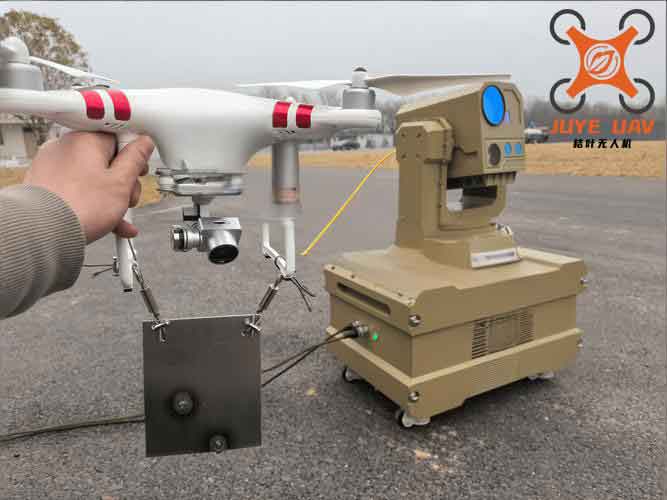
| Kinetic/Physical | Uses nets (from another drone or cannon), lasers, or projectiles. | Physically destroys or captures the drone. | Definitive neutralization. | High collateral damage risk (falling debris, laser misuse); legal and safety concerns are significant. | Low. Net-capture drones might be used in very specific, controlled scenarios as a last resort. Lasers and projectiles are generally unsuitable. |
The optimal prison anti-UAV system typically relies on directional RF jammers as the primary mitigation tool. The required jamming power $$ P_j $$ at the drone’s receiver to achieve a sufficient Jamming-to-Signal Ratio (JSR) is given by:
$$ P_j \geq \text{JSR}_{\text{req}} \cdot P_r \cdot \left( \frac{R_j}{R_t} \right)^2 $$
where \( \text{JSR}_{\text{req}} \) is the required ratio (typically >1), \( P_r \) is the received legitimate signal power at the drone, and \( R_j \) and \( R_t \) are the distances from the drone to the jammer and the legitimate transmitter, respectively.
3. Cultivating Specialized Personnel: Technology is useless without skilled operators. Prisons must establish dedicated anti-UAV units. Personnel require training not only in system operation but also in radio frequency theory, basic drone aerodynamics, legal frameworks, and evidence handling related to drone incidents. Regular, realistic drills are essential to maintain proficiency. The competency level $$ C(t) $$ of a team can be modeled as a function of training frequency \( f \), drill realism \( r \), and time \( t \) since last training, subject to a decay factor \( \alpha \):
$$ C(t) = C_0 \cdot e^{-\alpha t} + \beta \cdot f \cdot r \cdot (1 – e^{-\alpha t}) $$
where \( C_0 \) is initial competency and \( \beta \) is a learning coefficient.
Pillar III: Building an Integrated Collaborative Platform
The anti-UAV system must act as a force multiplier within the broader security ecosystem.
- Seamless Air-Ground System Integration: The anti-UAV dashboard must be fully integrated into the prison’s central command and control platform. Alerts should automatically pop up on digital maps, cue PTZ cameras to track the target, and log all data for forensic analysis. This creates a true “observe, orient, decide, act” (OODA) loop for aerial threats, merging seamlessly with responses to ground-based incidents.
- Deepening Inter-Agency Collaboration: Partnership with law enforcement is crucial. While prisons deploy defensive anti-UAV “shields,” police often employ offensive UAV “spears” for surveillance and search. Collaborative standards for data sharing (e.g., drone telemetry feeds into law enforcement GIS systems), joint training exercises, and coordinated investigation protocols for cross-border drone crimes must be established. This “shield and spear” synergy enhances overall regional security.
- Maintaining Dynamic Industry Partnership: UAV and counter-UAV technology evolves rapidly. Prisons should establish long-term service agreements with technology providers for system updates, performance optimization, and advanced operator training. This ensures the anti-UAV capability does not become obsolete and adapts to new threat models, such as drones using AI for navigation or swarm tactics.
In conclusion, the democratization of aerial technology has irrevocably altered the security calculus for correctional facilities. The threat from malicious UAVs is real, present, and growing. A proactive, systematic, and technology-driven approach to low-altitude defense is no longer futuristic but foundational. By expanding security perspectives vertically, customizing reliable detection and mitigation technologies, and forging integrated collaborative platforms, we can construct effective anti-UAV shields. This will secure the critical airspace above prisons, ensuring these facilities remain impervious to emerging aerial threats and upholding their fundamental role in justice and public safety. The time to invest in and deploy these anti-UAV systems is now, before the next major breach defines the urgency for us.