
The rapid proliferation of commercial small Unmanned Aerial Vehicles (UAVs) has unlocked transformative applications across industries, from cinematography and precision agriculture to infrastructure inspection and emergency response. However, this accessibility has concurrently escalated the risks associated with their illicit use, including privacy invasion, safety hazards at critical infrastructure, and potential security breaches. Consequently, the development and deployment of robust and reliable anti-UAV systems have become a pressing technological imperative for public safety and security authorities.
Effective counter-drone measures fundamentally depend on accurate detection and localization. While technologies like video surveillance and radar offer solutions, they possess significant limitations. Optical systems are hampered by weather conditions and limited field of view, rendering them non-all-weather solutions. Active radar, though powerful, emits electromagnetic waves that contribute to spectrum congestion and raise environmental and health concerns, making passive, radio frequency (RF)-based detection a preferred and stealthy approach for modern anti-UAV systems. A core function of such RF-based systems is Direction Finding (DF)—determining the azimuth and elevation of a target UAV from its communication or telemetry signals. Among various DF techniques, such as amplitude comparison, Doppler, and spatial spectrum estimation, phase interferometry stands out for its superior accuracy and relative implementation simplicity, making it a cornerstone technology for high-performance anti-UAV solutions.
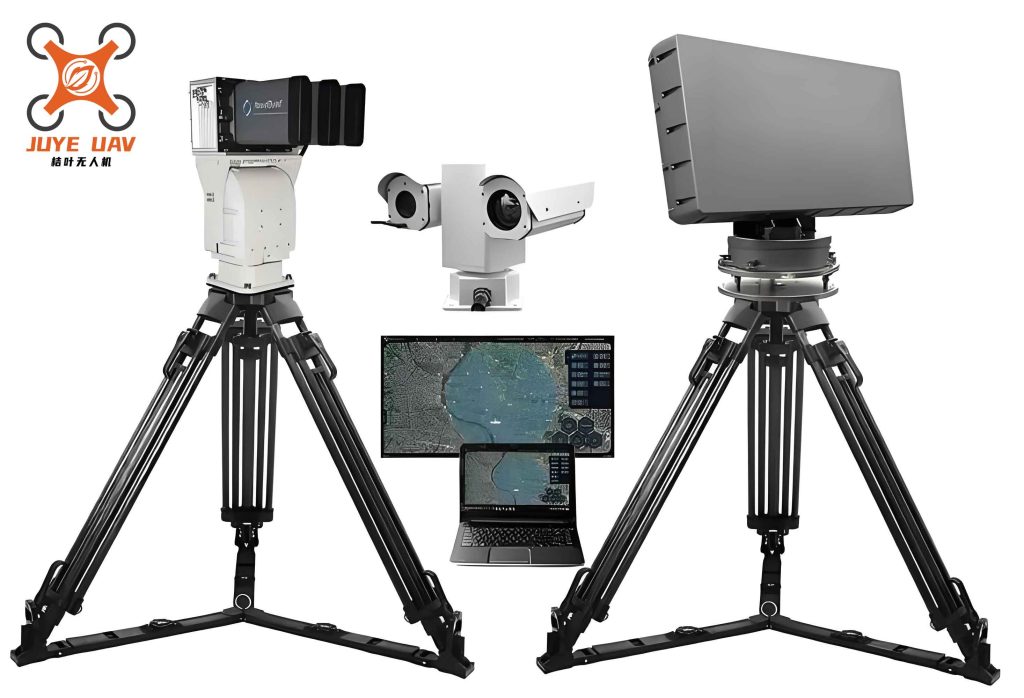
This article provides an in-depth exploration of phase interferometric direction finding, specifically employing a uniform circular array (UCA), which is favored over linear or L-arrays due to its symmetric structure, consistent accuracy across all bearings, and high sensitivity. We will derive the foundational mathematical principles, simulate the algorithm’s performance under ideal and non-ideal conditions, and discuss practical implementation considerations for an effective anti-UAV system.
1. Theoretical Foundation of Phase Interferometric DF
The core principle of phase interferometry is to measure the direction of an incoming radio wave by exploiting the phase differences it induces at spatially separated antenna elements. These phase differences are directly proportional to the path length differences from the source to each antenna.
Consider a Uniform Circular Array (UCA) consisting of \(N\) omnidirectional antenna elements, labeled \(A_1, A_2, …, A_N\), equally spaced on a circle of radius \(R\). The center of the circle is point \(O\). We define a coordinate system where the plane of the array is the \(xOy\) plane, with antenna \(A_1\) lying on the positive x-axis. The angular position of the \(n\)-th element is given by:
$$
\phi_n = \frac{2\pi}{N}(n-1), \quad n = 1, 2, …, N
$$
Therefore, its coordinates are:
$$
(x_n, y_n, z_n) = (R\cos\phi_n, R\sin\phi_n, 0)
$$
Assume a UAV signal source located at point \(M\) in the far-field, implying the incoming wavefront is planar. Its spherical coordinates relative to the array center \(O\) are defined by the range \(L\), azimuth angle \(\alpha\) (measured from the x-axis in the xOy plane), and elevation angle \(\beta\) (measured from the xOy plane). The Cartesian coordinates of \(M\) are:
$$
(x_M, y_M, z_M) = (L\cos\beta\cos\alpha,\ L\cos\beta\sin\alpha,\ L\sin\beta)
$$
For a plane wave arriving from direction \((\alpha, \beta)\), the extra distance \(\Delta d_n\) the wave must travel to reach antenna \(A_n\) compared to reaching the array center \(O\) is the projection of the antenna position vector onto the unit vector pointing from the source to the origin. This can be calculated as:
$$
\Delta d_n = \frac{\overrightarrow{OA_n} \cdot \overrightarrow{OM}}{|\overrightarrow{OM}|} = \frac{(R\cos\phi_n, R\sin\phi_n, 0) \cdot (L\cos\beta\cos\alpha, L\cos\beta\sin\alpha, L\sin\beta)}{L}
$$
$$
\Delta d_n = R\cos\beta\cos(\phi_n – \alpha)
$$
This path difference corresponds to a phase difference \(\Delta \varphi_n\) at the antenna, relative to the phase at the center:
$$
\Delta \varphi_n = \frac{2\pi}{\lambda} \Delta d_n = \frac{2\pi}{\lambda} R\cos\beta\cos(\phi_n – \alpha)
$$
where \(\lambda\) is the wavelength of the incoming signal.
The measurable quantity in a phase interferometry-based anti-UAV system is not the absolute phase at each element (which is unknown) but the phase difference between pairs of elements. For any two antenna elements \(n\) and \(m\), the interferometric phase difference is:
$$
\Delta \varphi_{n,m} = \Delta \varphi_n – \Delta \varphi_m = \frac{2\pi}{\lambda} R\cos\beta \left[ \cos(\phi_n – \alpha) – \cos(\phi_m – \alpha) \right]
$$
Using trigonometric identities, this expression can be reformulated. A particularly useful form for solving for the angles is obtained by expanding and rearranging terms. For a UCA, after manipulation, the phase difference can be expressed as a linear function in terms of intermediate variables \(x = \cos\alpha\cos\beta\) and \(y = \sin\alpha\cos\beta\):
$$
\Delta \varphi_{n,m} = a_{n,m} \cdot x + b_{n,m} \cdot y
$$
where the coefficients \(a_{n,m}\) and \(b_{n,m}\) are constants determined solely by the array geometry and the signal wavelength:
$$
a_{n,m} = -\frac{4\pi}{\lambda} R \sin\left( \pi\frac{(n-m)}{N} \right) \sin\left( \pi\frac{(n+m-2)}{N} \right)
$$
$$
b_{n,m} = \frac{4\pi}{\lambda} R \sin\left( \pi\frac{(n-m)}{N} \right) \cos\left( \pi\frac{(n+m-2)}{N} \right)
$$
By measuring the phase differences \(\Delta \varphi_{n,m}\) for multiple independent antenna pairs, we can construct a system of linear equations. For an \(N\)-element array, selecting \(M\) unique baseline pairs (where \(M \geq 2\)) yields:
$$
\begin{bmatrix}
\Delta \varphi_{1} \\
\Delta \varphi_{2} \\
\vdots \\
\Delta \varphi_{M}
\end{bmatrix} =
\begin{bmatrix}
a_{1} & b_{1} \\
a_{2} & b_{2} \\
\vdots & \vdots \\
a_{M} & b_{M}
\end{bmatrix}
\begin{bmatrix}
x \\
y
\end{bmatrix}
$$
Or, in matrix form:
$$
\mathbf{B} = \mathbf{A} \mathbf{X}
$$
where \(\mathbf{B}\) is the vector of measured phase differences, \(\mathbf{A}\) is the geometry matrix, and \(\mathbf{X} = [x, y]^T\) is the unknown vector.
This overdetermined system (when \(M > 2\)) is best solved using the Least Squares (LS) method, which provides a robust estimate \(\hat{\mathbf{X}}\) that minimizes the squared error:
$$
\hat{\mathbf{X}} = (\mathbf{A}^T\mathbf{A})^{-1}\mathbf{A}^T\mathbf{B}
$$
Finally, the azimuth \(\alpha\) and elevation \(\beta\) angles for the target UAV are recovered from the estimated \(x\) and \(y\):
$$
\alpha = \arctan\left(\frac{y}{x}\right) \quad \text{(using a four-quadrant arctangent function)}
$$
$$
\cos^2\beta = x^2 + y^2 \quad \Rightarrow \quad \beta = \arccos\left(\sqrt{x^2 + y^2}\right)
$$
Note that the arccosine yields the absolute value of the elevation angle. A single-plane circular array cannot distinguish between a UAV above (\(\beta > 0\)) or below (\(\beta < 0\)) the array plane. Resolving this ambiguity requires a secondary array displaced in the z-direction or prior knowledge of the operational environment for the anti-UAV system.
2. Critical Array Design Parameters for Anti-UAV Applications
The performance of a phase interferometric anti-UAV DF system is heavily influenced by the physical parameters of the antenna array. The key parameter is the array radius \(R\). From the phase difference equation \(\Delta \varphi_{n,m} = \frac{2\pi}{\lambda} \Delta d_{n,m}\), it is clear that the phase difference is directly proportional to the baseline length between antennas. However, practical phase measurement devices (e.g., ADCs, digital receivers) can typically only measure phase unambiguously within a range of \([- \pi, \pi)\) radians. If the actual phase difference exceeds this range, it suffers from modulo-\(2\pi\) ambiguity, which complicates the angle calculation.
To ensure unambiguous phase measurement for the longest baseline in the array (which is typically between adjacent antennas for a UCA, with \(|n-m|=1\)), we impose the constraint:
$$
|\Delta \varphi_{n,m}|_{max} \leq \pi
$$
Substituting the expression for the maximum path difference for adjacent elements (\(\Delta d_{max} \approx R \cdot 2 \sin(\pi/N)\) for small \(\beta\)), we derive the fundamental design rule for the UCA radius in an anti-UAV system:
$$
R \leq \frac{\lambda}{4 \sin(\pi / N)}
$$
This formula dictates the maximum allowable radius to prevent phase ambiguity for signals arriving from any direction. The choice of \(N\) involves a trade-off: more elements provide more independent phase measurements, improving accuracy and robustness, but also increase system cost and complexity. Common choices for anti-UAV systems are \(N=5\) or \(N=6\), offering a good balance.
The following table illustrates the maximum theoretical radius and a suggested practical radius (accounting for manufacturing tolerances and a safety margin) for UCAs with different numbers of elements at two common UAV control frequencies.
| Number of Elements (N) | Frequency (MHz) | Wavelength, λ (m) | Theoretical Max Radius (m) \(R_{max} = \lambda / (4 \sin(\pi/N))\) |
Recommended Practical Radius (m) |
|---|---|---|---|---|
| 5 | 433 (ISM Band) | ~0.693 | ~0.294 | 0.27 |
| 5 | 900 | ~0.333 | ~0.141 | 0.12 |
| 9 | 433 (ISM Band) | ~0.693 | ~0.506 | 0.48 |
| 9 | 900 | ~0.333 | ~0.243 | 0.22 |
This table highlights a critical consideration for anti-UAV system designers: the operational frequency band directly constrains the physical size of the DF array. Lower frequencies (longer wavelengths) permit or require larger arrays for the same number of elements, which can be advantageous for accuracy but may impact portability.
3. Algorithm Simulation and Performance Analysis
To validate the derived theory and analyze the performance of this DF method for anti-UAV applications, we conduct simulations using MATLAB. The simulation process involves generating synthetic signals impinging on a modeled UCA, adding realistic system impairments, and processing the data with the least-squares algorithm.
3.1 Ideal Case Simulation: First, we assume a perfect system: identical antenna patterns, perfectly matched receiver channels, and no noise. We set the true UAV direction to azimuth \(\alpha = 49.5^\circ\) and elevation \(\beta = 11^\circ\). A 5-element UCA with a radius adhering to the rule in Table 1 is modeled. The simulation generates complex baseband signals for each antenna, calculates the phase differences for all adjacent pairs, and solves for the angle estimates over 100 independent snapshots. As expected, under ideal conditions, the estimated angles exhibit zero error and zero variance, perfectly aligning with the true values. This confirms the mathematical correctness of the algorithm.
3.2 Non-Ideal (Realistic) Case Simulation: In a practical anti-UAV system, channel imbalances are inevitable. These arise from variations in antenna element characteristics, differences in cable lengths, and mismatches in the gain and phase response of each RF receiver chain. These impairments manifest as constant (or slowly varying) phase offsets and amplitude scaling factors unique to each channel.
To model this, we introduce random, time-invariant phase errors \(\delta_n\) to each receiver channel, drawn from a uniform distribution over \([-5^\circ, 5^\circ]\). The measured phase difference between channels \(n\) and \(m\) thus becomes:
$$
\widetilde{\Delta \varphi}_{n,m} = \Delta \varphi_{n,m} + (\delta_n – \delta_m)
$$
where \(\Delta \varphi_{n,m}\) is the ideal geometric phase difference. The simulation is repeated with these biases. The results show that while the estimates are no longer perfect, the algorithm remains stable. The estimated angles cluster around the true values with a small bias and a standard deviation of less than \(1^\circ\). This demonstrates the inherent robustness of the multi-baseline least-squares approach, as the random channel errors partially average out across the multiple equations. However, it underscores the necessity for a calibration procedure in a real anti-UAV system to measure and compensate for these fixed channel imbalances, which can otherwise become a dominant source of systematic error.
3.3 Performance Metrics and Error Sources: The accuracy of a phase interferometric anti-UAV DF system is quantified by the Root Mean Square Error (RMSE) of the angle estimates. Key sources of error include:
- Channel Phase/Amplitude Imbalance: As simulated, these cause fixed biases. They can be mitigated through precise factory calibration and potentially adaptive online calibration using an internal reference signal.
- Phase Measurement Noise: Thermal noise in the receivers causes random errors in the measured phase differences. The impact of this noise is inversely proportional to the Signal-to-Noise Ratio (SNR) and the effective baseline lengths.
- Array Geometry Imperfections: Any deviation of the antenna elements from their assumed perfect positions on the circle introduces errors in the \(\mathbf{A}\) matrix. Mechanical rigidity and precise manufacturing are crucial.
- Multipath Propagation: Reflections of the UAV signal from the ground or structures can create multiple wavefronts arriving at the array, violating the single plane-wave assumption and causing severe DF errors. Advanced algorithms (e.g., spatial smoothing, MUSIC) may be needed for multipath-rich environments.
The theoretical Cramér-Rao Lower Bound (CRLB) for the bearing accuracy \(\sigma_\theta\) of a phase interferometer provides a benchmark for the best possible performance:
$$
\sigma_\theta \geq \frac{1}{\frac{2\pi}{\lambda} d_{eff} \cos\theta \cdot \sqrt{SNR \cdot M \cdot T}}
$$
where \(d_{eff}\) is an effective baseline, \(M\) is the number of independent samples, and \(T\) is the integration time. This shows that DF accuracy for an anti-UAV system improves with larger aperture (larger \(R\), hence larger \(d_{eff}\)), higher SNR, and longer observation time.
4. Practical Implementation and Field Validation in an Anti-UAV System
Translating the theory into a functional anti-UAV system requires careful engineering. A common hardware architecture for a cost-effective yet capable system utilizes a time-division multiplexing approach to minimize the number of expensive, high-dynamic-range receivers.
4.1 System Architecture: A typical implementation might use a 5-element UCA connected to a fast RF switch matrix. This switch sequentially connects different pairs of adjacent antennas to a dual-channel coherent receiver. A Field-Programmable Gate Array (FPGA) controls the switching sequence, synchronizes data acquisition, and streams the digitized I/Q samples from both channels to a host computer via a high-speed interface like PCIe. The host computer runs the DF software, which performs signal detection, channel calibration, phase difference extraction, and the least-squares angle calculation.
4.2 Signal Processing Chain: The processing for each time slice (corresponding to one antenna pair) involves:
- Digital Down-Conversion (DDC) & Filtering: Isolate the frequency band of interest (e.g., the 2.4 GHz Wi-Fi or 5.8 GHz control band used by many UAVs).
- Amplitude and Phase Calibration: Apply complex weights to correct for measured channel imbalances.
- FFT and Peak Detection: Compute the power spectral density to identify the frequency bin containing the UAV signal.
- Phase Difference Estimation: For the target frequency bin, compute the phase of the complex FFT output for each channel and subtract them to obtain \(\widetilde{\Delta \varphi}_{n,m}\).
- Angle Solving: Once phase differences for a complete set of baselines are collected over one switching cycle, populate the \(\mathbf{B}\) vector, and compute \(\hat{\mathbf{X}} = (\mathbf{A}^T\mathbf{A})^{-1}\mathbf{A}^T\mathbf{B}\). Finally, compute \(\alpha\) and \(|\beta|\).
4.3 Field Test Results: In a field test, such a system was deployed to detect a commercial quadcopter UAV. The system successfully acquired the UAV’s control signal. Over 100 consecutive measurement cycles, the DF algorithm produced stable angle estimates. The results showed the azimuth estimate varying within a \(3^\circ\) window and the elevation estimate within a \(3^\circ\) window, consistent with the simulation results that included moderate channel errors and environmental noise. This validates the practical efficacy of the phase interferometry technique for real-world anti-UAV direction finding.
The table below summarizes key error sources and mitigation strategies for a deployable anti-UAV DF system.
| Error Source | Effect on DF | Mitigation Strategy |
|---|---|---|
| Receiver Channel Imbalance | Fixed bearing bias | Precision factory calibration; Internal reference loop for online calibration. |
| Thermal Noise | Random angular jitter | Increase receiver SNR (better LNAs, filters); Use longer integration time (\(T\)). |
| Array Manifold Errors (Element position/pattern) | Systematic distortion | Precision mechanical design; Array calibration in anechoic chamber. |
| Multipath Interference | Large, sporadic errors (ghost bearings) | Site selection to minimize reflectors; Use of array processing algorithms robust to coherent sources. |
| RF Switch Timing & Isolation | Phase drift and crosstalk | Use high-isolation, fast-switching components; Careful timing design in FPGA. |
5. Conclusion and Future Directions
Phase interferometry using a uniform circular array provides a theoretically sound and practically effective method for high-precision direction finding, forming a critical sensor component in modern passive anti-UAV systems. Its advantages of high accuracy, relatively straightforward implementation, and passive operation make it highly suitable for security applications where reliability and stealth are paramount. The mathematical framework, centered on solving a linear system derived from measured phase differences, is both elegant and computationally efficient.
The performance of such an anti-UAV DF system is fundamentally governed by the array geometry (radius \(R\) and number of elements \(N\)), the quality of the RF front-end, and the rigor of system calibration. Adherence to the phase ambiguity constraint \(R \leq \lambda / (4 \sin(\pi/N))\) is essential for unambiguous operation.
Future advancements in anti-UAV technology will likely integrate phase interferometric DF with other sensors (e.g., acoustic, radar) for sensor fusion and improved tracking. Algorithmically, there is potential to extend the basic least-squares approach to handle wider bandwidth signals, perform simultaneous DF on multiple UAVs, and integrate directly with tracking filters like the Kalman filter for real-time, smooth trajectory estimation. Furthermore, the development of low-cost, integrated RF-switching and receiver modules will make this high-performance DF technology more accessible for widespread deployment in comprehensive anti-UAV defense networks.