
The rapid evolution and proliferation of Unmanned Aerial Vehicle (UAV) swarms present a paradigm-shifting challenge to modern defense architectures. Characterized by attributes such as expansive operational range, formidable resilience through redundancy, exceptional tactical flexibility, and a compelling cost-effectiveness ratio, UAV swarms are transitioning from conceptual models to potent military assets. Their projected missions encompass a broad spectrum, including reconnaissance and surveillance, electronic warfare (jamming and deception), and lethal saturation attacks. The inherent robustness and self-organizing, emergent behavior of these swarms starkly expose the limitations of traditional, centralized ground-based air defense systems. These legacy systems face mounting difficulties in detection and early warning, experience slowed decision-making cycles, suffer from diminished interception efficacy, and grapple with unfavorable cost-exchange ratios, particularly in the context of large-scale, unmanned, and intelligent warfare.
This paper, drawing upon current advancements in artificial intelligence (AI), air/ground unmanned systems, swarm control, and counter-UAV (C-UAV) technologies, proposes a novel, system-of-systems approach to neutralize the swarm threat. Guided by the principle of “systematic synergy and intelligent supremacy,” the proposed construct is an Intelligent Air-Ground Cooperative Counter-Swarm System. Its objective is to achieve all-weather, intelligent, precise detection and coordinated kinetic/non-kinetic interception of UAV swarms, thereby contributing to the development of a next-generation, intelligent air defense ecosystem and enhancing our layered anti-UAV capabilities.
The core challenge in anti-UAV swarm defense lies in addressing its multi-faceted nature. Contemporary counter-swarm methodologies can be broadly categorized into three pillars: Detection & Tracking, Disruption & Deception, and Destruction & Interception.
For Detection & Tracking, a layered, heterogeneous sensor fusion approach is essential. This integrates radar, electro-optical/infrared (EO/IR), radio frequency (RF) spectrum sensing, and acoustic systems to maintain persistent surveillance. AI-driven data fusion algorithms are then critical for track correlation, target classification, and intent recognition against “low, slow, small, and numerous” (LSSN) targets.
Disruption & Deception tactics aim to break the swarm’s cohesion and purpose. This involves jamming command-and-control (C2) and Global Navigation Satellite System (GNSS) links, employing cyber-attacks to infiltrate swarm networks, or deploying spoofing and decoy systems to mislead the swarm’s sensors or navigation, causing it to deviate or land controllably.
Destruction & Interception represents the hard-kill pillar. Options range from traditional air-defense missiles and directed-energy weapons (lasers, high-power microwaves) to more novel approaches like interceptor drones, net-capture systems, or even trained birds of prey. Each option presents a trade-off between cost, range, probability of kill (Pk), and collateral damage. Notably, an active defense concept utilizing our own “counter-swarms” of low-cost, attritable drones to engage the adversary’s swarm proactively offers high potential for scalability and effectiveness.
Architecture of the Intelligent Air-Ground Counter-Swarm System
The proposed system is a distributed, intelligent combat system integrating command, control, communications, computers, intelligence, surveillance, and reconnaissance (C4ISR) with engagement functions. It is designed for sustained, day-and-night operations across diverse and complex environments, enabling real-time precise detection, identification, threat assessment, and multi-domain interception of UAV swarms.
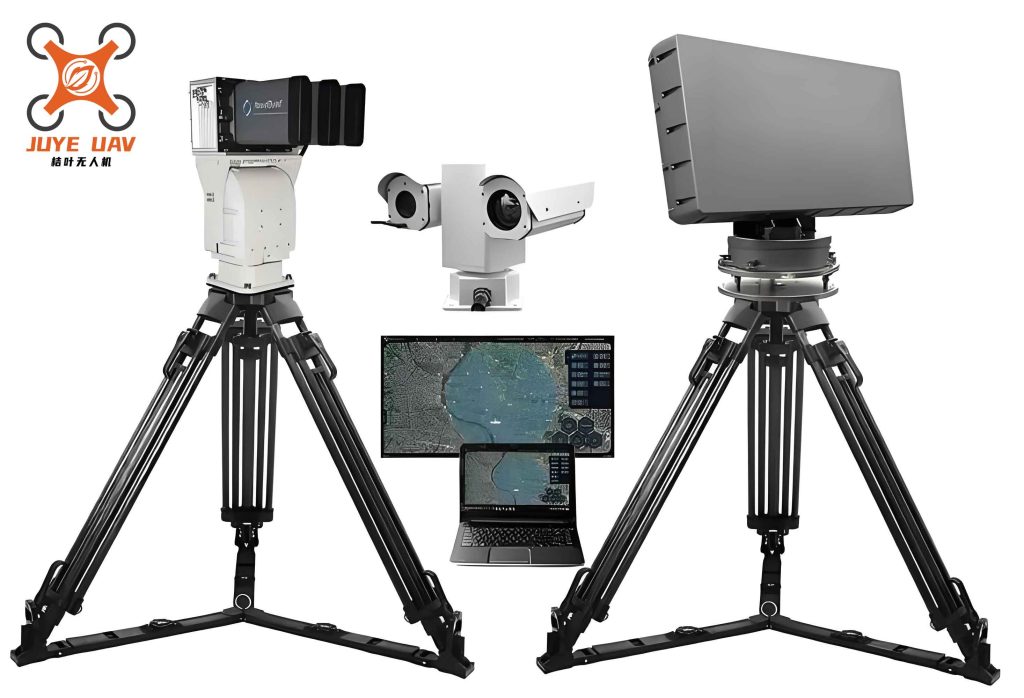
System Components
The architecture is built upon three synergistic pillars:
1. Air-Ground Cooperative Intelligent Command, Control, and Communications (C3) System: This serves as the “brain” of the system. It comprises airborne, vehicle-mounted, and man-portable command posts. Its functions include:
- Fusing intelligence from all sensors to create a common operational picture (COP).
- Conducting AI-aided threat analysis and battle damage assessment (BDA).
- Performing resource allocation, mission planning, and generating synchronized tasking orders for air and ground assets.
- Facilitating intuitive human-machine interaction (HMI) via voice, gesture, or even brain-computer interfaces for rapid decision-making.
2. Air-Ground Cooperative Intelligent Sensing System: This forms the “eyes and ears” of the system. It is a networked mix of unmanned aerial and ground platforms equipped with multi-spectral sensors:
- Unmanned Aerial/Ground EO/IR Systems: For visual identification, tracking, and night operations.
- Unmanned Aerial/Ground Radar Systems: Including advanced holometric digital array radars for detecting LSSN targets.
- Unmanned Aerial/Ground Electronic Support Measures (ESM): For RF fingerprinting, signal intelligence (SIGINT), and detecting communication/navigation emissions.
These assets deploy flexibly to form a persistent, low-altitude surveillance grid, with onboard AI enabling preliminary target recognition and feature extraction.
3. Air-Ground Cooperative Intelligent Interception System: This constitutes the “fist” of the system. It is a diverse arsenal of unmanned effectors deployed on air and ground platforms:
- Unmanned Aerial/Ground Electronic Attack (EA) Systems: For jamming and cyber-electronic attacks.
- Unmanned Aerial/Ground Directed-Energy Weapons (DEW): Laser and high-power microwave (HPM) systems.
- Unmanned Aerial/Ground Kinetic Effectors: Missiles, guns, or interceptor drones.
- Unmanned Aerial/Ground Physical Capture Systems: Net-based capture drones.
This mix allows for scalable, graduated responses from soft-kill to hard-kill.
Operational Workflow
The system operates through a closed-loop, OODA (Observe, Orient, Decide, Act) cycle, heavily augmented by autonomy.
Phase 1: Distributed Sensing & Target Identification. Unmanned sensor platforms, following C3 directives, deploy to establish a surveillance perimeter. Upon detecting a potential swarm, they initiate cooperative tracking. AI algorithms perform multi-source fusion, classifying the threat and estimating swarm size, formation, and likely intent. This fused intelligence is streamed to the C3 node. Key performance metrics for detection can be summarized by the probability of detection (Pd) for a sensor fusion system, which can be modeled as a function of individual sensor probabilities:
$$P_{d\_fused} = 1 – \prod_{i=1}^{N} (1 – P_{d\_i})$$
where \( P_{d\_i} \) is the detection probability of the i-th sensor, and \( N \) is the number of independent sensors.
Phase 2: AI-Enhanced Command & Control. The C3 system’s decision support engine processes the incoming track data. It assesses threat priority, evaluates friendly asset status and proximity, and runs wargaming simulations to generate optimal engagement plans. The commander approves or modifies the AI-recommended course of action (COA). Synchronized engagement orders are then disseminated to the interceptor teams.
Phase 3: Coordinated Multi-Domain Engagement. Interceptor teams execute the plan. Typically, non-kinetic effects are prioritized: EA platforms attempt to disrupt swarm C2 and GNSS. If unsuccessful or if the threat is imminent, kinetic and DEW assets are employed. Counter-swarms of interceptor drones may be launched for close-in attrition. The engagement employs cooperative behaviors, such as area denial or targeted suppression of “leader” nodes within the adversary swarm.
Phase 4: Real-Time Battle Damage Assessment & Adaptation. Sensor platforms continuously monitor the engagement zone, assessing effects (e.g., number of UAVs neutralized, swarm dispersion). This BDA is fed back to the C3 system. Based on results, the system dynamically re-tasks sensors and effectors, closing the kill chain and adapting to the evolving threat. This adaptive loop can be conceptualized as a reinforcement learning (RL) problem, where the system learns optimal policies \( \pi \) to maximize the reward \( R_t \) (successful defense) over time:
$$ \pi^* = \arg\max_{\pi} \mathbb{E} \left[ \sum_{t=0}^{\infty} \gamma^t R_t | \pi \right] $$
where \( \gamma \) is a discount factor.
Critical Enabling Technologies for Effective Anti-UAV Swarm Defense
The realization of this intelligent anti-UAV system hinges on breakthroughs in several cross-disciplinary technologies.
1. Holometric Digital Array Radar (HDAR) for Swarm Detection
Traditional radars struggle with swarms due to resolution limits and track confusion. HDAR technology, utilizing digital beamforming for transmit and receive, allows for staring observation of a sector. Long-time coherent integration of echoes significantly improves the signal-to-noise ratio (SNR) for small radar cross-section (RCS) targets like drones. Key research thrusts include:
- Joint Motion Compensation & Long-Time Integration: To maintain phase coherence for moving swarm targets during extended integration time \( T_{obs} \), improving effective SNR. The integrated SNR gain is proportional to \( T_{obs} \cdot B \) where \( B \) is bandwidth.
- High-Resolution Range-Doppler Processing for Population Estimation: Using super-resolution techniques to resolve individual drones within a swarm cluster in the range-Doppler domain, enabling count estimation.
- Swarm Track Initiation & Association: Developing algorithms based on Kalman filtering with spatial constraints and Hough transforms to initiate and maintain distinct tracks for densely packed targets, mitigating track coalescence.
2. Multi-Source Information Fusion and Intelligent Situational Awareness
Fusing data from radar, EO/IR, and ESM sensors is non-trivial due to differing formats, accuracies, and update rates. A Bayesian framework is often foundational:
$$P(State | Z_{1:k}) \propto P(Z_k | State) \cdot \int P(State | State_{k-1}) P(State_{k-1} | Z_{1:k-1}) dState_{k-1}$$
where \( Z_{1:k} \) represents all sensor measurements up to time \( k \). Beyond fusion, cognitive AI is needed for “swarm sense-making.” This involves:
- Building a knowledge graph of swarm behaviors, formations (e.g., wedge, line), and tactics.
- Using graph analysis or neural networks to identify key nodes (potential leaders or communication relays) and swarm vulnerabilities.
- Predicting swarm intent and likely maneuver patterns, transitioning from simple tracking to predictive threat assessment.
3. Counter-Swarm Decision-Making and Planning Against Emergent Behavior
The system must not only react but out-think the swarm. This requires AI that can model and counter emergent swarm intelligence. A hybrid AI architecture is proposed:
- Knowledge Base & Reasoning: Encodes doctrinal knowledge, rules of engagement (ROE), and historical data on swarm tactics.
- Deep Reinforcement Learning (DRL) Models: Train in simulation to develop optimal counter-tactics, such as which effector type to use against which swarm formation. The agent learns a policy \( \pi(a|s) \) mapping states (swarm size, distance, formation) to actions (deploy EA, fire laser, launch counter-swarm).
- Adversarial Wargaming: The system continuously runs “what-if” simulations, using generative models to create novel swarm attack patterns, ensuring the DRL policies remain robust and adaptive.
The planning output is a synchronized task network, optimally allocating resources across air and ground domains.
4. Blockchain-Inspired Autonomous Swarm Coordination
To manage its own fleet of heterogeneous unmanned counter-swarm assets, a resilient coordination mechanism is vital. Borrowing from blockchain concepts can enhance autonomy:
- Byzantine Fault-Tolerant (BFT) Consensus: Allows a group of unmanned platforms to agree on a shared situation picture or a coordinated maneuver plan even if some members are compromised or reporting faulty data.
- Smart Contract-like Tasking: Pre-defined, verifiable “contracts” (e.g., “if swarm breaches perimeter X, closest two interceptor drones engage”) can execute automatically upon trigger conditions being met, enabling rapid response.
- Tokenized Incentive Mechanisms: In a fully autonomous mode, platforms could be “rewarded” with priority for resources or simpler tasks for successful cooperation, fostering emergent cooperative behaviors within the friendly counter-swarm.
5. Adversarial AI: Attack and Defense for the Cognitive Layer
Since future UAV swarms will likely use AI for perception and navigation, the anti-UAV system must operate at this cognitive layer. This involves:
- Generating Adversarial Examples: Creating subtle perturbations to EO/IR patterns or RF signals that can fool the swarm’s AI classifiers. An adversarial perturbation \( \eta \) for an image classifier can be found by solving: \( \min_{\|\eta\|_p \leq \epsilon} L(f(x+\eta), y_{target}) \), where \( f \) is the swarm’s model, \( L \) is a loss function, and \( \epsilon \) bounds the perturbation.
- Defending Own AI Systems: Hardening the counter-swarm system’s own AI models against similar attacks through techniques like adversarial training, defensive distillation, or runtime detection of anomalous inputs.
6. High-Bandwidth, Anti-Jam, and Low-Latency Communications
The network backbone linking all elements must be robust. Key technologies include:
- Cognitive Radio & Dynamic Spectrum Access: To sense and avoid jamming, hopping to clean frequencies.
- MIMO and Beamforming: For spatial diversity, directing signals precisely to intended receivers and nulling jammers.
- Adaptive Coding and Modulation: To maintain link reliability under varying channel conditions.
- Mesh Networking Protocols: For self-healing, multi-hop communications among aerial and ground nodes, ensuring network resilience.
The required link capacity \( C \) can be estimated based on data from \( N \) sensors with update rate \( R \): \( C > \sum_{i=1}^{N} (Data\_Rate_i) \).
System Advantages and Comparative Analysis
Compared to existing point-solution C-UAV systems (e.g., standalone jammers, laser systems), the proposed intelligent air-ground system offers transformative advantages:
| Feature | Traditional Point Defense C-UAV | Proposed Intelligent Air-Ground Counter-Swarm System |
|---|---|---|
| Operational Efficacy | Limited to specific threat types (e.g., jamming only, kinetic only); single-point failure risk. | High Systemic Efficacy: Integrated “detect-to-engage” chain with multiple, complementary effectors. AI-driven synergy optimizes overall Probability of Kill (Pk). |
| Tactical Flexibility & Coverage | Static or semi-static deployment; limited defensive footprint. | Dynamic & Expansive Coverage: Mobile air and ground units can redeploy rapidly. Supports “air-to-air,” “ground-to-air,” and “air-ground-cooperative” engagement modes for layered defense. |
| Resilience & Survivability | High-value asset; attractive target for preemptive strike. | High Resilience: Distributed, networked, and partially attritable assets. Loss of individual nodes degrades but does not cripple the system (graceful degradation). |
| Adaptability & Cost | Fixed response; high cost per engagement for missile-based systems. | Intelligent Adaptability: Learns and adapts to new swarm tactics. Favorable Cost Exchange: Employs a mix of low-cost interceptors and high-value assets, optimizing resource use. |
| Complex Environment Operation | May be degraded in urban canyons, electronic warfare environments. | Sustained Operation: Heterogeneous sensors (RF, acoustic, visual) overcome individual limitations. Unmanned platforms can operate in high-risk CBRN or contested zones without crew fatigue. |
Application Scenarios and Force Multiplier Effect
The system’s flexibility makes it applicable across multiple domains:
1. Fixed Site & Critical Infrastructure Protection: Deploying a persistent sensor and interceptor web around airfields, command centers, or nuclear facilities. Ground-based radars and DEW provide the base layer, while aerial sensor drones extend the detection radius, and interceptor drones handle close-in breaches.
2. Mobile Force Protection (Convoy/Formation Defense): Vehicle-mounted components provide organic protection for armored columns or naval task groups. Short-range systems (EA, microwave) on vehicles, complemented by launched interceptor drones, create a moving “bubble” of protection.
3. Border & Coastal Surveillance: Networked ground sensors along a border, patrolled by persistent aerial surveillance drones (HALE or MALE UAVs). Upon detection of a swarm incursion, the C3 node can vector interceptor drones from the nearest forward operating base.
4. Counter-Swarm Offensive Operations: The system can transition to an offensive role, using its own swarms to seek out and destroy adversary UAV launch sites or C2 vehicles, engaging in unmanned vs. unmanned warfare beyond the defensive perimeter.
Conclusion and Future Outlook
The threat posed by intelligent UAV swarms is asymmetric and evolving. A paradigm shift from platform-centric defense to a system-centric, intelligent, and highly adaptive counter-swarm ecosystem is not merely advantageous but imperative. The proposed Intelligent Air-Ground Cooperative Counter-Swarm System, founded on the pillars of distributed unmanned assets, multi-source AI fusion, and autonomous collaborative engagement, provides a comprehensive architectural answer to this challenge. It moves beyond simply shooting down drones to dismantling the swarm’s informational and decision-making fabric—fighting intelligence with superior, human-augmented collective intelligence.
The path forward involves focused R&D in the core technologies outlined, particularly in robust AI/ML models resilient to deception, scalable and secure swarm-to-swarm communication protocols, and miniaturization of powerful effectors like compact DEW systems. Furthermore, the development of vast, realistic simulation environments for training and testing these systems against adaptive red-team swarms will be crucial. By investing in this holistic anti-UAV swarm vision, defense forces can cultivate a decisive, multi-domain capability to control the skies in the age of autonomous, collective warfare.
| Engagement Type | Mechanism | Advantages | Limitations | Best Suited For |
|---|---|---|---|---|
| Radio Frequency Jamming/Cyber | Disrupts C2/GNSS links; injects malicious commands. | Non-kinetic, wide area effect, low collateral damage, potentially reversible. | May be ineffective against autonomous/pre-programmed swarms; can affect friendly comms. | First line of defense, area denial, disrupting swarm coordination. |
| Directed Energy (Laser) | Thermal ablation of critical components. | Speed-of-light engagement, deep magazine (power-dependent), high precision, low cost-per-shot. | Line-of-sight required, atmospheric attenuation (rain, fog), limited range against multiple fast-moving targets. | Point defense, neutralizing individual high-priority drones in a swarm. |
| Directed Energy (HPM) | High-power RF pulse fries electronics. | Area effect, can engage multiple drones simultaneously, all-weather capability. | Shorter effective range than lasers, high power requirement, potential for wider collateral electronic damage. | Engaging tightly packed swarms, terminal defense. |
| Kinetic (Interceptor Drones) | Physical collision or proximity net/explosive. | High probability of kill, can operate beyond line-of-sight (if guided), adaptable. | Attritable (cost per unit), limited payload/range, may struggle with very large swarms due to magazine depth. | Active defense, counter-swarm maneuvers, engaging in complex terrain. |
| Traditional Air Defense (Missiles) | Blast/fragmentation warhead. | Long range, high velocity, proven technology. | Extremely high cost-per-kill against cheap drones, saturation risk, overkill. | Last-resort defense against large or high-altitude UAVs, not cost-effective for typical swarms. |