
The rapid evolution of information and aviation technology has catalyzed the explosive growth of low-altitude unmanned aerial vehicles (UAVs), swiftly transforming the low-altitude airspace into a new, contested battlespace. Modern low-altitude drones boast advanced performance and diverse functionalities, often featuring capabilities such as self-organizing networks, autonomous navigation, and precision hovering. With potent reconnaissance and combat potential, their low technical barrier and wide availability make them attractive tools for malicious actors, terrorists, and adversarial forces. Swarm technology represents a pivotal future direction for UAV development. UAV swarm operations exhibit formidable battlefield survivability and mission accomplishment potential, standing as one of the disruptive technologies influencing future warfare’s victory mechanisms and posing severe challenges to low-altitude defense. Critical locations like military airfields, command hubs, and fuel depots face acute threats from low-altitude reconnaissance and attack, demanding effective countermeasures urgently.
Analysis of the UAV Swarm Threat
In recent years, sensitive sites worldwide have witnessed numerous incidents of small UAV intrusions, creating significant security hazards. Public reports detail drone incursions over the Pentagon, the White House, French nuclear power plants, the Japanese Prime Minister’s office, and the Korean Blue House. Similarly, vital political centers, military bases, and nuclear facilities have experienced illegal UAV entries.
Notably, the January 6, 2018, coordinated attack by 13 explosive-laden drones on Russia’s Khmeimim Air Base and Tartus naval facility in Syria first demonstrated the substantial operational potential of UAV swarms. The 2020 Nagorno-Karabakh conflict highlighted drones as decisive tools, and the 2022 Russia-Ukraine war further solidified low-cost drone warfare as a highly cost-effective new combat paradigm. As artificial intelligence and sensing technologies accelerate, swarm tactics are becoming a primary future combat style. Major powers are heavily investing in swarm technology development, with projects like the U.S. “Perdix” swarm, the “Offensive Swarm-Enabled Tactics” (OFFSET) program, and the “Gremlins” initiative.
The challenge of anti-UAV swarm defense lies in their low cost, vast numbers, and difficulty in detection and neutralization. Small, low-altitude drones have minimal radar cross-sections and weak infrared signatures, making them hard to detect with conventional air defense systems. Traditional countermeasures include low-altitude search radars, electro-optical/infrared sensors for detection, and short-range missiles, artillery, or GPS/communication jammers for engagement. However, these systems often suffer from slow reaction times, low precision against small targets, difficulty with fuze-warhead matching, significant collateral damage potential, and poor cost-effectiveness, especially against agile swarm saturation attacks. This gap necessitates novel solutions to address emerging threats.
| Characteristic | Description | Defense Challenge |
|---|---|---|
| Low Cost & Proliferation | Easy to manufacture, modify, and deploy in large numbers. | Makes traditional missile-based defense economically unsustainable. |
| Small Radar Cross-Section (RCS) | Minimal radar signature, often comparable to birds. | Difficult for traditional radar to detect and track at sufficient range. |
| Low Infrared (IR) Signature | Small engines emit limited heat. | Challenges IR-based tracking systems, especially in cluttered environments. |
| Swarm Saturation | Simultaneous attack by dozens or hundreds of drones. | Overwhelms point-defense systems with limited engagement channels and ammunition. |
| Autonomous Operation | Can use pre-programmed routes or AI, reducing reliance on continuous control links. | Limits effectiveness of traditional radio frequency (RF) jamming. |
The Characteristics of Directed Energy Weapons
Directed Energy Weapons (DEWs), primarily High-Energy Lasers (HELs) and High-Power Microwaves (HPMs), are uniquely suited for low and very-low-altitude defense due to their inherent properties.
Mechanism and Advantages of High-Energy Lasers
High-Energy Laser weapons function by emitting a concentrated beam of photons that deposits energy on the target’s surface. This energy transfer causes rapid heating, leading to ablation, melting, or structural failure of critical components like sensors, motors, flight control surfaces, or composite materials, ultimately resulting in loss of control or crash.
The key advantages for anti-UAV applications are:
- Speed-of-Light Engagement: Essentially instantaneous hit, negating the need for lead calculation.
- Deep Magazines & Low Cost-Per-Shot: Primarily limited by electrical power and coolant, offering hundreds of engagements per system at a cost of only a few dollars per shot.
- Precision & Low Collateral Damage: Highly focused beam minimizes risk to surrounding areas.
- Rapid Re-targeting: Beam steering mirrors can switch between targets extremely quickly.
The fundamental equation governing the laser’s effect on target is related to the energy density (fluence):
$$ F = \frac{P \cdot t \cdot \tau_{atm}}{A_{spot}} $$
Where \(F\) is the fluence (\(J/cm^2\)), \(P\) is the laser power (W), \(t\) is the dwell time (s), \(\tau_{atm}\) is the atmospheric transmission coefficient, and \(A_{spot}\) is the laser spot area (\(cm^2\)). A target is defeated when \(F\) exceeds its damage threshold.
Mechanism and Advantages of High-Power Microwave Weapons
High-Power Microwave weapons generate intense, short pulses of electromagnetic energy. These pulses can couple into a UAV’s electronics via “front-door” (intended接收 antennas like GPS or control links) or “back-door” (cables, seams, apertures) pathways. The induced currents and voltages can disrupt or permanently damage microprocessors, sensors, and navigation systems, causing immediate loss of function.
Their advantages are complementary to lasers for anti-UAV swarm defense:
- Area Effect: A single pulse can cover a wide beamwidth, potentially disabling multiple drones within a cone of effect simultaneously.
- All-Weather Capability: Microwave propagation is less affected by atmospheric conditions like rain or fog compared to lasers.
- Effect Against Electronic Systems: Directly targets the core vulnerability of modern UAVs.
- Speed-of-Light, Multi-Target Engagement: Like lasers, engagement is instantaneous and can affect many targets in the beam path with one pulse.
The power density at range is critical:
$$ S = \frac{P_{peak} \cdot G}{4 \pi R^2} $$
Where \(S\) is the power density (\(W/m^2\)), \(P_{peak}\) is the peak microwave power (W), \(G\) is the antenna gain, and \(R\) is the range to target (m). The system must achieve a power density above the target’s susceptibility threshold within the effective beam area.
| System Type | Engagement Mechanism | Advantages for Anti-Swarm | Limitations for Anti-Swarm |
|---|---|---|---|
| Kinetic (Missiles/Guns) | Physical impact/explosion. | High single-shot kill probability. | Low magazine depth, high cost-per-kill, collateral damage risk, slow against multiple fast targets. |
| Radio Frequency Jamming | Disrupts control/GPS signals. | Non-kinetic, wide area effect. | Ineffective against autonomous/pre-programmed drones; can cause friendly interference. |
| High-Energy Laser (HEL) | Thermal/structural damage. | Very low cost-per-shot, deep magazine, precision, fast re-targeting. | Line-of-sight required, performance degraded by atmosphere (fog, rain). |
| High-Power Microwave (HPM) | Electronic disruption/damage. | Wide-area, multi-target engagement per pulse, all-weather, effective against electronics. | Potential for collateral electronic damage, requires significant power. |
Development Status of Directed Energy Weapons
Recognized as potential game-changers, HEL and HPM weapons are under vigorous development by major military powers. Technologies are maturing, with several nations advancing systems specifically for low-altitude defense.
In the laser domain, systems like Lockheed Martin’s Area Defense Anti-Munitions (ADAM, 10 kW), Boeing’s High Energy Laser Mobile Demonstrator (HEL MD, 5-10 kW), Rheinmetall’s “Skyguard” (5-50 kW), and the U.S. Navy’s Laser Weapon System (LaWS, 33 kW) have successfully engaged drones, rockets, and mortars in tests. For HPM, Raytheon’s “Phaser” system and other prototypes have demonstrated the ability to down multiple UAVs with a single burst.
U.S. military exercises like “Black Dart” and the “Mobile Integrated FireX” (MIFX) have yielded significant insights. Results indicate that while existing air defense can handle larger UAVs, lasers and HPM weapons show superior effectiveness against small drones. During MIFX 2018, a combined test using HPM and laser systems reportedly defeated 45 drones, validating that integrated DEW systems can effectively counter swarm attacks.
Domestically, significant progress has also been made. Various enterprises have developed and field-tested tactical laser defense systems. These systems have conducted numerous successful interception trials against various drone types, achieving high success rates. They have been deployed for the security of major national events and have proven their operational utility in real-world scenarios by neutralizing threat targets, thereby eliminating security risks.
| Phase | Time (Seconds) | System Action | Key Parameter / Equation |
|---|---|---|---|
| Detection & Cueing | t0 to t0+5 | Ku-band radar detects incoming swarm, cues EO/IR tracker. | Detection Range: \(R_{det} = \sqrt[4]{\frac{P_t G^2 \lambda^2 \sigma}{(4\pi)^3 k T_0 B F_n (SNR)_{min}}}\) |
| Acquisition & Tracking | t0+5 to t0+7 | Fine-track sensor locks onto lead target, provides precision pointing data. | Tracking Error < \(\theta_{beam}\) (beam divergence). |
| Aimpoint Selection & Dwell | t0+7 to t0+12 | Beam director slews, laser fires, and dwells on vulnerable component (e.g., motor). | Dwell Time: \(t_{dwell} = \frac{F_{threshold} \cdot A_{spot}}{P \cdot \tau_{atm}}\) |
| Kill Assessment | t0+12 to t0+14 | EO/IR observes target for loss of control, smoke, or change in trajectory. | Confidence > 90% before disengagement. |
| Re-targeting | t0+14 to t0+16 | Beam director slews to next highest priority target in swarm. | Slew Rate defines time to next engagement. |
Concept for a Directed Energy-Based Integrated Low-Altitude Defense System
Effectively countering UAV swarms requires a system-of-systems approach, integrating multi-layered detection, interception, and intelligent command and control (C2). A defense-in-depth strategy, combining layered sensors and soft/hard kill effectors, is essential.
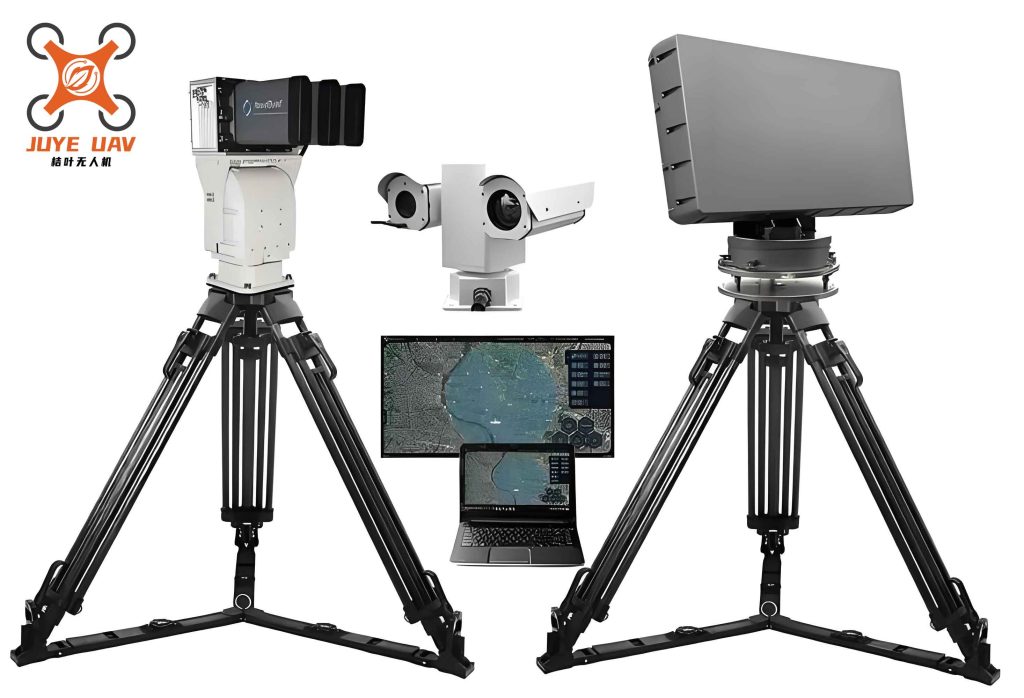
For detection, a composite sensor suite is optimal. Ku-band or similar radars provide wide-area search and initial tracking with good resolution for small targets. This data seamlessly cues multi-spectral electro-optical/infrared (EO/IR) systems for high-resolution identification, confirmation, and precise tracking. Emerging technologies like acoustic detection and RF spectrum analyzers can be fused to create a comprehensive, resilient air picture through multi-sensor data fusion.
For interception, Directed Energy Weapons should form the primary hard-kill layer, complemented by other measures. The number and type of DEW systems (laser vs. microwave) are scaled and adapted based on the protected site’s geography and threat axis. HEL systems provide precise, single-target neutralization, while HPM systems offer a broad-area capability ideal for engaging tightly packed swarm elements.
The operational workflow consists of three core phases:
- Warning Phase: The integrated sensor network (organic and external) provides fused track data, triggering an alert.
- Decision Phase: The intelligent C2 system performs automatic threat evaluation (identification, classification, intent estimation) and presents engagement recommendations to the human operator, or executes pre-authorized rules of engagement.
- Interception Phase: The C2 system allocates threats to appropriate effectors (e.g., assign high-value, isolated target to laser; assign dense sub-swarm to HPM). Following engagement, Battle Damage Assessment (BDA) is performed to inform follow-on actions (re-engage, shift fire, or stand down).
The synergy between different DEW types can be formalized. For a mixed swarm, an optimal engagement sequence might involve an initial HPM pulse to degrade the electronic coherence and navigation of a large portion of the swarm, followed by precise HEL engagements to pick off any remaining high-priority or resilient targets. The overall system effectiveness \(E_{sys}\) against a swarm of size \(N\) can be modeled as a function of individual weapon probabilities of kill (\(P_{k}\)) and engagement rates (\(\lambda\)):
$$ E_{sys} = 1 – \prod_{i=1}^{N} \left(1 – P_{k_{alloc(i)}}(t) \right) $$
where \(alloc(i)\) determines which weapon system (HEL or HPM) is assigned to target \(i\) based on C2 logic, and \(P_k\) is time-dependent based on engagement sequencing.
In conclusion, the escalating threat posed by UAV swarms necessitates robust and adaptive defensive measures. Directed Energy Weapons, particularly High-Energy Lasers and High-Power Microwaves, have entered a critical phase of maturation and practical deployment. Their unique attributes—speed-of-light engagement, deep magazines, and cost-effectiveness—make them indispensable components of a modern anti-UAV architecture. By integrating these new physical principle weapons with mature radar, EO/IR, and command systems, we can construct resilient, multi-layered, integrated low-altitude defense systems. Deploying such systems at core facilities and strategic locations will significantly enhance operational defensive capabilities, providing a decisive shield against low-altitude threats and safeguarding critical national security assets.