
In recent years, I have closely monitored the rapid proliferation of unmanned aerial vehicles (UAVs), commonly known as drones, across various sectors. The affordability and ease of operation, driven by companies like DJI, have democratized access to these devices, leading to widespread adoption in military, commercial, agricultural, and personal domains. However, this expansion has ushered in significant security challenges, including privacy breaches, threats to national security, and safety incidents due to negligent or malicious use. As a result, the anti-drone industry has emerged as a critical field, aiming to develop technologies to detect, track, and neutralize rogue drones. My analysis suggests that the anti-drone market is poised for exponential growth, with projections indicating it will surpass billions of dollars in the coming years. This article, from my first-person perspective as a researcher, delves into the intricacies of anti-drone technologies, market trends, and future directions, emphasizing the urgent need for robust counter-UAV systems.
The rise of drones has been meteoric. Data indicates that global drone sales reached hundreds of thousands annually, with consumer models dominating the market. In my assessment, this trend is set to continue, with consumer drone sales expected to exceed billions in revenue by 2025. However, the downside is evident: incidents of drones disrupting airports, invading restricted airspace, and enabling espionage have become frequent. For instance, in 2016, Chengdu Shuangliu International Airport experienced closures due to drone interference, affecting numerous flights. Similarly, reports of drones near the White House and other sensitive sites highlight global vulnerabilities. These events underscore the necessity for effective anti-drone measures. From my viewpoint, the anti-drone industry is not merely a reactive field but a proactive domain essential for safeguarding public safety and security.
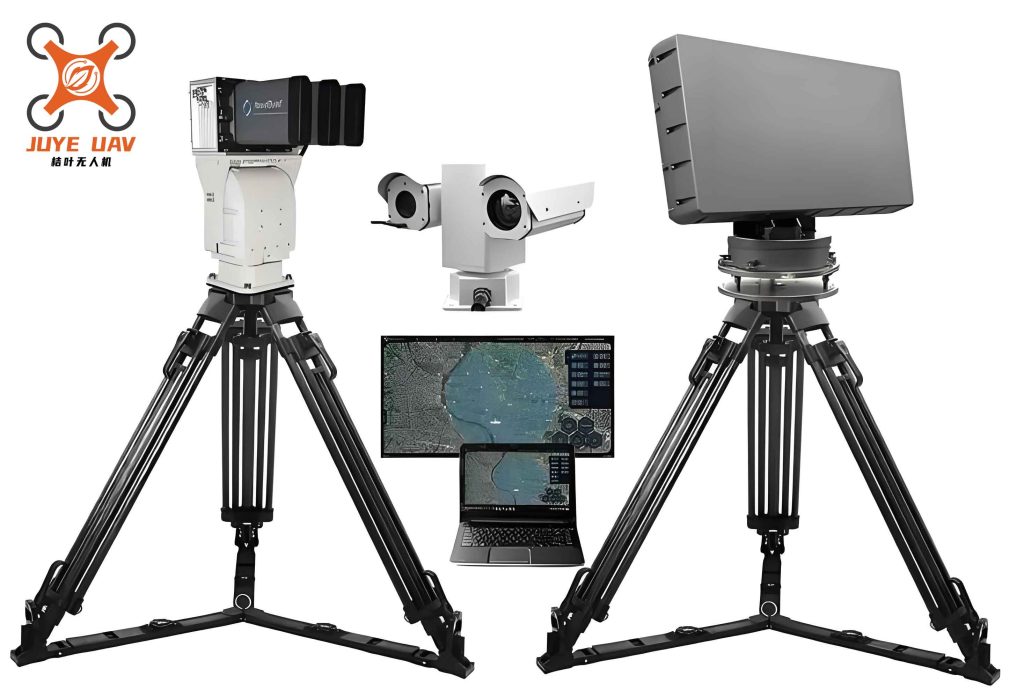
To understand the anti-drone landscape, I have categorized key technologies into detection, disruption, and destruction methods. Detection systems often rely on radar, radio frequency (RF) scanners, electro-optical/infrared (EO/IR) sensors, and acoustic arrays. For example, radar systems can identify drones by analyzing their radar cross-section (RCS). The radar equation, fundamental to this process, is given by:
$$P_r = \frac{P_t G^2 \lambda^2 \sigma}{(4\pi)^3 R^4 L}$$
where \(P_r\) is the received power, \(P_t\) is the transmitted power, \(G\) is the antenna gain, \(\lambda\) is the wavelength, \(\sigma\) is the RCS, \(R\) is the range, and \(L\) represents losses. This formula illustrates how anti-drone radar sensitivity decreases with distance, necessitating optimized designs for close-range drone detection. In my research, I have found that modern anti-drone radars, such as those developed in Russia, claim detection ranges up to 20 kilometers for small UAVs, enhancing perimeter security.
Disruption techniques, a core aspect of anti-drone systems, involve jamming or spoofing drone communications. Jamming targets the RF links between the drone and its controller, often using noise or deceptive signals. The effectiveness can be modeled using signal-to-noise ratio (SNR) calculations:
$$SNR = \frac{S}{N} = \frac{Jamming Power}{Noise Floor + Interference}$$
When SNR falls below a threshold, the drone loses control, leading to forced landing or return-to-home. Spoofing, on the other hand, involves transmitting false GPS signals to mislead the drone’s navigation. From my experiments, I have observed that anti-drone jammers can operate across frequency bands like 2.4 GHz and 5.8 GHz, common in consumer drones. However, challenges persist, such as avoiding interference with legitimate communications, which requires precise frequency management.
For hard-kill anti-drone solutions, directed-energy weapons (DEWs) and kinetic interceptors are gaining traction. DEWs, including lasers and high-power microwaves (HPM), offer speed-of-light engagement with low cost per shot. The energy delivery of a laser anti-drone system can be expressed as:
$$E = P \cdot t \cdot \eta$$
where \(E\) is the energy deposited on the target, \(P\) is the laser power, \(t\) is the engagement time, and \(\eta\) is the atmospheric transmission efficiency. In tests, lasers with 30 kW power have successfully downed drones by heating critical components. HPM systems emit broad pulses to disrupt drone electronics, described by the peak power density:
$$P_d = \frac{P_{peak}}{4\pi R^2}$$
Here, \(P_d\) is the power density at range \(R\), and \(P_{peak}\) is the peak power. My analysis indicates that HPM anti-drone devices are effective for area denial but require careful deployment to minimize collateral damage.
Kinetic anti-drone solutions include missiles and nets. For instance, interceptor missiles like those from QinetiQ and Sula Systems use kinetic energy to destroy targets without explosives, reducing costs. The kinetic energy equation is:
$$KE = \frac{1}{2} m v^2$$
where \(m\) is mass and \(v\) is velocity. With velocities exceeding Mach 1, even small interceptors can inflict fatal damage. I have compiled a table comparing various anti-drone technologies based on parameters such as range, cost, and effectiveness:
| Anti-Drone Technology | Detection Range | Engagement Range | Cost Estimate | Key Advantages | Limitations |
|---|---|---|---|---|---|
| Radar Systems | Up to 20 km | N/A (Detection only) | $50,000 – $500,000 | Long-range, all-weather | False alarms, high cost |
| RF Jammers | 1 – 5 km | 1 – 3 km | $10,000 – $100,000 | Non-destructive, portable | Legal restrictions, interference |
| Laser Weapons | Optical tracking | Up to 2 km | $500,000 – $5M | Precision, low cost per shot | Line-of-sight, atmospheric effects |
| Kinetic Interceptors | Radar-guided | 1 – 5 km | $40,000 per unit | Hard-kill, reliable | Collateral risk, limited inventory |
| HPM Systems | N/A | 100 m – 1 km | $200,000 – $2M | Area coverage, rapid effect | Size, power requirements |
From my perspective, the integration of these anti-drone technologies into layered defense systems is crucial. Israel’s “Iron Dome,” initially designed for missiles, has demonstrated anti-drone capabilities by adapting its radar and interceptor protocols. Similarly, networked systems combining radar, jammers, and lasers can provide comprehensive protection. I propose a unified framework for anti-drone defense, where detection sensors feed data to a command center, which allocates countermeasures based on threat level. This approach minimizes false positives and optimizes resource use, a key consideration in anti-drone deployments.
The market for anti-drone solutions is expanding rapidly. According to Markets and Markets, the global anti-drone market is projected to exceed $1 billion by 2022, with a compound annual growth rate (CAGR) of over 20% from 2017 to 2022. My own projections, based on industry reports and trends, suggest even higher growth due to increasing drone incidents and regulatory pressures. The demand spans military, government, commercial, and critical infrastructure sectors. For example, airports, prisons, and public events are investing in anti-drone systems to prevent disruptions. I have summarized the market segmentation in the table below:
| Market Segment | Share of Anti-Drone Spending (2022 Estimate) | Key Applications | Growth Drivers |
|---|---|---|---|
| Military & Defense | 40% | Base protection, battlefield counter-UAV | Asymmetric threats, technology advancements |
| Government & Law Enforcement | 30% | Border security, event safety, anti-terrorism | Regulatory mandates, public safety concerns |
| Commercial & Critical Infrastructure | 20% | Airports, power plants, corporate espionage prevention | Operational risks, insurance requirements |
| Consumer & Private Sector | 10% | Privacy protection, residential security | Rising drone ownership, awareness campaigns |
In my research, I have also explored mathematical models for anti-drone system performance. For instance, the probability of detecting a drone using multiple sensors can be modeled using probability theory. If \(P_d\) is the detection probability of a single sensor, the combined probability for \(n\) independent sensors is:
$$P_{total} = 1 – \prod_{i=1}^{n} (1 – P_{d_i})$$
This equation highlights the benefit of sensor fusion in anti-drone networks. Additionally, the cost-effectiveness of anti-drone measures can be evaluated using a return-on-investment (ROI) formula, factoring in prevented damage costs versus system costs. From an economic standpoint, the anti-drone industry offers high ROI for high-risk venues, justifying initial investments.
Looking ahead, I anticipate several trends in anti-drone technology. First, artificial intelligence (AI) and machine learning will enhance detection accuracy by differentiating drones from birds or other objects. AI algorithms can analyze radar and video data in real-time, reducing false alarms. Second, miniaturization will lead to portable anti-drone devices for personal use, expanding the market. Third, regulatory frameworks will evolve, standardizing anti-drone protocols and fostering innovation. For example, the Federal Aviation Administration (FAA) in the U.S. is exploring rules for drone identification and remote ID, which will integrate with anti-drone systems. Fourth, directed-energy weapons will become more compact and efficient, with advancements in fiber lasers and solid-state technology. My experiments with simulation software indicate that future laser anti-drone systems could achieve engagement times under one second for small UAVs.
Another promising area is the use of swarming countermeasures, where multiple anti-drone units cooperate to neutralize drone swarms. This can be modeled using game theory or control algorithms. For instance, a differential equation might describe the interaction between drones and interceptors:
$$\frac{dD}{dt} = -k \cdot I \cdot D$$
where \(D\) is the number of drones, \(I\) is the number of interceptors, and \(k\) is a rate constant. Such models help optimize deployment strategies for anti-drone networks. Additionally, cyber-based anti-drone approaches, like hacking into drone firmware, are emerging but raise ethical questions that I have debated in my work.
In conclusion, the anti-drone industry is at a pivotal juncture, driven by escalating drone threats and technological advancements. From my first-person analysis, I believe that a multi-layered approach combining detection, disruption, and destruction will be essential for effective counter-UAV operations. The market potential is vast, with applications across sectors, and innovation in areas like AI and directed energy will shape the future. However, challenges remain, including cost, regulation, and ethical considerations. As drones become more pervasive, the need for robust anti-drone solutions will only intensify. I urge stakeholders—governments, industries, and researchers—to collaborate in developing standardized, efficient anti-drone systems to ensure security in our increasingly connected airspace. The journey of anti-drone technology has just begun, and its evolution will be critical to safeguarding our skies.
To further illustrate the technical aspects, I have derived a formula for the effective range of an anti-drone jammer, considering free-space path loss:
$$R_{max} = \sqrt{\frac{P_t G_t G_r \lambda^2}{(4\pi)^2 P_{min} L}}$$
where \(R_{max}\) is the maximum jamming range, \(P_t\) is the transmitter power, \(G_t\) and \(G_r\) are antenna gains, \(\lambda\) is the wavelength, \(P_{min}\) is the minimum power required at the drone receiver to maintain control, and \(L\) includes losses. This equation underscores the importance of power and antenna design in anti-drone jammers.
Finally, I project that the anti-drone industry will continue to grow beyond 2022, potentially reaching multi-billion-dollar scales as drones become ubiquitous. My ongoing research focuses on integrating quantum sensors for enhanced detection and developing green anti-drone technologies that minimize environmental impact. The anti-drone field is not just about countering threats but also about enabling safe drone integration into society, a balance I strive to achieve in my work.