
In recent years, the rapid proliferation of unmanned aerial vehicles (UAVs), commonly known as drones, has transformed various sectors, from agriculture to surveillance. However, this growth has introduced significant security challenges, particularly for general aviation airports. These airports, often smaller and with more flexible flight plans, are increasingly vulnerable to drone incursions that threaten air safety. As a researcher in aviation security, I have observed firsthand the urgent need for effective anti-drone measures. In this article, I will delve into the current state of anti-drone technologies, evaluate their applicability to general aviation airports, and propose integrated solutions. The focus will be on both technical and managerial approaches, with an emphasis on the keyword “anti-drone,” which I will reference throughout to underscore its importance. To enhance clarity, I will incorporate tables and mathematical formulations to summarize key concepts and efficiencies.
The threat posed by drones cannot be understated. Even lightweight drones, weighing as little as 400 grams, can cause catastrophic damage upon collision with aircraft. For instance, tests have shown that such drones can shatter helicopter windshields, while heavier models may severely impair jet engines. General aviation airports, due to their scale and operational nature, often lack the robust security infrastructures of major hubs, making them prime targets for accidental or malicious drone intrusions. Therefore, developing and deploying anti-drone systems is paramount. In my analysis, I categorize anti-drone measures into two broad groups: hard-kill and soft-kill techniques, each with distinct mechanisms and implications.
Hard-Kill Anti-Drone Technologies
Hard-kill methods involve physical interception or destruction of drones. These are typically employed in scenarios where immediate neutralization is required. I will discuss two primary hard-kill anti-drone approaches: net-based systems and destructive systems.
Net-based anti-drone systems, such as the “Sky Net One” developed in China, operate by launching nets or specialized meshes to entangle drones. These systems can be fixed or mobile, offering flexibility in deployment. The interception process often includes a parachute mechanism to ensure the captured drone lands safely, preserving evidence and minimizing collateral damage. The success rate of such systems can be modeled using a probability function. Let \( P_{\text{net}} \) represent the probability of successful interception, which depends on factors like operator skill, drone speed, and environmental conditions. We can express this as:
$$ P_{\text{net}} = f(s, v, e) = \frac{1}{1 + e^{-(k_1 s + k_2 v + k_3 e)}} $$
where \( s \) is operator skill level (ranging from 0 to 1), \( v \) is drone velocity (in m/s), \( e \) is environmental interference (e.g., wind, on a scale of 0 to 1), and \( k_1, k_2, k_3 \) are constants. For typical deployments, \( P_{\text{net}} \) has been reported around 80% under optimal conditions. However, these systems face limitations against swarm attacks, as the time required for aiming and reloading reduces effectiveness. In table 1, I summarize the pros and cons of net-based anti-drone systems.
| Aspect | Advantages | Disadvantages |
|---|---|---|
| Interception Method | Non-destructive, allows drone recovery | Limited to single or few targets per engagement |
| Mobility | Can be deployed on vehicles or fixed positions | Requires line-of-sight and manual aiming |
| Safety | Minimizes risk of debris; includes parachutes | May fail in high-wind conditions |
| Cost | Relatively low compared to advanced systems | Operational costs include training and maintenance |
| Suitability for Airports | Ideal for isolated incidents; complements other measures | Ineffective against large-scale drone swarms |
Destructive anti-drone systems, on the other hand, utilize kinetic weapons, lasers, or high-power microwaves to disable drones. For example, the U.S. Marine Corps has developed a high-power microwave system that emits concentrated electromagnetic pulses to fry drone electronics, causing them to crash. The effective range can extend hundreds of meters, covering multiple drones simultaneously. The energy required for such destruction can be calculated using the formula for electromagnetic power density:
$$ I = \frac{P}{4\pi r^2} $$
where \( I \) is the power density (in W/m²), \( P \) is the transmitted power (in watts), and \( r \) is the distance from the source (in meters). To ensure drone disablement, \( I \) must exceed a threshold \( I_{\text{thresh}} \) specific to the drone’s shielding. While destructive systems offer high efficacy, they pose significant risks in airport environments. Debris from destroyed drones could be ingested by aircraft engines, leading to potential fires or explosions. Therefore, I advise against deploying these anti-drone systems within airport boundaries; they are better suited for peripheral defense or military applications.
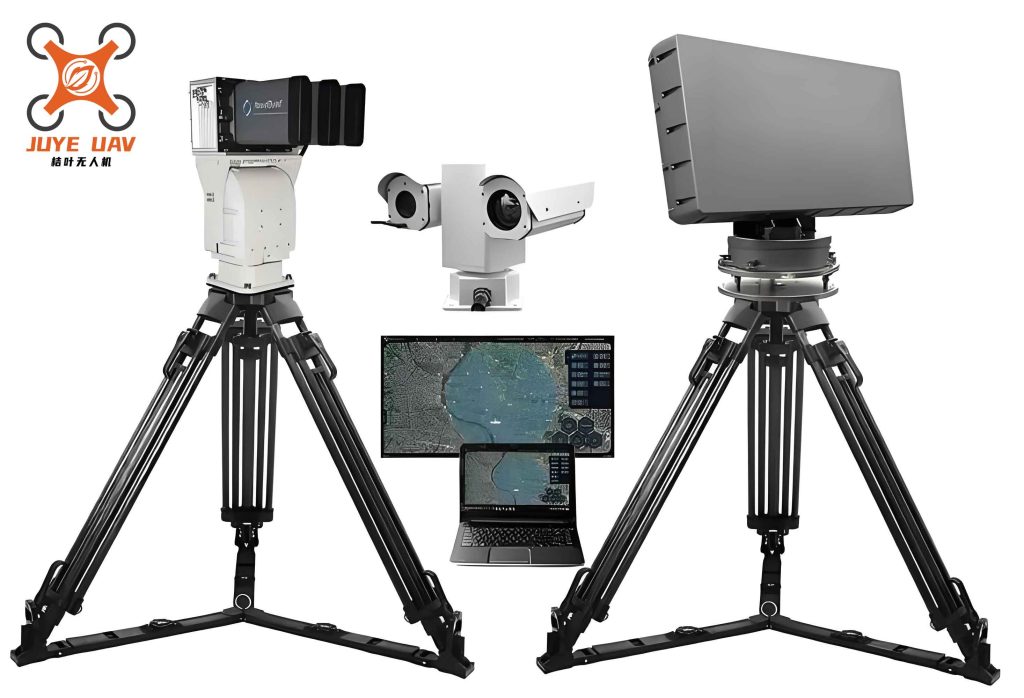
The image above illustrates a typical anti-drone deployment scenario, highlighting the integration of various technologies. As seen, net-based systems are often used in close-range defense, while broader area coverage might involve electronic measures. This visual underscores the multifaceted nature of anti-drone strategies, which I will explore further in the soft-kill section.
Soft-Kill Anti-Drone Technologies
Soft-kill techniques involve electromagnetic interference to disrupt drone operations without physical contact. These methods are generally classified into navigation signal jamming/spoofing and communication signal interference/hijacking. From my perspective, soft-kill anti-drone systems are crucial for general aviation airports due to their scalability and minimal physical risk. However, they must comply with radio frequency regulations to avoid interfering with airport communications.
Navigation signal spoofing anti-drone systems work by broadcasting false Global Positioning System (GPS) or other global navigation satellite system (GNSS) signals. This deceives the drone into believing it is at a different location, prompting it to fly away from protected airspace. The spoofing signal \( S_{\text{spoof}}(t) \) can be modeled as:
$$ S_{\text{spoof}}(t) = A_{\text{spoof}} \cos(2\pi f_{\text{GPS}} t + \phi_{\text{spoof}}) $$
where \( A_{\text{spoof}} \) is the amplitude, \( f_{\text{GPS}} \) is the GPS frequency (e.g., 1.57542 GHz for L1 band), and \( \phi_{\text{spoof}} \) is the phase offset designed to mimic legitimate signals. The effectiveness \( E_{\text{spoof}} \) depends on the signal-to-noise ratio (SNR) and the drone’s authentication capabilities:
$$ E_{\text{spoof}} = \frac{SNR_{\text{spoof}}}{SNR_{\text{legit}} + \alpha} $$
where \( SNR_{\text{legit}} \) is the SNR of legitimate signals, and \( \alpha \) is a correction factor for drone firmware. These anti-drone systems typically operate in bands like 900 MHz, 1.5 GHz, 2.4 GHz, and 5.8 GHz, which may overlap with Wi-Fi or Bluetooth but generally avoid critical airport communication frequencies. Thus, they can be deployed at airport edges with directional antennas to minimize interference.
Communication signal interference anti-drone systems employ jamming to block the control link between the drone and its operator. This can be achieved through noise jamming, where a high-power signal \( J(t) \) is transmitted:
$$ J(t) = A_j \sin(2\pi f_j t + \phi_j) $$
with \( A_j \) as the jamming amplitude, \( f_j \) as the jamming frequency matching the drone’s communication band (e.g., 2.4 GHz for many consumer drones), and \( \phi_j \) as a random phase. The jamming success rate \( P_{\text{jam}} \) is given by:
$$ P_{\text{jam}} = 1 – e^{-\beta \cdot \frac{P_j}{P_d}} $$
where \( P_j \) is the jamming power, \( P_d \) is the drone’s signal power, and \( \beta \) is an efficiency constant. However, such jamming can disrupt airport operations if not carefully managed, as it may affect air traffic control communications. Therefore, I recommend cautious use, with thorough testing under regulatory guidelines.
Communication signal hijacking is a more sophisticated soft-kill anti-drone approach. It involves intercepting the drone’s control signal and replacing it with malicious commands to take over the drone. Systems like EnforceAir use radio frequency (RF) networking techniques to sever the original link and inject new controls. The hijacking process can be described as a Markov chain with states representing connection status: legitimate control, intercepted, and hijacked. The transition probability matrix \( \mathbf{P} \) is:
$$ \mathbf{P} = \begin{pmatrix} p_{11} & p_{12} & p_{13} \\ p_{21} & p_{22} & p_{23} \\ p_{31} & p_{32} & p_{33} \end{pmatrix} $$
where \( p_{ij} \) denotes the probability of moving from state \( i \) to state \( j \). For successful hijacking, \( p_{13} \) must be high, but this depends on drone model vulnerabilities. A major limitation is that hijacking anti-drone systems are often specific to certain drone types, requiring continuous updates to address new models. Additionally, they pose interference risks similar to jammers, making them less suitable for dense airport environments.
To compare these soft-kill anti-drone technologies, I have compiled table 2, which outlines their key characteristics and suitability for general aviation airports.
| Technology | Mechanism | Frequency Bands | Advantages | Disadvantages | Suitability for Airports |
|---|---|---|---|---|---|
| Navigation Spoofing | Broadcasts false GNSS signals | 1.5 GHz, 2.4 GHz | Non-destructive; can divert multiple drones | May affect nearby GPS devices; requires precise tuning | High (if deployed peripherally) |
| Communication Jamming | Emits noise to block control links | 2.4 GHz, 5.8 GHz | Immediate effect; works on various drones | Risk of interfering with airport communications; legal restrictions | Low (due to interference risks) |
| Signal Hijacking | Intercepts and replaces control signals | Drone-specific bands | Allows controlled landing; precise | Model-dependent; potential for signal conflict | Medium (with strict controls) |
From this analysis, I conclude that navigation spoofing is the most viable soft-kill anti-drone option for general aviation airports, given its balance of effectiveness and minimal interference. However, a layered approach combining multiple anti-drone systems is often best, as I will discuss in the management section.
Management and Regulatory Measures for Anti-Drone Security
Technical solutions alone are insufficient; effective anti-drone strategies require robust management and regulatory frameworks. In my experience, many drone incidents stem from lax oversight or public unawareness. Therefore, I propose four key management measures to complement anti-drone technologies.
First, clarifying regulatory authorities and responsibilities is essential. Currently, drone regulations are fragmented, with overlapping jurisdictions between aviation, law enforcement, and local governments. This ambiguity hinders swift responses to drone threats. I suggest establishing a centralized anti-drone coordination body with clear mandates. The efficiency of such a body can be modeled using a response time function \( T_{\text{response}} \):
$$ T_{\text{response}} = t_{\text{detect}} + t_{\text{notify}} + t_{\text{act}} $$
where \( t_{\text{detect}} \) is the time to detect a drone, \( t_{\text{notify}} \) is the notification delay between agencies, and \( t_{\text{act}} \) is the action time. By reducing \( t_{\text{notify}} \) through defined protocols, overall response improves. Additionally, penalties for violations should be stringent to deter “black flights.” For example, fines could be proportional to the risk posed, calculated as:
$$ \text{Fine} = k \cdot (w \cdot v \cdot d) $$
where \( w \) is drone weight (in kg), \( v \) is velocity (in m/s), \( d \) is distance from airport core (in km), and \( k \) is a constant factor. Such formulas make penalties more transparent and deterrent.
Second, strengthening flight plan审批 management is crucial. Many drone operators neglect to apply for airspace permissions due to complex procedures. Simplifying审批 processes while maintaining safety is key. I propose an online portal with automated checks using algorithms to assess risk based on flight parameters. Let \( R_{\text{flight}} \) represent the risk score of a drone flight plan:
$$ R_{\text{flight}} = \sum_{i=1}^{n} w_i x_i $$
where \( x_i \) are factors such as altitude, proximity to airports, and operator experience, and \( w_i \) are weights assigned by regulators. Plans with \( R_{\text{flight}} \) below a threshold \( R_{\text{thresh}} \) could be auto-approved, speeding up the process. This encourages compliance and reduces unauthorized flights.
Third,完善ing实名制 registration management is vital. While China has implemented drone registration for units over 250 grams, the system lacks verification and traceability. I advocate for a “one-drone-one-code” system where each drone receives a unique identifier at manufacture, linked to its owner in a national database. This enhances anti-drone efforts by enabling quick identification. The uniqueness of codes can be ensured using cryptographic hashes:
$$ \text{Code} = \text{Hash}(\text{Manufacturer ID} \parallel \text{Serial Number} \parallel \text{Timestamp}) $$
where \( \parallel \) denotes concatenation, and Hash is a secure function like SHA-256. This makes codes tamper-proof and facilitates tracking.
Fourth, expanding aviation law education is necessary to raise public awareness. Many drone users are unaware of no-fly zones, such as airport净空 areas. Educational campaigns can reduce inadvertent intrusions. The effectiveness of education \( E_{\text{edu}} \) can be measured as the reduction in incident rate \( \lambda \):
$$ E_{\text{edu}} = \frac{\lambda_{\text{before}} – \lambda_{\text{after}}}{\lambda_{\text{before}}} \times 100\% $$
Targeted programs for schools, hobbyist groups, and commercial operators can boost this metric. Additionally, simulating drone incursions in training exercises helps airport staff prepare anti-drone responses.
To summarize these management measures, I present table 3, which aligns them with anti-drone objectives.
| Measure | Description | Key Actions | Expected Impact on Anti-Drone Efficacy |
|---|---|---|---|
| Regulatory Clarification | Define agency roles and penalties | Establish coordination bodies; set graduated fines | Reduces response times; deters violations |
| Flight Plan审批 | Streamline approval processes | Implement online risk assessment; auto-approve low-risk plans | Increases compliance; lowers unauthorized flights |
| 实名制 Registration | Enforce unique drone codes | Mandate manufacturer coding; link to owner database | Enables traceability; aids in post-incident analysis |
| Education Campaigns | Raise awareness of no-fly zones | Conduct workshops; use media outreach | Decreases accidental incursions; promotes responsible use |
These management strategies, when integrated with technical anti-drone systems, create a comprehensive defense. As I look to the future, several advancements could further enhance this framework.
Future Prospects for Anti-Drone Systems at General Aviation Airports
The evolution of anti-drone technology is ongoing, and for general aviation airports, adopting forward-looking approaches will be key. Based on my research, I foresee three major developments: deployment of certified anti-drone systems, conditional low-altitude airspace opening, and universal implementation of “one-drone-one-code.”
First, deploying tested and certified anti-drone systems is crucial. Airports should conduct risk assessments to select systems tailored to their needs. For example, a combination of net-based and navigation spoofing anti-drone systems can cover both close-range and wide-area threats. The overall system effectiveness \( E_{\text{total}} \) can be optimized using a weighted sum model:
$$ E_{\text{total}} = \sum_{i=1}^{m} w_i E_i $$
where \( E_i \) is the effectiveness of the \( i \)-th anti-drone component (e.g., \( E_{\text{net}} \) for net systems, \( E_{\text{spoof}} \) for spoofing), and \( w_i \) are weights based on threat probability. Certification by bodies like the national radio monitoring center ensures compliance with electromagnetic standards, minimizing interference. I recommend that airports establish anti-drone test ranges to evaluate new technologies before full deployment.
Second, conditional low-altitude airspace opening could mitigate drone conflicts. By designating specific corridors for drone flights outside airport净空 zones, airspace pressure is reduced. This requires precise geofencing, where virtual boundaries are enforced via software. The geofencing function \( G(x,y) \) for a point \( (x,y) \) in airspace can be defined as:
$$ G(x,y) = \begin{cases} 1 & \text{if } (x,y) \in \text{permitted zone} \\ 0 & \text{if } (x,y) \in \text{restricted zone} \end{cases} $$
Drones would be required to have onboard systems that respect \( G(x,y) \), with anti-drone measures activating only when breaches occur. This approach balances innovation and safety, potentially reducing the need for aggressive anti-drone interventions.
Third, achieving universal “one-drone-one-code” would revolutionize drone management. By embedding unique codes in hardware, anti-drone systems could identify drones and apply targeted measures. For instance, if a drone enters restricted airspace, anti-drone jammers could focus on its specific communication frequency, minimizing blanket interference. The identification process involves matching detected signals to a database. Let \( D \) be the set of registered drones, each with code \( c_d \) and frequency \( f_d \). Upon detection, the anti-drone system solves:
$$ \arg \min_{d \in D} | f_{\text{detected}} – f_d | $$
to identify the drone. This precision enhances anti-drone efficiency and reduces false positives.
To quantify the benefits of these future measures, I propose a holistic metric called the Anti-Drone Security Index (ADSI). It combines technical and managerial factors:
$$ \text{ADSI} = \alpha T + \beta M + \gamma F $$
where \( T \) is the technical score (based on system coverage and reliability), \( M \) is the management score (from regulatory compliance and education), \( F \) is the future readiness score (including adoption of codes and geofencing), and \( \alpha, \beta, \gamma \) are normalization constants. Airports can use ADSI to benchmark their anti-drone preparedness.
In table 4, I project how these future developments could improve anti-drone outcomes over the next decade.
| Measure | Expected Implementation Timeline | Predicted Reduction in Drone Incidents | Key Challenges |
|---|---|---|---|
| Certified Anti-Drone Systems | Short-term (1-3 years) | 40-60% | Cost; interoperability issues |
| Conditional Low-Altitude Opening | Medium-term (3-6 years) | 30-50% | Regulatory changes; public acceptance |
| One-Drone-One-Code Universal | Long-term (5-10 years) | 50-70% | Global standardization; retrofitting existing drones |
As these anti-drone advancements unfold, general aviation airports will become safer and more resilient. Collaboration between industry, regulators, and the public will be essential to realize this vision.
Conclusion
In this comprehensive analysis, I have explored the multifaceted realm of anti-drone technologies and strategies for general aviation airports. From hard-kill methods like net-based systems to soft-kill approaches such as navigation spoofing, each anti-drone technique offers unique benefits and limitations. Management measures, including regulatory clarity and education, play a complementary role in mitigating drone threats. Looking ahead, the integration of certified systems, conditional airspace opening, and unique drone coding promises to enhance anti-drone efficacy significantly. Throughout this discussion, I have emphasized the keyword “anti-drone” to highlight its centrality in aviation security discourse. By adopting a layered defense that combines technical innovations with robust governance, general aviation airports can safeguard their operations while fostering responsible drone use. As a researcher, I believe that continued investment in anti-drone research and collaboration will pave the way for a safer airspace ecosystem.