
As I survey the contemporary security landscape, the pervasive and asymmetric threat posed by unmanned aerial systems (UAS) dominates my analytical focus. The proliferation of relatively inexpensive commercial and military-grade drones has fundamentally altered the tactical calculus for forces worldwide, necessitating a rapid and multi-faceted evolution in defensive capabilities. The term ‘anti-drone’ is no longer a niche concept but a core requirement for force protection, base security, and naval operations. My examination of recent developments confirms a global scramble to deploy effective counter-UAS (C-UAS) solutions, ranging from kinetic hard-kill systems to sophisticated electronic warfare suites. This article will delve into the technological, operational, and strategic dimensions of modern ‘anti-drone’ warfare, utilizing mathematical models and comparative analysis to frame the discussion.
The foundation of any robust ‘anti-drone’ architecture lies in its ability to detect, track, identify, and then defeat the threat. This kill chain must operate within compressed timelines, especially against low-altitude, low-radar-cross-section (RCS) drones. The probability of successfully neutralizing a drone, $P_{kill}$, can be conceptualized as the product of the probabilities of each stage in this sequence:
$$
P_{kill} = P_{detect} \times P_{track} \times P_{identify} \times P_{engage} \times P_{defeat}
$$
Each of these factors is influenced by environmental conditions, drone capabilities, and the specific ‘anti-drone’ technologies employed. For instance, $P_{detect}$ for a radar system is a function of the target’s RCS, range, and the radar’s power-aperture product. A common simplified form of the radar range equation helps illustrate the challenge:
$$
R_{max} = \sqrt[4]{\frac{P_t G_t G_r \lambda^2 \sigma}{(4\pi)^3 P_{min}}}
$$
Where $R_{max}$ is the maximum detection range, $P_t$ is transmit power, $G_t$ and $G_r$ are antenna gains, $\lambda$ is wavelength, $\sigma$ is the target’s RCS, and $P_{min}$ is the receiver’s minimum detectable signal. As shown in Table 1, small drones possess extremely low $\sigma$ values, pushing modern detection systems to their limits.
| Platform Type | Approximate RCS ($\sigma$) [m²] | Typical Detection Challenge |
|---|---|---|
| Large Fighter Jet | 5 – 10 | Low |
| Small Helicopter | 1 – 2 | Moderate |
| Commercial Quadcopter | 0.01 – 0.1 | High |
| Mini/Micro Drone | 0.001 – 0.01 | Very High |
Once detected and identified, the ‘engage’ and ‘defeat’ phases present their own challenges. Kinetic solutions, such as missiles or guns, are often cost-prohibitive for swarms of cheap drones. This economic imbalance drives innovation in directed-energy weapons (DEWs) and electronic attack systems. Laser-based ‘anti-drone’ systems, for example, offer a deep magazine and low cost-per-shot, but their effectiveness is governed by factors described by a simplified engagement equation. The time-on-target ($t_{tot}$) required to neutralize a drone with a laser is related to the laser power ($P_{laser}$), the beam quality and atmospheric transmission ($\tau$), and the target’s vulnerability:
$$
t_{tot} \propto \frac{E_{required}}{P_{laser} \cdot \tau \cdot \text{Beam Focus}}
$$
where $E_{required}$ is the energy needed to cause mission kill (e.g., burn through casing, disable sensor). Systems that have recently been demonstrated, like vehicle-mounted high-energy lasers, aim to minimize $t_{tot}$ to engage multiple targets rapidly, a critical feature for a modern ‘anti-drone’ system.
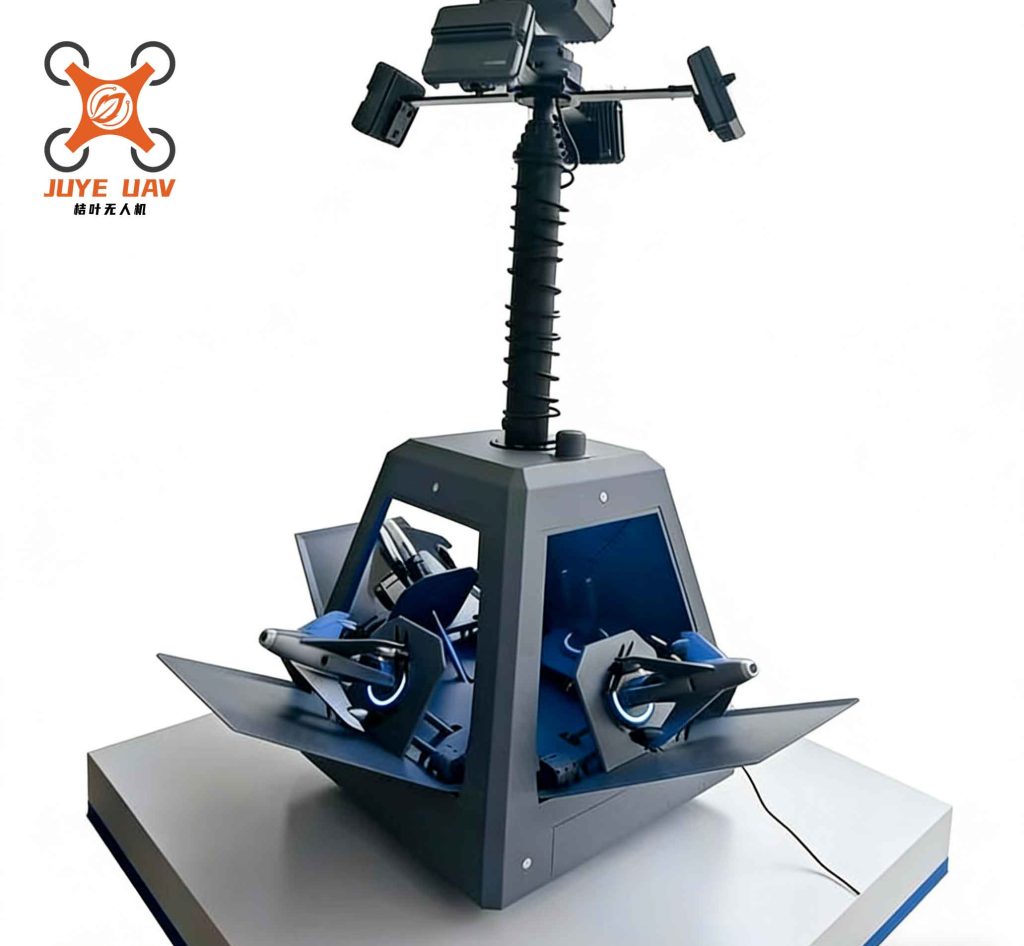
The operational deployment of ‘anti-drone’ systems is expanding across all domains. Naval forces are particularly vulnerable, as drones can threaten vessels from unpredictable angles. The integration of low-power laser ‘dazzler’ systems on warships represents a scalable, non-kinetic layer of defense. These systems, designed to degrade or destroy electro-optical sensors on drones, are a key component of a ship’s layered ‘anti-drone’ shield. Their deployment underscores the shift from purely destructive measures to effects-based countermeasures that negate the threat’s functionality. The effectiveness of such a system in a naval environment depends not just on the laser parameters, but on the stabilization platform’s ability to maintain beam focus on a moving target from a moving ship in high sea states.
A comprehensive ‘anti-drone’ strategy, however, cannot rely on a single technology. A layered, integrated approach is essential. This often combines soft-kill and hard-kill mechanisms. Table 2 outlines a notional multi-layer defense system for a fixed site, such as a forward operating base.
| Layer | Range Band | Primary Technology | Defeat Mechanism | ‘Anti-Drone’ Role |
|---|---|---|---|---|
| 1. Long-Range Detection & Deterrence | > 10 km | Strategic Radar, EW Surveillance | Early Warning, Electronic Identification | Situational Awareness & Pre-emptive Jamming |
| 2. Area Denial & Disruption | 5 – 10 km | Broadband RF Jammers, GNSS Spoofers | Control Link/ Navigation Disruption | Soft-Kill, Break C2 Link |
| 3. Point Defense Engagement | 1 – 5 km | High-Power Microwave (HPM), High-Energy Laser (HEL) | Electronics Disablement, Physical Destruction | Hard-Kill, Area & Point Defense |
| 4. Last-Ditch Intercept | < 1 km | Kinetic Interceptors (Micro-missiles, EW-aided Guns) | Physical Destruction | Hard-Kill, Close-in Defense |
The integration of these layers requires a sophisticated command and control (C2) system that can fuse data from diverse sensors—radar, electro-optical/infrared (EO/IR), acoustic, and radio frequency (RF) detectors. The C2 system’s algorithm must perform rapid sensor correlation and threat prioritization. A key metric for such a system is the decision time, $T_D$, which must be less than the threat’s time-to-impact, $T_I$, minus the engagement time, $T_E$:
$$
T_D < T_I – T_E
$$
Artificial intelligence and machine learning are becoming indispensable in shrinking $T_D$ by automating the classification of drone types based on their unique RF signatures or flight patterns, thereby accelerating the ‘identify’ phase in the kill chain.
Beyond the immediate tactical ‘anti-drone’ fight, there is a strategic dimension to countering unmanned systems. Adversaries use drones not just for attack, but for intelligence, surveillance, and reconnaissance (ISR). Platforms adapted for terrain mapping and high-resolution imaging provide a significant operational advantage. Defending against such ISR drones requires a different subset of ‘anti-drone’ tactics, often focused on deception, camouflage, and electronic masking rather than outright destruction. The goal is to deny information, which can be expressed as reducing the Shannon mutual information $I(X; Y)$ between the actual battlefield state $X$ and the data $Y$ received by the adversary’s drone:
$$
I(X; Y) = H(X) – H(X|Y)
$$
Where $H(X)$ is the entropy (uncertainty) of the battlefield state, and $H(X|Y)$ is the conditional entropy (remaining uncertainty after observing $Y$). Effective ‘anti-drone’ ISR measures aim to increase $H(X|Y)$, making the observed data $Y$ less informative about the true state $X$.
The development cycle for ‘anti-drone’ technology is locked in a continuous race with drone innovation. As drones become faster, stealthier, and capable of autonomous swarm behavior, countermeasures must evolve in parallel. Future ‘anti-drone’ systems will likely emphasize network-centric warfare, where data from distributed sensors feeds a common operational picture, enabling coordinated swarms of interceptor drones or widely networked DEW systems. Furthermore, the cost-benefit analysis remains paramount. The utility $U$ of an ‘anti-drone’ system must justify its cost $C$, especially when facing swarm attacks with $N$ drones. A simple utility model might consider the expected number of drones neutralized:
$$
U = \sum_{i=1}^{N} P_{kill,i} \cdot V_{threat,i} – C_{system} – \sum_{j=1}^{M} C_{intercept,j}
$$
Here, $V_{threat}$ is the value or potential damage of the $i$-th drone, $C_{system}$ is the fixed system cost, and $C_{intercept}$ is the cost of each interceptor (e.g., missile, laser shot). Systems with a low $C_{intercept}$, like lasers, become highly advantageous in high-$N$ swarm scenarios, which is why they are a central research focus for next-generation ‘anti-drone’ capabilities.
In conclusion, the paradigm of ‘anti-drone’ warfare defines a critical axis of modern military development. It is a multidisciplinary challenge spanning radar engineering, optics, electromagnetics, computer science, and tactical doctrine. The mathematical relationships governing detection, engagement, and system utility highlight the complex trade-offs involved. From portable jammers to ship-based lasers and integrated base defense networks, the global push for effective counter-UAS solutions is a testament to the transformative—and disruptive—impact of drones. As the technology on both sides of this conflict evolves, so too must the operational concepts and mathematical models that guide the development and deployment of ‘anti-drone’ systems. Success will belong to those who can best integrate diverse technologies into a seamless, rapid, and cost-effective defensive network, ensuring that the skies are denied to hostile drones while preserving the operational freedom of friendly forces.