
As a researcher in the field of defense technology, I have observed the rapid proliferation of unmanned aerial vehicles (UAVs) and the escalating threats they pose to security worldwide. In this article, we delve into the current state of anti-drone technology, examining its architectures, methodologies, and future directions. The term “anti-drone” refers to systems designed to detect, track, and neutralize unauthorized drones, and it has become a critical focus in modern security paradigms. We will explore how these technologies integrate various approaches to counter UAV threats, using tables and formulas to summarize key insights. The development of anti-drone capabilities is driven by the need to protect critical infrastructure, military assets, and public safety from malicious drone activities. Through this analysis, we aim to provide a detailed overview that highlights both achievements and challenges in the anti-drone domain.
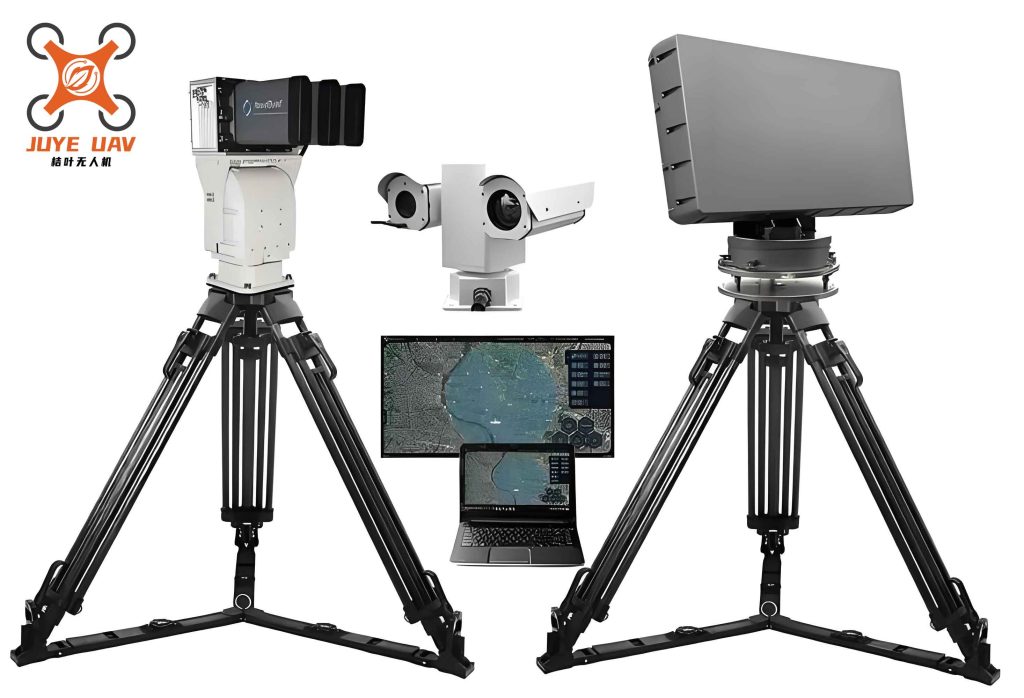
The global anti-drone market has expanded significantly, with technologies evolving to address diverse threats. From my perspective, the core of anti-drone systems lies in a layered defense approach that combines detection, electronic warfare, and physical interception. We begin by outlining the technical architecture of anti-drone solutions, which typically encompasses three main categories: detection and identification, electronic countermeasures, and physical interception. Each category employs distinct mechanisms to neutralize UAVs, and their integration is essential for effective anti-drone operations. In this discussion, we will use mathematical models to illustrate performance metrics, such as detection probabilities and interference efficiencies, reinforcing the scientific basis of anti-drone technologies.
Detection and identification form the first line of defense in any anti-drone system. These technologies rely on multi-modal sensing to locate and classify UAVs. For instance, radio frequency (RF) detection analyzes communication signals emitted by drones, with success rates often modeled by probability functions. A common formula for detection probability in RF-based anti-drone systems is: $$ P_d = 1 – e^{-\frac{S}{N}} $$ where \( P_d \) is the probability of detection, \( S \) is the signal strength, and \( N \) is the noise level. This highlights how environmental factors impact anti-drone performance. Radar detection, another key method, uses electromagnetic waves to track drones. The maximum detection range \( R \) for radar in anti-drone applications can be expressed as: $$ R = \left( \frac{P_t G_t G_r \lambda^2 \sigma}{(4\pi)^3 P_{min}} \right)^{1/4} $$ where \( P_t \) is transmitted power, \( G_t \) and \( G_r \) are antenna gains, \( \lambda \) is wavelength, \( \sigma \) is radar cross-section, and \( P_{min} \) is minimum detectable power. Electro-optical and infrared sensors complement these by providing visual identification, crucial for anti-drone systems in all-weather conditions. To summarize, we present a table comparing detection technologies used in anti-drone contexts.
| Technology Type | Core Principle | Typical Range | Advantages | Disadvantages | Application in Anti-Drone Systems |
|---|---|---|---|---|---|
| RF Detection | Signal analysis of drone communications | Up to 5 km | High accuracy (up to 98% in ideal conditions), can identify operator locations | Susceptible to signal masking and encryption | Urban areas, critical infrastructure monitoring |
| Radar Detection | Electromagnetic wave reflection | Up to 8 km for small drones | Effective in various weather, tracks multiple targets | High false alarm rates in cluttered environments | Military bases, border surveillance |
| Electro-Optical/Infrared | Visual and thermal imaging | Up to 3 km | Provides visual confirmation, works in low light | Limited by fog and rain, requires line-of-sight | Airports, public events for anti-drone security |
Electronic countermeasures represent a soft-kill approach in anti-drone technology, aiming to disrupt drone operations without physical damage. These methods include communication jamming, navigation spoofing, and protocol hacking. From my analysis, jamming is a prevalent anti-drone technique that overwhelms control signals. The effectiveness of jamming can be quantified by the jamming-to-signal ratio: $$ JSR = \frac{P_j}{P_s} $$ where \( P_j \) is jamming power and \( P_s \) is signal power. A higher JSR typically leads to successful disruption in anti-drone scenarios. Navigation spoofing involves emitting false GPS signals to mislead drones, with position errors modeled as: $$ \Delta x = k \cdot \sin(\omega t) $$ where \( \Delta x \) is the positional deviation, \( k \) is spoofing strength, and \( \omega \) is frequency. Protocol hacking, though complex, allows anti-drone systems to take control of drones by exploiting vulnerabilities. We summarize electronic countermeasures in the table below, emphasizing their role in anti-drone defense.
| Electronic Countermeasure Type | Mechanism | Typical Range | Advantages | Disadvantages | Role in Anti-Drone Operations |
|---|---|---|---|---|---|
| Communication Jamming | Broadcast interference signals on drone frequencies | Up to 2 km | Portable, non-destructive, allows drone recovery for forensics | Effective only against known protocols, can affect friendly communications | Quick-response anti-drone measures in sensitive zones |
| Navigation Spoofing | Emit counterfeit satellite signals | Up to 5 km | Can redirect drones to safe zones, low collateral damage | Requires precise timing, may not work on inertial-guided drones | Military anti-drone systems for deception |
| Protocol Hacking | Reverse-engineer drone communication to seize control | Varies by system | Enables capture and analysis of hostile drones | Technically demanding, limited to specific drone models | High-stakes anti-drone missions for intelligence gathering |
Physical interception serves as the hard-kill component of anti-drone technology, involving direct methods to disable or destroy drones. This includes kinetic interceptors, energy weapons, and net-based systems. In my view, kinetic approaches use projectiles or interceptors to collide with drones, with interception probability given by: $$ P_i = \frac{A_t}{A_d} $$ where \( P_i \) is interception probability, \( A_t \) is target area, and \( A_d \) is defensive coverage area. Energy weapons, such as lasers and high-power microwaves, offer precision strikes. The energy required for laser-based anti-drone systems to disable a drone can be estimated as: $$ E = \frac{P \cdot t}{\eta} $$ where \( E \) is energy delivered, \( P \) is laser power, \( t \) is engagement time, and \( \eta \) is atmospheric transmission efficiency. Net systems provide non-destructive capture, ideal for anti-drone operations in populated areas. The table below outlines physical interception technologies in anti-drone contexts.
| Physical Interception Type | Mechanism | Typical Range | Advantages | Disadvantages | Application in Anti-Drone Defense |
|---|---|---|---|---|---|
| Kinetic Interceptors | Projectiles or drones that collide with targets | Up to 10 km | High lethality, cost-effective for mass attacks | Risk of collateral damage, limited ammunition | Military anti-drone systems for swarm defense |
| Laser Weapons | High-energy beams to burn drone components | Up to 5 km | Light-speed engagement, low per-shot cost, scalable | Atmospheric attenuation, high power requirements | Fixed-site anti-drone protection for bases |
| High-Power Microwaves | EMP pulses to fry electronics | Area coverage up to 1 km radius | Can disable multiple drones simultaneously, soft-kill | Short range, may affect nearby electronics | Anti-drone crowd defense in tactical environments |
| Net-Based Systems | Launch nets to entangle drones | Up to 100 m | Non-destructive, allows evidence preservation | Short range, requires line-of-sight | Civil anti-drone operations at airports or events |
Despite advancements, current anti-drone technology faces significant limitations, primarily in environmental adaptability and system interoperability. From my research, environmental factors like urban clutter and weather degrade anti-drone performance. For example, detection accuracy in cities can drop by 30% due to multipath effects, modeled as: $$ \sigma_{urban} = \sigma_0 \cdot e^{-\alpha d} $$ where \( \sigma_{urban} \) is urban detection error, \( \sigma_0 \) is baseline error, \( \alpha \) is attenuation coefficient, and \( d \) is distance. Weather impacts laser anti-drone systems severely, with efficiency loss in rain approximated by: $$ \eta_{rain} = \eta_0 \cdot (1 – 0.6 \cdot R) $$ where \( \eta_{rain} \) is transmission efficiency in rain, \( \eta_0 \) is clear-air efficiency, and \( R \) is rainfall rate in mm/h. These formulas underscore the challenges in deploying robust anti-drone solutions across diverse conditions.
System interoperability is another critical bottleneck in anti-drone networks. Incompatible data formats and communication delays hinder coordinated responses. The latency \( L \) in multi-system anti-drone operations can be expressed as: $$ L = \sum_{i=1}^{n} (t_{proc_i} + t_{trans_i}) $$ where \( t_{proc_i} \) is processing time per system and \( t_{trans_i} \) is transmission time. For effective anti-drone defense against swarms, latency must be under 200 ms, but current systems often exceed this, reducing efficacy. Standardization efforts are essential to enhance anti-drone capabilities, enabling seamless integration of sensors and effectors. We can quantify interoperability improvement through a coherence metric: $$ C = \frac{N_{connected}}{N_{total}} \cdot \frac{1}{1 + \Delta t} $$ where \( C \) is coherence, \( N_{connected} \) is number of integrated systems, \( N_{total} \) is total systems, and \( \Delta t \) is time synchronization error. Higher \( C \) values indicate better anti-drone network performance.
Looking ahead, the future of anti-drone technology will be shaped by emerging innovations like artificial intelligence, quantum sensing, and autonomous systems. AI can enhance anti-drone detection through machine learning algorithms that predict drone behavior. The improvement in detection rate with AI can be modeled as: $$ P_{d,AI} = P_d + \beta \cdot \log(N_{data}) $$ where \( P_{d,AI} \) is AI-enhanced detection probability, \( \beta \) is learning coefficient, and \( N_{data} \) is training data size. Quantum technologies may revolutionize anti-drone sensing by providing ultra-precise measurements, potentially extending detection ranges beyond 20 km. Autonomous anti-drone systems could achieve reaction times under 1 second and handle over 100 targets simultaneously, redefining防空作战模式. The integration cost for next-gen anti-drone systems might follow an economy-of-scale formula: $$ Cost = C_0 \cdot e^{-\gamma t} $$ where \( Cost \) is per-unit cost, \( C_0 \) is initial cost, \( \gamma \) is improvement rate, and \( t \) is time. This suggests that anti-drone solutions will become more affordable and widespread.
Ethical and legal considerations are paramount in anti-drone development. As we advance these technologies, we must ensure compliance with international norms, such as minimizing collateral damage and respecting privacy. Anti-drone systems should incorporate fail-safes to prevent misuse, balancing security with humanitarian principles. The societal impact of anti-drone measures can be assessed through a risk-benefit analysis: $$ RB = \frac{B_{security}}{R_{harm}} $$ where \( RB \) is risk-benefit ratio, \( B_{security} \) is security benefit, and \( R_{harm} \) is potential harm. A ratio greater than 1 justifies anti-drone deployment, guiding responsible innovation.
In conclusion, anti-drone technology has evolved into a sophisticated ecosystem encompassing detection, electronic warfare, and physical interception. Through this analysis, we have highlighted key methodologies, using tables and formulas to summarize performance metrics. The term “anti-drone” encapsulates a dynamic field where continuous innovation addresses evolving threats. Current limitations in environmental adaptability and interoperability require focused research, while future trends point toward smarter, more integrated systems. By fostering technological advancements and ethical frameworks, we can build resilient anti-drone defenses that safeguard global security. The journey of anti-drone development is ongoing, and as a community, we must collaborate to overcome challenges and harness opportunities for a safer world.