
As a researcher deeply immersed in the field of electromagnetic spectrum operations and counter-unmanned aerial systems, I have witnessed firsthand the escalating threat posed by rogue drones in both military and civilian domains. The proliferation of cheap, agile, and increasingly autonomous drones has necessitated a paradigm shift in defensive strategies. Traditional point-defense systems are often inadequate against swarming tactics or sophisticated electronic countermeasures. In this article, I will articulate a comprehensive framework for next-generation anti-drone systems, drawing upon the convergence of big data analytics, machine learning, and multi-layered kinetic and non-kinetic effectors. The core thesis is that superior situational awareness and decision-making, derived from the real-time mining and analysis of electromagnetic big data, form the bedrock of effective anti-drone operations. Throughout this discussion, I will repeatedly emphasize the critical role of integrated anti-drone architectures in neutralizing these asymmetric threats.
The modern battlespace is saturated with electromagnetic emissions. Every device, from communication relays to radar systems and, most pertinently, drones and their controllers, leaves a unique spectral fingerprint. The sheer volume, velocity, and variety of this data constitute what we term “electromagnetic big data.” Harnessing this data is no longer a luxury but a necessity for proactive anti-drone defense. My approach centers on building a software and hardware framework that can ingest, process, and interpret this data deluge to predict, detect, identify, and engage drone threats with high precision and minimal collateral damage.
The foundational layer of any advanced anti-drone system is its sensing and data acquisition grid. A mobile, resilient sensor network is paramount. Imagine a vehicle-based platform, akin to some of the most advanced prototypes demonstrated globally, equipped with a suite of sensors. Four radar sensors positioned at strategic points provide continuous 360-degree coverage, generating a constant stream of range, velocity, and angle data on potential aerial contacts. This raw radar data, often characterized by high dimensionality and noise, is the first input into our big data pipeline. Concurrently, signals intelligence (SIGINT) systems passively sweep the frequency spectrum, capturing communication links between drones and their operators. This includes telemetry, command-and-control signals, and even video downlinks. The data fusion challenge here is immense. We must correlate pulsed radar returns with continuous wave SIGINT detections in real-time. Let us formalize a basic detection model. The probability of detecting a drone target, $P_d$, can be modeled as a function of the signal-to-noise ratio (SNR) at the sensor:
$$ P_d = 1 – \Phi\left( \frac{\theta – \mu_{signal}}{\sigma} \right) $$
where $\Phi$ is the cumulative distribution function of the noise, $\theta$ is the detection threshold, $\mu_{signal}$ is the mean amplitude of the target return, and $\sigma$ is the standard deviation of the noise. In cluttered environments, this becomes a dynamic optimization problem. The data from these disparate sensors—radar and SIGINT—are fed into a central computing system. The initial processing involves filtering, registration, and association. A simplified data association cost matrix for matching radar tracks $R_i$ to SIGINT emitters $S_j$ might be based on spatial and temporal proximity:
$$ C_{ij} = \alpha \cdot \| \text{Loc}(R_i) – \text{Loc}(S_j) \| + \beta \cdot | t(R_i) – t(S_j) | $$
where $\alpha$ and $\beta$ are weighting coefficients, and $\text{Loc}$ and $t$ denote location and time, respectively. Minimizing the total association cost across all $i, j$ is a classic assignment problem solvable with algorithms like the Hungarian method.
| Sensor Type | Data Output | Primary Anti-Drone Function | Data Rate & Volume |
|---|---|---|---|
| Pulse-Doppler Radar | Range, azimuth, elevation, radial velocity | Kinematic tracking of aerial targets | High (MB/s per sensor) |
| SIGINT/ESM Receiver | RF frequency, bandwidth, modulation, direction of arrival | Identification, protocol analysis, operator geolocation | Very High (GB/s possible) |
| EO/IR Camera | High-resolution imagery, thermal signature | Visual confirmation, non-cooperative target recognition | Extreme (Video streams) |
| Acoustic Sensor Array | Audio frequency spectrum | Detection of propeller noise in RF-denied environments | Medium |
Once the raw data streams are aligned and associated, the true power of the anti-drone system is unlocked through advanced data mining and machine learning techniques. This is where insights from electromagnetic big data research become pivotal. The integrated system must move beyond simple tracking to understanding patterns, predicting behavior, and identifying intent. One crucial application is the use of time-series analysis to forecast drone activity. By analyzing historical spectral occupancy and signal detections, we can model periodic patterns—for instance, recurrent reconnaissance flights. An AutoRegressive Integrated Moving Average (ARIMA) model is often a starting point for such forecasts. The general ARIMA$(p, d, q)$ model for a time series $X_t$ is defined as:
$$ \phi(B) (1-B)^d X_t = \theta(B) \varepsilon_t $$
where $B$ is the backshift operator ($B X_t = X_{t-1}$), $\phi(B)=1-\phi_1 B – \cdots – \phi_p B^p$ is the autoregressive polynomial, $\theta(B)=1+\theta_1 B + \cdots + \theta_q B^q$ is the moving average polynomial, $d$ is the degree of differencing, and $\varepsilon_t$ is white noise. For more complex, non-linear patterns inherent in drone swarm tactics, Long Short-Term Memory (LSTM) networks, a type of recurrent neural network, are exceptionally effective. The core LSTM cell equations governing the flow of information are:
$$
\begin{aligned}
f_t &= \sigma(W_f \cdot [h_{t-1}, x_t] + b_f) \\
i_t &= \sigma(W_i \cdot [h_{t-1}, x_t] + b_i) \\
\tilde{C}_t &= \tanh(W_C \cdot [h_{t-1}, x_t] + b_C) \\
C_t &= f_t \circ C_{t-1} + i_t \circ \tilde{C}_t \\
o_t &= \sigma(W_o \cdot [h_{t-1}, x_t] + b_o) \\
h_t &= o_t \circ \tanh(C_t)
\end{aligned}
$$
Here, $f_t$, $i_t$, $o_t$ are the forget, input, and output gate activations; $C_t$ is the cell state; $h_t$ is the hidden state; $x_t$ is the input (e.g., feature vector of spectral activity); $W$ and $b$ are weights and biases; $\sigma$ is the sigmoid function; and $\circ$ denotes element-wise multiplication. Training such networks on vast datasets of historical electromagnetic environment (EME) data allows the anti-drone system to predict likely threat windows and launch points.
Another vital data mining task is association rule mining and knowledge graph construction to discover hidden relationships within the electromagnetic spectrum. For example, frequent pattern mining can reveal that the appearance of a specific type of frequency-hopping signal (Signal A) is often followed by the activation of a particular video downlink frequency (Signal B) 30 seconds later. This rule, $A \Rightarrow B$, can be quantified by support and confidence metrics:
$$ \text{Support}(A \Rightarrow B) = P(A \cap B) $$
$$ \text{Confidence}(A \Rightarrow B) = P(B | A) $$
By building a knowledge graph where nodes represent emitters, signal types, geographic locations, and temporal events, and edges represent observed relationships (e.g., “controls,” “precedes,” “co-located with”), we enable sophisticated reasoning. This graph can be queried to identify potential command nodes in a drone network or to locate interference sources. The anti-drone system’s cognitive engine uses this graph to hypothesize about threat networks, enhancing its targeting fidelity for both soft and hard kill measures.
| Technique Category | Specific Method | Application in Anti-Drone Context | Output for Decision-Mupport |
|---|---|---|---|
| Time Series Analysis | ARIMA, LSTM, Prophet | Predicting patrol routes, launch times, swarm formation | Timeline of high-probability threat activity |
| Clustering | DBSCAN, K-means, Spectral Clustering | Grouping emitters to identify fleets, discovering normal vs. anomalous EME | Emitter clusters, anomaly alerts |
| Association Rule Mining | Apriori, FP-Growth | Finding rules linking control signals to drone actions | “If-Then” rules for automatic threat recognition |
| Graph Analytics | Knowledge Graph, Community Detection | Mapping the network of drones and controllers, finding key nodes | Visual network map, recommended high-value targets |
| Classification | SVM, Random Forest, CNN | Identifying drone type from RF fingerprint or EO/IR image | Target classification (e.g., quadcopter, fixed-wing, swarm) |
The insights derived from this intensive data processing must be translated into decisive action. This is where the concept of “sensor-to-shooter” or, more accurately, “sensor-to-effector” integration is realized in a mature anti-drone system. The system architecture employs a closed-loop observe-orient-decide-act (OODA) cycle, drastically compressed by automation. Upon the positive identification of a hostile or anomalous drone, the system evaluates a dynamic engagement policy. The first line of defense is typically soft-kill, utilizing electronic attack (EA) capabilities. The SIGINT subsystem, having identified the communication protocol, can initiate jamming or deception. Jamming effectiveness against a particular link can be modeled by the jammer-to-signal ratio (JSR) at the drone’s receiver:
$$ \text{JSR} = \frac{P_j G_j G_r(\theta_j) \lambda^2}{(4\pi R_j)^2 L_j} \div \frac{P_s G_s G_r(\theta_s) \lambda^2}{(4\pi R_s)^2 L_s} $$
where $P$ is power, $G$ is antenna gain, $G_r(\theta)$ is the receive gain in the direction of the source, $\lambda$ is wavelength, $R$ is range, $L$ is loss, and subscripts $j$ and $s$ denote jammer and signal source, respectively. If the JSR exceeds a threshold, the link is disrupted. More subtly, the system can inject spoofing commands, taking control of the drone or directing it to a safe landing zone. The ability to geolocate the operator’s signal, through time-difference-of-arrival (TDoA) or frequency-difference-of-arrival (FDoA) techniques, adds a layer of deterrence and enables counter-targeting.
When soft-kill measures are deemed insufficient, ineffective, or when rules of engagement dictate, the anti-drone system escalates to hard-kill options. These are integrated directly onto the mobile platform, creating a self-contained “hunter-killer” unit. The primary kinetic effector is often a remotely operated weapon station (ROWS) equipped with a chain gun, such as a 30mm autocannon. The key innovation for anti-drone use is airburst munitions. The fuzing is controlled by the central computer, which receives real-time target coordinates from the fused sensor track. The optimal burst point $(x_b, y_b, z_b, t_b)$ to maximize the probability of kill ($P_k$) against a small, fast target is calculated by solving an optimization problem that considers projectile ballistics, target predicted position, and fragment dispersion. A simplified fragment density model at the target location can be:
$$ D_f = \frac{N_f}{4\pi R_f^2} \cdot \exp\left(-\frac{\|\mathbf{p}_t(t_b) – \mathbf{p}_b\|^2}{2\sigma_f^2}\right) $$
where $N_f$ is the number of fragments, $R_f$ is the nominal fragment spray radius, $\mathbf{p}_t(t_b)$ is the target’s predicted position at burst time, $\mathbf{p}_b$ is the burst point, and $\sigma_f$ characterizes the dispersion. The $P_k$ is then a function of $D_f$ and the target’s vulnerability. This makes the system potent against drone swarms, as a single airburst can engage multiple targets in a volume.
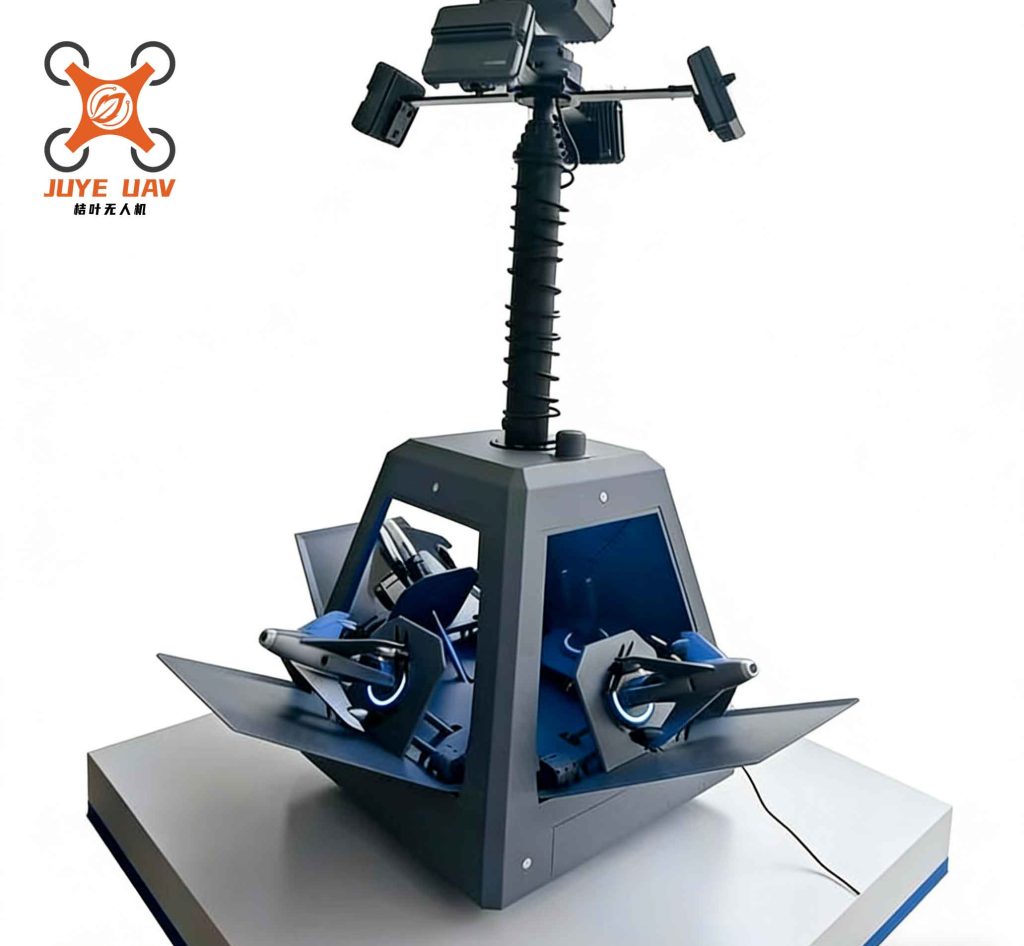
Complementing the area-effect gun system is a point-defense interceptor, such as a dedicated anti-drone drone. These are small, vertically launched unmanned interceptors propelled by high-speed motors and guided by an on-board seeker, with final target acquisition often aided by the mother vehicle’s tracking data. Their engagement geometry is that of a pursuit curve, often approximated by proportional navigation. The commanded acceleration, $\mathbf{a}_c$, is perpendicular to the interceptor’s velocity vector and proportional to the line-of-sight (LOS) rate:
$$ \mathbf{a}_c = N’ V_c \dot{\lambda} \times \mathbf{1}_v $$
where $N’$ is the navigation constant (typically 3-5), $V_c$ is the closing velocity, $\dot{\lambda}$ is the LOS rate vector, and $\mathbf{1}_v$ is a unit vector perpendicular to the interceptor’s velocity. The integration of such a layered, multi-effect architecture onto a single, mobile platform like a 4×4 tactical vehicle represents the zenith of current anti-drone system design. It provides maneuver forces with organic, persistent protection that can keep pace with them, a critical capability denied by static counter-UAS installations.
The software framework that orchestrates this entire ballet of sensors, data, and effectors is itself a masterpiece of distributed systems engineering. It must adhere to a cloud-edge-device协同 paradigm. The vehicle acts as a powerful edge node, processing time-critical data for immediate engagement decisions. However, it is not an island. It periodically uploads condensed feature vectors, threat reports, and learned models to a theater-level cloud or fog network. This cloud performs heavier, longer-term analytics—training large machine learning models on aggregated data from hundreds of platforms, performing wide-area correlation to track macro threat movements, and disseminating updated threat libraries (e.g., new drone RF fingerprints) back to the edge. This bidirectional flow is essential for maintaining an adaptive, learning anti-drone network. The communication between edge and cloud can be modeled as an optimization problem minimizing latency and bandwidth use while maximizing information gain. Let $D_{edge}$ be the data at the edge, $F(D_{edge})$ be a feature extraction function, and $I(F; Threat)$ be the mutual information between the extracted features and the threat state. The edge must decide what subset $F^*$ to transmit subject to a bandwidth constraint $B$:
$$ \max_{F^* \subset F(D_{edge})} I(F^*; Threat) \quad \text{subject to} \quad \text{size}(F^*) \leq B $$
This ensures the cloud receives the most valuable data for collective learning, enhancing the overall efficacy of every connected anti-drone unit.
| Engagement Type | Mechanism | Typical Range | Advantages | Limitations | Data Dependency |
|---|---|---|---|---|---|
| Soft-Kill (Electronic) | Jamming, Spoofing, Cyber-takeover | Medium to Long (km) | Non-kinetic, reversible, denies intelligence gain to enemy | May affect friendly spectrum, requires precise protocol knowledge | Extreme (RF fingerprint, protocol analysis) |
| Hard-Kill (Kinetic – Gun) | Autocannon with Airburst Ammunition | Short to Medium (1-2 km) | Effective against swarms, high rate of fire, cost-per-shot relatively low | Collateral damage risk, limited by line-of-sight ballistics | High (Precise real-time track) |
| Hard-Kill (Kinetic – Interceptor) | Miniature Missile or Anti-Drone Drone | Medium (2-5 km+) | High single-shot probability of kill, can engage beyond line-of-sight | High cost per engagement, limited payload capacity on vehicle | Very High (Track quality, IFF confirmation) |
| Directed Energy | High-Power Microwave (HPM) or Laser | Varies (Tactical Laser: 1-5 km, HPM: hundreds of meters) | Speed-of-light engagement, deep magazines, precision effects | High power requirements, atmospheric attenuation, line-of-sight | High (Stable track for dwell time) |
Looking forward, the evolution of anti-drone systems will be inexorably linked to advances in artificial intelligence and data fusion. Autonomous threat evaluation and weapon assignment is the next frontier. We are developing algorithms that can dynamically allocate effectors (e.g., jammer, gun, interceptor) to a set of incoming targets $T = \{t_1, t_2, …, t_n\}$ based on a multi-objective cost function. This function, $J(A)$, for a particular assignment plan $A$, might incorporate:
$$ J(A) = \sum_{i} \left[ w_1 \cdot C_{effector}(a_i) + w_2 \cdot (1 – P_{k,i}(a_i)) + w_3 \cdot T_{engage,i}(a_i) + w_4 \cdot R_{collateral,i}(a_i) \right] $$
where $a_i$ is the effector assigned to target $t_i$, $C$ is resource cost, $P_k$ is probability of kill, $T_{engage}$ is time to engage, $R_{collateral}$ is estimated collateral risk, and $w$ are weights reflecting command priorities. The system solves for $A^* = \arg\min J(A)$ in near-real-time. Furthermore, the rise of stealthier drones using low-probability-of-intercept (LPI) waveforms and cooperative behaviors within swarms will push our data mining techniques to new limits. We will need to rely more on passive, multi-static sensing and subtle “patterns of life” analysis in the electromagnetic spectrum to detect these advanced threats. The anti-drone mission is, at its heart, a grand data science challenge played out in the physical domain.
In conclusion, the modern anti-drone paradigm I have described is a symphony of cutting-edge technologies. It begins with the meticulous collection of electromagnetic big data from a resilient sensor grid. This data is transformed into knowledge and understanding through a suite of machine learning and data mining algorithms, enabling prediction and intent recognition. This cognitive layer then drives a seamlessly integrated suite of soft-kill and hard-kill effectors, all mounted on a mobile platform for persistent, adaptive protection. The entire process is governed by a cloud-edge协同 software framework that ensures the system learns and evolves from every encounter. The repeated emphasis on a holistic, data-centric anti-drone approach is deliberate; it is the only way to stay ahead of an agile and proliferating threat. As drone technology continues to advance, so too must the sophistication of our countermeasures, always grounded in the relentless pursuit of information superiority. The future of defense against unmanned aerial systems lies not in isolated point solutions, but in intelligent, networked, and data-driven anti-drone ecosystems.