
As a researcher focused on modern warfare and defense technologies, I have closely monitored the evolution of unmanned aerial vehicles (UAVs) and their transformative impact on military strategies. The advent of drone swarm operations, where large numbers of low-cost micro-drones coordinate autonomously to execute missions, poses a significant challenge to existing防空 systems. This has spurred intense interest in developing effective anti-drone countermeasures. In this article, I will delve into the intricacies of anti-drone swarm warfare, examining its conceptual foundations, operational weaknesses, and diverse defensive strategies. My aim is to provide a thorough exploration that underscores the urgency of innovating anti-drone capabilities to safeguard maritime and other domains from swarm threats.
The rise of drone swarm tactics marks a paradigm shift in warfare, echoing historical patterns like human-wave tactics or wolf-pack strategies but with a technological twist. Enabled by advancements in artificial intelligence,通信 networks, and miniaturization, these swarms can be deployed from various platforms—such as ships, aircraft, or ground vehicles—to conduct surveillance, deception, or attacks. For instance, programs like the U.S. Navy’s LOCUST project utilize drones like the “Coyote,” which are lightweight, portable, and capable of forming coordinated clusters. The core appeal lies in their ability to achieve mass, agility, and cost-effectiveness, overwhelming defenses through sheer numbers and intelligent coordination. However, this very reliance on technology unveils vulnerabilities that anti-drone systems can exploit.
To understand anti-drone swarm defense, one must first grasp the operational advantages of swarms. They excel in creating localized numerical superiority, enabling distributed sensing and strike capabilities. The swarm’s effectiveness can be modeled in terms of collective performance metrics. For example, the overall survivability of a swarm against point defenses might be expressed as: $$ S_{\text{swarm}} = 1 – \prod_{i=1}^{N} (1 – p_i) $$ where \( N \) is the number of drones, and \( p_i \) is the survival probability of the \( i \)-th drone. This formula highlights how even with individual weaknesses, the swarm as a whole can persist if defenses are inadequate. Yet, this strength is counterbalanced by inherent limitations, which I will analyze next.
Drone swarm operations face several technical hurdles that impede their full potential. First, artificial intelligence remains a bottleneck; while autonomy is the goal, current systems often require human-in-the-loop oversight, introducing latency and reliability issues. The processing delay can be approximated as: $$ \tau = \frac{D}{v_c} + t_{\text{proc}} $$ where \( D \) is the communication distance, \( v_c \) is the signal propagation speed, and \( t_{\text{proc}} \) is the computation time. This delay can disrupt real-time coordination, especially in dynamic environments. Second, swarm communications depend on robust wireless networks that are susceptible to interference, jamming, or hacking. The signal-to-noise ratio for swarm links might be given by: $$ \text{SNR} = \frac{P_t G_t G_r \lambda^2}{(4\pi R)^2 N_0} $$ where \( P_t \) is transmission power, \( G_t \) and \( G_r \) are antenna gains, \( \lambda \) is wavelength, \( R \) is range, and \( N_0 \) is noise power. Low SNR can lead to packet loss and swarm disintegration. Third, energy storage constraints limit endurance; battery capacity often caps flight times to under an hour, restricting operational radius. The energy consumption rate can be modeled as: $$ E_{\text{total}} = P_{\text{avionics}} t + \frac{1}{2} \rho v^3 A C_d t $$ where \( P_{\text{avionics}} \) is power for electronics, \( \rho \) is air density, \( v \) is velocity, \( A \) is frontal area, and \( C_d \) is drag coefficient. These factors collectively underscore the swarm’s fragility.
Beyond technical challenges, drone swarms exhibit operational disadvantages that anti-drone tactics can target. Their slow speeds—typically under 250 km/h—make them vulnerable to interception by faster assets like fighter jets or helicopters. The time-to-intercept for a defender can be calculated as: $$ T_{\text{intercept}} = \frac{R_{\text{detect}} – R_{\text{engage}}}{v_{\text{defender}} – v_{\text{swarm}}} $$ where \( R_{\text{detect}} \) is detection range, \( R_{\text{engage}} \) is engagement range, and \( v_{\text{defender}} \) and \( v_{\text{swarm}} \) are velocities. Short operational ranges, often below 300 km, necessitate proximity to launch platforms, exposing them to preemptive strikes. Additionally, swarms struggle in adverse weather, as precipitation or high winds can degrade sensor accuracy and flight stability. The probability of mission success under恶劣 conditions might be: $$ P_{\text{success}} = P_{\text{base}} \cdot e^{-k W} $$ where \( P_{\text{base}} \) is baseline success probability, \( k \) is a weather factor, and \( W \) is weather intensity. These weaknesses form the basis for designing anti-drone defenses.
Anti-drone swarm operations encompass a multifaceted approach, integrating layered defenses to neutralize threats at various ranges. I categorize these into four primary domains: area denial, soft-kill measures, area-saturation defenses, and point-defense systems. Each domain offers distinct advantages and trade-offs, which I will elaborate on with examples and quantitative assessments.
Area denial strategies aim to prevent swarm deployment by targeting their carriers or control nodes. This is the most proactive form of anti-drone defense, as it addresses the threat at its source. For instance, detecting and destroying aircraft like the C-130 that release swarms can be modeled using engagement dynamics: $$ P_{\text{kill}} = 1 – e^{-\frac{R_{\text{strike}}^2}{2 \sigma^2}} $$ where \( R_{\text{strike}} \) is strike accuracy and \( \sigma \) is dispersion. Similarly, neutralizing ground control stations disrupts command links, rendering swarms inert. The effectiveness of such denial can be summarized in a table comparing different anti-drone methods.
| Index | Anti-Drone Method | Engagement Range | Cost-Effectiveness | Operational Efficacy | Technology Maturity |
|---|---|---|---|---|---|
| 1 | Area Denial (Carrier Destruction) | >300 km | Medium | High | Mature |
| 2 | Area Denial (Control Node Neutralization) | >300 km | Medium | High | Mature |
| 3 | Soft-Kill (Electronic Jamming) | >300 km | High | High | Mature |
| 4 | Soft-Kill (Control Hijacking) | >300 km | Medium | Medium | Emerging |
| 5 | Soft-Kill (Radar Decoy Deployment) | Varies (100 m to 50 km) | Medium | Medium | Emerging |
| 6 | Area-Saturation (High-Power Microwave) | ~200 km | Medium | High | Emerging |
| 7 | Area-Saturation (Counter-Swarm Drones) | >200 km | Medium | Medium | Emerging |
| 8 | Area-Saturation (Large-Radius Missiles) | >200 km | Medium | Medium | Mature |
| 9 | Area-Saturation (Net-Based Interceptors) | 100 m to 50 km | High | Medium | Emerging |
| 10 | Point-Defense (Helicopter Guns) | >200 km | Medium | Medium | Mature |
| 11 | Point-Defense (Directed Energy Weapons) | >35 km | High | High | Emerging |
| 12 | Point-Defense (Electromagnetic Railguns) | >10 km | Medium | High | Emerging |
| 13 | Point-Defense (Close-In Weapon Systems) | ~3 km | Medium | Medium | Mature |
| 14 | Point-Defense (Water Cannon Systems) | ~1 km | Low | Low | Mature |
Soft-kill measures involve non-kinetic means to disrupt swarm functionality, making them a cost-effective anti-drone option. Electronic jamming, for example, targets GPS and communication signals, causing drones to lose navigation or coordination. The jamming effectiveness can be quantified by the bit error rate: $$ \text{BER} = Q\left(\sqrt{\frac{E_b}{N_0 + J_0}}\right) $$ where \( E_b \) is energy per bit, \( N_0 \) is noise density, and \( J_0 \) is jamming power density. Control hijacking takes this further by injecting malicious commands to seize or crash drones—a sophisticated anti-drone technique that exploits software vulnerabilities. Radar decoys, meanwhile, mimic real targets to divert swarm attacks, with deception probability given by: $$ P_{\text{deceive}} = \frac{N_{\text{decoys}}}{N_{\text{decoys}} + N_{\text{real}}} $$ These methods underscore the importance of电子 warfare in modern anti-drone strategies.
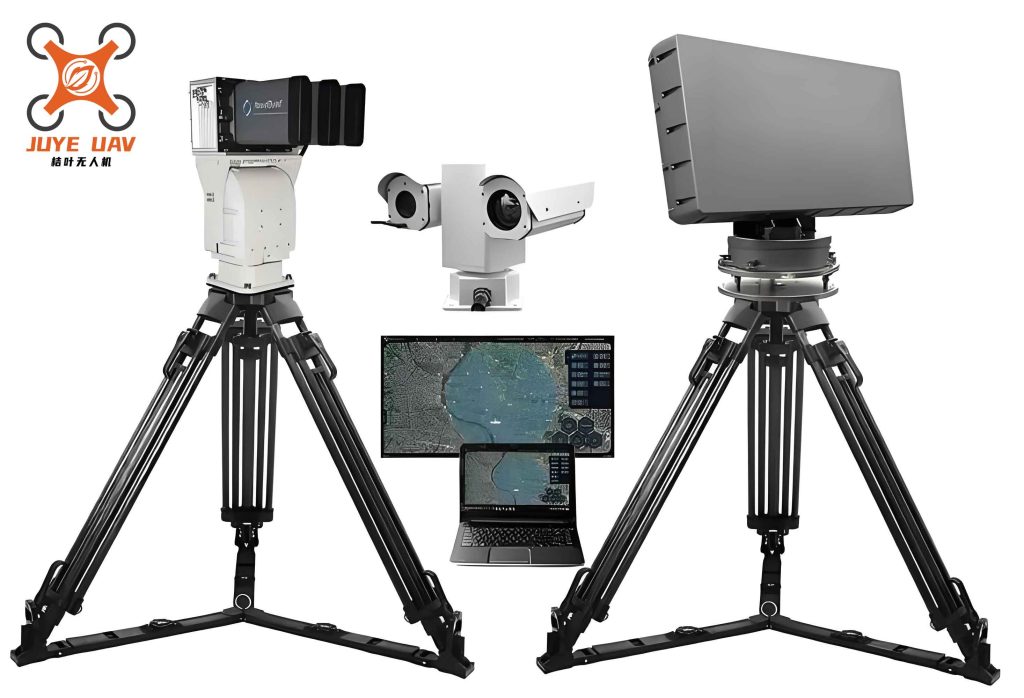
Area-saturation defenses are designed to engage multiple drones simultaneously, addressing the swarm’s numerical advantage. High-power microwave weapons emit pulses that fry electronic components, offering wide coverage. The energy density required for damage can be expressed as: $$ E_{\text{req}} = \frac{P_{\text{avg}} \cdot t_{\text{pulse}}}{A_{\text{beam}}} $$ where \( P_{\text{avg}} \) is average power, \( t_{\text{pulse}} \) is pulse duration, and \( A_{\text{beam}} \) is beam area. Counter-swarm tactics involve deploying friendly drone swarms to intercept adversaries, creating a battle of attrition. The outcome of such encounters can be modeled using Lanchester’s laws: $$ \frac{dD}{dt} = -\alpha F, \quad \frac{dF}{dt} = -\beta D $$ where \( D \) and \( F \) are drone numbers for defender and foe, and \( \alpha, \beta \) are attrition coefficients. Large-radius missiles with fragmentation warheads or net-based systems provide additional layers, though their efficiency depends on swarm density \( \rho_{\text{swarm}} \): $$ P_{\text{hit}} = 1 – e^{-\sigma \rho_{\text{swarm}} R} $$ where \( \sigma \) is cross-section and \( R \) is range.
Point-defense systems offer precision engagement for last-resort protection, typically at shorter ranges. Directed energy weapons like lasers deliver concentrated beams to thermally destroy drones, with the required irradiance given by: $$ I = \frac{P_{\text{laser}}}{\pi \left(\frac{\theta R}{2}\right)^2} $$ where \( \theta \) is beam divergence. Electromagnetic railguns propel projectiles at high velocities, enabling rapid fire against incoming threats. The kinetic energy impact is: $$ KE = \frac{1}{2} m v^2 $$ where \( m \) is mass and \( v \) is velocity. Close-in weapon systems (e.g., Phalanx) and water cannons serve as terminal defenses, though their effectiveness diminishes against dense swarms. The cumulative拦截 probability for layered anti-drone defenses can be approximated as: $$ P_{\text{total}} = 1 – \prod_{i=1}^{n} (1 – P_i) $$ where \( P_i \) is the interception probability of the \( i \)-th layer, emphasizing the need for integrated systems.
In maritime contexts, anti-drone swarm operations must account for unique challenges like sea clutter, limited sensor horizons, and platform mobility. The radar detection range over sea is influenced by the refraction index: $$ R_{\text{detect}} = \sqrt{2h_t} + \sqrt{2h_r} $$ where \( h_t \) and \( h_r \) are transmitter and receiver heights. Naval forces can leverage ship-based helicopters for extended interception, combining sensors and weapons to create an anti-drone umbrella. The operational concept involves distributed nodes—ships, aircraft, and shore installations—forming a networked defense. This aligns with the broader trend toward multi-domain anti-drone solutions, where data fusion and AI enhance threat assessment. For instance, the probability of correctly classifying a swarm target might be: $$ P_{\text{ID}} = \frac{1}{1 + e^{-k(S_{\text{NR}} – \theta)}} $$ where \( S_{\text{NR}} \) is signal-to-noise ratio, \( k \) is a constant, and \( \theta \) is a threshold.
The economic aspect of anti-drone warfare cannot be overlooked. Since drone swarms are low-cost, defenses must balance efficacy with affordability to avoid cost-exchange ratios that favor attackers. A simple cost model might be: $$ C_{\text{exchange}} = \frac{C_{\text{defense}}}{C_{\text{swarm}} \cdot N_{\text{downed}}} $$ where \( C_{\text{defense}} \) is defense cost per engagement, \( C_{\text{swarm}} \) is per-drone cost, and \( N_{\text{downed}} \) is number of drones neutralized. Anti-drone systems with high \( C_{\text{exchange}} \) are unsustainable, driving innovation toward scalable solutions like electronic warfare or microwave weapons. Furthermore, the rapid evolution of drone technology necessitates adaptive anti-drone research, focusing on machine learning for threat prediction and autonomous response. The learning curve can be represented as: $$ E_{\text{error}}(t) = E_0 e^{-\lambda t} $$ where \( E_0 \) is initial error, \( \lambda \) is learning rate, and \( t \) is time.
Looking ahead, the anti-drone landscape will likely see increased integration of AI and cyber capabilities. Swarms may evolve to counter anti-drone measures, leading to an arms race dynamic. For example, drones could employ frequency-hopping or AI-driven evasion, modeled as a game theory problem: $$ \max_{a_d} \min_{a_a} U(a_d, a_a) $$ where \( a_d \) and \( a_a \) are defender and attacker actions, and \( U \) is utility. This underscores the need for continuous investment in anti-drone R&D, spanning hardware, software, and doctrinal innovations. In my view, a holistic anti-drone strategy should prioritize early detection, layered interdiction, and resilience against adaptive threats.
In conclusion, the proliferation of drone swarm tactics presents a formidable challenge that demands robust anti-drone responses. By analyzing their weaknesses—from AI limitations to energy constraints—and leveraging a mix of denial, soft-kill, saturation, and point-defense methods, we can develop effective countermeasures. The integration of these approaches into a cohesive anti-drone framework is essential for maintaining defensive superiority in future conflicts. As technology advances, so too must our anti-drone capabilities, ensuring that we stay ahead in this evolving battlespace. This comprehensive analysis aims to inspire further innovation in anti-drone operational concepts, contributing to safer and more secure environments globally.