
In recent years, the proliferation of unmanned aerial vehicles (UAVs), commonly known as drones, has escalated dramatically, posing significant threats across both military and civilian domains. As a researcher in this field, I have observed firsthand how the accessibility and technological advancement of drones have lowered barriers to entry, enabling their misuse in activities ranging from terrorism and espionage to smuggling and privacy invasion. The urgency to develop effective anti-drone systems has never been greater. This article delves into the current state of anti-drone technology, examining classification methods, global developments, and emerging trends. My aim is to provide a thorough overview while emphasizing the critical need for innovative solutions in countering drone threats. Throughout this discussion, I will frequently reference the term “anti-drone” to underscore the focus on defensive measures against these aerial platforms.
The core of anti-drone systems revolves around two fundamental functions: detection and counteraction. Detection technologies leverage various sensors to identify and track drones based on their physical signatures, such as radar cross-section, radio frequency emissions, optical characteristics, acoustic noise, or thermal signatures. On the other hand, countermeasure technologies, often termed “anti-drone” measures, aim to neutralize threats through either soft-kill methods (e.g., jamming, spoofing) or hard-kill methods (e.g., lasers, missiles). To illustrate these categories, I have compiled tables summarizing key technologies and their attributes.
| Technology | Principle | Advantages | Disadvantages | Maximum Range |
|---|---|---|---|---|
| Radar | Uses Doppler effect to measure velocity and filters to distinguish drones from clutter. | Long range, high accuracy, weather-resistant, mature technology. | Poor identification capability, active emission may compromise stealth. | Up to 10 km |
| Radio Frequency (RF) Sensing | Detects and analyzes wireless signals from drone controllers or telemetry. | Low cost, easy implementation. | Ineffective against drones in electromagnetic silence. | Few hundred meters |
| Passive Optical Imaging | Utilizes UV, visible, or near-infrared spectra to capture and analyze images. | Low cost, flexible field of view. | Susceptible to weather and clutter, poor nighttime performance. | Few hundred meters |
| Passive Thermal Imaging | Relies on infrared imaging to detect heat signatures. | Low clutter interference, effective at night. | Weak thermal signatures for micro-drones, requires complementary sensors. | Up to 1 km |
| Acoustic Sensing | Captures sound waves and matches them to known drone acoustic profiles. | Low cost, passive operation. | Range uncertain, high false alarms in noisy environments, wind-sensitive. | Few hundred meters |
Each detection method has its trade-offs. For instance, radar offers excellent range but struggles with target identification, whereas acoustic sensors are cost-effective but limited by environmental factors. In my view, the integration of multiple sensors is pivotal for robust anti-drone systems. The detection range can be modeled using fundamental equations. For radar, the maximum detection range \(R\) for a drone with radar cross-section \(\sigma\) is given by the radar range equation:
$$R = \sqrt[4]{\frac{P_t G_t G_r \lambda^2 \sigma}{(4\pi)^3 P_{min}}}$$
where \(P_t\) is transmitted power, \(G_t\) and \(G_r\) are antenna gains, \(\lambda\) is wavelength, and \(P_{min}\) is minimum detectable signal. This formula highlights how anti-drone radar performance depends on factors like power and frequency. Similarly, for RF sensing, the signal-to-noise ratio (SNR) determines detection capability:
$$SNR = \frac{P_r}{N_0 B}$$
with \(P_r\) as received power, \(N_0\) as noise spectral density, and \(B\) as bandwidth. These mathematical foundations underscore the technical challenges in optimizing anti-drone detection.
| Technology | Principle | Advantages | Disadvantages | Effectiveness Against Swarms |
|---|---|---|---|---|
| Jamming and Disruption | Emits high-power interference signals to disrupt control, navigation, or data links. | Highly effective against commercial drones. | Less effective against advanced drones, risk of collateral electromagnetic damage. | Good |
| Spoofing and Deception | Uses optical, thermal, acoustic, or electronic mimicry to mislead drone sensors or operators. | Effective against manually controlled or command-reliant drones. | Complex to implement, low efficacy against autonomous drones. | Poor |
| Laser/Microwave Weapons | Directs concentrated energy (laser or microwave) to damage or destroy drone components. | High precision, minimal collateral damage. | Performance depends on target material and distance, high cost. | Moderate to Good |
| Guns and Missiles | Traditional kinetic methods using projectiles or missiles. | Technologically mature. | Expensive, high risk of secondary damage. | Poor |
| Net Capture | Deploys nets from ground or air to entangle and capture drones. | Low cost, simple implementation. | Low hit probability. | Poor |
In assessing these anti-drone countermeasures, I note that soft-kill methods like jamming are preferable for non-lethal scenarios, while hard-kill methods provide definitive neutralization. The effectiveness against swarms is a critical metric, as drone swarm attacks are an emerging threat. For laser weapons, the energy required to disable a drone can be estimated using the formula for power density \(I\):
$$I = \frac{P_{laser}}{A_{spot}}$$
where \(P_{laser}\) is laser power and \(A_{spot}\) is spot area. If \(I\) exceeds a threshold \(I_{threshold}\) for drone material damage, the anti-drone system succeeds. This highlights the importance of high-energy lasers in future anti-drone applications.
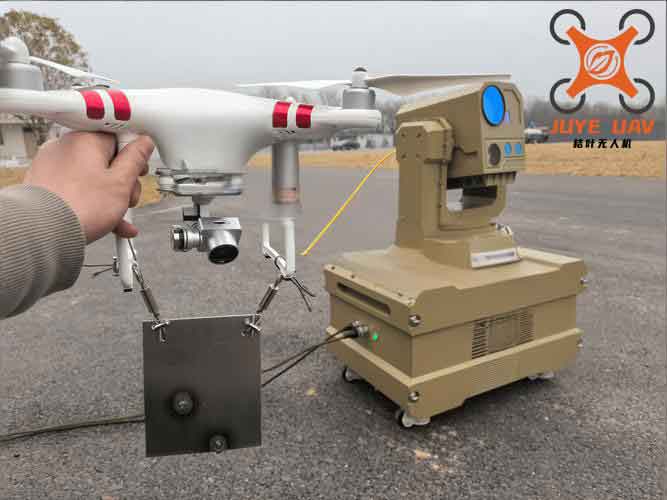
Globally, the development of anti-drone systems has accelerated, with numerous countries investing in research and deployment. In the United States, anti-drone initiatives date back to early strategic plans, focusing on integrated defense systems. For example, one prominent system combines sensors and cyber tools for detection and interception, demonstrating the viability of multi-layered anti-drone approaches. Laser-based anti-drone weapons have been tested successfully, showcasing their capability to disable drones within seconds. Additionally, the concept of “drone vs. drone” has emerged, where interceptor drones equipped with radar and warheads are used to neutralize threats. This reflects a shift towards intelligent anti-drone solutions that leverage autonomy.
In Europe, collaborative efforts have yielded integrated anti-drone systems capable of detection, tracking, and neutralization. These systems often employ electronic warfare techniques to jam or take over drone control, forcing them to land safely. Portable anti-drone systems, such as net-capture launchers, have also been deployed for short-range defense. Israel has contributed significantly with systems that incorporate laser hard-kill options, enhancing the lethality of anti-drone measures. These systems are designed for low-altitude defense, emphasizing the need for adaptable anti-drone technologies in urban environments.
Russia has prioritized anti-drone capabilities, allocating substantial resources to military drones and countermeasures. Portable missile systems and mobile command vehicles have been developed to address drone threats at various ranges. Notably, Russia has explored “predator” drones that hunt other drones, either through destructive means or capture via nets. This aligns with the trend of using unmanned platforms for anti-drone operations, reducing human risk.
In China, domestic companies have advanced anti-drone technologies, including laser defense systems that intercept “low, slow, small” targets. These systems represent milestones in indigenous anti-drone development. Furthermore, electronic deception systems have been introduced, using interference and spoofing to hijack drone navigation. The integration of radar, electro-optics, and jamming in vehicle-mounted systems exemplifies the move towards comprehensive anti-drone solutions.
To summarize global progress, I have compiled a comparative analysis of anti-drone systems across regions, focusing on key technologies and applications. This underscores the widespread recognition of anti-drone necessities.
| Region/Country | Key Anti-Drone Systems | Primary Technologies | Notable Features |
|---|---|---|---|
| United States | Integrated sensor systems, laser weapons, interceptor drones | Radar, RF sensing, lasers, kinetic impact | High-energy lasers, autonomous interception |
| Europe | Electronic warfare systems, net-capture devices | Jamming, spoofing, optical sensors | Portable designs, soft-kill emphasis |
| Israel | Laser-based defense, multi-sensor platforms | Lasers, radar, electro-optics | Hard-kill capabilities, low-altitude focus |
| Russia | Portable missiles, mobile command vehicles, hunter drones | Kinetic missiles, nets, electronic countermeasures | Drone-on-drone tactics, mobility |
| China | Laser interceptors, electronic deception systems | Lasers, jamming, radar-EO integration | Domestic innovation, integrated platforms |
Looking ahead, I identify several trends that will shape the future of anti-drone technology. First, multi-mode composite detection systems will become standard. Relying on a single sensor is inadequate for complex environments; instead, fusion of radar, electro-optics, acoustic, and RF data will enhance accuracy and reduce false alarms. The probability of detection \(P_d\) in a multi-sensor system can be expressed as:
$$P_d = 1 – \prod_{i=1}^{n} (1 – P_{d,i})$$
where \(P_{d,i}\) is the detection probability of sensor \(i\). This shows how combining sensors improves overall anti-drone performance. Second, unattended detection powered by artificial intelligence (AI) is crucial for scalability. Current systems require human intervention due to high false alarm rates, but AI algorithms can automate target recognition, enabling large-scale deployment. I envision neural networks trained on drone signatures optimizing anti-drone surveillance.
Third, directed energy weapons, particularly lasers and microwaves, will dominate anti-drone hard-kill measures. Lasers offer speed and precision, with cost per shot lower than missiles. The energy storage challenge can be addressed through advancements in battery technology. Microwave weapons, capable of emitting wide-area pulses, show promise against drone swarms. The power density for microwave anti-drone systems follows:
$$S = \frac{P_{mw} G}{4\pi R^2}$$
with \(P_{mw}\) as microwave power, \(G\) as antenna gain, and \(R\) as range. Ensuring \(S\) exceeds the disruption threshold for drone electronics is key. Fourth, the concept of “unmanned vs. unmanned” warfare will mature, with intelligent anti-drone platforms autonomously detecting and engaging threats. This reduces human risk and increases response speed.
Fifth, soft-hard combination approaches will be essential for flexible anti-drone responses. Soft-kill methods like jamming can disable drones non-lethally, while hard-kill methods provide assured destruction. The synergy can be modeled as an optimization problem: minimize collateral damage while maximizing neutralization probability. For instance, an anti-drone system might first attempt jamming; if that fails, deploy a laser. This layered defense aligns with the evolving nature of drone threats.
In conclusion, as drones become more sophisticated and ubiquitous, the demand for effective anti-drone systems will intensify. From my perspective, the integration of advanced detection, AI-driven autonomy, directed energy, and combined countermeasures will define next-generation anti-drone capabilities. The anti-drone landscape is dynamic, requiring continuous innovation to stay ahead of adversarial adaptations. By embracing these trends, we can enhance security against drone threats in both military and civilian spheres. The journey of anti-drone technology is one of constant evolution, and I am committed to contributing to its progress through research and development. The term “anti-drone” will remain central in our lexicon as we strive to safeguard airspace and critical infrastructure.
To further illustrate the technical aspects, I present additional formulas relevant to anti-drone systems. For acoustic detection, the sound pressure level \(SPL\) at a distance \(r\) from a drone is:
$$SPL = SPL_0 – 20 \log_{10}\left(\frac{r}{r_0}\right)$$
where \(SPL_0\) is reference level at \(r_0\). This decay affects anti-drone acoustic sensor placement. For jamming effectiveness, the jammer-to-signal ratio \(J/S\) must exceed a threshold:
$$\frac{J}{S} = \frac{P_j G_j R^2_{ts} L_s}{P_t G_t R^2_{tj} L_j}$$
with \(P_j\) as jammer power, \(G_j\) as jammer antenna gain, \(R_{ts}\) as range from target to sensor, \(L_s\) as loss factors, \(P_t\) as transmitter power, \(G_t\) as transmitter gain, \(R_{tj}\) as range from target to jammer, and \(L_j\) as jammer losses. This equation guides anti-drone electronic warfare design.
In summary, the anti-drone field is rich with interdisciplinary challenges, spanning engineering, physics, and computer science. As we advance, collaboration across sectors will be vital to develop robust anti-drone solutions that protect our skies. The future of anti-drone technology is bright, driven by innovation and necessity.