
In recent years, the rapid advancement of information and aviation technologies has led to the迅猛发展 of low-altitude unmanned aerial vehicles (UAVs). The low-altitude airspace is quickly becoming a new battlefield for攻防 operations. New types of low-altitude drones feature advanced performance and diverse functionalities, often equipped with capabilities such as self-organizing networks, autonomous navigation, and precise hovering. Moreover, they possess strong reconnaissance and combat abilities. The low technical门槛 and wide availability of drones make them easily exploitable by malicious actors, terrorists, and hostile forces. Swarm technology is a critical direction for the future development of drones, and drone swarm operations exhibit high battlefield survivability and mission accomplishment capabilities. This represents one of the disruptive technologies influencing the future war胜利机理, posing severe challenges to low-altitude defense. Particularly, key locations such as military airfields, command hubs, and oil depots face严峻的低空侦察与攻击威胁, urgently requiring effective solutions. As a researcher in this field, I have closely followed these developments and believe that directed energy weapons, including high-energy lasers and high-power microwaves, are pivotal in addressing these anti-drone challenges.
The threat posed by drone swarms is multifaceted and growing. In recent years, sensitive locations worldwide have experienced multiple incidents of small drones illegally侵入, leading to significant security risks. According to公开报道, key sites such as the Pentagon and White House in the United States, nuclear power plants in France, the Japanese Prime Minister’s residence, and the Blue House in South Korea have reported numerous drone intrusions. In my country, important政治中心, military bases, and nuclear power plants have also witnessed frequent illegal drone entries. For instance, on January 6, 2018, the Russian military base in Khmeimim, Syria, and the supply base in Tartus were attacked by a swarm of 13 drones, each carrying 10 bombs, showcasing the immense potential of drone swarm attacks for the first time. The 2020 Nagorno-Karabakh conflict saw Azerbaijan’s combat drones become a decisive tool in shaping the war’s outcome. The 2022 Russia-Ukraine war further标志 that low-cost drone operations are emerging as a cost-effective new作战样式. With the加速发展 of artificial intelligence and sensing technologies, drone swarm operations are becoming a crucial future作战样式. Currently, many nations are heavily investing in “swarm”作战技术 and equipment. The United States, for example, is持续推进 projects like the “Perdix” drone swarm, “Offensive Swarm-Enabled Tactics” (OFFSET), and the Gremlins program.
| Year | Location | Incident Description | Anti-Drone Implications |
|---|---|---|---|
| 2018 | Khmeimim Air Base, Syria | 13-drone swarm attack with explosives | Highlighted need for robust anti-drone defenses |
| 2020 | Nagorno-Karabakh region | Extensive use of combat drones in conflict | Demonstrated drones as game-changers in warfare |
| 2022 | Various sites in Ukraine | Widespread low-cost drone operations | Emphasized cost-effectiveness of drone threats |
| Multiple | Global敏感要地 | Illegal intrusions by small drones | Urged development of anti-drone systems |
Countering drone swarm operations presents several难点. Drone swarm attacks are characterized by low cost, large numbers, and difficulties in target detection and处置. Drones are inexpensive, have low technical门槛, and are易于大规模生产; they can be simply modified to carry small explosive devices. Due to their small几何尺寸, low radar cross-section, and weak infrared signatures, low-altitude drones are challenging for conventional防空系统 to detect and intercept in a timely manner. To address low-altitude drone threats, detection methods primarily rely on low-altitude search radars and infrared/visible light detection systems. For countermeasures, traditional approaches include hard-kill手段 like short-range防空导弹 and self-propelled artillery, as well as soft-kill手段 such as GPS/communication link radio frequency jamming. While these systems can在一定程度上完成无人机防御任务, they suffer from issues like slow reaction speeds, low打击精度, difficulties in引战匹配, significant附带损伤, and low效费比. Sometimes, they may even cause unnecessary social panic and diplomatic disputes. Particularly against agile small威胁目标, especially drone swarm饱和攻击, their作战效果 is not ideal. There is an urgent need for new质作战力量 to address these emerging现实威胁. In my analysis, this is where directed energy weapons shine as a promising anti-drone solution.
Directed energy weapons, represented by high-energy lasers and high-power microwaves, possess unique characteristics and capabilities that make them highly suitable for defense in low-altitude and ultra-low-altitude battlefields. High-energy laser weapons operate by emitting laser beams to irradiate UAVs from a distance, depositing energy on the target surface to directly or indirectly ablate sensors, power systems, flight control components, or驱动部件, thereby causing them to lose飞行能力 and crash. The key advantages of high-energy laser weapons include light-speed attack,隐蔽作战, strong作战持续能力, rapid火力转移,抗电磁干扰, minimal附带损伤, and extremely low单发拦截成本 (high效费比). The energy deposition can be described by the formula: $$E = \int P(t) \, dt$$ where \(E\) is the total energy delivered, \(P(t)\) is the laser power as a function of time, and the integral represents the cumulative effect over the engagement duration. For a constant power laser, this simplifies to: $$E = P \cdot t$$ where \(P\) is the laser power and \(t\) is the exposure time. This principle underpins the effectiveness of laser-based anti-drone systems.
High-power microwave weapons, on the other hand, emit electromagnetic pulses that couple into drones through back-door pathways (such as cables or缝隙) to disrupt flight control systems, or through front-door pathways (microwave reception channels) to damage their control receivers, ultimately causing the drones to lose control or crash. High-power microwave weapons consume only electrical energy, and微波效应 typically occur within 3-5 pulses, offering瞬态光速杀伤. With wide beam coverage and杀伤区域 spanning thousands of square meters, they can perform area denial against multiple drones in swarms, making them a powerful tool for countering drone swarm attacks. The power density \(S\) of a microwave beam at a distance \(r\) can be approximated by: $$S = \frac{P_{\text{avg}} G}{4\pi r^2}$$ where \(P_{\text{avg}}\) is the average transmitted power and \(G\) is the antenna gain. This公式 highlights how microwave weapons can cover large areas for anti-drone applications.
The development of directed energy weapons is progressing rapidly worldwide. High-energy laser and high-power microwave weapons are新质作战力量 that could potentially alter battlefield rules, and major military powers are actively advancing their development. In recent years, technologies for these weapons have gradually matured, with countries like the United States, Russia, Israel, and Germany accelerating their deployment as key手段 for low-altitude protection. For instance, the United States has tested systems such as Lockheed Martin’s Area Defense Anti-Munitions (ADAM) system (10 kW), Boeing’s High Energy Laser Mobile Demonstrator (HEL MD, 50 kW), and the Navy’s Laser Weapon System (LaWS, 33 kW). Germany’s Rheinmetall has developed the “Skyguard”箱式激光武器站 (50 kW). Additionally, Raytheon in the U.S. has created a high-power microwave反无人机系统 prototype called “PHASER”. The U.S. military’s “Black Dart” series of annual anti-drone/swarm exercises has shown that existing防空系统 perform well against larger drones/swarms, but for small unmanned aerial vehicles,激光系统 and high-power microwave weapons yield better results. In the March 2018 “Mobile Fire Integrated Experiment” (MFIX) exercise, Raytheon used high-power microwave武器 and high-energy激光武器 to shoot down 45 drones, validating that integrating激光 and high-power microwave technologies can effectively suppress small drone swarms in an anti-drone context.
| Weapon Type | 代表系统 | Power Level | Key Advantages for Anti-Drone | Limitations |
|---|---|---|---|---|
| High-Energy Laser | ADAM, HEL MD, Skyguard | 10-50 kW | Precision strike, low cost per shot, minimal collateral damage | Atmospheric attenuation, line-of-sight required |
| High-Power Microwave | PHASER | Classified (high peak power) | Area coverage, multiple target engagement, all-weather capability | Potential for friendly interference, limited range against shielded targets |
In my country, several enterprises have also developed and launched series of tactical laser weapon products. To date, hundreds of interception tests against various types of drones have been conducted, with击落成功率接近百分之百. These systems have successfully supported multiple重大安保任务 such as the “9·3” parade, G20 summit, “Belt and Road” forum, and BRICS meetings, and have participated in dozens of实战演练. Notably, during a practical保障任务, they successfully击落威胁目标, eliminating security risks and ensuring the smooth conduct of major political activities. This underscores the real-world efficacy of directed energy weapons in anti-drone roles.
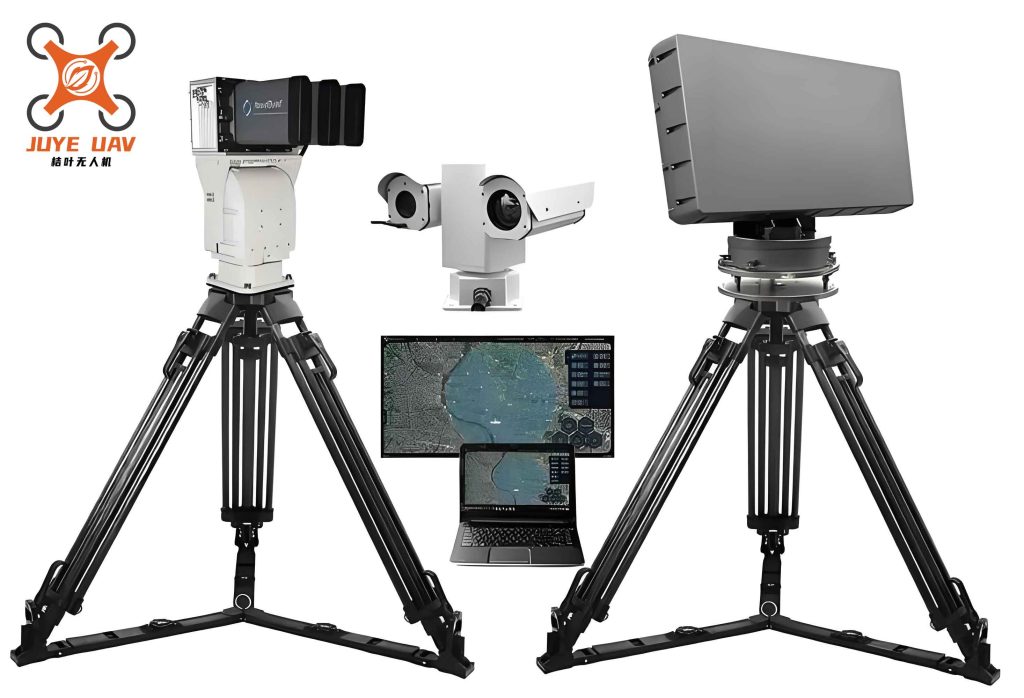
To effectively counter drone swarm threats, a systemic approach is necessary. I propose establishing a comprehensive防御体系 that integrates multiple detection, monitoring, interception, and intelligent command capabilities. This体系 should feature远近搭配 and软硬结合 to achieve effective defense against drone swarms. In terms of detection手段, research and practical applications indicate that复合侦测手段 combining radar搜索 and光电探测 can effectively detect low-slow-small飞行器 and seamlessly interface with laser搜索跟踪 systems. Ku-band radars offer high resolution for small targets and strong tracking识别能力, enabling large-area来袭告警.光电探测 utilizes mid- and long-wave infrared along with visible light多波段探测, providing high resolution for target识别, confirmation, and取证. Additionally, emerging technologies can be融合, employing多种体制探测装备 such as radar, electro-optics, acoustics, and spectrum analysis to leverage their respective advantages. Multi-platform, multi-sensor情报信息 should be融合处理 to form a unified空中综合态势图, crucial for anti-drone operations.
For interception处置手段,激光 and high-power microwave拦截 should serve as the primary means, while maintaining openness to integrate with other处置手段. The types, quantities, and技战术能力 of equipment can be adjusted based on实际场地 and防御范围大小. The作战流程 primarily consists of three stages:预警阶段,决策阶段, and拦截阶段. The防御系统 issues alerts based on its own预警探测系统 and external预警信息, after which the intelligent指控系统 identifies targets and assesses威胁等级, reporting处置决心建议. Upon higher-level command决策 or under authorized本级指控,火力分配 is conducted to拦截处置 targets, followed by效能评估,火力转移, or战斗结束. This structured approach enhances the overall anti-drone capability.
Considering the严峻形势 of drone swarm threats, establishing effective防御措施 is both necessary and urgent. Currently,新概念武器 like high-energy lasers and high-power microwaves are entering a critical window of实用化. Based on实际防御需求,加强针对性设计 is essential, integrating with mature防空武器,雷达探测,光电搜索跟踪 systems to construct low-altitude区域综合防御体系 in core areas, military要地, and other关键部位. This will continuously enhance实战能力 and play a vital role in safeguarding low-altitude security. The integration of directed energy weapons into these systems represents a significant advancement in anti-drone technology.
In-depth analysis of the effectiveness of these weapons requires mathematical modeling. For laser weapons, the time to neutralize a drone can be estimated using the formula: $$t_{\text{kill}} = \frac{E_{\text{thresh}}}{P \cdot \eta \cdot A_{\text{spot}}}}$$ where \(E_{\text{thresh}}\) is the threshold energy required to disable the drone, \(P\) is the laser power, \(\eta\) is the atmospheric transmission efficiency, and \(A_{\text{spot}}\) is the laser spot area on the target. For microwave weapons, the probability of disruption \(P_d\) for a drone in a swarm can be expressed as: $$P_d = 1 – e^{-\lambda S t}$$ where \(\lambda\) is a susceptibility constant, \(S\) is the power density, and \(t\) is the exposure time. These models help optimize anti-drone strategies.
| Parameter | Laser Systems | Microwave Systems |
|---|---|---|
| Engagement Range | 1-5 km (depending on power and weather) | 0.5-3 km (area coverage) |
| Time to Effect | Seconds to tens of seconds | Milliseconds to seconds |
| Target Capacity | Sequential engagement | Simultaneous multiple targets |
| Power Requirement | High continuous power | High peak power pulses |
| Anti-Drone Suitability | High for precision strikes | High for swarm suppression |
The future of anti-drone defense will likely involve hybrid systems combining lasers, microwaves, and traditional kinetic methods. From my perspective, the synergy between these technologies can create a layered defense: lasers for precise点防御, microwaves for broad面防御, and missiles or guns for backup. The cost-benefit analysis favors directed energy weapons due to their low cost per engagement. For example, the cost of a laser shot is primarily electricity, estimated at a few dollars, compared to thousands for a missile. This makes them ideal for countering low-cost drone swarms, where traditional methods become prohibitively expensive. Moreover, the scalability of these systems allows for deployment on various platforms, from ground vehicles to ships and aircraft, enhancing their anti-drone versatility.
In conclusion, directed energy weapons are transformative tools in the realm of anti-drone operations, especially against swarms. Their unique attributes—speed, precision, and cost-effectiveness—address the core challenges posed by modern drone threats. As technology advances, I anticipate further improvements in power输出, beam control, and system integration, making these weapons even more pivotal for homeland security and military defense. The ongoing development and deployment of such systems worldwide underscore their importance in the evolving landscape of aerial warfare. By embracing these innovations, we can build robust anti-drone capabilities that protect critical infrastructure and ensure operational superiority in low-altitude domains. The journey toward comprehensive anti-drone defense is complex, but with directed energy weapons at the forefront, it is a achievable goal.
To reinforce the technical aspects, let’s consider additional formulas. The maximum range \(R_{\text{max}}\) for a laser weapon against a drone can be derived from the beam divergence and atmospheric losses: $$R_{\text{max}} = \sqrt{\frac{P \eta_t \eta_a}{\pi \theta^2 S_{\text{thresh}}}}$$ where \(\eta_t\) is the transmitter efficiency, \(\eta_a\) is the atmospheric transmission, \(\theta\) is the beam divergence angle, and \(S_{\text{thresh}}\) is the threshold irradiance to disable the drone. For microwave weapons, the effective辐射功率 (ERP) is critical: $$\text{ERP} = P_t G_t$$ where \(P_t\) is the transmitted power and \(G_t\) is the antenna gain. This determines the power density at range for anti-drone effects. These equations guide the design and deployment of directed energy anti-drone systems.
In summary, the application of directed energy weapons in anti-drone swarm operations represents a paradigm shift in defense technology. Through continuous research and实战 testing, these systems are proving their worth in countering the growing menace of drone swarms. As I reflect on the progress made, it is clear that investing in such capabilities is essential for future security. The integration of lasers, microwaves, and advanced sensors will define the next generation of anti-drone defenses, ensuring resilience against evolving threats. Let us continue to innovate and collaborate to harness the full potential of directed energy for a safer world.