
The nature of aerial threats has undergone a profound transformation in recent conflicts. The ubiquity and effectiveness of unmanned aerial systems (UAS), ranging from commercial-grade quadcopters to sophisticated loitering munitions, have rendered traditional battlefield sanctuaries obsolete. Ground artillery systems, long the bastion of long-range firepower and decisive force, now find themselves persistently hunted and dangerously vulnerable. This new reality demands a fundamental reevaluation of artillery’s role and capabilities. The imperative is clear: to ensure survivability and maintain operational relevance, ground artillery must evolve beyond its purely offensive mandate. It must develop and integrate a credible, organic anti-drone self-defense capability, transitioning towards a paradigm of integrated offensive-defensive operations. This evolution is not merely an incremental upgrade but a necessary adaptation to the “cheap and numerous” threat paradigm that defines modern asymmetrical and peer conflicts.
The battlefield impact of drones is no longer theoretical. In contemporary conflicts, drones perform persistent intelligence, surveillance, and reconnaissance (ISR), enable precision strike through kamikaze attacks or laser designation, and can saturate defenses with swarm tactics. High-value assets like self-propelled howitzers, once considered relatively safe behind front lines, are now priority targets. The loss rates are stark, driven by drones’ low cost, ease of deployment, and ability to exploit gaps in traditional high-altitude air defense systems. This has created a critical capability gap in the short-range air defense (SHORAD) layer, precisely where artillery units operate. Filling this gap solely with dedicated, expensive missile-based SHORAD systems is economically and tactically unsustainable against massed drone attacks. Therefore, the logical and pressing solution lies in enabling the artillery itself to contribute to its own aerial defense, creating a more resilient, distributed, and cost-effective anti-drone network.
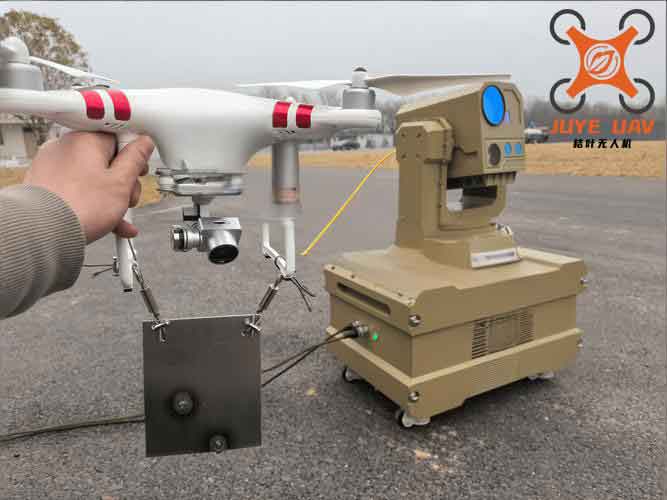
The threat posed by UAS is multi-faceted and has fundamentally altered tactical behavior. The primary modes of threat can be categorized and analyzed to understand the required counter-capabilities.
| Threat Category | Primary Mode | Impact on Artillery | Key Characteristics |
|---|---|---|---|
| Persistent ISR & Targeting | Overhead surveillance, target identification, battle damage assessment (BDA). | Eliminates concealment, enables counter-battery fire, fixes unit locations. | Long loiter time, real-time data link, EO/IR sensors. Low radar cross-section (RCS). |
| Direct Kinetic Strike | Loitering munitions (suicide drones) with explosive payloads. | Direct physical destruction of guns, ammunition, and crew. High single-attack probability of kill (PK). | Low-altitude flight, low acoustic/radar signature, terminal dive. Often used in “pop-up” attacks. |
| Indirect Fire Support | Laser designation for guided artillery/mortars, or drone-dropped munitions. | Artillery unit becomes target for precision indirect fires triggered by drone spotting. | Requires coordination with other arms. Increases lethality and speed of enemy kill chain. |
| Saturation & Swarm Attacks | Coordinated attack by multiple low-cost UAS to overwhelm defenses. | Exceeds engagement capacity of dedicated SHORAD, leads to assured leakage and attrition. | Large numbers, decentralized control, cooperative behavior. A “cost-exchange” weapon. |
The mathematical challenge of defending against swarms highlights the insufficiency of traditional point-defense. The probability of a leaker penetrating a defense with `N` interceptors against a swarm of `M` drones, assuming a single-shot probability of kill `P_k`, can be modeled simplistically. If each interceptor engages a unique target, the expected number of survivors `S` is:
$$ S = M – (N \cdot P_k) $$
However, in reality, with limited engagement channels (`C`) where `C < M`, and the need for re-engagement, the system quickly becomes saturated. The probability of complete swarm neutralization `P_{neutral}` with limited channels and time is low:
$$ P_{neutral} \approx (P_k)^C \text{ (for first engagement wave)} $$
This underscores the need for high-volume, low-cost effectors—a role artillery-based systems are uniquely positioned to fill compared to missile-centric defenses.
Recognizing this paradigm shift, major military powers are actively exploring and prototyping concepts to赋予火炮 anti-drone capabilities. These efforts are not about turning artillery into primary air defense but about creating a complementary, organic layer of defense that enhances overall system survivability.
| Country/Entity | Program/Concept | Artillery Platform | Core Anti-Drone Method | Key Technology Enablers |
|---|---|---|---|---|
| United States (Army) | Extended Range Cannon Artillery (ERCA) Test | XM1299 155mm Howitzer | Firing hypervelocity projectiles (HVP) against aerial targets. | HVP ammunition, Advanced Fire Control, Integrated Air Picture. |
| United States (Air Force) | Multi-Domain Artillery Prototype | 155mm Truck-mounted Gun | Air-transportable cannon for base defense vs. cruise missiles/drones. | Advanced Battle Management System (ABMS) linkage, Palletized munitions. |
| Northrop Grumman (US) | Counter-Battery Air Defense (CBAD) Concept | Multi-Caliber Gun Systems | Layered defense using precision-guided airburst munitions from naval/land guns. | Multi-role fire control, Precision-guided shells, Networked sensors. | United States (Marines) | HIMARS Multi-Mission Launcher | M142 HIMARS | Launching interceptors (e.g., AIM-9X) for point defense. | “One platform, multiple payloads” philosophy, Modular launcher. |
| Germany (Rheinmetall) | Lynx KF41 IFV | 35mm Automatic Cannon | Firing AHEAD-type programmable airburst munitions. | 35mm Revolver Cannon, Programmable fuse, Advanced FCS. |
| France/UK (Nexter/BAE) | RapidFire / CTAS 40mm | 40mm Cased Telescoped System | High-rate-of-fire airburst against low, slow drones and missiles. | Cased Telescoped Ammunition, Airburst grenade, Lightweight turret. |
Analyzing these trends reveals several convergent development vectors essential for effective artillery-based anti-drone capabilities:
1. Networked Situational Awareness and Data Fusion: An artillery piece cannot defend against a threat it cannot see. The foundational enabler is seamless integration into the broader tactical network. The platform must receive a common, integrated air picture (CIAP) from external sensors (radar, electro-optical, electronic support measures). This data fusion, potentially via a system like the future Integrated Tactical Network (ITN) or ABMS, allows the artillery fire control system to treat aerial tracks as valid targets. The key metric is the latency `L` of the kill chain: `L = T_{detect} + T_{identify} + T_{track} + T_{decide} + T_{engage}`. For engaging fast-moving or pop-up drones, `L` must be minimized, necessitating direct sensor-to-shooter links and automated threat evaluation protocols.
2. Multi-Mode, Agile Fire Control Systems (FCS): The existing ballistic FCS must be augmented with an anti-drone engagement mode. This involves new software algorithms to compute firing solutions for fast-moving aerial targets, often requiring high lead angles and compensation for platform motion. The fire solution must account for the unique ballistics of specialized air defense munitions. The transition between “ground fire” and “air defense” modes must be rapid and intuitive for the crew, ideally with a high degree of automation to handle the time-critical nature of the threat. The FCS must solve the 3D intercept problem, which for a constant-velocity target and projectile with drag can be represented by a set of differential equations seeking a solution where the projectile and target arrive at the same point in space-time. A simplified condition for a direct-hit munition is finding firing angles `(\theta, \phi)` and time-of-flight `t_f` such that:
$$ \vec{P}_{proj}(t_f, \theta, \phi, v_0) = \vec{P}_{target}(t_0) + \vec{v}_{target} \cdot t_f $$
where `\vec{P}` are position vectors, `v_0` is muzzle velocity, and `\vec{v}_{target}` is the target’s velocity vector.
3. Development of Specialized, Cost-Effective Munitions: Standard high-explosive (HE) shells are inefficient against small, agile drones. Specialized munitions are required. For medium/large caliber guns (e.g., 155mm), the focus is on guided or smart projectiles:
- Hyper-Velocity Projectiles (HVP): Electrically launched or gun-fired, relying on kinetic energy (KE). Their time-to-target `t_{tt}` is very short: `t_{tt} \approx R / v_{avg}`, where `R` is range and `v_{avg}` is very high ( > 1500 m/s). This minimizes errors in target prediction.
- Precision-Guided Aerial Burst Shells: Fitted with guidance (e.g., GPS/INS, semi-active laser) and a proximity or timed fuse. The lethal radius `R_L` from fragmentation is key. If a drone’s critical component area is `A_{crit}`, the probability of a hit from a randomly distributed fragment pattern with density `\rho_f` is: `P_{hit} \approx 1 – e^{-\rho_f \cdot A_{crit}}`. The goal is to optimize `\rho_f` and `R_L` for the UAS target set.
For small/medium caliber automatic cannons (e.g., 30-40mm), the solution is Programmable Airburst Munitions (PABM). A shell is programmed just before firing to detonate at a precise point in space, creating a lethal cloud of sub-projectiles (tungsten spheres). The number of sub-projectiles `N_s` and their spread angle `\alpha` determine the coverage.
4. The “Cost Exchange Ratio” as a Driving Principle: This is perhaps the most critical trend. The economic logic of using a $100,000 missile to shoot down a $1,000 drone is untenable at scale. Artillery-based anti-drone systems aim to reverse this ratio. The cost-exchange ratio `\eta` should favor the defender:
$$ \eta = \frac{Cost_{Interceptor}}{Cost_{Threat}} << 1 \text{ (or at least } \leq 1 \text{)} $$
A 155mm guided shell may cost $50,000, and a 40mm airburst round $500, both offering a more favorable `\eta` against many military drones and a vastly better one against commercial derivatives. This enables sustainable defense against saturation attacks.
5. Platform Adaptability and Modularity: The approach is not to design entirely new systems but to adapt existing, proliferated platforms. This leverages established logistics, training, and maintenance chains. The “multi-domain” concept emphasizes that a single artillery platform, with minor hardware modifications and major software upgrades, can deliver effects against land, sea (in some cases), and now air targets. This aligns with force design goals of simplicity, versatility, and resilience.
Building on these trends, specific development pathways can be outlined for the main artillery categories to realize their anti-drone potential. The guiding principle is “minimal change for maximum added capability,” focusing on integration, software, and specialized munitions.
For Heavy Suppression Artillery (e.g., 155mm Self-Propelled Howitzers):
These systems offer high payload and long range. Their development should focus on area denial and counter-swarm roles. The primary upgrade is the integration of a battalion/brigade-level air picture via tactical datalinks. The fire control system requires a new software module to process aerial tracks and calculate firing solutions for time-sensitive targets. The key hardware enabler is the procurement of specialized anti-drone munitions. Two types are promising: 1) Guided Area Denial Munitions: Shells that disperse a large number of grenade-sized submunitions over a predicted swarm flight path, creating a “wall of steel.” 2) Hypervelocity or Precision-Guided Kinetic Shells: For engaging higher-value, faster targets like loitering munitions or cruise missiles. The engagement sequence would be automated: receive track warning, FCS computes solution, loader selects special round, gun lays automatically, and fires. The large lethal radius of a 155mm airburst provides a high single-shot probability of kill against drones, making it efficient.
For Assault Guns & Infantry Fighting Vehicles (IFVs) (e.g., 30-40mm Automatic Cannons):
These platforms are naturally suited for the close-in anti-drone self-defense role. They already possess high-angle tracking capability, stabilized turrets, and high-rate-of-fire guns. The development path is more straightforward and mirrors modern air-defense guns. Necessary enhancements include:
- Sensor Fusion: Integrating the vehicle’s own sights (thermal, EO) with a dedicated, lightweight panoramic air search radar or electronic warfare (EW) detector for cueing.
- Advanced FCS: Implementing automatic tracking and lead calculation for aerial targets. The engagement equation here often uses a “future position” predictor in the FCS software.
- PABM Ammunition: Adopting and stockpiling programmable airburst rounds. The effectiveness `E` of a burst can be modeled as a function of sub-projectile density `D`, target cross-section `\sigma_t`, and range `r`: `E \propto \frac{D \cdot \sigma_t}{r^2}`.
An IFV company equipped with such systems can form an organic, mobile anti-drone screen for maneuvering forces, protecting not only themselves but also dismounted infantry and lighter assets.
For Multiple Launch Rocket Systems (MLRS):
Rocket artillery offers a unique potential for launching dedicated interceptor missiles or creating wide-area counter-swarm effects. The development here is more complex and parallels the US Marine Corps’ concept for HIMARS. It involves:
- Multi-Mission Launcher (MML): Replacing or augmenting standard rocket pods with a launch module capable of firing short-range interceptor missiles (like a miniaturized Surface-to-Air Missile).
- Specialized Interceptor Rockets: Developing guided rockets with proximity-fused warheads, optimized for engaging small aerial targets. The rocket’s maneuverability and warhead type (e.g., directed fragmentation) are critical.
- Network-Centric Operation: The MLRS platform acts purely as a remote launcher, receiving fire commands from an external air defense command post with its own dedicated radar/sensor network.
This approach provides a long-range, high-precision anti-drone capability but is likely the most expensive and specialized of the three paths.
The evolution of ground artillery into a multi-role, anti-drone-capable force is no longer a speculative concept but an operational necessity. The trends observed in leading militaries point towards a future where the distinction between “shooter” and “defender” blurs at the tactical edge. Success hinges on mastering network integration, developing agile fire control software, and most importantly, fielding cost-effective munitions that win the economic battle of attrition. By embracing this transformation, artillery can shed its vulnerability and become a more resilient, versatile, and decisive element of the future combined arms team. It will move from being a prized target for enemy drones to an active hunter in the contested skies above the battlefield, ensuring its enduring relevance in the age of pervasive unmanned threats.