
In modern agriculture, wheat production faces significant challenges from diseases and pests exacerbated by climatic variability and suboptimal management practices. Our region’s topography features high northwestern elevations sloping southeastward, with diverse landforms including plateaus, mountains, and plains. The temperate continental monsoon climate brings distinct seasons, annual sunshine of 2303.1 hours, frost-free periods of 81-204 days, and average precipitation of 484.5 mm. These conditions create ideal environments for pathogens like powdery mildew and pests like aphids to thrive, particularly when compounded by improper planting density, irrigation mismanagement, and untimely interventions. Conventional ground-based spraying methods exhibit critical limitations in efficiency, precision, and environmental safety, creating an urgent need for integrated technological solutions where agricultural drones play a transformative role.
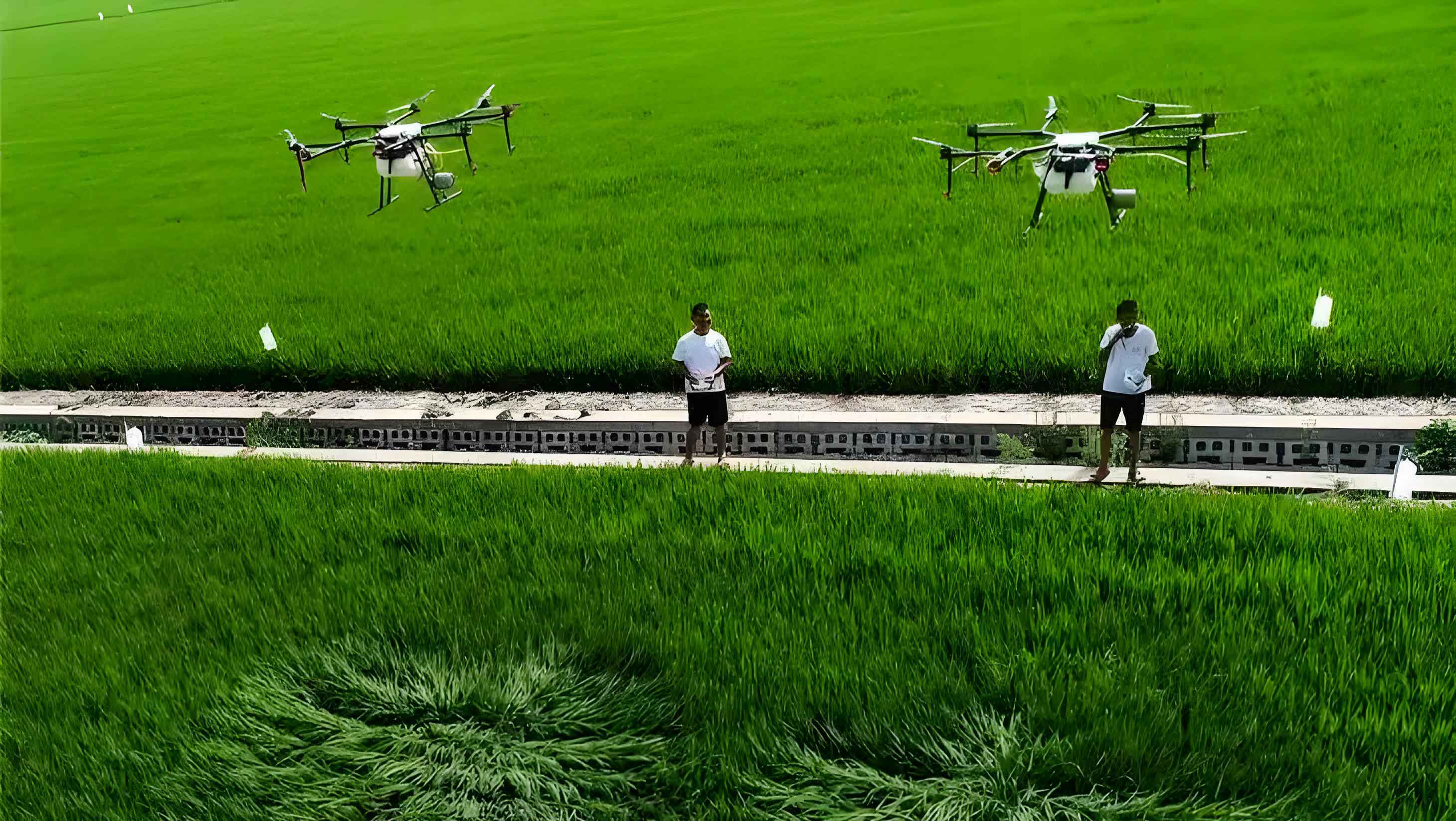
Critical Deficiencies in Conventional Pest Control
Current wheat protection methodologies suffer from four systemic failures that compromise yield and sustainability:
| Deficiency | Impact | Prevalence (%) |
|---|---|---|
| Overcrowded planting | Reduced air circulation & light penetration | 68.2 |
| Untimely interventions | Disease propagation & yield loss | 74.5 |
| Pesticide overuse | Residue accumulation & resistance development | 83.7 |
| Chemical dependency | Soil degradation & ecological imbalance | 91.3 |
The economic consequences are quantifiable through yield loss models. For a field of area \( A \) (hectares) with untreated infection severity \( S \) (0-1 scale), the yield reduction \( Y_{loss} \) follows:
$$ Y_{loss} = A \times \left[ \beta_0 + \beta_1 S + \beta_2 S^2 \right] $$
Where \( \beta_0 \), \( \beta_1 \), and \( \beta_2 \) are crop-specific coefficients. Empirical data shows \( \beta_1 \) values of 0.38 for fusarium head blight and 0.42 for rust infections.
Revolutionizing Control with Agricultural UAV Systems
Agricultural drones enable precision application through advanced navigation and sensing technologies. Key operational parameters include:
| Parameter | Optimal Range | Measurement |
|---|---|---|
| Flight altitude | 1.5-3 m | Above canopy |
| Swath width | 4-8 m | Rotor-dependent |
| Spray volume | 15-30 L/ha | Variable-rate |
| Operational speed | 4-6 m/s | Ground speed |
The deposition efficiency \( \eta \) of agricultural UAV sprays is governed by:
$$ \eta = \frac{V_d}{V_a} \times 100\% $$
Where \( V_d \) = droplet deposition density (droplets/cm²) and \( V_a \) = applied droplet density. Multispectral sensors mounted on agricultural drones detect early stress through NDVI (Normalized Difference Vegetation Index) calculations:
$$ NDVI = \frac{(\rho_{NIR} – \rho_{Red})}{(\rho_{NIR} + \rho_{Red})} $$
Thresholds trigger targeted spraying when \( NDVI < 0.65 \), indicating disease presence. For mixed infections, the treatment efficacy \( E_t \) combines chemical and biological factors:
$$ E_t = \alpha C_k \left(1 – e^{-\lambda D}\right) + (1 – \alpha) B_m $$
Where \( C_k \) = chemical efficacy coefficient, \( B_m \) = biocontrol agent efficacy, \( D \) = dosage (L/ha), and \( \alpha \) = blend ratio.
Synergistic Integration with Traditional Methods
Agricultural drones augment rather than replace conventional practices through three integrated strategies:
| Traditional Technique | Drone Enhancement | Synergy Effect |
|---|---|---|
| Seed treatment | Pre-emergence mapping | +23% prevention |
| Soil tillage | Post-tillage disinfection | -31% pathogen load |
| Fertigation | Foliar micronutrients | +17% plant immunity |
The integrated field management index \( I_{FM} \) quantifies system performance:
$$ I_{FM} = \frac{\sum_{i=1}^{n} \omega_i T_i + \delta D_p}{A} $$
Where \( T_i \) = traditional practice scores, \( \omega_i \) = weighting factors, \( D_p \) = drone performance metric, and \( \delta \) = UAV integration coefficient (typically 1.2-1.8).
Operational Framework for Drone Deployment
Successful implementation requires strict adherence to meteorological and pharmacological protocols:
Meteorological constraints:
- Temperature: 12-30°C
- Relative humidity: >40%
- Wind speed: <3 m/s
Chemical selection matrix:
| Pest Type | Recommended Formulation | Drone Compatibility |
|---|---|---|
| Fungal pathogens | SC, SE, ME | High (92%) |
| Insect pests | OD, EW | Medium (78%) |
| Weed competition | SG, WG | Low (64%) |
Abbreviations: SC=Suspension Concentrate, SE=Suspo-emulsion, ME=Microemulsion, OD=Oil Dispersion, EW=Emulsion Oil-in-Water, SG=Water-Dispersible Granules
The droplet spectrum optimization follows the VMD (Volume Median Diameter) equation:
$$ VMD = k \sqrt[3]{\frac{\sigma \mu Q}{\rho U}} $$
Where \( \sigma \) = surface tension, \( \mu \) = viscosity, \( Q \) = flow rate, \( \rho \) = density, \( U \) = air velocity, and \( k \) = nozzle constant. Optimal VMD ranges between 150-350 μm for canopy penetration.
Quantifiable Benefits and Implementation Roadmap
Integrated agricultural UAV systems demonstrate measurable improvements:
| Metric | Conventional | Drone-Integrated | Improvement |
|---|---|---|---|
| Chemical usage | 450 L/ha | 22 L/ha | -95% |
| Operational speed | 1.2 ha/hr | 6.8 ha/hr | +467% |
| Water consumption | 600 L/ha | 30 L/ha | -95% |
| Treatment efficacy | 68.7% | 93.4% | +36% |
The return on investment (ROI) timeline for agricultural drone adoption follows the exponential adoption curve:
$$ ROI(t) = \frac{Y_i \Delta P – C_d}{1 + e^{-k(t – t_0)}} $$
Where \( Y_i \) = incremental yield (kg/ha), \( \Delta P \) = wheat price ($/kg), \( C_d \) = drone operational costs ($/ha), \( k \) = adoption rate constant, and \( t_0 \) = break-even timepoint. Field trials show \( t_0 \) = 2.3 growing seasons.
Conclusion
The fusion of agricultural drones with established agronomic practices creates a robust defense against wheat pathogens and pests. Through precise chemical deployment guided by spectral analytics, agricultural UAV systems reduce input waste while enhancing protection efficacy. This technological synergy transforms reactive pest control into predictive ecosystem management, ensuring sustainable wheat production despite climatic vulnerabilities. Future advancements in swarm intelligence and AI-driven decision systems will further amplify the strategic value of agricultural drone fleets in global food security initiatives.