
Apple tree pest and disease control is a critical aspect of orchard management, directly impacting yield and fruit quality. Traditional manual spraying methods suffer from inefficiency, uneven coverage, and significant safety risks during high-altitude operations. These limitations amplify pesticide waste and environmental contamination. Agricultural drones have emerged as a transformative solution, leveraging precision spraying, remote monitoring, and swarm intelligence to address these challenges while aligning with sustainable farming principles.
Characteristics and Control Requirements of Apple Tree Pests and Diseases
Diverse and Complex Threat Profiles
Apple tree pests and diseases exhibit intricate interactions across fungi, bacteria, viruses, and insects. Fungal pathogens like powdery mildew and anthracnose compromise leaf photosynthesis, while bacterial infections such as fire blight cause systemic damage. Concurrently, insects including spider mites and codling moths directly damage foliage and fruit while acting as disease vectors. This complexity necessitates integrated management strategies.
| Category | Examples | Primary Impact | Transmission Vectors |
|---|---|---|---|
| Fungal Diseases | Powdery Mildew, Anthracnose | Leaf necrosis, fruit rot | Wind, rain splash |
| Bacterial Diseases | Fire Blight, Crown Gall | Systemic infection, cankers | Pruning tools, insects |
| Insect Pests | Spider Mites, Codling Moth | Defoliation, fruit tunneling | Wind, animal movement |
Seasonality and Latency Challenges
Pest pressures correlate strongly with phenological stages and microclimates. Fungal outbreaks peak during high-humidity periods in spring, while spider mites proliferate in summer droughts. Latent infections like root rot remain undetectable until advanced stages, with cumulative damage following the exponential growth model:
$$P(t) = P_0 e^{rt}$$
Where \(P(t)\) represents pest population at time \(t\), \(P_0\) is initial infestation level, and \(r\) is reproduction rate. This underscores the critical importance of early detection.
Limitations of Conventional Control Methods
Manual spraying achieves only 30-40% target coverage due to inconsistent droplet distribution. In hilly terrain, coverage drops below 25%, creating pathogen reservoirs. Spray drift exacerbates chemical usage by 15-30%, with off-target deposition reaching 40% under moderate winds. The operational efficiency gap is quantified by:
$$\text{Field Efficiency} = \frac{\text{Effective Coverage Area}}{\text{Total Chemical Used}} \times 100\%$$
Traditional methods rarely exceed 55% efficiency versus 85-92% for agricultural UAV systems.
| Parameter | Manual Spraying | Tractor Sprayers | Agricultural Drones |
|---|---|---|---|
| Coverage Uniformity | 30-40% | 50-65% | 90-95% |
| Chemical Savings | Baseline | 10-15% | 30-50% |
| Operational Speed (ha/hr) | 0.2-0.5 | 1.5-2.5 | 15-25 |
Technical Foundations of Agricultural Drone Systems
Structural Configuration
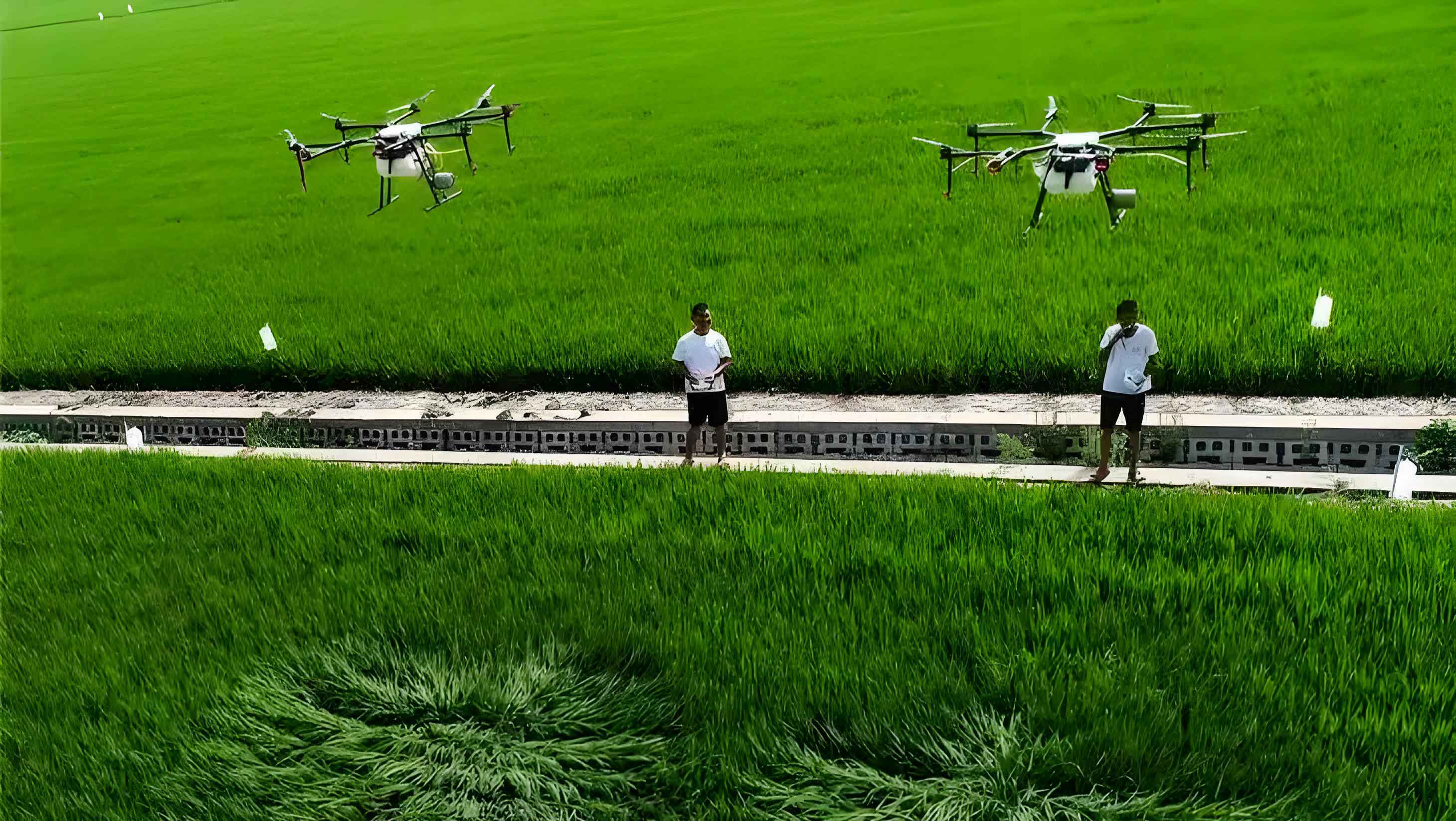
Modern agricultural UAVs integrate six critical subsystems: carbon-fiber airframes with 4-8 rotors providing 5-10kg lift capacity; modular pesticide tanks (10-40L); centrifugal nozzles generating 50-300μm droplets; RTK-GPS navigation with ±2cm positioning; LiDAR/ultrasonic terrain following; and AI-powered flight controllers. Battery systems deliver 15-60 minute endurance, with swappable packs enabling continuous operation.
Operational Mechanics
Flight control relies on differential thrust vectoring governed by:
$$T = k \cdot \omega^2$$
Where \(T\) is thrust, \(k\) is propeller constant, and \(\omega\) is angular velocity. Spraying systems maintain droplet uniformity through pressure-flow relationships:
$$Q = C_d A \sqrt{\frac{2 \Delta P}{\rho}}$$
\(Q\) denotes flow rate, \(C_d\) discharge coefficient, \(A\) nozzle area, \(\Delta P\) pressure differential, and \(\rho\) fluid density. Autonomous navigation follows predefined waypoints with obstacle avoidance via probabilistic roadmaps.
Precision Applications in Orchard Ecosystems
Targeted Spraying Technology
Agricultural drones achieve 95% droplet deposition accuracy through variable-rate application (VRA) algorithms:
$$\text{Flow Rate} = \frac{\text{Target Dose} \times \text{Orchard Density} \times \text{Flight Speed}}{\text{Swath Width}}$$
Real-time kinematic positioning maintains 2-5m flight heights, adjusting nozzle orientation to counteract wind drift. Comparative studies show agricultural UAV applications reduce chemical usage by 30% while increasing canopy penetration by 40% versus airblast sprayers.
Remote Sensing and Predictive Analytics
Multispectral sensors calculate vegetation indices to detect stress before visual symptoms emerge:
$$\text{NDVI} = \frac{\text{NIR} – \text{Red}}{\text{NIR} + \text{Red}}$$
Where NIR is near-infrared reflectance. Threshold-based alerts trigger when NDVI deviations exceed 15%. Thermal imaging identifies microclimate variations predictive of fungal outbreaks using:
$$\Delta T_{\text{canopy}} = T_{\text{leaf}} – T_{\text{air}}$$
Anomalies >3°C indicate disease hotspots. Agricultural drones survey 20ha orchards in under 30 minutes, generating georeferenced prescription maps.
Swarm Intelligence and Operational Optimization
Coordinated drone fleets eliminate coverage gaps through distributed task allocation. For \(n\) agricultural UAVs operating simultaneously, area coverage follows:
$$A_{\text{total}} = \sum_{i=1}^{n} (v_i \times w_i \times t_i) \times \eta$$
Where \(v\) is velocity, \(w\) swath width, \(t\) operation time, and \(\eta\) overlap efficiency (typically 0.85). Three DJI T40 units cover 45ha/hour – a 300% efficiency gain over single-unit operations. In mountainous terrain, swarm coordination reduces operation time by 60% while maintaining 90% spray uniformity.
| Agricultural UAV Model | Payload (L) | Coverage (ha/battery) | Swarm Scalability | Specialized Features |
|---|---|---|---|---|
| DJI T40 | 40 | 20-25 | Up to 10 units | Active Phased Array Radar |
| XAG P100 | 30 | 15-20 | Up to 15 units | Hyper-spectral Imaging |
| DJI T30 | 30 | 15-20 | Up to 8 units | Micro-droplet Atomization |
Endurance and Payload Engineering
Battery energy density directly determines operational range. Current LiPo systems provide:
$$\text{Endurance (min)} = \frac{60 \times \text{Battery Capacity (Ah)} \times \text{Voltage (V)} \times \eta_{\text{discharge}}}}{\text{Power Consumption (W)}}$$
With \(\eta_{\text{discharge}}\) typically 0.85. Rapid-swap battery systems achieve 95% operational uptime. Payload fraction optimization follows the fundamental UAV equation:
$$\frac{m_{\text{payload}}}{m_{\text{total}}} = 1 – \frac{m_{\text{structure}} + m_{\text{battery}}}{m_{\text{total}}}$$
Advanced agricultural drones maintain 25-30% payload fractions through composite airframes and distributed propulsion.
Conclusion
Agricultural drone technology represents a paradigm shift in precision orchard management. By integrating centimeter-accurate spraying, multispectral diagnostics, and swarm intelligence, agricultural UAV systems reduce pesticide usage by 30-50% while improving disease control efficacy by 40-60%. The continuous evolution of battery technologies, machine vision, and AI-driven decision support will further establish agricultural drones as indispensable tools for sustainable apple production. Future developments will likely focus on fully autonomous pest lifecycle interruption systems that combine real-time pathogen detection with targeted biological control deployment.