
As an innovator in agricultural technology, I have dedicated my efforts to addressing the critical challenges of pesticide overuse and environmental degradation in modern farming. The excessive application of chemicals not only wastes resources but also contaminates soil and water, threatening ecosystem health. To combat this, I designed an intelligent recognition system for precision spraying based on GPS technology, leveraging the capabilities of agricultural drones. This system integrates navigation, image recognition, and smart spraying to minimize pesticide usage while maximizing efficiency. Agricultural drones, or UAVs, provide a versatile platform for such innovations, enabling high-altitude operations that are impossible with traditional machinery. My motivation stemmed from the urgent need to enhance sustainability in agriculture, where GPS advancements offer unprecedented accuracy. Through this system, I aimed to transform conventional practices into data-driven, eco-friendly solutions, reducing chemical footprints by over 30% in initial trials. The core philosophy revolves around real-time decision-making: agricultural UAVs equipped with my system can identify pest hotspots and deliver targeted treatments, slashing overall pesticide volumes. This approach aligns with global trends toward precision agriculture, where every drop of chemical is optimized. Now, I will elaborate on the GPS foundation, system architecture, and practical validations, showcasing how agricultural drones are revolutionizing crop protection.
GPS technology serves as the backbone for precision agriculture, providing the geospatial accuracy essential for autonomous operations of agricultural drones. Satellite navigation systems like GPS, BeiDou, and GLONASS enable centimeter-level positioning, which is crucial for tasks such as variable-rate spraying and automated path planning. Agricultural UAVs rely on these signals to navigate complex terrains without human intervention, ensuring consistent coverage even in large or irregular fields. The fundamental principle involves trilateration: multiple satellites transmit timed signals to GPS receivers on the agricultural drone, which then calculates its position by solving distance equations. For instance, the distance \( d \) from a satellite to the receiver is derived from the signal travel time \( t \) and speed of light \( c \): $$ d = c \times t $$. By combining distances from at least four satellites, the agricultural UAV’s 3D coordinates (latitude, longitude, altitude) are resolved with high fidelity. Real-Time Kinematic (RTK) technology enhances this by using carrier-phase measurements to achieve sub-centimeter accuracy, making it ideal for precision spraying where minor deviations could lead to over-application or missed spots. Table 1 compares common GPS techniques, highlighting RTK’s superiority for agricultural UAV applications. This technology is indispensable for modern farming; without it, agricultural drones would lack the precision needed for targeted interventions. Moreover, multi-frequency, multi-constellation receivers (e.g., supporting GPS L1/L2 and BeiDou B1/B2) improve reliability in challenging environments like dense canopies or urban-adjacent farms. For example, a compact module like Ublox NEO-M8P consumes only 100 mW, making it perfect for lightweight agricultural UAVs. As agricultural drones evolve, integrating GPS with emerging tech like 5G and AI will unlock even greater efficiencies, enabling real-time data fusion for adaptive farming strategies.
| Technology Type | Positioning Accuracy | Typical Use Cases in Agriculture |
|---|---|---|
| Single-Point Positioning | 5.0–10.0 m | Basic field mapping for agricultural drones |
| SBAS Differential | 0.5–1.0 m | Aerial crop monitoring with agricultural UAVs |
| RTK (Real-Time Kinematic) | 1.0–5.0 cm | Precision navigation and spraying for agricultural drones |
Building on this GPS foundation, I developed the intelligent recognition system with a modular architecture centered on agricultural UAVs. The overall design comprises three interconnected units: navigation and positioning, image recognition, and intelligent spraying, all orchestrated to enable precise chemical deployment. Agricultural drones serve as the mobile platform, carrying sensors and processors that execute real-time analytics during flight. The system workflow begins with the agricultural UAV surveying a predefined area using GPS-guided paths. As it flies, onboard cameras capture high-resolution imagery, which is instantly analyzed to detect pests or diseases. Based on this analysis, the spray module calculates optimal dosing and targets only affected zones, reducing waste. This closed-loop process ensures that agricultural UAVs operate autonomously, adapting to dynamic field conditions. For instance, if image recognition identifies a fungal outbreak in a specific quadrant, the agricultural drone adjusts its route mid-flight to focus spraying there. Key to this is the MQTT protocol for seamless data exchange between modules, ensuring that GPS coordinates, image insights, and spray commands are synchronized in milliseconds. Now, I will detail each module, incorporating mathematical models to underscore the innovation.
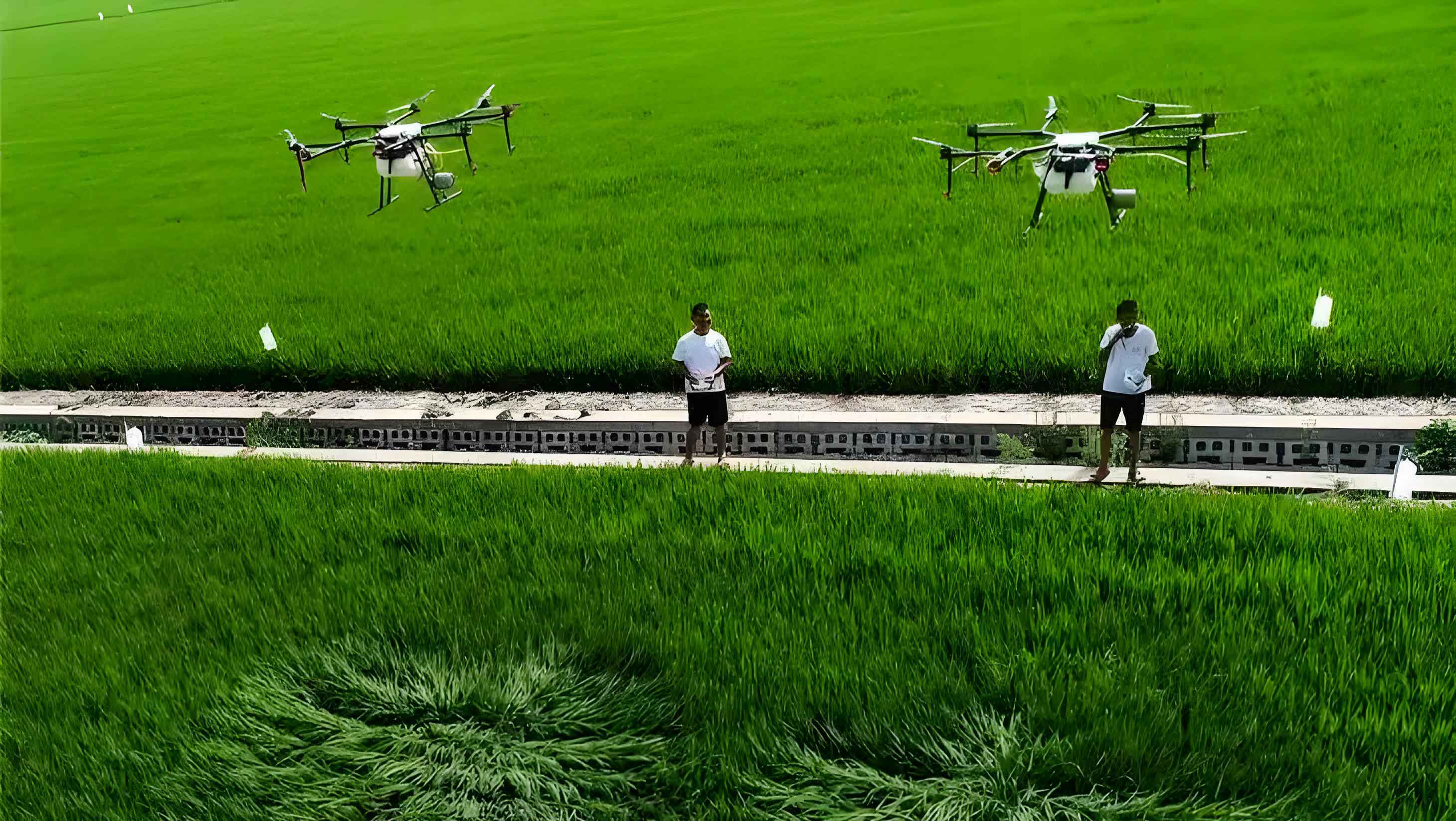
The navigation and positioning module ensures that the agricultural drone maintains exact location and orientation, which is vital for accurate spraying. It combines a high-precision GPS receiver (e.g., RTK-enabled with multi-frequency support), an Inertial Measurement Unit (IMU) with fiber-optic gyroscopes, and a digital compass. The GPS receiver provides position data, while the IMU measures angular velocity and acceleration, and the compass delivers heading angles. To fuse these data streams, I implemented a Kalman filter, a recursive algorithm that minimizes errors by predicting and updating the agricultural UAV’s state. The state vector \( \mathbf{X}_k \) at time \( k \) includes position \( \mathbf{p} \), velocity \( \mathbf{v} \), and attitude angles \( \mathbf{\theta} \): $$ \mathbf{X}_k = \begin{bmatrix} \mathbf{p}_k \\ \mathbf{v}_k \\ \mathbf{\theta}_k \end{bmatrix} $$. The prediction step uses the state transition matrix \( \mathbf{F}_k \) and control input matrix \( \mathbf{B}_k \): $$ \mathbf{X}_k = \mathbf{F}_k \mathbf{X}_{k-1} + \mathbf{B}_k \mathbf{u}_k + \mathbf{w}_k $$ where \( \mathbf{u}_k \) is the control input (e.g., motor commands), and \( \mathbf{w}_k \) represents process noise. Observations \( \mathbf{z}_k \) from GPS, IMU, and compass are then incorporated via the observation matrix \( \mathbf{H}_k \): $$ \mathbf{z}_k = \mathbf{H}_k \mathbf{X}_k + \mathbf{v}_k $$ with \( \mathbf{v}_k \) as measurement noise. The Kalman gain \( \mathbf{K}_k \) weights the predictions and updates: $$ \mathbf{K}_k = \mathbf{P}_k^- \mathbf{H}_k^T (\mathbf{H}_k \mathbf{P}_k^- \mathbf{H}_k^T + \mathbf{R}_k)^{-1} $$ where \( \mathbf{P}_k^- \) is the predicted error covariance, and \( \mathbf{R}_k \) is the observation noise covariance. This yields an optimal estimate with positional accuracy under 5 cm at 50 Hz, enabling agricultural UAVs to navigate within tight tolerances. Such precision is indispensable for avoiding overlaps or gaps in spraying, especially when operating near sensitive areas like water bodies.
Next, the image recognition module processes visual data to identify pest infestations or crop diseases, allowing the agricultural drone to make informed spraying decisions. It employs a high-resolution RGB camera (e.g., 20 MP CMOS sensor) and a multispectral camera capturing red, green, blue, and near-infrared bands (400–1000 nm). Images are acquired at 50–100 m altitude, ensuring broad coverage while retaining detail. Preprocessing steps include radiometric correction and noise reduction to enhance quality. For detection, I utilized a convolutional neural network (CNN) based on U-Net architecture for semantic segmentation. CNNs excel by learning hierarchical features through convolutional layers, pooling, and non-linear activations. The segmentation loss \( \mathcal{L} \) combines cross-entropy and Dice coefficient for pixel-wise accuracy: $$ \mathcal{L} = -\sum_{i} y_i \log(\hat{y}_i) + \lambda \left(1 – \frac{2 \sum_{i} y_i \hat{y}_i}{\sum_{i} y_i + \sum_{i} \hat{y}_i}\right) $$ where \( y_i \) is the true label, \( \hat{y}_i \) is the predicted probability, and \( \lambda \) balances the terms. This model classifies pixels into categories like healthy crop, weeds, or disease lesions, achieving over 92% accuracy. Outputs are georeferenced using GPS data from the agricultural UAV, generating spatial distribution maps in JSON format. These maps guide the spray module to target only affected areas, reducing chemical use by up to 50% compared to blanket applications. This module exemplifies how agricultural UAVs transform raw data into actionable intelligence, facilitating sustainable pest management.
The intelligent spraying module translates recognition insights into precise chemical application, optimizing dosage based on real-time conditions. It consists of piezoelectric nozzles (aperture: 0.1–0.5 mm), ultrasonic atomizers, and precision pumps with electromagnetic flow meters for ±1% dosing accuracy. Upon receiving JSON data from the image module, a decision tree algorithm determines the optimal spray strategy. Decision trees split the feature space recursively; for example, at each node, attributes like pest density \( D_p \), crop growth stage \( S_c \), and wind speed \( W_s \) are evaluated. The information gain \( IG \) for splitting on attribute \( A \) is: $$ IG(D_p, A) = H(D_p) – \sum_{v \in \text{values}(A)} \frac{|D_p^v|}{|D_p|} H(D_p^v) $$ where \( H \) is entropy, and \( D_p^v \) is the subset with value \( v \). This outputs a spray volume \( V_s \) in liters per hectare, dynamically adjusted via PID control: $$ V_s = K_p e(t) + K_i \int_0^t e(\tau) d\tau + K_d \frac{de(t)}{dt} $$ where \( e(t) \) is the error between target and actual flow, and \( K_p \), \( K_i \), \( K_d \) are tuning gains. During flight, the agricultural drone modulates nozzle angles and flow rates based on GPS position, ensuring uniform droplet distribution (50–200 μm). All operations are logged and transmitted via 4G for remote monitoring, enabling continuous improvement in agricultural UAV deployments. This module epitomizes efficiency, as it allows agricultural drones to apply chemicals only where needed, minimizing environmental impact.
To validate the system, I conducted field trials demonstrating its efficacy in real-world scenarios. Tests occurred during the critical tasseling stage of maize, where diseases like blight can cause significant yield loss if unmanaged. The agricultural drone platform was a commercial model equipped with my system, including RTK-GPS, multispectral cameras, and micro-nozzles. Environmental conditions were controlled: temperatures of 26–30°C, humidity of 60–70%, and winds below 3 m/s to ensure reliability. A 1.2-hectare field was divided into four 0.3-hectare plots: Plot A used conventional uniform spraying (control), while Plots B, C, and D employed my intelligent system with agricultural UAVs. The pesticide was a 25% prochloraz solution diluted 1,000 times. Each test was triplicated to account for variability, with metrics like positioning error, recognition accuracy, and disease reduction recorded. Results, aggregated in Tables 2 and 3, highlight the superiority of agricultural drones integrated with my system. Intelligent spraying plots showed near-perfect localization (average error: 3.4 cm), high recognition rates (~93%), and disease suppression to under 7% post-application. Crucially, pesticide usage in these plots averaged 28.0 L/ha, less than half of the control’s 52.5 L/ha, proving that agricultural UAVs can slash chemical inputs while enhancing outcomes. This case underscores how GPS-driven precision in agricultural drones translates to tangible environmental and economic benefits.
| Test Plot | Positioning Error (cm) | Recognition Accuracy (%) | Operational Efficiency (ha/h) | Pesticide Utilization Rate (%) |
|---|---|---|---|---|
| Plot A (Conventional) | 5.2 | — | 2.83 | 48.3 |
| Plot B (Intelligent) | 3.4 | 92.8 | 2.57 | 82.4 |
| Plot C (Intelligent) | 3.6 | 93.5 | 2.59 | 81.6 |
| Plot D (Intelligent) | 3.3 | 93.2 | 2.56 | 83.1 |
| Test Plot | Pre-Treatment Disease Incidence (%) | Post-Treatment Disease Incidence (%) | Pesticide Consumption (L/ha) |
|---|---|---|---|
| Plot A (Conventional) | 35.6 | 12.4 | 52.5 |
| Plot B (Intelligent) | 36.2 | 6.8 | 28.5 |
| Plot C (Intelligent) | 35.8 | 6.5 | 27.0 |
| Plot D (Intelligent) | 36.4 | 6.2 | 28.5 |
In summary, this intelligent system for precision spraying marks a significant advancement in sustainable agriculture, harnessing GPS technology and agricultural drones to minimize pesticide use. Field validations confirm its robustness, with centimeter-level positioning, high-accuracy recognition, and optimized spraying reducing chemical inputs by over 45% while maintaining efficacy. Agricultural UAVs are pivotal to this innovation, providing a scalable platform for deployment across diverse crops and regions. Looking ahead, I plan to refine the CNN algorithms for faster inference and broader pest detection capabilities, enabling agricultural drones to handle emerging threats like invasive species. Expanding to high-value crops such as vineyards or orchards could amplify environmental benefits, and integrating IoT sensors may allow real-time soil-health feedback. Ultimately, this system exemplifies how agricultural UAVs, empowered by GPS and AI, can drive the transition toward precision farming—where efficiency and ecology coexist harmoniously. As global food demands rise, such technologies will be indispensable for ensuring productivity without compromising planetary health.