
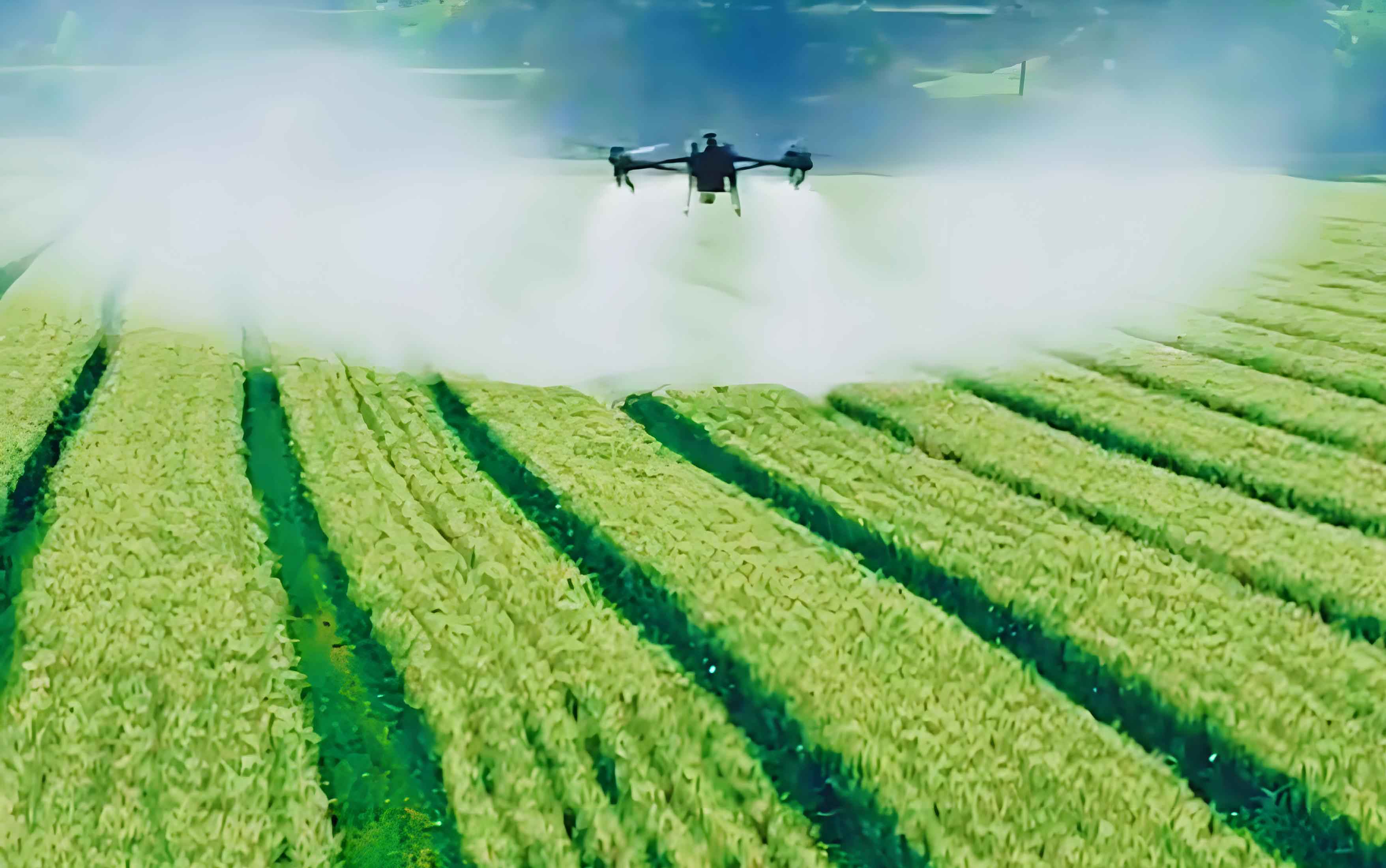
Aerial plant protection technology represents a cutting-edge advancement in modern agriculture. Compared to manual spraying methods, agricultural drone pesticide application offers significant advantages including reduced labor requirements, lower operational costs, higher efficiency, terrain-independent operation, and minimized chemical usage. This study establishes a three-dimensional computational fluid dynamics (CFD) model coupled with a discrete phase model (DPM) to investigate the downwash flow characteristics and droplet deposition patterns of single-rotor agricultural UAVs. The governing equations for fluid dynamics and particle motion are defined as follows:
$$ \frac{\partial U}{\partial t} + \frac{\partial (F – F_v)}{\partial x} + \frac{\partial (G – G_v)}{\partial y} + \frac{\partial (H – H_v)}{\partial z} = 0 $$
$$ \frac{du_p}{dt} = \frac{18\mu C_D Re}{24\rho_p d_p^2} (u – u_p) + g_x \frac{(\rho_p – \rho)}{\rho_p} + \frac{1}{2} \frac{\rho}{\rho_p} \frac{d}{dt}(u – u_p) $$
where $U$ represents the flow vector, $u_p$ denotes particle velocity, $\rho$ is continuous phase density, $\rho_p$ is particle density, $d_p$ is particle diameter, and $Re$ is Reynolds number. The SST k-ω turbulence model accurately captures the complex vortex structures generated by agricultural UAV rotors:
$$ \frac{\partial (\rho k)}{\partial t} + \frac{\partial (\rho u_i k)}{\partial x_i} = \frac{\partial}{\partial x_j} \left[ \Gamma_k \frac{\partial k}{\partial x_j} \right] + G_k – Y_k + S_k $$
$$ \frac{\partial (\rho \omega)}{\partial t} + \frac{\partial (\rho u_j \omega)}{\partial x_j} = \frac{\partial}{\partial x_j} \left[ \Gamma_\omega \frac{\partial \omega}{\partial x_j} \right] + G_\omega – Y_\omega + D_\omega + S_\omega $$
The computational domain encompasses a 7m × 3m × 4m rectangular region with polyhedral meshing. Boundary layer refinement (first layer height: 1mm) ensures accuracy in rotor near-wall regions. Key simulation parameters include:
| Parameter | Discrete Phase | Continuous Phase |
|---|---|---|
| Temperature (K) | 290 | 290 |
| Density (kg/m³) | 1000 | 1.225 |
| Viscosity (Pa·s) | 0.001 | 1.20e-5 |
| Molar Mass (kg/mol) | 18 | 28 |
| Turbulence Intensity (%) | – | 10 |
The agricultural UAV’s downwash flow field exhibits distinct aerodynamic characteristics. At 750 rpm, velocity contours reveal accelerated airflow beneath rotors with maximum velocity decreasing radially from blade tips to rotation axis. Ground interaction creates upward-reflected vortices that significantly influence droplet trajectories. Velocity profiles demonstrate rotational speed dependence:
| Rotational Speed (rpm) | Core Velocity (m/s) | Vortex Span (m) |
|---|---|---|
| 500 | 6.0 | 1.4 |
| 750 | 10.0 | 1.6 |
| 1000 | 14.0 | 2.0 |
Spray deposition patterns from pressure-swirl nozzles (30° cone angle) show distinct distribution characteristics. Droplet sizes range 25-280μm with smaller diameters concentrated in core regions. Higher agricultural UAV rotational speeds accelerate droplet deposition through enhanced downwash velocity, increasing ground deposition density by 32-47% across tested conditions. The relationship between operational parameters and spray characteristics follows:
$$ d_{p,max} = 185.7 \cdot Q^{0.36} \cdot P^{-0.41} $$
where $d_{p,max}$ represents maximum droplet diameter (μm), $Q$ is flow rate (kg/s), and $P$ is atomization pressure (MPa). Cross-sectional analysis reveals that increasing agricultural UAV flight height expands effective coverage by 15-22% per 0.5m elevation, while reducing flow rate from 0.008kg/s to 0.002kg/s decreases droplet size by 41% and deposition area by 28%.
Optimization strategies for agricultural UAV operations include:
1. Maintaining 1.0-1.5m altitude balances coverage and drift control
2. Higher viscosity formulations require 15-20% increased atomization pressure
3. Downwash velocity calibration improves deposition uniformity by 27%
4. Flight speed should not exceed 4m/s to maintain 85% deposition efficiency
The Taylor Analogy Breakup (TAB) model accurately predicts droplet fragmentation dynamics under high Weber number conditions:
$$ F – kx – d\frac{dx}{dt} = m\frac{d^2x}{dt^2} $$
where $F$ represents external forces, $kx$ models surface tension, and $d dx/dt$ quantifies viscous dissipation. This model confirms that agricultural UAV downwash generates Weber numbers exceeding critical thresholds, promoting secondary atomization that reduces drift-prone droplets below 100μm by 19-33%.
Agricultural drone spray systems demonstrate significant operational advantages when parameters are optimized. Increased rotational speed enhances deposition efficiency but requires precise navigation to avoid uneven chemical distribution. Future agricultural UAV designs should incorporate adaptive nozzle systems that dynamically adjust to downwash velocity variations during flight maneuvers.