
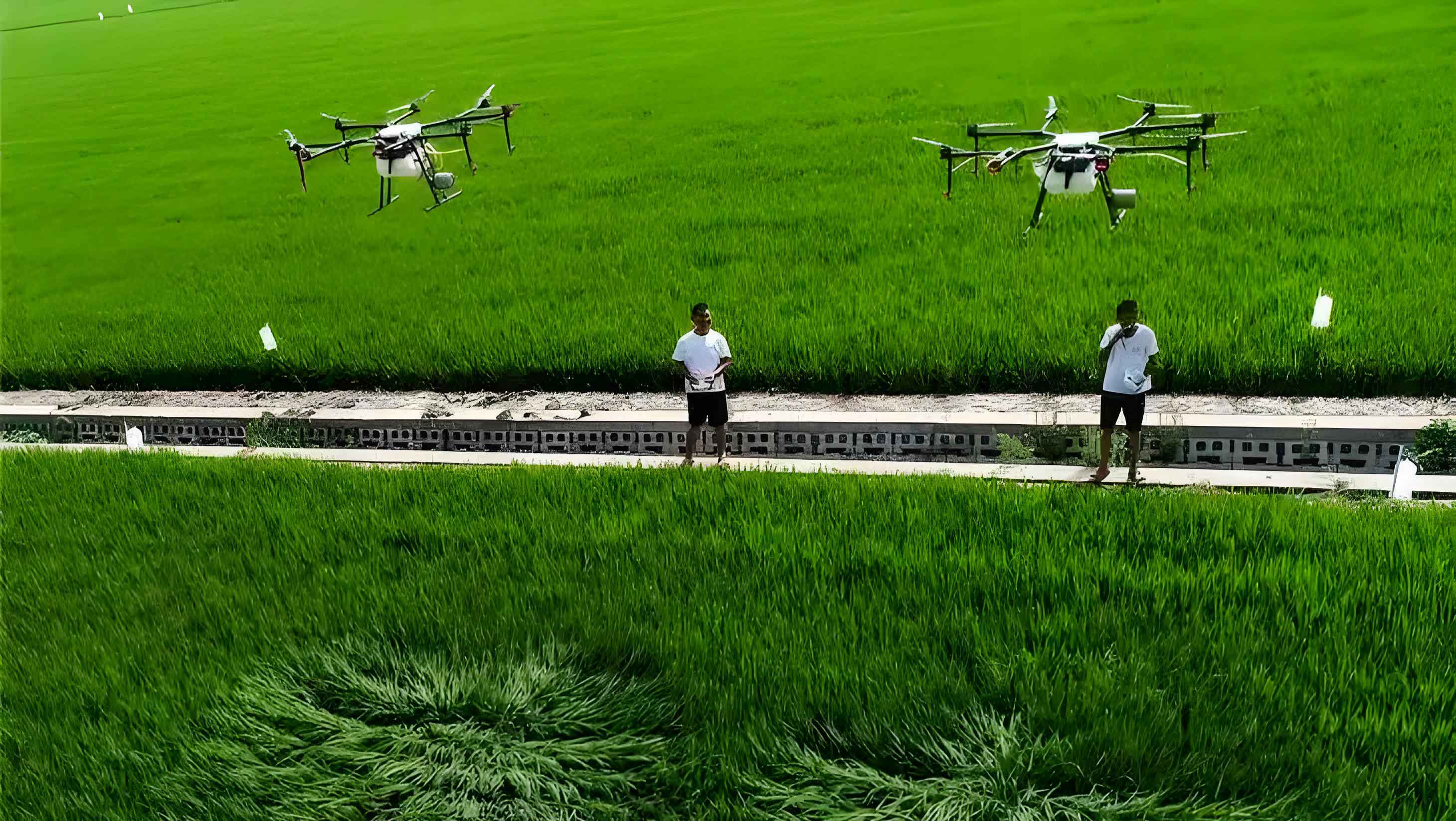
Tea (Camellia sinensis) cultivation faces significant challenges in pest management due to labor shortages and the need for precise chemical application. Agricultural drones (UAVs) offer transformative solutions with their efficiency, terrain adaptability, and reduced operator exposure. This study systematically evaluates how operational parameters—droplet size, flight altitude, flight speed, and spray volume—affect deposition distribution within tea canopies using a quadrotor agricultural UAV (EA-30X model).
Experimental Framework
Trials were conducted in a standardized tea plantation (‘Longjing 43’ cultivar, row spacing: 1.5 m) under consistent environmental conditions (temperature: 28–32°C; humidity: 51–56%; wind speed: 0.2–0.4 m·s⁻¹). The agricultural UAV featured centrifugal nozzles with adjustable droplet sizes and a 30L tank capacity. Key metrics—droplet coverage (%), volume median diameter (VMD, µm), and deposition uniformity (coefficient of variation, CV)—were quantified using water-sensitive papers analyzed via DepositScan software.
Droplet Size Optimization
Droplet size critically influences canopy penetration. At fixed parameters (altitude: 5 m; speed: 2 m·s⁻¹; spray volume: 30 L·ha⁻¹), larger droplets significantly enhanced deposition:
| Droplet Size (µm) | Surface Coverage (%) | Inner Canopy Coverage (%) | VMD Surface (µm) | VMD Inner (µm) |
|---|---|---|---|---|
| 20 | 2.98 ± 0.31c | 0.52 ± 0.07c | 82.3 ± 4.1c | 79.6 ± 3.8c |
| 40 | 5.92 ± 0.42b | 1.20 ± 0.15b | 163.7 ± 6.5b | 159.2 ± 5.9b |
| 100 | 9.24 ± 0.87a | 2.14 ± 0.24a | 241.5 ± 8.3a | 238.1 ± 7.6a |
Values followed by different superscripts differ significantly (p < 0.05).
Mathematically, coverage increased proportionally with droplet size:
$$ \text{Surface Coverage} = 0.0924 \times \text{Droplet Size} – 0.926 \quad (R^2 = 0.98) $$
$$ \text{Inner Coverage} = 0.0214 \times \text{Droplet Size} – 0.428 \quad (R^2 = 0.96) $$
Flight Parameter Synergies
A factorial design evaluated altitude (2 m, 3.5 m, 5 m), speed (2 m·s⁻¹, 5 m·s⁻¹), and spray volume (30, 60, 90 L·ha⁻¹). Multivariate ANOVA confirmed all parameters significantly affected deposition (p < 0.05), with no significant interactions.
| Treatment | Altitude (m) | Speed (m·s⁻¹) | Spray Volume (L·ha⁻¹) | Surface Coverage (%) | Inner Coverage (%) | VMD (µm) | CV (%) |
|---|---|---|---|---|---|---|---|
| T1 | 2.0 | 2.0 | 30.0 | 5.31 ± 0.48 | 1.12 ± 0.18 | 185.3 ± 7.2 | 69.7 |
| T2 | 3.5 | 2.0 | 30.0 | 4.02 ± 0.41 | 0.81 ± 0.12 | 174.6 ± 6.8 | 70.2 |
| T3 | 5.0 | 2.0 | 30.0 | 3.67 ± 0.35 | 0.41 ± 0.07 | 162.4 ± 6.1 | 65.3 |
| T4 | 2.0 | 5.0 | 30.0 | 2.89 ± 0.31 | 0.29 ± 0.05 | 172.8 ± 6.3 | 68.4 |
| T5 | 3.5 | 5.0 | 30.0 | 2.24 ± 0.26 | 0.21 ± 0.04 | 159.7 ± 5.9 | 66.9 |
| T6 | 5.0 | 5.0 | 30.0 | 2.00 ± 0.22 | 0.15 ± 0.03 | 148.2 ± 5.3 | 63.8 |
| T7 | 2.0 | 2.0 | 60.0 | 8.97 ± 0.76 | 2.58 ± 0.31 | 223.6 ± 8.1 | 53.2 |
| T8 | 3.5 | 2.0 | 60.0 | 7.12 ± 0.64 | 1.87 ± 0.24 | 210.3 ± 7.7 | 57.4 |
| T9 | 5.0 | 2.0 | 60.0 | 5.43 ± 0.52 | 0.94 ± 0.14 | 191.8 ± 7.0 | 61.5 |
| T10 | 2.0 | 2.0 | 90.0 | 11.52 ± 0.92 | 3.41 ± 0.42 | 287.1 ± 9.4 | 45.7 |
| T11 | 3.5 | 2.0 | 90.0 | 9.84 ± 0.81 | 2.67 ± 0.33 | 269.5 ± 8.9 | 49.1 |
| T12 | 5.0 | 2.0 | 90.0 | 7.89 ± 0.73 | 1.62 ± 0.22 | 248.7 ± 8.3 | 55.6 |
Key trends emerged:
- Spray Volume: Increasing from 30 to 90 L·ha⁻¹ boosted surface coverage by 151% (T3→T12) and inner coverage by 141% (T3→T12). VMD increased proportionally: $$ \Delta \text{VMD} = 2.86 \times \Delta \text{Spray Volume} \quad (R^2 = 0.94) $$
- Flight Altitude: Reducing altitude from 5 m to 2 m increased surface coverage by 45% (T3→T1) and inner coverage by 173% (T9→T7). Deposition decay followed: $$ \text{Coverage} = \frac{12.8}{\text{Altitude}^{0.72}} \quad (R^2 = 0.89) $$
- Flight Speed: Slowing from 5 m·s⁻¹ to 2 m·s⁻¹ enhanced surface coverage by 84% (T6→T3) and inner coverage by 252% (T6→T3). The relationship was linear: $$ \text{Coverage} = -1.84 \times \text{Speed} + 11.6 \quad (R^2 = 0.91) $$
Deposition Uniformity
Higher spray volumes (90 L·ha⁻¹) reduced CV by 34.4% compared to 30 L·ha⁻¹ applications (T10 vs. T1). Lower altitudes and slower speeds further improved uniformity. The CV model incorporated all parameters:
$$ \text{CV} = 75.2 – 0.28 \times \text{Volume} – 6.3 \times \text{Altitude}^{-1} – 4.1 \times \text{Speed}^{-1} \quad (R^2 = 0.87) $$
Operational Recommendations
Optimized parameters for the agricultural UAV in tea plantations balance efficacy, efficiency, and safety:
- Droplet Size: 100 µm (maximizes deposition without runoff)
- Flight Altitude: 2 m (minimizes drift and evaporation)
- Flight Speed: 2 m·s⁻¹ (enhances exposure time)
- Spray Volume: 90 L·ha⁻¹ (ensures canopy penetration)
Implementation Considerations
While these parameters optimize deposition, real-world agricultural drone operations must account for:
- Canopy Dynamics: Adjust parameters for different growth stages or pruning styles.
- UAV Specifications: Calibrate settings for rotor configuration and nozzle types.
- Environmental Safety: Monitor wind (>3 m·s⁻¹) and temperature (>35°C) to minimize off-target drift.
Agricultural UAVs represent a paradigm shift in precision crop protection. This study provides a framework for optimizing tea plantation spraying, with implications for other high-value crops requiring targeted deposition.