
As a researcher in naval defense systems, I have closely monitored the evolving threats posed by unmanned aerial vehicles (UAVs) to surface ships. The rapid proliferation and technological sophistication of military UAVs are reshaping modern maritime warfare, compelling us to rethink traditional air defense strategies. In this article, I will explore the classification of military UAVs, analyze existing anti-drone weapon systems, discuss key technologies, and outline future trends, all from a first-person perspective based on my observations and studies. The increasing use of military UAVs in conflicts underscores the urgent need for cost-effective and efficient countermeasures. I aim to provide a comprehensive overview that emphasizes the importance of integrating multi-layered defense approaches to safeguard naval assets.
Military UAVs represent a diverse range of threats, from small surveillance drones to large armed systems. To understand these threats, I rely on standardized classifications, such as that used by the U.S. Department of Defense, which categorizes UAVs into five groups based on size, weight, altitude, and speed. This classification helps in assessing the specific challenges posed by each type. For instance, Group I and II military UAVs, often referred to as mini or small UAVs, are particularly concerning due to their low cost, stealth characteristics, and ability to swarm in large numbers. These military UAVs can carry precision-guided munitions, posing a direct risk to ship personnel and critical systems like radars and command centers. In contrast, larger military UAVs in Groups IV and V, while more capable of carrying heavy payloads like anti-ship missiles, are fewer in number and can be engaged with existing air defense missiles. However, the sheer volume of smaller military UAVs in a swarm attack can overwhelm conventional defenses, leading to high interception costs and reduced effectiveness. Thus, I believe that a focused analysis of military UAV threats is essential for developing tailored countermeasures.
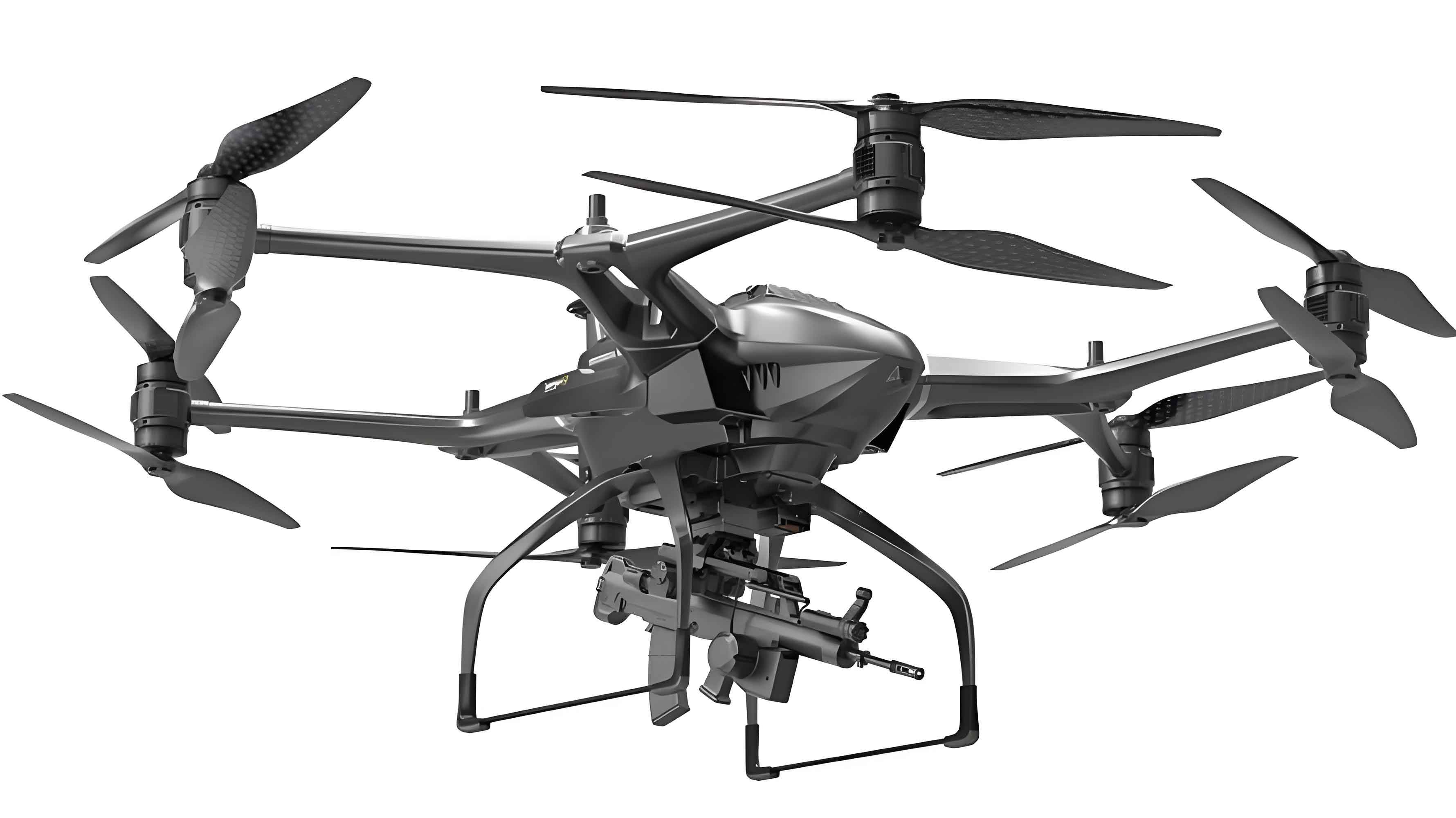
To illustrate the classification of military UAVs, I have compiled a table summarizing their key parameters. This table highlights the operational characteristics that influence their threat level to surface ships.
| Category | Size | Takeoff Weight (kg) | Operational Altitude (m) | Speed (m/s) | Typical Examples |
|---|---|---|---|---|---|
| I | Micro | 0–9 | <360 | <50 | Raven RQ-11, Puma |
| II | Small | 9–25 | <1,100 | <130 | Scan Eagle, Switchblade 600 |
| III | Medium | <600 | <5,500 | <130 | Pioneer RQ-2, Hunter RQ-5 |
| IV | Large | >600 | <5,500 | Unrestricted | Predator MQ-1, Gray Eagle MQ-1C |
| V | Very Large | >600 | >5,500 | Unrestricted | Global Hawk RQ-4 |
The threat posed by military UAVs is not just about individual capabilities but also about their collective behavior. Swarm attacks, where multiple military UAVs coordinate to saturate defenses, represent a significant challenge. I have analyzed that the probability of a successful swarm penetration, denoted as $P_{penetration}$, can be modeled using a binomial distribution if we assume independent interception events. For a swarm of $n$ military UAVs, each with an individual interception probability $p$, the probability that at least $k$ UAVs penetrate the defense is given by:
$$P_{penetration} = \sum_{i=k}^{n} \binom{n}{i} (1-p)^i p^{n-i}$$
This formula underscores the difficulty of defending against large numbers of military UAVs, especially when $p$ is low due to the small radar cross-section and agility of these targets. Therefore, enhancing detection and interception capabilities is crucial. Military UAVs often exploit low-altitude flight paths to avoid radar detection, blending with sea clutter. I have found that combining multiple sensors, such as radar, electro-optical, and electronic support measures, can improve detection probability. The overall detection probability $P_d$ for a fused sensor system can be expressed as:
$$P_d = 1 – \prod_{j=1}^{m} (1 – P_{d_j})$$
where $P_{d_j}$ is the detection probability of the $j$-th sensor, and $m$ is the number of sensors. This multiplicative model shows how sensor fusion can significantly boost performance against stealthy military UAVs.
Turning to anti-drone weapon systems, I have evaluated various technologies currently deployed or under development. These systems range from kinetic weapons like rapid-fire guns and missiles to non-kinetic options such as jammers, lasers, and microwaves. Each has distinct advantages and limitations in countering military UAVs. For instance, rapid-fire guns like the Phalanx CIWS are effective at close ranges but consume large amounts of ammunition per engagement, making them costly against low-cost military UAVs. In contrast, electronic warfare systems can disable military UAVs by jamming their communication or navigation signals, but they may be less effective against military-grade encrypted links. To compare these systems, I have created a table summarizing their key performance metrics and suitability against different types of military UAVs.
| System Type | Effective Range (km) | Interception Cost per UAV (Estimated USD) | Key Advantages | Limitations | Suitability Against Military UAVs |
|---|---|---|---|---|---|
| Rapid-Fire Gun (e.g., Phalanx) | 0.4–3.5 | 10,000–50,000 | High rate of fire, proven technology | High ammunition consumption, short range | Low for swarms, moderate for individual targets |
| Electronic Jammer (e.g., Titan) | 1–30 | 500–2,000 | Low cost, area denial capability | Susceptible to countermeasures, collateral interference | High for commercial UAVs, variable for military UAVs |
| Laser Weapon (e.g., HEL TV) | 1–10 | 1–10 (per shot energy cost) | Precision engagement, low cost per shot | Atmospheric attenuation, limited range in bad weather | High for small to medium military UAVs |
| Microwave Weapon (e.g., Leonidas) | 0.5–5 | 100–1,000 | Area effect, effective against swarms | Short range, potential collateral damage | High for swarm military UAVs |
| Air Defense Missile (e.g., APKWS) | 5–20 | 20,000–100,000 | Long range, high accuracy | High cost per missile | High for all military UAVs, but cost-ineffective for swarms |
From my analysis, I conclude that no single system is optimal for all scenarios involving military UAVs. Instead, a layered defense approach is necessary. For example, lasers and microwaves offer cost advantages for engaging multiple military UAVs, but their effectiveness depends on environmental conditions. I have derived a cost-effectiveness ratio $CER$ for evaluating these systems:
$$CER = \frac{P_{intercept}}{C_{engagement}}$$
where $P_{intercept}$ is the probability of intercepting a military UAV, and $C_{engagement}$ is the total cost per engagement. Systems with higher $CER$ are preferable for sustained operations against military UAV swarms. Based on this, lasers and jammers often show favorable $CER$ values for small military UAVs, while missiles are reserved for high-value threats.
In terms of key technologies for ship-based anti-drone defense, I have identified several critical areas that require advancement. First, system integration is paramount. Modern naval vessels must accommodate anti-drone modules without major structural changes. I advocate for open architectures that allow seamless integration with existing combat management systems. For instance, a modular anti-drone system can be containerized and deployed on various ship types, reducing installation time and costs. Second, collaborative detection technology is essential for tracking military UAVs. By fusing data from radar, electro-optical/infrared sensors, and electronic intelligence, ships can achieve a comprehensive air picture. I have modeled the improved track accuracy $\sigma_{track}$ using a Kalman filter fusion approach:
$$\sigma_{track} = \sqrt{ \frac{1}{\sum_{j=1}^{m} \frac{1}{\sigma_j^2}} }$$
where $\sigma_j$ is the measurement error of the $j$-th sensor. This reduction in error enhances engagement decisions against elusive military UAVs. Third, heterogeneous weapon coordination is crucial for efficient resource allocation. The weapon-target assignment (WTA) problem can be formulated as an optimization to maximize the total interception probability while minimizing costs. For $n$ military UAV threats and $w$ weapon systems, the objective function is:
$$\text{Maximize} \sum_{i=1}^{n} \sum_{j=1}^{w} P_{ij} x_{ij} – \lambda \sum_{i=1}^{n} \sum_{j=1}^{w} C_{ij} x_{ij}$$
subject to constraints such as $\sum_{j=1}^{w} x_{ij} \leq 1$ for each threat $i$, where $P_{ij}$ is the interception probability of weapon $j$ against threat $i$, $C_{ij}$ is the cost, $x_{ij}$ is a binary assignment variable, and $\lambda$ is a weighting factor. Solving this efficiently using algorithms like genetic algorithms enables real-time response to military UAV swarms.
Looking ahead, I foresee several trends shaping the future of anti-drone technology for surface ships. These trends are driven by the need to counter advanced military UAVs effectively and affordably. I have summarized them in a table below, along with their potential impact.
| Trend | Description | Key Technologies Involved | Expected Impact on Military UAV Defense |
|---|---|---|---|
| Collaborative Target Detection | Integration of multi-sensor data for enhanced situational awareness | Sensor fusion algorithms, AI-based recognition | Improved detection range and accuracy against stealthy military UAVs |
| Diversified Interception Means | Combination of kinetic and non-kinetic systems for layered defense | Laser weapons, microwave systems, electronic warfare | Higher interception rates and lower costs per engagement for military UAV swarms |
| Integrated Fire Control Systems | Unified command and control for optimal weapon deployment | Advanced WTA algorithms, real-time data processing | Efficient resource use against coordinated military UAV attacks |
| Modular Weapon Systems | Containerized or plug-and-play modules for flexible deployment | Standardized interfaces, open architecture designs | Rapid adoption and scalability across different naval platforms |
| Minimized Equipment Costs | Focus on affordability through mass production and commercial components | 3D printing, commercial off-the-shelf parts | Sustainable defense against low-cost military UAV threats |
In my view, the trend toward collaborative detection is particularly vital. As military UAVs become more adept at evading radar, combining active and passive sensors will be key. For example, using electronic support measures to detect communication signals from military UAVs can provide early warning, supplementing radar tracks. I estimate that such integration can boost detection probability by up to 30% for small military UAVs. Additionally, diversified interception means will allow ships to engage military UAVs at multiple ranges: jammers for long-range disruption, lasers for medium-range kills, and guns or missiles for close-in defense. This layered approach maximizes the chances of neutralizing military UAVs before they can inflict damage.
Moreover, the integration of fire control systems will enable automated responses to military UAV threats. By using artificial intelligence to analyze threat patterns, ships can prioritize targets and assign weapons dynamically. I have developed a simplified model for this, where the threat level $T_i$ of a military UAV $i$ is calculated based on its speed, proximity, and payload:
$$T_i = \alpha v_i + \beta \frac{1}{d_i} + \gamma p_i$$
where $v_i$ is speed, $d_i$ is distance, $p_i$ is payload risk factor, and $\alpha, \beta, \gamma$ are weighting coefficients. Systems can then allocate resources to high-$T_i$ military UAVs first, optimizing defense effectiveness.
Regarding modular weapon systems, I believe they represent a pragmatic solution for rapidly upgrading existing fleets. Containerized anti-drone modules, like those seen in recent deployments, can be installed on various ship decks without major modifications. This flexibility is crucial for countering the evolving threat of military UAVs, as it allows for quick technology refreshes. For instance, a module might combine a laser, a jammer, and a control system in a single unit, providing a comprehensive anti-drone capability. I have seen prototypes where such modules can be operational within hours, significantly enhancing a ship’s readiness against military UAV incursions.
Cost minimization is another critical trend. Given the low cost of many military UAVs, using expensive missiles for interception is unsustainable. I advocate for leveraging commercial technologies, such as 3D printing for weapon components, to reduce production expenses. The cost savings $S$ from using additive manufacturing can be approximated as:
$$S = C_{traditional} – C_{3D} = k \cdot V \cdot ( \rho_{traditional} – \rho_{3D} )$$
where $C$ is cost, $k$ is a material constant, $V$ is volume, and $\rho$ is density. This allows for more frequent engagements with military UAVs without depleting resources. Additionally, using industrial-grade electronics in guidance systems can cut costs while maintaining reliability against military UAV targets.
In conclusion, from my perspective as a defense analyst, the rise of military UAVs presents both a challenge and an opportunity for naval warfare. By understanding the classifications and threats of military UAVs, evaluating current anti-drone systems, and investing in key technologies like collaborative detection and heterogeneous weapon coordination, surface ships can enhance their defensive capabilities. The future trends point toward more integrated, modular, and cost-effective solutions that will be essential for countering the growing menace of military UAV swarms. I am confident that through continued research and innovation, we can develop robust defenses that protect naval assets while maintaining operational affordability. The journey ahead involves constant adaptation, as military UAV technology evolves, but by staying ahead of the curve, we can ensure maritime security in an increasingly contested environment.